Derek Voss spat a racist insult at her. “I said move.” Derek Voss, senior teller at Prestige Atlantic Bank, waved Brenda Owens forward. She hurried to the counter and set her brown leather purse down. Derek glanced at it and froze.
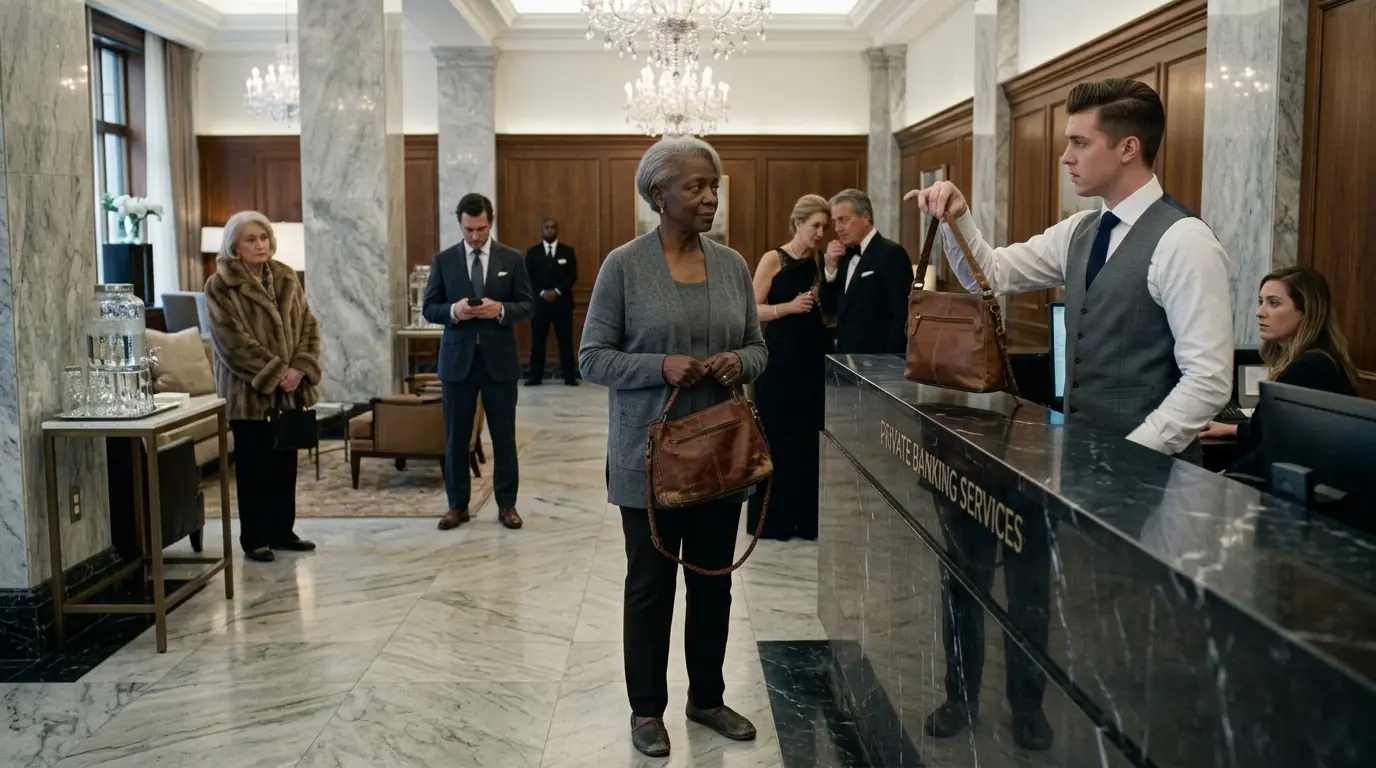
“Whoa. Get that thing off my counter.” He picked it up with two fingers, nose scrunched.
“Where did you dig this up, a dumpster? Smell that. Go on.” He dangled it toward the blonde teller.
Brenda stood there meekly. “I’d just like to access my account.” He dropped it like it burned him.
“This filthy thing tells me everything I need to know about your account.” Brenda picked up her purse, held it close, said nothing. Derek leaned back and laughed. The blonde shook her head, grinning. The security guard looked away, but the woman Derek Voss had just humiliated like a stray dog, was about to bring his entire branch to its knees.
Here's how it all started. Thirty minutes earlier, the morning had started like any other at Prestige Atlantic Bank. The Upper East Side branch sat on the corner of Madison and 72nd, sandwiched between a private art gallery and a boutique that sold scarves for $800.
The front doors were frosted glass with gold lettering. Inside the floor was Italian marble, cream with veins of gray, polished until it reflected the chandeliers overhead. The air smelled like leather and fresh lilies arranged on a center table that cost more than a sedan. The water cooler in the corner dispensed sparkling water. Not still water. Sparkling water.
This was not a bank for ordinary people. And nobody knew that better than Derek Voss. Derek was 26.
He grew up in a middle-class suburb outside Newark. Father sold insurance. Mother worked at a nail salon. He spent his childhood staring at Manhattan through a bus window, watching men in tailored suits step out of black cars. And he made himself a promise.
One day that would be him. It wasn't him. Not yet. But he was close enough to taste it. Two months ago, he'd been promoted to senior teller, the youngest in the branch.
He celebrated by buying a slim fit gray vest, a navy tie, and a silver watch on a 12-month payment plan. He wore cologne that cost $60 a bottle. Not the best, but enough to announce himself when he walked past. His hair was gelled and parted to the left, sharp as a blade. Derek didn't just serve clients. He performed.
When a man in a Brioni suit approached the counter, Derek stood up straighter, smiled wider, shook hands like he was meeting an equal. When a woman set a Birkin bag on the counter, Derek complimented it before she even spoke. He memorized names. He memorized watches. He knew the difference between a Patek Philippe and a Jaeger-LeCoultre.
And he made sure the client knew he knew. But when someone walked in wearing the wrong shoes, carrying the wrong bag, looking like they'd wandered in from the wrong neighborhood, Derek's face changed. The smile disappeared. The handshake vanished. In its place, a slow look top to bottom and a silence that said everything.
That was the version of Derek Voss that Brenda Owens met when she walked through the revolving door at 9:47 a.m. She took ticket number 14 from the machine. She sat in one of the leather chairs near the window and placed her brown leather purse on her lap. Her gray cardigan had a loose thread near the left cuff. Her flat shoes made no sound on the marble.
Nobody greeted her. Nobody offered her sparkling water. Derek called number 11. A man in a charcoal suit stepped forward. Big smile.
Firm handshake. “Good morning, sir. How can I help you today?” Number 12. A couple wearing matching Rolexes, shopping bags from the boutique next door.
“Welcome back, Mr. and Mrs. Callaway. Always a pleasure.” Number 13. A young man in a cashmere sweater, AirPods in, barely looking up.
Derek still smiled, still stood, still shook his hand. He even offered a business card, his personal line handwritten on the back, as if a senior teller at a bank branch had a personal line worth giving. Each time, Brenda watched the same thing: the bright smile switching on like a spotlight whenever someone who looked like money stepped forward. Derek adjusted his tie before each greeting, like a performer about to go on stage. He leaned forward, made eye contact, and spoke in a voice warm enough to melt butter.
And each time she saw him glance at her between clients, a quick look, a flicker of something between amusement and disgust. Then he'd turn away as if she were furniture. Number 14 should have been next. Derek glanced toward the waiting area. He saw Brenda, the cardigan, the flat shoes, the purse with the braided cord strap.
He looked at her for exactly two seconds. Then he looked away and called, "Number 15." Brenda didn't move. She sat still, hands on her purse, watching. He did it again.
Number 16. And again. 17. Each time he glanced at Brenda. Each time he turned away like she was a stain on the leather chair that someone would deal with eventually.
Five seats away, Denise Holloway stood with a clipboard pressed against her black blazer. Branch manager, 44, thin-framed glasses, brown hair clipped tight. She saw everything: the skipped numbers, the glances, the deliberate avoidance. She adjusted her glasses. She checked something on her clipboard.
She did absolutely nothing. Denise had a philosophy she repeated to herself whenever something uncomfortable happened on her floor. Don't create problems where there aren't any. So, she didn't.