"Hey, hey, shoo. Go on, scrub somewhere else. Nobody wants to watch some old Black lady drag a mop while I'm filming."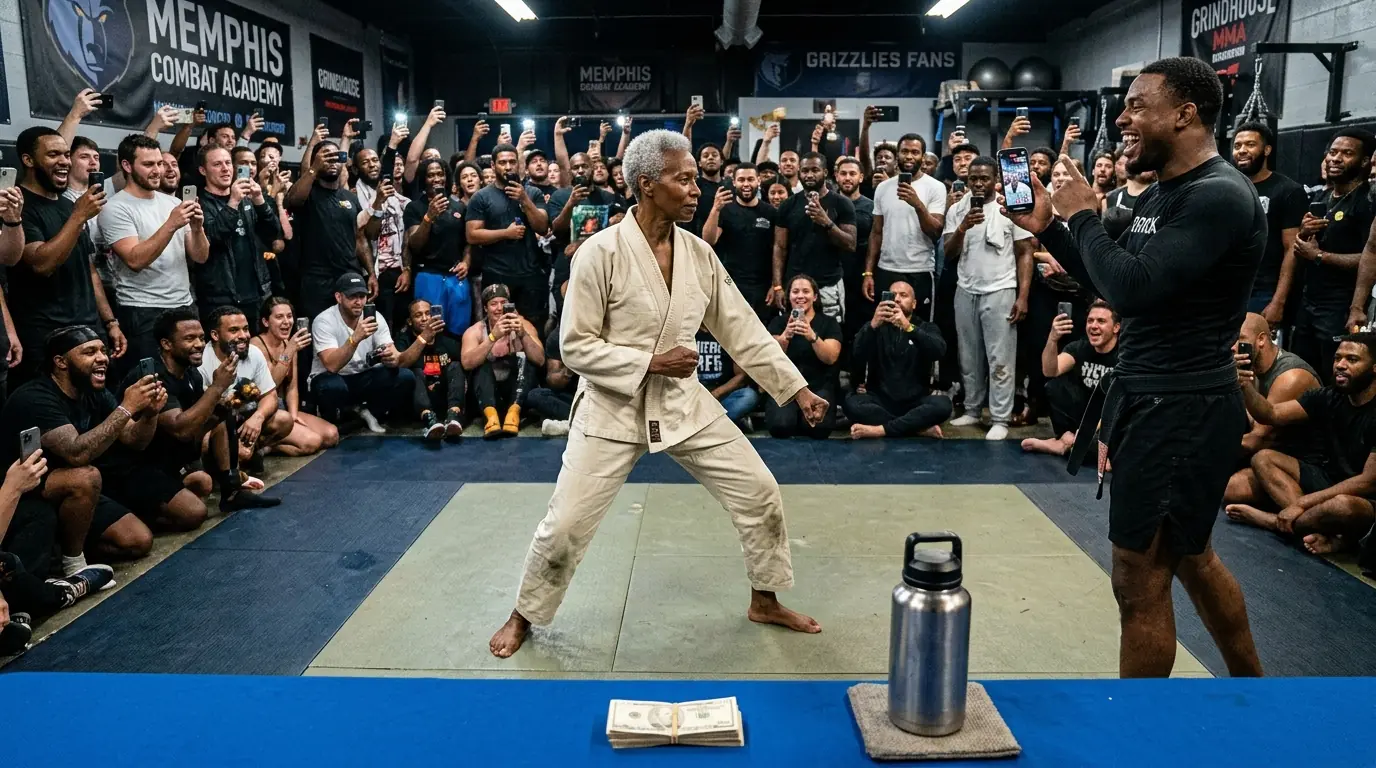
Brandon Vance flicked his hand at her like she was a stray dog, then grabbed the handle of her cart and shoved it rolling across the mat toward the exit.
"Out. Move it, Grandma. This floor's for fighters, not janitors."
Loretta Green, sixty-seven years old, walked after her cart in silence. The whole gym laughed. *Look at her go.*
Brandon grinned at his camera. "Smile for the followers, old-timer. The mop's the only black belt you'll ever touch."
She bent to fix the cart. He nudged it again with his foot just to make her chase it.
"Aw, she's still moving. Somebody check if she's got a pulse or if it's just the wheels squeaking."
The gym howled. He leaned right down into her face.
"You should have stayed home, Grandma. Sit in a rocking chair, knit something. Leave the real world to people who actually matter."
She didn't answer. She wiped the spot he had dirtied in long, even arcs, the way she had for nine quiet years. What Brandon didn't know—what none of those two hundred laughing strangers knew—was that the woman he just shooed off the mat had broken harder men than him before he was born. And in exactly three seconds, on a date that meant everything to her, she would teach him a lesson the internet would never forget.
At 5:00 in the morning in Memphis, Tennessee, the Apex Combat Center sat dark and silent on Lamar Avenue, and Loretta Green unlocked the side door the way she had for nine years. One soft click, one quiet breath, one nod to the empty room that nobody saw her give.
She filled her bucket at the slop sink. She measured the soap the way a chemist measures a reaction—exact, unhurried. Then she mopped the training floor in long, even arcs that never once crossed their own path. Most people clean a floor; Loretta read it. Every scuff told her a story. The heel drag near the heavy bags meant somebody had trained tired, fighting on a bad ankle they wouldn't admit to. The smeared sweat prints by the cage wall meant a young man had thrown a thousand sloppy combinations and called it discipline.
She knew this gym better than the men who owned it, and the men who owned it had never once asked her name. She was sixty-seven years old, lean as braided wire, with close-cropped silver hair and hands the color of river clay, her knuckles thickened by decades. Nobody here could see. She moved slowly, but she never moved clumsily. Watch her long enough and strange things surfaced. She never stood with her weight on both heels. She folded her cleaning rags into perfect thirds, the corners sharp as folded paper.
When a forty-pound dumbbell slid off a crooked rack one morning and dropped toward the floor, her hand was simply there, catching it an inch above her own foot before her eyes seemed to move. A young trainer had seen it and laughed. "Quick reflexes, Ms. Lowe."
"Old habit," she answered, and set the weight back gently, saying nothing else.
'Habit' was a word she let people interpret however they liked.
Home was a small brick house in South Memphis—paid off, quiet, the kind of quiet that has weight to it. Inside, the shelves held the ordinary things of an ordinary widow: a Bible with a cracked spine, a row of teacups, a photograph lying face down on the mantel that she dusted without ever lifting. In the bedroom closet, on the highest shelf, sat a wooden box with a brass lock. The key hung on a thin chain around her neck under her collar, warm against her chest. Fifteen years and she had not turned it once. Some nights she took the box down and held it on her knees in the dark. She never opened it. She just listened to the house settle and breathe around her.
And every single morning before work, Loretta Green made two cups of tea. She poured the first and drank it standing at the kitchen window. She poured the second and set it down across the table in front of an empty chair, letting it go cold. She never explained this to anyone because there was no one left to explain it to. The second cup was for Samuel. It had been for Samuel for fifteen years, and it would be for Samuel until the morning she didn't wake up.
At the gym, the staff treated her like part of the building—furniture that walked. The trainers called her 'Miss Lowe' when they wanted the bathrooms restocked and called her nothing at all the rest of the time. The members stepped around her cart without seeing it. A man can stand right beside a mountain and call it a hill if nobody ever tells him different.
Only two people at Apex looked at Loretta and saw a whole person. One was a little girl named Jasmine, eight years old, who came to the children's class on Tuesdays and stayed late on the bench because her mother worked a double shift and couldn't pick her up until 7:00 p.m. Loretta always left a granola bar by the girl's bag. She never made a thing of it; the bar was just there, the way the dumbbell catch was just there.
"Morning, Miss Lowe," Maya would say every day, meaning it.
"Morning, baby," Loretta would answer, and for a second the old woman's eyes would warm before she pushed her cart on down the hall, humming something low and old—a tune Maya never recognized and never forgot.
There were things about Loretta Green that didn't add up if you stopped to add them. There was the way she watched sparring with a stillness that wasn't boredom—it was reading. There was the way her eyes tracked a fighter's hips, not his hands, the way only someone who had spent a lifetime in combat learns to do. There was the way when a heavyweight got rocked in the cage and stumbled toward the corner post, Loretta's whole body shifted half an inch toward him before she caught herself and went back to mopping.
But nobody at Apex was paying attention. Nobody was asking questions. That was about to change. Because on a slow Tuesday evening in the corner of an empty mat, a frustrated eight-year-old girl was about to throw a punch that landed wrong, and an old janitor with a mop was about to fix it with two fingers in front of the one person finally curious enough to wonder, *Who taught the cleaning lady to build a fighter without saying a single word?*
Brandon Vance trained at Apex like the building owed him rent. He was twenty-four years old, a second-degree black belt, with fourteen straight regional wins and a highlight reel he watched more often than he watched film of his opponents. The talent was real; that was the dangerous part. His spinning kicks cracked the heavy bag like rifle shots, and every crack pulled his eyes straight to the mirror to watch himself do it. Members orbited him. Sponsors texted him. Over one hundred and twenty thousand followers replayed his knockouts and called him the future of the sport, and Brandon Vance agreed with them loudly, often, and without a trace of doubt.
Behind Brandon stood his father. Richard Vance owned commercial real estate across half of Memphis—strip malls, office parks, and two hotels downtown with his name on the marquee. Richard had written the single largest sponsorship check the Apex Combat Center had ever cashed, and the gym's manager, Doug Holloway, had that check framed in his office like a college diploma. Doug Holloway had exactly two rules: keep the equipment clean, and keep the Vances happy. Whenever Brandon's jokes turned cruel—and they turned cruel often—Doug found something fascinating on his clipboard and studied it until the laughter died down on its own. People said Doug wasn't a bad man; they said he was just a man whose backbone bent in the direction of money.
Maya Torres watched all of it from the front desk, and she kept a quiet ledger in her head of every time Doug looked away. She had grown up watching her mother get looked through, so Maya noticed things. She noticed that Brandon never said please to Loretta. She noticed that he called her grandma and old-timer with a grin that invited everyone else to join in. She noticed that Loretta never flinched, never argued, just kept her arcs even and her eyes down. And somehow that stillness made Brandon meaner, the way a calm surface makes some people want to throw a rock.
"Why doesn't she ever say anything back?" Maya asked her one afternoon while refilling the water cooler.
Loretta wiped down the front counter. "Saying something back is what he wants, baby," she said. "A man like that is hungry. You don't have to feed everything that's hungry."
Maya thought about that for a week.
Then came the Tuesday evening that started everything. The children's class had ended at 6:00 p.m. The coaches had gone home. The overhead lights in the far corner were half-dimmed, and on the empty practice mat, eight-year-old Jasmine was throwing punches at the air, all elbows and frustration. Her mother's shift had run long again. The girl was angry at the air, at the late hour, at the way her fist kept landing soft when she wanted it to land hard. Her stance was a mess—feet crossed, chin lifted high, balance leaking out of her like water from a cracked cup. She threw the same punch over and over, and it kept dying in the air, her eyes starting to shine wet with that particular helpless fury only children and the very proud ever feel.
Nobody was watching. Nobody but the janitor.
Loretta came down the hall with her cart, and she slowed, and she stopped. She set the mop against the wall. She crossed the mat in three quiet steps and stood beside the girl. She didn't lecture. She tapped the back of Jasmine's rear foot with two fingers, turning it out. She set one knuckle against the girl's hip and rotated it two inches. She lifted a single finger and pressed it gently under Jasmine's chin until the girl's head dropped level and her eyes settled forward.
"Don't punch the air, baby," Loretta said softly. "Punch through it. Like you're reaching for something on the other side that's yours."
Then she stepped back, picked up her mop, and went on cleaning as if nothing had happened.
Jasmine reset. She set her feet the new way. She turned her hip. She kept her chin down. She threw the punch.
It snapped a clean, whip-crack pop of knuckle and air that echoed off the empty walls like a gunshot in a church. The girl froze. She stared at her own fist like it belonged to a stranger.
At the front desk, Maya Torres looked up, the phone ringing in her hand entirely forgotten. She had seen the whole thing—the two fingers, the knuckle, the chin—and she had seen a frustrated eight-year-old transform in four seconds into something balanced, dangerous, and correct.
Loretta was already pushing her cart toward the dark end of the hall, humming that low, old tune.
"Miss Lowe," Maya called. The old woman paused without turning. "Where'd you learn to do that?"
For a long moment, Loretta didn't answer. Her hand tightened just slightly on the cart handle. "Long time ago," she said finally. "Different life."
And she pushed her cart into the shadows, and the conversation was over. But Maya sat very still at that desk for a long time, the dial tone humming in her ear, one question turning slowly in her mind. She had grown up around fighters. She had watched a thousand coaches try to fix a thousand stances. She had never once seen anyone fix a child with two fingers and a single sentence.
Across the gym, taped to the trophy wall, hung a glossy poster of Brandon Vance mid-kick, his name in gold letters: *The Future*. And down the dark hallway, pushing a bucket of gray water, walked a woman whose name wasn't written anywhere in that building. Maya didn't know it yet, but she had just started pulling on a thread that would, in three weeks, unravel everything Apex thought it knew.
Saturday came loud. Brandon Vance had just taken his fifteenth straight win, a second-round knockout across town, and he came back to Apex with the trophy in one hand and his phone in the other, an audience already forming before his gym bag hit the floor. Forty members crowded the mats. The phones came out before the jackets came off. Brandon played his knockout on the gym's big screen twice, narrating his own greatness over the speakers, and the room laughed and cheered on cue.
And then he got bored. Bored champions go looking for entertainment. And the entertainment that afternoon was pushing a mop along the far wall.
"Hey, hey, everybody," Brandon called, holding up his phone, the live indicator glowing red. "Special guest, Apex's biggest star." He pointed across the room. "Miss Mop herself."
The cameras turned. Loretta Green stood by the wall with her cart, the gray water in her bucket gone perfectly still. She did not look up. Brandon crossed the floor, grinning at his followers. "Watch this."
What happened next took eleven seconds, and forty phones caught all of it. He grabbed the edge of her cart and yanked it sideways, then put both hands flat on the bucket and shoved. It tipped. Gray mop water sluiced across the mat, across Loretta's shoes, and up the leg of her gray uniform pants. She stepped back to keep her balance, her heel caught the wet floor, and she went down hard onto one hip, one hand splayed in the dirty water.
The gym exploded with laughter.
"Clean up on aisle Grandma!" Brandon crowed. "Somebody get her some floaties. She's swimming now, boys. Smile for the camera, old-timer."
Loretta sat in the spreading gray puddle for one long breath. Her hand was flat in the water. Her face showed nothing at all—not anger, not pain, not even surprise. Just a stillness so complete it should have frightened them.
Then she rose. Not all at once, but joint by joint, the way old bodies rise when pride is the heaviest thing they have to lift. She got one knee under her. She got one foot flat. She pushed up with that river-clay hand and stood, water running off her sleeve, and she did not look at Brandon Vance even once. She picked up the bucket. She set it upright. She walked to the supply closet, came back with the yellow 'wet floor' sign, and stood it on the mat. And then she lowered her mop and began to clean the same spot again in long, even arcs while forty phones filmed her soaked back and the laughter rolled on behind her.
Only one person in that whole room wasn't laughing. Jasmine stood by the cubbies, her little gym bag on her shoulder, watching the woman who had fixed her stance with two fingers get treated like a joke by a grown man with a camera. The girl's chin was trembling. Her hands were balled into the fists Loretta had taught her to make.
Loretta caught the child's eyes for half a second across the room. And then—this was the part that hurt worst—she looked away. Because some things are harder to carry in front of a child than a wet uniform ever could be.
By 8:00 p.m. that night, the clip was everywhere. Brandon had posted it with a laughing caption: *Mop lady takes a tumble. #apexlife.* Two hundred thousand views before midnight. Strangers stitched it, slowed her fall down for comedy, froze the frame of her face hitting that moment of impact, and made it a reaction meme. They didn't know her name. They didn't ask. In a comment section three thousand replies deep, exactly four people typed the words: *Is she okay?*
Across town, in a small brick house in South Memphis, Loretta Green sat on the edge of her bed. Her wet uniform hung over the edge of the tub, dripping a slow rhythm onto the tile. Her hip ached where it had met the floor. She had peeled off the chain from around her neck, and now she held it—the small brass key, warm in her palm, the wooden box resting on her knees.
Fifteen years that key had stayed warm against her chest and cold to its only purpose. Fifteen years she had carried it without using it, the way you carry a name you can't say out loud. She thought about Samuel. She thought about the gray water and the laughing faces and the trembling chin of a little girl by the cubbies. She thought about a man young enough to be her grandson flicking his hand at her like she was a stray on the floor she had kept spotless for nine years.
Her thumb found the brass lock. It traced the cold edge of it once, twice. She had buried so much in that box. She had promised herself she would never dig it up again. The promise had kept her safe, quiet, and small for fifteen years. But tonight, for the first time since the funeral, Loretta Green's thumb stopped tracing the lock and settled on the key.
She did not turn it. Not yet. She sat in the dark with the box on her knees and the chain in her fist, listening to her wet uniform drip onto the bathroom tile, listening to the empty house breathe around her. Listening to something inside her own chest that had been silent for fifteen years and was very faintly beginning to stir. She closed her eyes, and somewhere in the dark of that quiet room, the old woman made a decision that would put three hundred people in a gym, two lawyers in a courtroom, and nine million strangers on the edge of their seats.
But first, she had to open the box.
At 2:00 in the morning, Loretta Green turned the key. The brass lock gave with a small, reluctant click—the sound of fifteen years coming loose. Then, she lifted the lid slowly, the way you lift a bandage from a wound you're not sure has healed.
The box held three things. The first was a black belt, worn soft and gray at the edges from ten thousand classes, the satin rubbed thin where ten thousand bows had folded it at the waist. She did not touch it; she only looked.
The second was a photograph. Four people stood beneath a banner that read *Southern Regional Championships*. Three of them were young and laughing, and one of them was a tall man with a wide, gentle smile and his arm around a younger, fiercer version of the woman now sitting on the bed. Samuel Green—her husband, her training partner, the other half of the dojo they had built with their own hands on a side street in Memphis back when a Black couple teaching karate was something people drove past slowly to stare at.
The third thing was a phone—an old flip phone, years out of date, kept charged by a habit she had never explained to anyone. She had paid the carrier for fifteen years to keep one number alive. Her thumb knew the path in the dark. One saved voicemail. She pressed play.
*"Hey Lo,"* Samuel's voice was warm and unhurried, filling the quiet room. *"Just finishing up at the dojo. Locking the doors. I'm going to stop and get that lemon cake you like, the one from Bowles. It's our anniversary, woman, you think I forgot? Thirty-one years."* A soft laugh. *"Be home by 8:00. Put the kettle on. I love you, Lo. See you soon."*
He never made it home by 8:00 p.m. A drunk driver on Poplar Avenue saw to that fifteen years ago, on a date Loretta had circled in black ink in every calendar she'd owned since. The kettle had gone cold on the stove. The lemon cake was found in the wreckage, the box crushed flat.
She listened to the message twice. She did not cry; she had done her crying in rooms this city had never seen. Then she pressed save, the way she always pressed save, closed the lid, locked the box, and hung the key back around her neck. But she did not put the box away on the high shelf. She set it on the nightstand where she could see it.
While Loretta sat in her quiet house, Brandon Vance woke up famous—not fight famous, internet famous, which is louder, hungrier, and meaner. *Mop lady takes a tumble* crossed two million views in three days. Brandon's follower count jumped by sixty thousand overnight. A supplement company slid into his messages with a sponsorship offer.
He scrolled through the numbers in bed, grinning, and learned the oldest lesson the algorithm teaches: cruelty performs. His knockouts took eight weeks of training camp; the janitor clip took eleven seconds. And the eleven seconds did better numbers. So when his manager texted asking what the next post would be, Brandon didn't say a title defense. He typed back: *Give the people a sequel.*
Doug Holloway saw the views, too. He saw the new foot traffic, the kids signing up because they'd seen Apex on their feeds. He told himself it was harmless. He told himself Loretta hadn't complained, and that part at least was true. Loretta never complained. He filed the discomfort under boys being boys and went back to his clipboard.
What none of them knew—what the laughing internet would have refused to believe—was who they were laughing at. Thirty-five years ago, in 1989, a woman named Loretta Green had walked into the Southern Regional Karate Championships and beaten every fighter the bracket put in front of her. She was faster than all of them, smarter than all of them, and twice as disciplined. She won the open division clean. And when they handed out the trophy, they handed it to the white runner-up.
The official reason was a scoring review. The real reason was spoken in a hallway, low, where she wasn't supposed to hear it: "We can't put her face on the regional poster, you understand. It's not the image." Samuel had wanted to burn the building down. Loretta had simply taken her gym bag, gone home, and gotten better.
She never appeared on a poster. She never got the trophy. But over the next twenty years, she and Samuel quietly trained three young fighters who did—three kids nobody else would coach. And every one of them became a national champion, and not one newspaper ever printed the name of the woman who built them. She had spent her whole life being the legend nobody was allowed to see. And now a boy with a camera was making a fortune off her wet uniform.
Loretta knew about the videos. Jasmine's mother had mentioned them, mortified, apologizing on Brandon's behalf as if she could. Maya had quietly asked if she was all right. The whole gym was watching the clip, and Loretta knew it, and still every morning at 5:00 a.m., she unlocked the side door, mopped the floor in even arcs, and said nothing. But the box was on the nightstand now. And something had shifted in the old woman's spine—a straightening so small no one would have noticed it, except that her cart wheels squeaked a little less, and her arcs grew a little more exact, and the stillness in her eyes had changed from grief into something with a sharper edge.
She was not planning revenge. Loretta Green didn't believe in revenge, but she had spent fifteen years swallowing what the world did to people like her. And somewhere in that quiet house, a different decision was finishing forming. She didn't know it yet, but Brandon Vance was already planning the sequel, and the sequel would be far crueler than anyone expected.
The sequels came all week. On Monday, Loretta found her supply cart locked inside the dry sauna, the metal handles too hot to grip. Brandon filmed her wrapping her hands in rags to pull it out. *Hot stuff, Grandma.* Forty thousand views.
On Tuesday, somebody emptied a full tub of chalk powder across the lobby floor she had just finished mopping. Brandon caught her on her knees in the white dust, sweeping it back into a pile. He captioned it: *Snow day at Apex.*
On Wednesday, he invented a new game. He planted himself in the middle of the hallway and wouldn't let her pass with the cart until she bowed to him. "Bow to the champ, Grandma. It's tradition. Show some respect."
Loretta bowed—small, slow, her eyes on the floor. The camera loved it. The followers loved it more. Every clip ended the same way: Brandon's grinning face and a caption about respect that the comments turned into a thousand cruel jokes.
Maya Torres watched it all, and Maya did two things. First, she took it to Doug Holloway. Twice. Both times, Doug studied his clipboard. "Boys blow off steam," he said. "She hasn't filed anything. If she had a problem, she'd say something." And Maya, who understood exactly why a woman like Loretta would never say something, walked back to the desk with her jaw tight.
Second—and this she told no one—every night before the security system overwrote the day's footage, Maya copied the files onto a silver hard drive she kept in the glove box of her car. She didn't know why yet. She just knew that someday, somebody was going to need to see what really happened in that gym. And she was going to make sure the truth survived the night.
On Thursday evening, Loretta sat in her truck in the Apex parking lot, too tired to turn the key. She took out the old flip phone and listened to Samuel's voicemail once in the dark, the way she did when the world got too heavy. *Be home by 8:00. Put the kettle on. I love you, Lo.* She listened. She breathed. She drove home.
By Friday, the numbers dipped. The internet was getting bored, and Brandon could feel it like a drop in temperature. Pranks were appetizers; the audience wanted a main course. So that night, he posted a poll to his one hundred and eighty thousand followers: *Should the mop lady fight me?* Ninety-one percent said yes.
Brandon stared at the result with a strange heat rising in his chest. Somewhere underneath the grin, in a room of himself he never visited, a small voice asked why an old woman's silence bothered him this much. Why her refusal to break felt like a door he couldn't kick open. He muted that voice. He always did.
Saturday afternoon, the gym was packed for open mats. Brandon waited until the room was full, then he killed the music. "Everybody gather up, special event." He dragged a folding chair to the center of the mat and climbed onto it, phone lights finding him like stage beams. "Apex, give it up for the real star of my page, the mop lady herself!"
The laughter rolled. Forty cameras turned to the far wall where Loretta stood with her cart, the gray water in her bucket gone perfectly still. At the front desk, Maya quietly angled security camera three toward the mat and checked the red recording light. Brandon hopped down and crossed the floor.
"Ah, did I startle you, Grandma? My bad. Tell you what..." He pulled a money clip from his pocket and peeled off five one-hundred-dollar bills, slapping them down on the edge of the mat. "Five hundred bucks. Right here. All you got to do is fight me. Sixty seconds. You last sixty seconds, the money's yours."
"I don't fight, son," Loretta said quietly.
"Course not. Mops don't fight back." He leaned in. "So here's your other option. You don't want to fight? Then you get down on your knees right here and you shine my belt while everybody watches. Your choice, Grandma. Sixty seconds, or you kneel."
The gym went strange and quiet, the way a room goes when a joke tips over into something uglier. Loretta looked at the money. She looked at the boy. And for the first time in nine years, she spoke a full sentence loud enough for the whole room to hear.
"Everybody falls, son," she said. "Some of us just haven't met the floor yet."
Brandon blinked. Then he laughed louder than before to cover the silence. "Tomorrow noon, mop lady versus the champ. Sixty seconds, be here."
The crowd roared back to life, and the moment was content again—safe and shareable. Doug Holloway appeared at the edge of the mats, took one look at the five hundred dollars and the cameras, and walked straight back into his office. Loretta pushed her cart toward the supply room. Her hands were steady. Her arcs, when she wiped the door handle out of habit, stayed even. Only her jaw had changed its set, like a door finally, quietly closing.
In the supply room, she sat on an upturned crate among the bleach and the spare mats and took out her other phone—the new one with a calendar. She opened it. Tomorrow's date stared back in small gray letters, and the air left her chest. Tomorrow was the anniversary. Fifteen years ago tomorrow, two state troopers had stood on her porch with their hats in their hands and told her that Samuel was gone. Of all the days that boy could have picked for his circus—of all three hundred and sixty-five—Brandon Vance had chosen the one day Loretta Green buried her whole world.
She closed the phone. She stared at the wall a long, long time. And then slowly, the old woman nodded once to herself, to the dark, to a man fifteen years gone.
Sunday came up gray and soft over Memphis. Before the sun cleared the trees, Loretta Green stood in the Elmwood Cemetery with two folding chairs and one paper cup of tea. She set one chair beside the headstone that read: *Samuel Green, beloved husband, teacher, fighter.* She sat in the other.
She poured half the tea into the grass at the foot of his stone, the way she had shared every cup with him for thirty-one years. She drank the rest cold.
"They want me on a mat today, Sam," she said to the granite. "On your day. Can you believe that? On your day." The wind moved through the oaks. She let it. "I know what you'd say. You'd say, 'Lo, you're sixty-seven, leave it be.'" She smiled faintly. "But that boy's not just hurting me, Sam. There's a little girl who watches, eight years old, got a punch like a whip already. And she's watching them turn me into a joke, and she's learning that's what happens to women who look like us when we get old and quiet. I can't teach her to stand tall and then let them push me down in front of her. I just can't."
She sat a long while. Then she stood, brushed off her coat, and made one phone call—a number she hadn't dialed in six years. It rang twice.
"This is Marcus."
"Marcus, it's Coach."
Silence on the line. Then a long breath, the sound of a grown man sitting down very suddenly. "Coach Green. My god. Coach, I've been... we've all been trying to—"
"Noon today," Loretta said. "Apex Combat Center on Lamar. I need a witness."
"A witness to what?"
"Sixty seconds."
At home, she opened the closet and took down a canvas bag stiff with disuse. She folded her old gi into it—the white gone cream with age—and she left the black belt in the box on the nightstand. She would not wear rank against a child.
*Defense only,* she told the empty house. *Not one strike, I promise you, Sam. Not one.*
By 11:30 a.m., the Apex parking lot was full, and the internet was waiting for a beating. It was about to get a lesson instead.
Noon arrived like a held breath. Three hundred people pressed around the main mat, and thousands more floated in Brandon's livestream, the view counter climbing in the corner of his screen. Somebody had printed a banner: *The Mop Lady Challenge.* The five hundred dollars sat under a water bottle at the mat's edge.
At 12:12 p.m., the crowd parted, laughing, phones held high, and Loretta Green walked through in a cream-colored gi, no belt, feet bare. The laughter shattered. Something about the way she walked confused the room. There was no shuffle now; each step landed quiet and exact, her weight pouring from foot to foot like water finding its level.
In the back row, a broad-shouldered man in a gray hoodie lowered his phone and went very still.
"Nice pajamas, Grandma," Brandon called, arms spread for his camera. "You get those from the lost and found?"
"They were a gift," Loretta said. "Sixty seconds. Try to survive."
"Sixty seconds," she agreed softly. "Try to listen."
"Listen to what?"
"Your own breathing, son. It's about to get real loud."
Doug Holloway stepped up as referee, raised an awkward hand, and dropped it. Somebody started a phone timer. Sixty seconds began.
Brandon came out fast—a feinted jab, then his trademark right cross, the one that had folded fourteen men. It hit nothing. Loretta was simply not where the fist arrived. Her head had slipped off the line by four inches—no more, no less.
The gym heard it before it understood it: the whisper of bare feet on vinyl, the snap of Brandon's sleeve cutting empty air. A low hook whistled through the space where her ribs had been half a second earlier. A high kick swept over a head that had already bowed politely beneath it. She never blocked. *Blocking is for people who arrive late.* She turned. She shifted. She breathed. And the mat under her made almost no sound at all.
Twenty seconds in, nobody in the building was laughing. Brandon's breathing got loud, exactly as promised. He swung harder, which made him slower, which made the empty air he kept hitting feel heavier and heavier.
In the livestream chat, the jokes were dying mid-sentence. *Is this real?* somebody typed. *She's a ghost,* typed another. The counter rolled past eighty thousand. Brandon heard none of it. All he heard was his own lungs and the soft, patient slide of two bare feet that would not stay still.
At thirty-one seconds, he abandoned striking and shot for a double-leg takedown, diving at the old woman's knees. What happened next would be replayed nine million times in slow motion. Loretta dropped her hips, caught his driving shoulders, and turned. Just turned. Brandon's own speed did the rest. It lifted him up and over her quiet hip and laid him flat on his back.
The sound of the landing went through the gym floor like a dropped piano. Three hundred people inhaled at once. Nobody exhaled. Brandon stared at the ceiling, his lungs empty, his pride emptier. Loretta stood over him, her hands open, offering to help him up.
"Breathe, son. You're all right. The floor caught you."
He slammed her hand away and scrambled up, his face burning. At the front desk, Maya Torres had stopped pretending to work, both hands pressed over her mouth. On her monitor, camera three recorded the wide angle no phone could see. She glanced at the red light and hit protect on the file.
The second fall came at forty-four seconds. Brandon charged blind—all technique gone, two hundred pounds of pure humiliation reaching for her throat. Loretta stepped off the line, guided his reaching arm past its mark, and let his own momentum write the ending. He hit the mat face down and slid to a stop at the foot of his own livestream tripod.
Ten seconds left, and Brandon Vance rose with something broken loose behind his eyes, and reached for the metal water bottle at the edge of the mat. The water bottle was steel, heavy, and full. Brandon swung it at the old woman's skull with everything his humiliation had left in him. Three hundred people screamed at once. In the livestream, a thousand comments froze mid-keystroke.
Loretta did not flinch back. She swayed inside the arc—close, not away. The only safe place to be when steel is coming for your head. And her hand closed around his swinging wrist like a clamp. Then she turned her hip one final time.
But this throw was different. Halfway through the fall, Brandon's body folded the wrong way, and his head—his bare, undefended head—was aimed straight at the concrete lip beyond the edge of the mat. A skull meets concrete only once. Loretta saw it the way she saw everything—half a second before it happened. Her palm shot out. It cupped the back of the boy's neck mid-fall, her fingers spreading wide across his nape. She pulled him in toward her own body, redirecting the whole arc, stealing the concrete out from under his head, and giving him back the soft vinyl instead.
She didn't drop him. She laid him down slow, controlled, the way you set down something fragile that you have decided, against all reason, is worth saving.
The phone timer sang. Sixty seconds. Finished.
Loretta Green had not thrown a single strike. She stood in the center of the mat, breathing the way people breathe in libraries. And she looked down at the boy gasping at her feet—the boy who had shoved her, mocked her, swung steel at her head—and she bowed to him. A small, complete, formal bow. Then she picked up her canvas bag, left the five hundred dollars untouched under the water bottle, and walked toward the locker room through a silence you could have framed and hung on a wall.
Brandon stayed down a moment, staring at the lights. Sixty seconds ago, he had been a champion with one hundred and eighty thousand followers. Now he was a meme being born in real time. And underneath the rage, in that locked room of himself he never entered, was a feeling he had no name for yet. It felt almost like awe. He buried it fast and reached for anger instead. Anger was familiar; anger had a father.
At the edge of the crowd, eight-year-old Jasmine began to clap, alone at first. Then the children's class joined her. Then their parents. Then the whole room—three hundred people, a rolling thunder of hands that Brandon Vance would hear in his sleep for months.
The broad-shouldered man in the gray hoodie did not clap. Marcus Webb just watched the cream-colored back disappear down the hall, and he whispered to no one at all, "She never lost a step."
At the front desk, Maya Torres looked down at her monitor. Camera three had it all—the wide angle no phone could capture. The shove, the bet, the five hundred dollars, the steel bottle, and the frame that mattered most: an old woman's palm cradling the neck of the boy who tried to hurt her, holding his skull an inch above ruin. Maya hit protect on the file, then export. Then she copied it twice more, her hands shaking because some part of her already knew what was coming.
By 6:00 p.m. that evening, the internet had a brand new obsession: the full livestream, the slow-motion breakdowns, the freeze-frame of that cradling hand. Martial arts channels dissected her footwork frame by frame and came back with the same stunned verdict: *This is not luck. This is sixty years of mastery you cannot fake and cannot buy.* The clip crossed five million views before midnight, and one question repeated in forty languages: *Who is she?*
Forty floors above downtown Memphis, Richard Vance watched his son slide across a mat face down in front of the entire world. He watched it twice. He did not call Brandon. He did not ask if his son was hurt. He scrolled to a name his money kept on permanent retainer—a name that had buried lawsuits, rivals, and inconvenient news stories alike.
Katherine Wolf answered on the first ring. "Vance."
"Katherine," Richard said quietly. "I need you to bury an old woman."
Katherine Wolf did not take cases; she took territory. Monday morning she sat in Richard Vance's glass office with the livestream playing on the wall, watching a sixty-seven-year-old janitor humiliate her newest client's son. She watched it the way surgeons read an X-ray—without expression.
"Your son challenged her publicly," she said. "Three hundred witnesses. He swung a steel bottle at her head. This is unwinnable, Richard."
Richard slid a folder across the desk. "Then we don't fight the truth," he said. "We replace it."
The folder held the architecture of a lie: a medical report, real enough, documenting Brandon's sprained shoulder and bruised spine from three falls; a statement drafted and waiting in which Brandon 'remembered' being threatened by a stranger in a gi; and one cold fact about the internet, underlined twice—*nobody watches the whole video.*
"We sue for assault and battery," Wolf said, reading. "Civil court. We claim the janitor is a trained, dangerous fighter who concealed her skills, provoked a young athlete, and assaulted him in front of children." She looked up. "I'll need the gym's cooperation. The security footage specifically."
Richard Vance smiled. "I own the gym's cooperation."
Down in a small brick house in South Memphis, Loretta Green knew none of this yet. She had gone to work at 5:00 a.m. that morning and found that her key no longer fit the side door of Apex. Doug Holloway was waiting in the parking lot with an envelope and a speech he had practiced badly.
"Liability issue, Ms. Lowe," he said, his eyes on the asphalt. "Nothing personal. The board, the insurance... the Vance's lawyer found some problems with your file. You understand."
Loretta looked at the envelope. Nine years folded into two weeks of severance. She did not yet know about the lawsuit. She did not yet know they were about to try to take everything.
The doctored video dropped on Wednesday. Ninety seconds, expertly cut. Gone was the shove. Gone was the five hundred dollars. Gone was the steel bottle swinging at a gray head. What remained was an old woman in a strange white gi throwing a young athlete onto his back three times while children watched from the front row. The caption wrote itself: *Hidden fighter assaults local champion.*
By Thursday, the local news ran it with a tilted headline: *67-year-old janitor with mysterious combat training injures young athlete at family gym.* The anchors used the word 'disturbing' twice. The same internet that had crowned Loretta on Sunday burned her by Friday.
*Why was a trained killer mopping floors around kids?*
*What was she hiding?*
*Who hires people like that?*
The five million views of the truth drowned under thirty million views of the lie. A woman with no social media accounts cannot answer thirty million strangers. Loretta didn't try.
The summons arrived Saturday by certified mail: *Vance versus Green.* Damages sought: $850,000. She read it twice at her kitchen table, set it beside her pension statement, and did the math. Even winning would bankrupt her. Lawyers cost more than janitors earn.
That night, the old doubts came back wearing new clothes. Everything the fighting life touches, it eventually collects—Samuel, the trophy they stole, and now her house, her name, her quiet. She took out the flip phone and held her thumb over Samuel's voicemail. And for the first time in fifteen years, she could not press play. She was afraid of what she would hear underneath his voice now: her own failure. She set the phone face down and sat in the dark.
Monday night, headlights swept her kitchen window. Then a second pair. Then a third. Car doors closed in the driveway, unhurried—one, two, three. The knock, when it came, was soft, almost reverent.
She opened the door, and fifteen years stood on her porch. Marcus Webb, his shoulders filling the frame—now head coach at a university program. Beside him stood Tanya Cross, silver-medal posture, two world titles behind her name. And Andre Coleman, tailored coat, the logo of his eleven gyms stitched on his cap. Nobody spoke.
Then Tanya stepped forward and hugged the old woman so hard the porch light shook. "You stopped answering our letters, Coach," she said into Loretta's shoulder. "So we stopped writing. We came instead."
They sat in her kitchen until 2:00 in the morning. Marcus had flown in for the challenge and stayed for the lawsuit. He had called the others the night the doctored video dropped. Loretta tried twice to send them home.
"This is my mess."
Andre set down his coffee. "Coach, you taught us the first rule of the corner. *Nobody fights alone.*" And for once, the old woman ran out of arguments.
Tuesday. The hearing room was small, but the story was not, so the hallway outside filled with cameras. Judge Ellis Crawford, a careful man with reading glasses and no patience for theater, called the room to order. Richard Vance sat behind his lawyer like a man who had already read the ending. Brandon sat beside him in a sling, his eyes down. Loretta came alone in her church suit, her hands folded, representing herself because she could afford nothing else.
Katherine Wolf worked the room like a scalpel. She played the ninety-second cut. She used the phrase 'concealed combat training' four times.
"Ms. Green, what rank do you hold?"
"I hold no rank, ma'am. I stopped wearing it."
"What rank have you held?"
A pause. "Black belt, three disciplines."
Murmurs rippled through the room. Wolf turned to the judge. "A woman with that training is a weapon, Your Honor. A weapon that worked beside children for nine years without disclosure. Why does a martial arts master spend9 years pushing a mop? Ms. Green, what were you hiding from?"
For the first time, the old woman's hands tightened on the table. The room leaned in. She opened her mouth and closed it again. "Some doors don't open in public."
Wolf smiled at the silence and let it work. "No further questions."
And that was when the doors at the back of the courtroom opened. Marcus Webb walked up the aisle in a university athletics jacket, and half the room recognized him before he reached the front. He asked to be heard. Judge Crawford, curiosity beating procedure, allowed it.
Marcus raised his hand, took the oath, and looked straight at the press row. "My name is Marcus Webb. The woman you've been calling a hidden threat is Loretta Green. We called her Coach. She built me from a fourteen-year-old nobody into a national champion. She built Tanya Cross. She built Andre Coleman." He paused. "Stand up."
Two people rose in the gallery. The murmur became a roar that Crawford had to gavel down.
"You asked what she was hiding from," Marcus said, his voice dropping. "I'll tell you because she never will. In 1989, she won the Southern Regional clean, and they gave her trophy to the white runner-up because her face wasn't the right image for their poster. She spent her whole life being the best fighter nobody was allowed to see. And fifteen years ago, on this exact date today, a drunk driver killed her husband, Samuel. That's the day that boy picked for his circus. She locked her belt in a box and never coached again. She didn't quit because she was dangerous." His voice cracked. "She quit because she was grieving. There's a difference."
The room had gone silent in a way courtrooms rarely manage. A reporter wiped her eyes.
Then the second door opened. Maya Torres came up the aisle holding a silver hard drive like it was made of glass. She had quit Apex that morning by text. Under oath, she told the court about the deletion order and the copies she had made.
Crawford ordered the full footage played. The shove, the bet, the steel bottle, and the frame he asked to see twice: an old woman's palm catching a boy's neck an inch above the concrete, laying him down like something worth saving.
When the lights came up, Katherine Wolf stood with a face like wet cement. "Your Honor, my client moves to withdraw the complaint with prejudice."
And then a chair scraped. Brandon Vance was on his feet. "Your Honor," Brandon said, "may I speak?"
Judge Crawford could have refused. The case was already withdrawn, the morning already historic. But he looked at the boy standing there, pulling the sling off over his head and dropping it on the table, and he nodded once. Brandon didn't go to the witness stand. He turned to face the gallery and the cameras he had spent years feeding.
"Everything Coach Webb said is true. Everything Maya showed you is true. I shoved her because she was a janitor and a Black woman, and I decided in my head that meant she was furniture." His voice broke, and he let it break. "She never threw one punch at me. Not one. The third fall, I was going headfirst into concrete, and she caught me. The woman I was trying to destroy reached out and caught me."
He faced Loretta last. "I picked this date for the fight. I didn't know what today was. Now I do, and I can't give it back." He bowed—clumsy, unpracticed, the first honest bow of his life. "I'm sorry, Ms. Green."
Loretta studied him a long moment and said nothing at all. Some apologies have to season before they can be answered.
The consequences arrived like dominoes that had been waiting politely in line. The State Athletic Commission reviewed the unedited footage and stripped Brandon's regional titles for conduct—the steel bottle ended that debate in under a minute. His sponsors were gone by Friday. The supplement company released a statement with the word 'values' in it three times.
Richard Vance fared worse. The district attorney opened an inquiry into who had edited and distributed the false video, and Richard's business partner, smelling weather, quietly pulled out of two downtown projects. The Apex board, suddenly brave, voted Doug Holloway out before lunch on a Tuesday. He packed his framed check himself.
Maya Torres turned down three news station offers and took a job at a civil rights law office instead.
Two weeks later, the Apex board called Loretta Green into the office that had spent nine years ignoring her. They offered her the head coaching position—full salary, her name on the wall. Loretta listened with her hands folded.
"I'll take it," she said. "On three conditions."
They waited.
"Tuesday and Thursday nights, the main mat belongs to the neighborhood. Free self-defense classes for every kid who walks through that door. No fees, no cuts." The board nodded. "Second, there's a girl named Jasmine. She trains free for life, and you put her in the youth program today." And the third, Loretta set a photograph on the table—four people under a championship banner, a tall man with a gentle smile. "The program has a name: The Green Academy. After my husband." She paused, and something in her voice finally straightened to its full height after thirty-five years. "And after me. Put both our names on that wall. The right ones this time."
Nobody in the room argued.
On the first night of the Green Academy, thirty-two children sat cross-legged on the main mat, Jasmine front and center. Loretta walked in carrying the wooden box and a small hammer. First, she drove a nail into the wall by the door and hung Samuel's photograph face out, where it would watch every class—a man forever about to smile. Beside it, she hung the regional results from 1989 with her own name written back in in fresh ink.
Then she opened the box in front of everyone, lifted out the black belt, worn soft and gray, and tied it around her own waist with hands that did not shake. Fifteen years of silence ended in two quiet knots.
"First lesson," she told the children, her voice carrying to the corners the way it used to. "The strongest thing you'll ever learn on this mat is how to walk away from a fight. The second strongest is making sure you can."
Thirty-two heads nodded like it was scripture. In the doorway, Marcus grinned at Tanya. The quiet hand was loud again.
She was halfway through teaching falls when the door opened. Brandon Vance stood there in plain gray sweats—no logos, no entourage, no camera. The room went still; the children knew his face. He crossed to the edge of the mat, stopped at the tape line like a man at a border, and bowed.
"Ms. Green, teach me the right way. I'll start from nothing."
Loretta looked at him a long, level moment. Then she pointed at the supply closet. "Grab a mop first," she said. "The floor teaches humility, son. Lesson one starts there."
And Brandon Vance, former champion, sponsorships gone, walked to the closet and picked up a mop in front of thirty-two children. And here is the strange part: nobody laughed.
Six months later, on a cold December night, the lights of the Green Academy burned warm against the dark. Sixty children now stood in lines that started crooked in October and stood straight by Christmas. The free program had a waiting list, then a second location, then plans for a third. Brandon was there every night, easy to miss, which was new for him. He swept the mats before class and mopped them after in long, even arcs that never crossed their own path because he had asked the old woman to show him how. He never posted again. When a reporter asked if this was a redemption arc, he thought about it and said, "No, it's just Tuesdays."
Loretta Green still arrived at 5:00 in the morning. Some habits are load-bearing. But Samuel's photo faced out now, and she had started talking to it again—small things, scores and stances, which child finally kept her chin down. And every year, on one date in spring, the academy held no classes. The mat stayed empty. The lights stayed on all night for a man who never made it home by 8:00 p.m. Nobody scheduled it; everybody honored it.
For nine years, a legend swept floors in silence, and nobody asked her name. It took sixty seconds of violence to make the world curious about a woman that sixty seconds of kindness would have revealed. Don't wait for the mat to find out who's standing beside you. Worth never wore a uniform.