11:21 p.m. October 23rd, 2019. A Chevron gas station on College Street in Auburn, Alabama. A young woman walks in, 19 years old. She moves the way people move when they are almost home loose, unhurried, already thinking about the couch and the dog and sleep.
She knows exactly what she wants. She comes here almost every night. Sour cream and onion chips, a drink. It takes her 90 seconds. She doesn't look over her shoulder.
She doesn't know she needs to because already visible in that same frame, already inside that same store, is a 30-year-old man named Ibraheem Yazeed. He is watching her. He has a history of kidnapping. He has a history of violence against people who cannot fight back. He is out on bond.
He should not be there. She should be safe. In 3 miles, she will be home. In 23 minutes, she will be gone. Her name is Aniah Haley Blanchard and this is the story of what the system decided her life was worth.
October 23rd, 2019. Earlier that day, Aniah and her brother Elijah drove 180 miles to attend a funeral in Hamilton there and back in the same day because that is the kind of family they were. She had work the next morning. He had class. Neither one of them considered not going.
By the time they got back to Auburn, it was close to 11 p.m. She dropped Elijah at his door. He told her to call when she got in. She said she would. He was tired enough that he fell asleep before he remembered to check.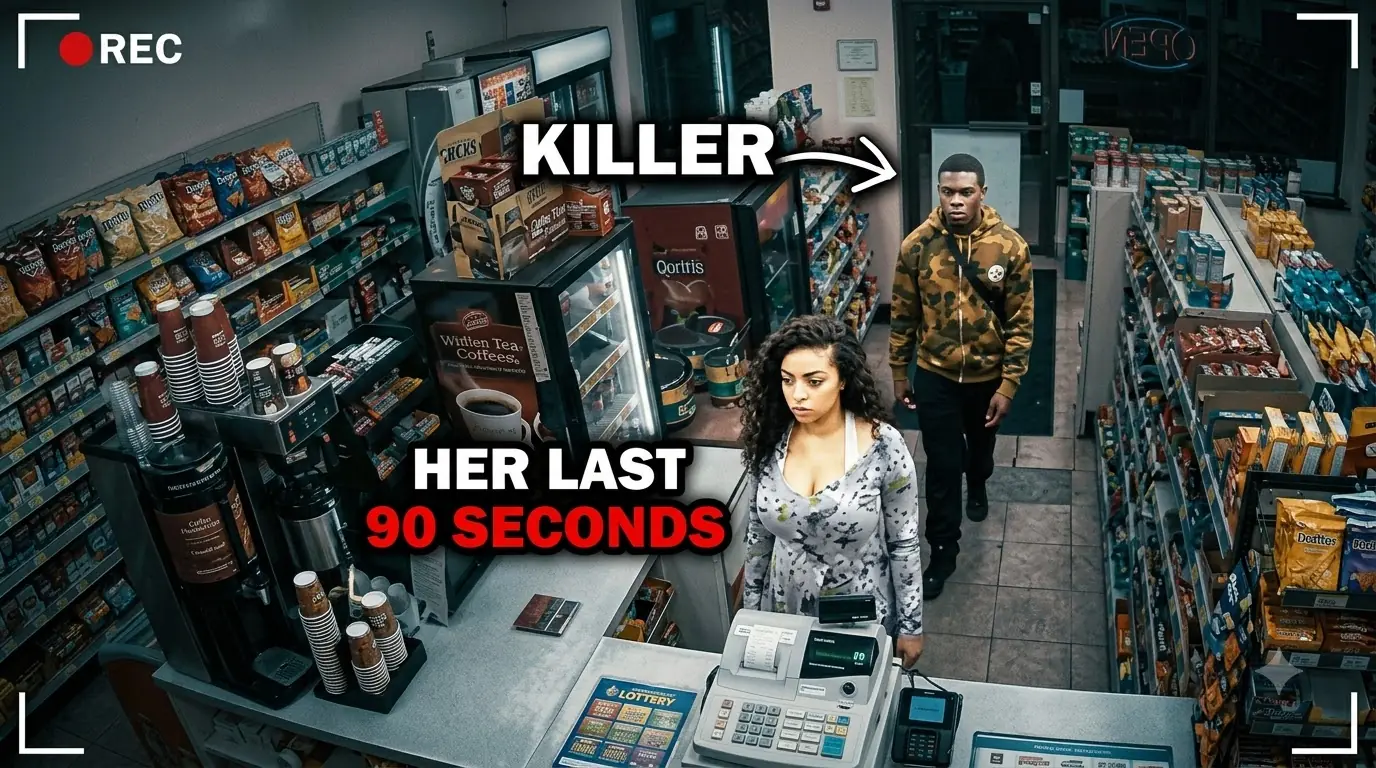
Her roommate Sarah was still awake. The two of them shared locations on their phones, something they had set up quietly without making a big deal of it the way young women do. Not because anything had ever happened, because they both understood, without saying it, that something always could.
At 11:09, Sarah texted, "Are you close to being home?" Aniah wrote back immediately. "Yeah." 30 minutes passed.
Sarah checked the location. It had moved not toward the apartment, but somewhere else, to a nearby complex filled mostly with college students. She messaged again.
"I just met him." "Where?" Sarah asked. No reply.
Sarah checked the shared location on her phone. The pin was sitting at an apartment complex nearby, one that housed mostly college students. The kind of place that does not feel like a red flag until it is.
She told herself it was probably fine. Aniah was 19 years old. She made her own choices. Sarah went to bed. In the morning, Aniah was not home.
Her dog, Blue, was still there. Aniah had adopted him from a shelter a few months earlier, a small, specific thing she had done to make her apartment feel like hers. Blue was still there. Aniah's car was not. Elijah Jr. called.
No answer. He called again. He drove to her apartment. He stood at the door of the room where his sister was supposed to be sleeping and understood, before anyone had said a single word to him, that something was wrong. By the time the Auburn Police Department opened a missing person's case, the first hours, the hours that would later be called the most critical, were already gone.
Detectives pulled convenience store surveillance footage from the Chevron on South College Street. What they found stopped the investigation cold. Aniah's car, a 2019 Honda CRV, was visible in the lot. She walked inside. She walked back out.
And then, just outside the door, the footage showed her being forced. The door of the CRV closed. The car pulled out of the lot. It did not go toward her apartment. The footage was grainy, but the timeline was exact, 11:23 p.m.
Within 14 minutes of texting her roommate that she was fine, the Auburn Police Department had a vehicle and a direction. What they did not yet have was a name. They also had something they were not saying publicly: a detail that investigators noted in the earliest reports and that would not surface for days. The message Aniah sent Sarah, the one that read, "I'm smoking a blunt low." did not match her phone's movement pattern at the time it was sent. Sarah had already known that.
She had known it the moment she read it. Aniah did not talk like that. Walt Harris did not sleep. He was a UFC heavyweight fighter, a man who had built an entire public identity around absorbing punishment and standing back up. In the days after Aniah disappeared, he stood in front of cameras and said the only honest thing he had.
Walt Harris had been in fights that broke bones, in training camps that lasted months, in a career built on refusing to go down. But there is no training for this. When he spoke to the press, 3 days in, his voice carried something that a fight camp cannot prepare you for. Blanchard's parents even meeting with the mother of Natalee Holloway, who vanished on a high school graduation trip to Aruba in 2005 and has never been found. Um that's my baby girl, so I'm a fighter by nature.
Um it's not just my profession. I've been battling all my life and I'm not going to stop battling for her right now. He was not performing. The sentence had no construction to it. It was just the truth, arriving in the only shape it could.
The search continued. Law enforcement widened the perimeter. The area between Auburn and Montgomery, roughly 50 miles of rural Alabama, became the primary zone. Texas EquuSearch, the volunteer search organization that had worked hundreds of missing persons cases, was called in. Hundreds of volunteers moved through fields and tree lines.
Aniah's stepfather was out there with them. Her biological father, Elijah Sr., worked the phones. Angela, her mother, was a nurse. She understood what the passing of time meant medically, statistically. She did not say this publicly.
She kept her face composed in front of cameras and behind it held a number she could not stop counting upward. The search had generated national attention. News broadcasts were running the story around the clock, and the coverage was pulling in details that the family had not yet been told publicly. The specific geography of the search area, the reward being offered by people who had never met Aniah, but understood exactly what Walt Harris was going through. The broadcasts captured something the press conferences could not.
Tonight, the search is intensifying for 19-year-old Aniah Blanchard. This surveillance video shows the last time she was seen more than a week ago, late at night inside this Auburn convenience store. Police found her car 2 days later, damaged and parked at an apartment complex in Montgomery. There's about 50 miles between Auburn and Montgomery, and so we're looking at that that area specifically as as the critical area where something took place. Police say evidence inside her car points to foul play.
I love her so much, and I I want her back so bad. Um, and so I'm going to hold out hope. Aniah's father says watching the surveillance video, something about his daughter seemed off. It was almost like somebody told her to do something. What was so unusual about her body language?
She was kind of just she looked kind of distant. Alabama officials are offering more than $100,000 reward for any information in Aniah's case, thanks in large part to an outpouring of donations from the UFC community. $100,000. The UFC community had not been asked; they had moved. The number said something that no press conference language could. This was not going to be allowed to go quiet.
While the public search moved through rural Alabama, a second track was running underneath it quieter, faster, and considerably more alarming. Investigators had been working the surveillance footage. They had expanded their canvas to nearby cameras, and somewhere in that footage, they found a face. For days, the name of the suspect had not been released. Auburn police were moving carefully, building a case that would hold.
But the breakthrough, when it came, arrived with a detail that reframed everything, not just about the night of October 23rd, but about the months before it. We begin tonight with breaking news in the search for 19-year-old Aniah Blanchard. The 19-year-old Alabama college student missing now for more than 2 weeks. He should be considered dangerous and would be potentially armed. There is currently a manhunt going on right now to track him down.
Police tell us there's a warrant out for the arrest of 30-year-old Ibraheem Yazeed of Montgomery. The charge, first-degree kidnapping. According to investigators, Yazeed was at the same convenience store where Aniah Blanchard was last seen on October 23rd. These are surveillance videos from a Chevron on South College Street in Auburn. Police shared that with us yesterday.
They tell us they believe Ibraheem Yazeed took Aniah against her will. You may recall her car was found at a Montgomery apartment complex on October 25th. That is 2 days after Aniah was last seen. There was damage on the front right passenger side of the car. Police say evidence inside Aniah's vehicle gave them reason to believe that Aniah may have been a victim of foul play.
Yazeed is currently out on bond for charges of kidnapping and attempted murder in a previous case in another jurisdiction. Again, police are still looking for this man. Crime Stoppers is offering a $105,000 reward for information leading to his arrest and conviction. Anyone who sees him is asked to call 911. Out on bond.
Those three words sat inside the broadcast like a splinter, small, specific, and the beginning of a much longer injury. The manhunt was underway, but the question forming beneath it was darker than the search. How had Ibraheem Yazeed been free to walk into that parking lot in the first place? Ibraheem Yazeed was not a stranger to law enforcement. In the period before October 23rd, he had been charged with kidnapping, attempted murder, and robbery.
These were not old charges, not distant history. They were active. He had appeared before a judge. The judge had reviewed the charges, reviewed the record, and then because Alabama law at that time required it, granted him bond. The Alabama Constitution, as it stood in 2019, guaranteed the right to bail for all defendants unless they were charged with capital murder.
Yazeed's charges were violent. They were serious. But, they were not capital offenses under Alabama law. And so, legally, a judge had no choice. The law did not permit denial of bond.
The law required that he be released. He posted bond. He walked out. He was free on the night he followed Aniah Blanchard into a gas station parking lot. The institution had not overlooked him.
It had processed him correctly. It had followed every rule. And the rules had put him back on the street. The manhunt moved quickly once the warrant was issued. Law enforcement agencies across Alabama were alerted.
Ibraheem Yazeed did not stay hidden long. When the announcement came, it carried the particular flatness of official language, the kind that sounds like resolution but does not feel like it. Breaking news, an arrest has just been made in the disappearance of Alabama teen Aniah Blanchard. An arrest had been made. Aniah had not been found.
The distinction mattered, and the family knew it. A man in custody is not a daughter returned. Walt Harris went back in front of the cameras within days of the arrest. And what he said was not relief. With Yazeed in custody, law enforcement had shifted their focus to locating Aniah.
Walt Harris understood that the arrest had answered one question and left a larger one completely open. He addressed the cameras directly, and what followed was not a statement. It was a plea. What I say to him? I don't even know if I can say it on national television, to be honest.
But, if he's listening, if he's somehow watching this, please tell the authorities where my daughter is. Please. We're still looking for Aniah, and that's what we want is to find her. We need help finding her cuz we don't know. We have no information about where she is, and that's the most important thing to us right now is getting her home.
Yazeed said nothing. The CRV had already been located, processed, and cataloged. What it contained would take forensic analysis days to interpret. In the meantime, Texas EquuSearch continued working the woodlines between Auburn and Montgomery. The family was receiving daily updates from Auburn Police Chief Register.
Elijah Sr., Aniah's biological father, a man who had rebuilt his relationship with his daughter and with Angela after their divorce, who had remained part of the family in the way that few divorced parents manage, was on the phone with investigators constantly. He later said that he was grateful for the communication, even when the news was nothing, because nothing was still honest. Weeks into the search, the question of whether Yazeed had acted alone or with assistance was still open. The family had been told that a second individual, a man named Fisher, was also in custody. But, the larger question, the one no one in law enforcement was answering, was whether the crime had been planned or whether it had been random.
Elijah Sr., and Angela sat down for a live interview to address that directly. This morning, it has been more than 3 weeks since Homewood native Aniah Blanchard was reported missing from the Auburn area. Even with the suspect now in custody, her family has never given up hope that she would be brought home safely. And joining me now live in Studio 42 is Aniah's father, Elijah Blanchard, and his wife, her stepmother. Thank you so much for being here this morning.
One of the most recent developments was the volunteer group Tech with Texas EquuSearch calling off their search. Talk to us about your reaction to hearing that that portion of the search would be called off. We we kind of was figuring that because I don't think they had a specific area that they wanted to search in. So, that's what, you know, once they pulled out, we, you know, but we have full confidence that the Auburn Police Department's going to do their due efforts to make sure everything goes good. Yesterday afternoon on Dr.
Phil, Aniah's mother and stepfather said they do not believe that this was random, that they believe this may have been premeditated. How do you all feel about that? Do you agree? If I Do you want me to? Um Our contention is that this was something random.
Um basically by seeing the photos from the car being damaged, we initially start get, you know, coming up with different scenarios as far as what could have possibly happened. And um you know, like I said again, it's random and we initially stated that, you know, we thought that it was a carjacking. And so, that has always been our position. Chief Register and his team are very, you know, very good. They they call me every day or they send random texts let me know, you know, what's going on with the case.
They've been really good with communicating with us. I have no problem with their what they're doing. They're strictly professional. Um but they don't want to give us anything that's going to be damaging or anything like that. So, but they are communicating with us daily.
All right, Mr. and Mrs. Blanchard, we thank you so much for coming in again this morning. We want you to know our thoughts and prayers remain with your family and with Aniah's the search continues. Thank you again. Texas EquuSearch had halted operations.
That decision made by professionals who understood the statistics was its own kind of sentence, delivered without words. The call came in late November. A rural woodline in Macon County, Alabama, a few feet in from the road, human remains. The family had been waiting for news. Every day of waiting had been its own specific kind of endurance.
The kind that does not look like suffering from the outside because it has no form, just the continuous absence of information. When the discovery in Macon County was announced, investigators confirmed that Yazeed and Fisher were both being held without bond. But the broadcast covered the detail that mattered most. And a lot of developments happening today as a matter of fact. Auburn police say investigators received information about the possible location of a body during their ongoing investigation into Blanchard's disappearance.
This is the area where the remains were discovered Monday morning. A rural area several feet into the woodline. The Lee County District Attorney says there is good reason to believe the remains are Blanchard's. Two suspects have been charged with kidnapping her. Well, today there is new information, but not what anyone wanted to hear.
Yazeed and Fisher are being held now in the Lee County jail. They are being held without bond. The remains had not yet been formally identified. That process would take time, and the time it took was its own particular cruelty the family already knew. And the law required them to wait for the science to confirm what they already knew.
The community did not wait for confirmation. They already knew. The family already knew. And so, before the forensic anthropologists had finished their work, before the official identification had been released, people gathered. Candles, a parking lot.
The kind of crowd that forms not because anyone has organized it, but because standing together is the only thing left to do when there is nothing left to do. Angela Harris stood in front of them. She was a nurse. She was trained to deliver information in a controlled, measured way. She was trained to hold herself together in rooms where other people were falling apart.
She stood at that vigil and did not perform grief. She delivered it directly without ornament in the direction of every parent standing in front of her. Angela had spent weeks composing herself for cameras, for investigators, for her younger children who did not fully understand what was happening. At the vigil, she stopped composing. What she said was not prepared.
It was the thing she had been carrying since the morning Aniah did not come home, finally set down in public where everyone could see the weight of it. I first want to address the parents. Parents, you never think that something like this is going to happen to your child. You prepare them, you think you prepared them enough. I thought I did.
I talked to Aniah about it every day, every day on the phone. "Hey Aniah, make sure you're not you know going anywhere by yourself at night. Make sure you're not doing the Yeah, Mom, I know. Yeah, I'm good, Mom. I got this." Trusted her with all my heart.
But nothing you do can can prepare you for some evil that is out there, y'all. Please. So I'm begging parents, put a just a little bit more uh teach your kids a little bit more at now I feel guilty maybe even nothing I could have done, but I should have prepared her just a little bit better um for things she might have came into contact with. The whole community, it's always been good, but now seeing the support that we have for what's happened to her, this would make uh she's smiling right now in heaven. I can tell you that right now.
She not smiling no. Aniah is laughing and she's laughing at y'all. I can tell you right now she's laughing at y'all. But um this is making her heart smile. It's making my heart smile because we all know how special of a girl that Aniah was.
She put everybody before her. She wanted everybody to have fun and laugh and it was always it was if y'all were having a good time, she was going to make sure you were having a good time because life was good for her and she was a happy happy happy girl and and that's just that's just the bottom line. Like She had said the thing that no parent in that crowd wanted to hear and every parent in that crowd already knew. The candles stayed lit. Nobody left early.
The formal identification process took weeks. Forensic anthropology is not fast work. The remains discovered in the Macon County woodline were scattered, the result of time, weather, and exposure. Each fragment had to be cataloged, analyzed, and cross-referenced. The medical examiner's office worked methodically, the way institutions work when they are functioning correctly, which is to say slowly and without regard for the calendar that the family was living on.
Angela counted days. Elijah Sr. counted days. Elijah Jr., 3 mi from the apartment where his sister had lived, took care of her dog Blue and did not speak publicly. He had been the last person to see her. He had told her to go straight home.
He had fallen asleep before she got there. There is no therapeutic framework that makes that fact easier to carry. He carried it anyway, quietly, in the way that younger siblings of lost children often do, by disappearing slightly from the world and hoping the world does not notice. It noticed. It just did not know what to do with him.
More than a year passed between the discovery in Macon County and the opening of Ibraheem Yazeed's trial. In that time, the legal machinery moved the way legal machinery moves, slowly, procedurally, with continuances and motions and the particular exhausting rhythm of a system that is not designed around the needs of the people waiting for it to finish. Homewood City Hall lit its building in blue lights in memory of Aniah. The family waited. When jury selection finally began, the scale of the process made clear how seriously the court was taking the case and how long the road ahead still was.
450 people had been summoned. The building that Aniah had grown up near glowed blue in her memory, and a reporter stationed outside the Lee County Courthouse filed the first of what would become many dispatches from the steps of a building the family had been waiting to enter for more than a year. Jury selection will continue tomorrow morning in the trial of Ibraheem Yazeed. Of the 450 jurors summoned for the case, 105 appeared in court. Some of them will return tomorrow alongside others scheduled to be reviewed.
The selection process could take up to a week. Homewood City Hall lit up in blue tonight in honor of Aniah and her family during the trial. Aniah went to Homewood High. The city says this will go on for the next 10 nights as a symbol of remembrance, support, and unity. 450 people asked to decide whether they could be fair.
The family had been asking for fairness since October of 2019. The process was only now catching up. The prosecution's case rested on forensic evidence, the kind that does not require eyewitness testimony, that does not depend on what anyone says they saw or heard or remember. Bone fragments, distribution patterns, the specific clinical vocabulary of a forensic anthropologist explaining to a jury how scattered human remains can still tell a precise and devastating story. The chief medical examiner testified, the forensic anthropologist testified.
Outside the courthouse, a reporter delivered the details live in the flat declarative language of someone who has learned to say terrible things without pausing. The testimony inside the courtroom was technical by design. Forensic science is the language of certainty in a case built on physical evidence rather than witnesses. But what was being described, stripped of its clinical vocabulary, was the process by which investigators had identified what remained of a 19-year-old woman from scattered bone fragments in a rural Alabama woodline. The reporter outside the courthouse did not editorialize.
He did not need to. The capital murder trial for Ibraheem Yazeed entering the final stages as the state and defense rest their cases in Lee County late today. Jason, today we heard from a forensic anthropologist and from the chief medical examiner in Alabama. They were both on site in Macon County where Aniah Blanchard's remains were discovered. Now, those remains were very scattered and they worked together to evaluate 1,700 square meters of woods.
The forensic anthropologist, alongside her team, worked to recover several different bones including skull fragments, vertebrae, ribs, soft tissue, and teeth. While on the stand, she said based on the bone fusion, bone length, and shape and size of the skull, she was able to determine the remains belong to an African-American woman in her late teens, saying they were consistent to Aniah Blanchard. The jury had heard enough to know what happened. The remaining question was what the law would call it. The jury deliberated.
Ibraheem Yazeed had been charged with capital murder. It was a charge that, if it held, would have made him eligible for the death penalty. The prosecution had built its case toward that outcome. The family had built their hope around it. The verdict came back.
The courtroom had been full for days. The family was present. The community that had gathered in parking lots with candles, that had lit City Hall blue, that had donated toward a $100,000 reward for a girl they had never met, they were waiting for a word. When the broadcast broke in with the jury's decision, the language was careful and procedural. What it described was not what the family had been promised by the charge. deliberations yesterday.
He was facing two counts of capital murder, but today the jury decided to go with lesser charges. Well, breaking news in a case we've been following for years. Ibraheem Yazeed was just sentenced for the murder of Homewood native Aniah Blanchard. Felony murder, intentional murder, not capital murder. The death penalty was off the table.
The family absorbed this in public, in the full view of cameras that had been following them for more than 2 years, and said the only things left to say. The judge sentenced Ibraheem Yazeed to life in prison, with no parole and no possibility of release. The rest of his life in a cell, which is the maximum the conviction allowed, and which the district attorney framed in the language of warning rather than closure. It is the sentence that the weight of this crime demanded, and one that Aniah's family has long deserved. This case has absolutely shaken our community to its core.
It is my intention that the response to this horrific crime will be a warning to anyone, anyone who believes they want to come to Lee County and engage in violent criminal behavior. They will certainly be dealt with, and the consequences will be severe. The family heard this. They sat with it. And then, one by one, they said what they needed to say on the record, in the room, in front of the man who had taken Aniah from them.
Angela said, "My daughter fought a very violent criminal. She fought hard, and she got him off the street so he could never hurt anybody again, and that feels good."
Elijah Sr. said, "My daughter's name speaks now, and her name was able to get a conviction, and most definitely happy to see whatever happens going forward, he will be behind bars for the rest of his life. It was important to look him in the eyes and let him know he didn't win."
Then he said, "This young man is really a lethal young man. He's gutless. He's ruthless, but he just doesn't have a conscience at all, and he's proven that by his past actions." Past actions, the phrase opened a door that the verdict had not closed.
Ibraheem Yazeed had been out on bond for kidnapping, attempted murder, and robbery when he murdered Aniah Blanchard. The trial had established what he did. It had not answered how he had been free to do it. That question had been forming since the night the manhunt broadcast first used the phrase out on bond. It had been building through the search, through the vigil, through the long procedural corridor of jury selection and forensic testimony.
Now, with a verdict on the record, the family turned toward it directly. Walt Harris said it plainly, "So, it blows my mind how a person like that is still able to walk around and be amongst people and yeah, I you know, there are a lot of things we need to answer." He did not finish the sentence. He did not need to. The Alabama Constitution, as written in 2019, guaranteed the right to bail for every defendant not charged with a capital offense. Yazeed's charges, kidnapping, attempted murder, robbery, were serious, violent, and well-documented, but they were not capital charges.
The judge who had released him had not made an error. The judge had followed the law. The law had followed its own logic to its worst possible conclusion, and the conclusion had a name: Aniah Blanchard. The family did not stop at the verdict. They had been inside the legal system long enough to understand exactly where it had broken.
They knew the specific line in the Alabama Constitution that had made Yazeed's release not just possible, but mandatory. And they knew that if the line stayed there, unchanged, the same outcome was possible for the next family. They were not willing to leave it there. The campaign for what became known as Aniah's Law moved through the Alabama legislature with a speed that most legislation does not achieve, driven by the specificity of the failure it was designed to correct, and by a family that had done the work of understanding exactly what needed to change. The law expanded the list of offenses for which a judge could completely deny bail.
It added 12 serious violent crimes to the existing framework. Murder and attempted murder, first-degree kidnapping, rape, robbery, domestic violence, aggravated child abuse. Twelve categories of violence that a judge could now look at and say, "No, not this time. You do not get to walk out." The Alabama legislature passed it. In November of 2022, Alabama voters approved it as a statewide constitutional amendment overwhelmingly.
The loophole that had put Ibraheem Yazeed back on the street, the specific structural gap in the law that a judge had been legally powerless to close, no longer existed. Mayor Jimmy Gardner said it simply, "Violent offenders should not be given the opportunity to commit violent crimes again. I think everybody should have an opportunity to get a bond, but yet when you're a violent offender and you find yourself going out a second time, there is no reason for us to allow you to have that opportunity because you've already proven yourself not to be a good citizen." Aniah's Law was not the only thing the family built from what they had lost. They founded a nonprofit organization called Aniah's Heart, focused on safety education for young people.
The organization did not position itself as a memorial. It positioned itself as a tool, something Aniah would have recognized, something that matched the way she had moved through the world, always looking out for someone else, always the one who picked people up after a loss and kept them going. There is a scholarship in her name. There is a bench in one of her favorite parks. Elijah Jr., who had fallen asleep 3 miles away on the night she disappeared, now cares for her dog Blue.
He focuses, people close to him say, on the simple things. He does not speak to the press. He does not need to. He carries what he carries in the way that only the people who love someone first and longest know how to carry it without language, without ceremony, just the daily fact of her absence folded into the daily fact of continuing. Her younger brother fell asleep for months holding her photograph.
Her younger sister, who was 6 years old when Aniah disappeared, kept asking where she was. The question had no answer that a 6-year-old could hold. Walt was called into her school because she could not stop crying about how much she missed her. He sat with her. He is a fighter by nature.
He has been battling all his life. He did not stop. Angela Harris had said many things in public over the years since October 23rd of 2019. She had said them to cameras, to investigators, to legislators, to crowds holding candles in parking lots. She had said them with her nurse's composure and her mother's devastation running simultaneously beneath it.
After the verdict, after the sentencing, after the law had been changed and the amendment had passed and the scholarship had been established and the bench had been placed in the park, she said the thing that all of it had been circling. I had Aniah on my birthday, June 22nd. That was just going to be something so special in life for she and I to share. Ordinary moments are painful because Aniah should be here. Her siblings must live the rest of their lives without her.
I must live the rest of my life without her. There is no sentence that can restore what was taken from us. There is no sentence that can restore what was taken from us. She said it not as an indictment of the court, not as a rejection of the verdict, not as a refusal of the law that now bears her daughter's name. She said it as a fact, the flattest, most honest fact in the entire story.
A law was changed. A man is in prison. A dog named Blue lives with a young man who falls asleep every night 3 miles from where his sister was last seen alive. Aniah's name speaks now. Her father said so and he was right.
It speaks in the Alabama Constitution. It speaks in the classrooms where her foundation sends safety educators. It speaks in the quiet of a park bench where someone who never knew her sits down and reads a name on a plaque and wonders, briefly, who she was. She was 19. She was studying to be a teacher.
She was someone's biggest cheerleader, someone's rock, the voice that kept people going. She was doing what millions of people do every single day. And because of what was done to her, and because of what her family refused to let her death become, the next judge who looks at a violent offender across a courtroom has a choice that the law would not previously allow. That is what Aniah's name does now. That is what it will keep doing.