The midnight blue Lamborghini was barely moving when the blue lights erupted in its rearview mirror.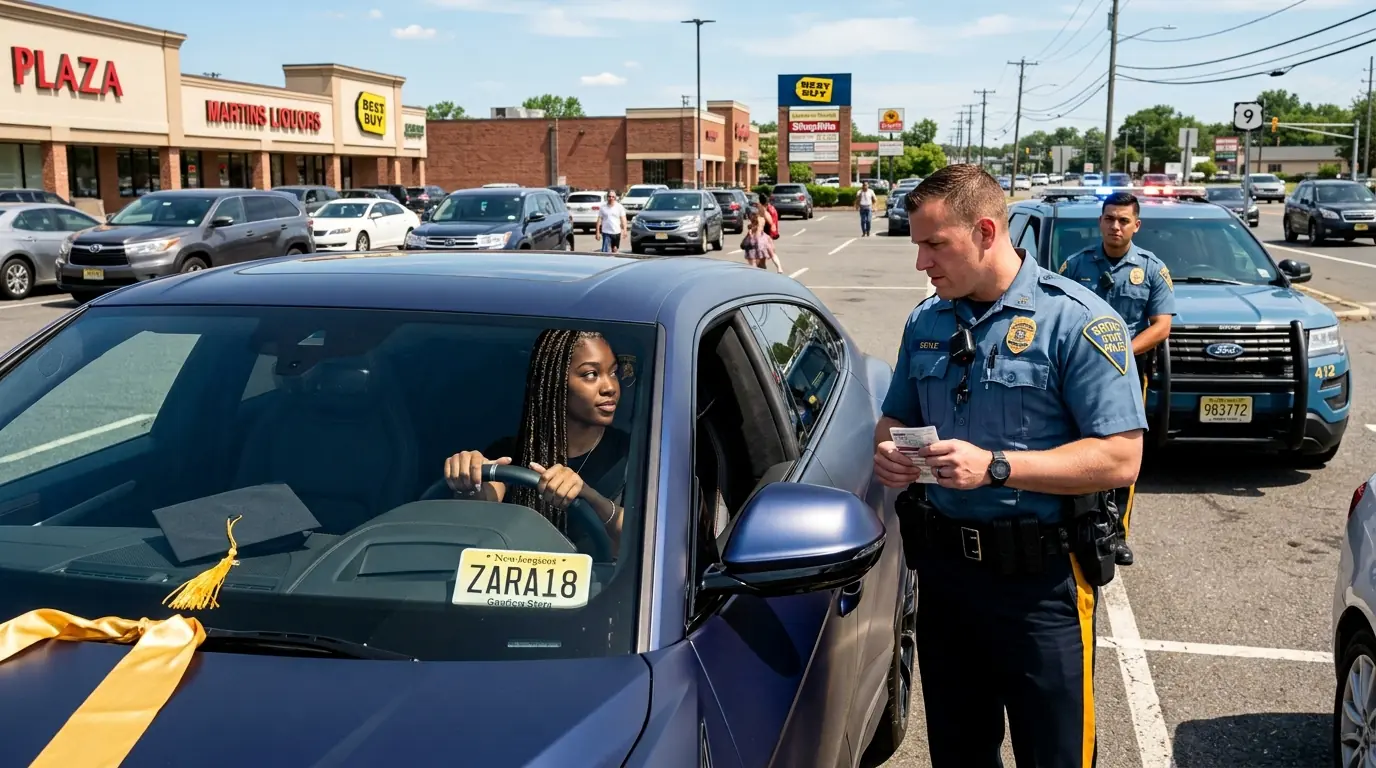
It was 2:26 in the afternoon on a Tuesday in June, and the car—a matte midnight blue Urus with personalized plates that read "ZARA18"—had done nothing wrong. It had signaled every lane change. It had maintained the speed limit with the kind of careful, deliberate precision that only new drivers possess: the kind that comes from a father's patient instruction and the knowledge that the world will not forgive you for a single slip. It had stopped completely at every stop sign, checked every mirror, and kept its distance from the car ahead.
There was nothing to see. There was nothing to find.
And yet, Officer Travis Doyle had already made up his mind. He looked through his patrol car windshield at the midnight blue Italian supercar and at the 18-year-old Black girl behind the wheel: braids past her shoulders, crop top, ripped jeans, singing quietly along to something on the radio. And his brain performed the particular kind of arithmetic that has nothing to do with the law and everything to do with what a person chooses to see when they look at someone else.
The calculation took about four seconds. The flashing lights followed immediately after.
What Officer Doyle did not know—what he was about to discover in the most devastating way of his professional life—was that this parking lot he was steering that girl into sat exactly 0.4 miles from the main gate of Fort Caldwell, the largest army installation in the southeastern United States. He did not know that the MPs on Gate 2 duty had already recognized the Lamborghini when it rolled past twenty minutes earlier, because the entire base had been talking about General Coleman's gift to his daughter since seven that morning. Nor did he know that inside Fort Caldwell headquarters, in an office whose walls were covered with the photographs of four different presidents and three different wars, a man in a pressed uniform was about to receive a phone call that would change the course of a state's law.
That man was Zara Coleman's father, and he did not travel light.
The first thing Zara Coleman noticed when she opened her eyes on the morning of June 15th was the smell. It came up through the floor vents in slow, warm ribbons: biscuits, butter, and the particular sweetness of Great-Aunt Loretta's cane syrup. The smell that meant Sunday even when it was a Tuesday; the smell that meant home even when everything else in the world was shifting and uncertain.
Zara lay still for a moment with her eyes open, staring at the ceiling of her bedroom in Sycamore Ridge, and let the smell hold her before the day could start. She was 18 years old as of six hours and twenty-two minutes ago. She had graduated from Claremont High School the previous afternoon, had walked across that stage in a cap and gown that was still hanging on the back of her closet door—the tassel pushed to the left because she had earned the right to push it—and had cried exactly once in the parking lot afterward when her father had put his hand on the back of her neck the way he did when she was small and told her he was proud of her. Just those four words in his voice that never rose and never shook, and she had been undone completely.
He was already gone, of course. He was always already gone by the time the house was awake. General Raymond Coleman left for Fort Caldwell at 4:45 every morning, and had done so, with variations of no more than ten minutes, for as long as Zara could remember. When she was small, she used to wake up to the sound of his careful footsteps on the stairs. He moved quietly for a large man—deliberately quietly, the way soldiers learn to move when they have spent enough time in places where sound travels wrong. She would listen to the front door close, lie in the dark, and feel simultaneously safe and bereft: the two feelings she associated most strongly with having a father who belonged to something larger than a household.
She rolled out of bed, padded across the hardwood floor in socked feet, and paused at her desk the way she did every morning now. The West Point acceptance letter was pinned above the desk with a single thumbtack, positioned at eye level so she would see it first thing. She had read it so many times that the paper had gone soft at the folds, the official seal slightly blurred from handling:
Dear Miss Zara J. Coleman, It is with great pleasure that the United States Military Academy offers you admission to the Class of 2029.
She did not read it this morning. She just looked at it for three seconds the way she had been looking at it every morning since March, and let it be true.
On the kitchen table downstairs, under a glass of orange juice that Great-Aunt Loretta had poured in advance, there was a note in her father's handwriting. He wrote the way he did everything: deliberately, without waste, each letter fully formed. The note said:
Drive.
Zara looked at Great-Aunt Loretta, who was at the stove with her back turned, the wide shoulders of her housecoat moving as she stirred something. The old woman said without turning around, "Go on, child. Door's unlocked."
Zara went out in her pajamas. She was not fully prepared for what she saw. She later told her father that her first thought—the very first, most honest thought that arrived before any other—was that it was a mistake, that it belonged to someone else, that there had been some confusion involving the driveway, a neighbor, and an extremely dramatic vehicle.
The car sat low and wide in the morning light, the paint so dark it seemed to absorb the sunlight rather than reflect it. Matte midnight blue: the color of deep water, the color of the sky at the exact moment before it decides to become night. A wide gold ribbon had been looped across the hood in a bow, theatrical and enormous, the kind of bow that appeared in car commercials and in her imagination at age twelve when she used to catalog the things she planned to have someday. The front wheels were turned slightly to the right, which gave the car an alert posture, poised like a thing deciding whether to move.
She stood on the porch and stared at it for a solid sixty seconds. Then she saw the license plate—"ZARA18"—and below the rearview mirror, barely visible through the windshield from where she stood, embossed in the headrest leather: Zara J. Coleman.
She went around to the driver's side. Tucked under the windshield wiper was a folded note in her father's handwriting. She unfolded it, standing in the driveway in her pajamas with the June air warm and pollen-heavy around her and the neighborhood still mostly asleep. It said:
Baby girl, you worked hard. You earned this. Drive safely. Love, Dad.
She sat down on the front step and cried for approximately four minutes.
Before the phone call, before the blue lights, before the handcuffs, the convoy, and the parking lot that would appear on every screen in North Carolina by nightfall—before all of it, there are things you need to understand about General Raymond Coleman.
He grew up in Beaufort County, South Carolina, in a three-room house at the end of a dirt road that was not on any map that mattered. He was nine years old when his parents were killed: his father at the wheel of a Buick that hydroplaned off Route 21 on a February night, his mother in the passenger seat, both of them gone before the ambulance arrived. After that, he went to live with his great-aunt Loretta, who was 54 years old, had a bad hip, worked double shifts at a textile mill in Walterboro, and had never in her life been asked whether she had the capacity for one more thing.
She had not been asked. He had simply arrived with a plastic garbage bag of clothes and a silence that lasted three months, and Loretta had made room. She fed him. She made him do his homework at the kitchen table where she could see him. She took him to church and made him sit up straight. She told him on a number of occasions that God had not put them both on this earth so they could feel sorry for themselves, that the only productive response to hardship was forward motion, and that the direction forward always involved, at minimum, doing something useful with your hands.
Raymond Coleman enlisted in the United States Army the day after his 18th birthday, on the same day he graduated from Beaufort High School. He had $340 in a savings account, a bus ticket to Fort Jackson, and a promise made to Loretta at the kitchen table the night before that he would make something of himself, that he would make it mean something.