A split-second decision in the harsh glare of an ordinary afternoon changed two men's lives forever.
Sirens cut through the quiet hum of daily life, though the real wrongdoing was happening behind the badge.
Power has a funny way of blinding those who wield it recklessly, twisting their perception until they believe they are untouchable.
When an arrogant patrolman decided to assert his dominance over a disabled veteran merely trying to cross the street, he expected absolute compliance. He expected fear. Instead, he met a pair of cold, unblinking eyes that had stared down organized crime syndicates and international threats. One bad decision, fueled by prejudice, set off an explosive chain reaction that would completely destroy a corrupted career.
Sunlight baked the pavement of Oakridge, a suburban enclave that prided itself on manicured lawns, quiet streets, and a general air of undisturbed peace. For Harlan Whitaker, it was a sanctuary. He had traded the relentless, adrenaline-soaked concrete canyons of Washington, D.C., for the slow, predictable rhythm of this Midwestern town.
He navigated the sidewalk of Elm Street with the practiced ease of a man who had long accepted his physical limitations. His motorized wheelchair hummed quietly, a steady mechanical companion that had replaced the use of his legs years earlier. Harlan was a man carved from mahogany and granite. Even seated, his posture was immaculately straight, his shoulders broad beneath a crisp, light-blue button-down shirt.
Silver peppered his close-cropped hair and neat beard, framing a face lined not just by age but by the heavy burdens of a life spent peering into the darkest corners of human nature. He had a serene resting expression, though his dark eyes missed nothing. They constantly scanned his environment, a lingering habit from decades of federal service.
He tracked the delivery truck turning the corner, the stray dog sniffing a fire hydrant, and the young mother pushing a stroller three blocks away. It was an involuntary reflex, the ghost of an operational mindset that refused to entirely fade. Today's mission was simple, a trip to the local corner grocer to pick up fresh basil and a newspaper.
He held a small reusable canvas bag on his lap, enjoying the gentle afternoon breeze. Oakridge was supposed to be safe. It was the kind of town where people nodded to each other on the street, but Harlan knew better than most that trouble rarely announced itself with trumpets. It usually arrived dressed in the mundane.
Cruising down a commercial strip sat Officer Derek Langford. Derek was thick-necked and carried himself with a permanent, tight-jawed scowl that he mistook for authority. He gripped the steering wheel of his police cruiser with white knuckles, his mirrored sunglasses reflecting the passing storefronts.
To Derek, the uniform was not a symbol of public service. It was a license. It was a shield that justified his worst impulses. Beside him sat Officer Caleb Voss, a young rookie fresh out of the academy, still possessing the naive belief that the job was entirely about helping people and saving lives.
Caleb was shifting uncomfortably in the passenger seat, sweating through his uniform, largely because his training officer had been ranting for the past several minutes.
"You see, Caleb, it's about establishing the baseline," Derek barked, his voice a gravelly sneer. "These people come into our town, they think they can just loiter, bring down the property values, act like they own the place. You give them an inch, they take a mile. You have to show them who holds the leash."
Caleb swallowed hard, staring out the window.
"Who? Who exactly do you mean, sir?"
Derek let out a sharp, humorless bark of laughter.
"Don't play dumb, kid. You know exactly what I'm talking about. The element. The ones who don't belong here. You can spot them a mile away. They don't respect the law until you make them respect it."
Derek had a personnel file that read like a masterclass in borderline misconduct. Numerous excessive-force complaints had been filed over the years, many of them involving allegations of selective targeting and racial bias. Most had been dismissed or settled quietly through a system that repeatedly protected him and enabled his escalating behavior.
Chief Victor Thorpe, a stern, old-school lawman, had repeatedly tried to find the evidence needed to strip Derek of his badge, but the patrolman was cunning. He knew where the camera blind spots were. He knew how to write a report that painted the other person as the aggressor. Derek survived on technicalities and a deeply ingrained departmental reluctance to admit they had a serious problem inside their own ranks.
"Just watch and learn, Caleb," Derek muttered, accelerating the cruiser past the speed limit simply because he could. "Today, you're going to see how real police work gets done. No more of that textbook garbage they fed you at the academy."
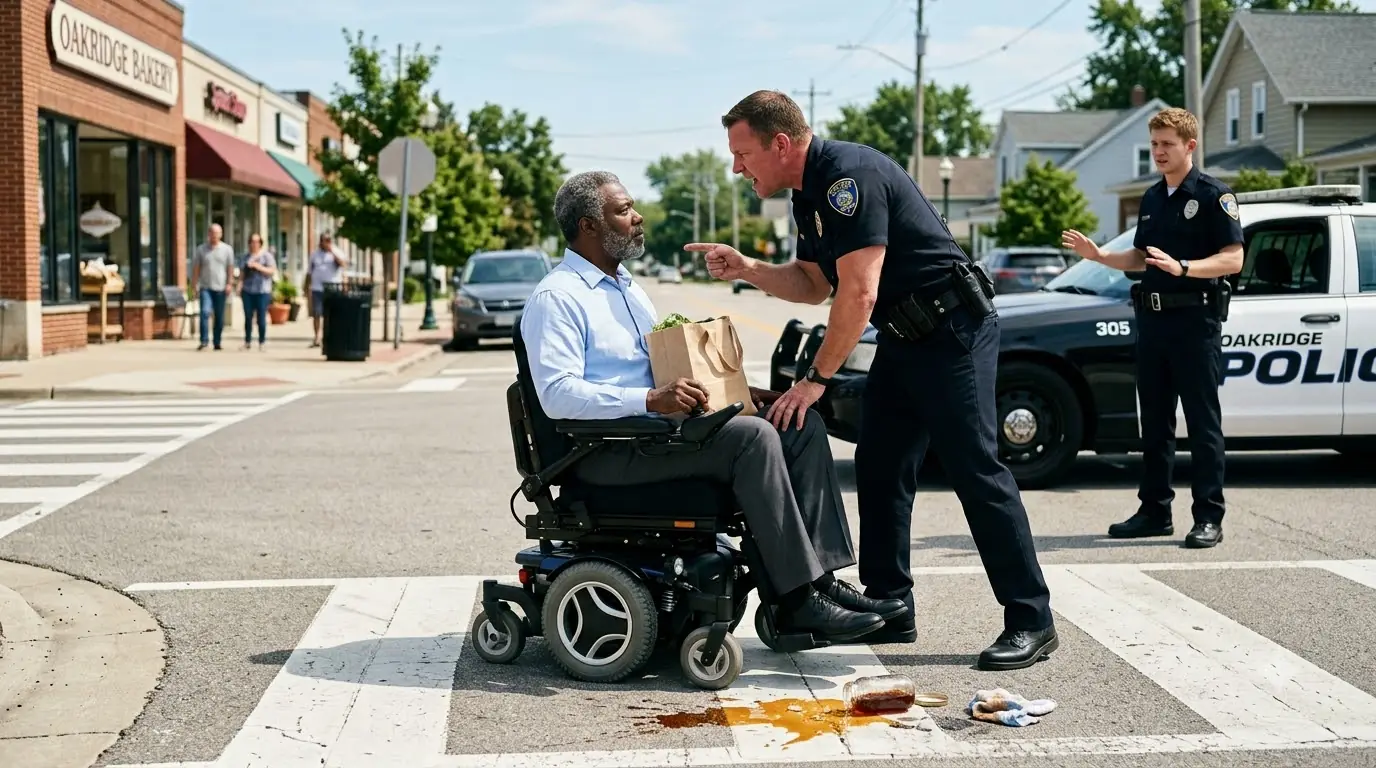
Back on Elm Street, Harlan approached the intersection of Fourth Avenue. The pedestrian crossing light glowed a steady white silhouette. He checked both ways, a lifelong habit, and engaged the joystick on his right armrest. The wheelchair rolled smoothly off the curb ramp and onto the asphalt.
He was halfway across the street when the canvas bag on his lap slipped. A small jar of expensive artisanal honey he had bought as a treat rolled off his lap and shattered on the pavement, spreading golden syrup and glass across the white lines of the crosswalk.
Harlan sighed, a sound of mild annoyance. He stopped the chair in the middle of the road, put it in park, and carefully leaned forward to assess the mess. He couldn't easily bend down to clean it, but he didn't want a car to damage a tire on the larger glass pieces.
He reached into his side pouch to grab a small rag, intending to push the larger pieces toward the gutter. At that exact moment, the roaring engine of a police cruiser turned onto Fourth Avenue.
Officer Derek Langford was at the wheel.
Derek slammed on the brakes, the cruiser's tires squealing in protest as the heavy vehicle lurched to a halt only feet from Harlan's wheelchair. The sudden aggressive stop sent a jolt of adrenaline through Caleb, who braced his hands against the dashboard.
"What is this idiot doing?" Derek snarled, his face instantly flushing with unwarranted anger.
He slammed his palm against the steering wheel horn, letting out a prolonged, deafening blast that shattered the quiet suburban afternoon.
Harlan flinched slightly at the jarring noise but did not panic. He slowly straightened his posture and turned his head to look over his shoulder at the cruiser. He raised one hand in a calm, apologetic gesture, pointing down at the shattered glass and spilled honey, signaling that he was temporarily delayed.
To a reasonable observer, the situation was clear. An older disabled man had dropped something and was figuring out how to manage it.
To Officer Derek Langford, it was an act of defiance. It was someone holding up his lane and refusing to instantly scatter at the sound of a police horn.
"Oh, you've got to be kidding me," Derek growled, unbuckling his seatbelt with violent speed. "Look at this guy. Thinks he owns the street. Probably intoxicated or looking for a payout."
"Sir, he's in a wheelchair. It looks like he dropped something," Caleb started, his voice trembling slightly.
"Shut up, Caleb. I'm handling this," Derek snapped.
He kicked the cruiser door open and stormed out into the afternoon heat, his hand resting near his duty belt in a familiar intimidation tactic.
Harlan watched the officer approach through the rearview mirror attached to his chair handle. He noted the aggressive, wide-legged stride, the flushed complexion, the flared nostrils. Harlan had profiled thousands of dangerous offenders. He recognized a man intoxicated by his own artificial authority almost instantly.
A cold, familiar stillness washed over Harlan.
The gentle retiree vanished, replaced entirely by the methodical, analytical mind of a seasoned federal agent.
"Hey! What do you think you're doing?" Derek bellowed as he closed the distance. "Move that chair to the sidewalk right now. You're obstructing traffic."
"Good afternoon, Officer," Harlan said, his voice a deep, resonant baritone, perfectly calm and devoid of the fear Derek was seeking. "As you can see, I've had a minor spill. There is broken glass on the road. I was attempting to clear the larger pieces so no one damages a tire. I'll be out of the way in just a moment."
Derek stopped a few feet away, looming over the seated man. He despised the calm in Harlan's voice. He hated the articulate, educated cadence. It challenged the pathetic little hierarchy Derek had built in his mind.
"I don't care what you dropped," Derek sneered, stepping closer. "You don't block a public roadway. You don't ignore a police horn. Now get this chair moving before I write you a citation for jaywalking and public nuisance."
"The crosswalk light was in my favor when I entered the street, Officer," Harlan replied, maintaining direct, unwavering eye contact. "I'm simply trying to be a considerate citizen. There is no need for hostility."
The word hostility seemed to short-circuit Derek's limited restraint.
The veins in his thick neck bulged.
"You want to talk to me about hostility?"
Derek jabbed a thick finger toward Harlan's face.
"Listen to me very carefully, old man. I don't know where you came from, but around here, when I say move, you move."
"I will move when it is safe to do so," Harlan said, his tone dropping an octave and carrying the icy weight of absolute authority. "Step back."
Officer Caleb Voss, who had cautiously exited the passenger side, stood awkwardly near the hood of the cruiser.
"Derek, come on," he muttered weakly. "Let's just help him move the glass aside."
"Stay out of this, Caleb," Derek roared without looking back.
He turned his furious gaze back to Harlan. The refusal to show fear was driving him toward the edge.
Derek leaned down, bringing his face inches from Harlan's.
"You think you're smart, huh?" Derek whispered maliciously. "You think sitting in that chair gives you a free pass to disrespect the badge? I've dealt with people like you before. Arrogant. Entitled."
Harlan's expression did not change.
Without warning, Derek grabbed the left armrest of Harlan's motorized wheelchair and jerked it sharply sideways. The sudden movement threw Harlan off balance, and his torso struck the side guard of the chair. The heavy machine tilted dangerously for a moment before dropping firmly back onto all four wheels.
"Hey!"
A woman's voice cut across the intersection.
Lila Bennett, the owner of the local bakery, had stepped out of her shop onto the sidewalk, her hands flying toward her mouth in shock.
"What are you doing to him? Leave him alone!"