"License and registration. Both of you. IDs out now."
"Officer, what's the reason for the stop?"
"I'll tell you the reason when I'm ready. IDs now."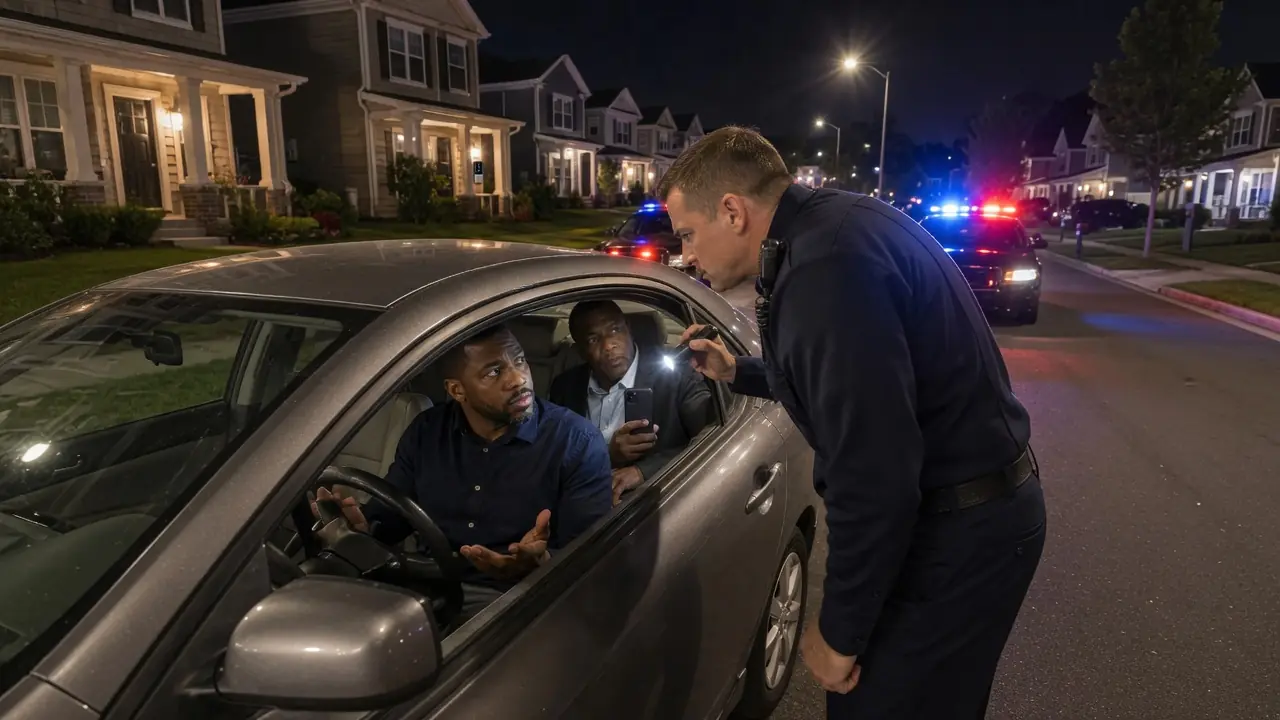
"Can you explain what traffic violation occurred?"
"Who asked you? Driver, tell your buddy to keep his mouth—"
Lieutenant Marcus Webb sits at his desk at 11:47 p.m. on a Thursday night in the Delaware State Police Internal Affairs Office, watching body cam footage for the sixth time. And he's seeing something that makes him want to put his fist through the monitor.
The footage shows Officer Ryan Myers pulling over a black motorist in Riverside Estates three weeks ago. Nice neighborhood. Expensive houses. The kind of place where the median home value is $680,000 and people call the cops if your lawn service shows up in a truck that looks too old.
Myers approaches the window. "License and registration."
The driver asks why he was pulled over.
Myers says, "I'll tell you when I'm ready."
The driver asks again.
Myers says, "You're in a neighborhood where people pay attention to things that don't belong."
Marcus pauses the video, rewinds it, and plays that line again. "Things that don't belong." He's heard Myers say variations of that phrase in four different stops over the past month. Never quite crossing the line into something you could write up in a formal complaint, always just vague enough to have deniability. But the pattern is there if you're looking for it.
Marcus has been looking for three months. He pulls up the stop data on his other monitor: Officer Ryan Myers, badge 2847, six years on the force. In the past twelve months, Myers has made 423 traffic stops. Marcus filters by race: 347 stops of black motorists. That's 82% in a city that's 31% black. He runs the search rates. Myers searched black motorists 44% of the time, and white motorists 9%. The hit rate for finding contraband is 12% for black drivers and 31% for white drivers.
Marcus has been building this case for three months. He's reviewed eighty-seven stop reports from Myers and two other officers in the same district. He's found patterns. He's documented the vague language they used to justify stops that shouldn't happen: "Suspicious behavior," "didn't look right," and "high crime area" used to describe neighborhoods that have almost no crime.
But he doesn't have enough yet. The union will fight this. They'll argue that the officers were using their judgment, that high stop numbers just mean they're working hard, and that the searches were all consensual. Marcus needs something undeniable. He needs to catch one of them doing it in a way that leaves no room for interpretation.
He's still looking at the data when his phone buzzes. It is a text message from James Holloway, his friend from college: *Car's in the shop until Monday. Can you give me a ride home from dinner Saturday? I'll buy.*
Marcus texts back: *Yeah, no problem. Where?*
James sends an address for a restaurant downtown. Marcus confirms and goes back to his spreadsheets. He doesn't know it yet, but that text message just gave him exactly what he's been looking for.
Saturday night. Marcus picks up James at the restaurant at 8:35 p.m. They've been friends since undergrad at Delaware State. James works in software engineering now, makes good money, and bought a house in Riverside Estates two years ago. He's engaged, with a wedding next spring—a normal, successful life, except for one thing that's not normal at all.
James has been pulled over four times in two years for driving in his own neighborhood. Same pattern every time: the officer can't explain what law was broken, and questions follow about where he's going, whether the car is his, and whether they can search it. James never filed complaints because what's the point? It's your word against theirs, and nobody ever believes you.
They're talking about James's wedding plans, arguing about whether a DJ or a band is better, when Marcus sees the lights come on behind them. James is driving his gray Honda Civic. They're two blocks from his house. They weren't speeding. They used signals. They weren't doing anything.
James looks in the rearview mirror. "Are you serious right now?"
Marcus looks back and feels something click in his head. He recognizes that patrol car. District 4—Myers's district.
"Don't worry about it," Marcus says. "Just pull over. Let me handle this."
James pulls into a well-lit area. There's a house with a Ring doorbell visible on the porch; Marcus makes a note of that. He pulls out his phone and starts a voice recording, keeping the phone below the window line. If the body cam footage mysteriously disappears later, he'll have his own copy.
The officer approaches. Marcus watches him in the side mirror—a white guy in his early thirties, moving with that particular swagger some cops develop when they think they're completely in control of a situation. The officer gets to the window. Marcus already knows who it is before he even sees the face: Officer Ryan Myers, badge 2847. The same officer whose stop data Marcus has been analyzing for three months. The same officer who has said "things that don't belong" four times in recent stops. And he's about to say it to an internal affairs lieutenant who has been building a case on him, though Myers doesn't know that yet.
Myers raps on the window with his flashlight. James rolls it down.
"Good evening, officer," James says.
The flashlight beam goes straight into James's face, then swings to Marcus.
"License and registration, both of you. IDs out now."
James keeps his voice respectful. "Officer, can you tell me the reason for the stop?"
"I'll tell you the reason when I'm ready. IDs, now."
Marcus speaks for the first time, his voice calm and conversational. "Can you explain what traffic violation occurred?"
Myers's attention swings to him, and the irritation is palpable. "Who asked you? Driver, tell your buddy to keep his mouth shut unless he wants to make this worse."
Marcus is recording every word on his phone. He's also watching the body cam on Myers's chest, making sure the little light is on. It is. This is being documented from multiple angles.
James tries again. "Officer, we weren't speeding. We used our signals. I'm just trying to understand what we did wrong."
And there it is. The line Marcus has been waiting to hear someone say directly to him, instead of on a recording:
"You're in a neighborhood where people notice when things don't look right."
Marcus leans forward slightly. "Before you do that, I have a question. How many stops have you made in this neighborhood in the past month?"
Myers stares at him. "That's none of your business. Last warning. IDs on the dashboard or you're both getting out."
Marcus reaches for his wallet slowly, but he doesn't pull out his driver's license. He pulls out his Delaware State Police Internal Affairs credentials—his badge and ID card. He hands them through the window to Myers.
"Here's my ID. Look at it carefully. Take your time. Because in about thirty seconds, you're going to realize you just made a career-ending mistake."
Myers takes the credentials and shines his flashlight on them: *Delaware State Police, Internal Affairs Division, Lieutenant Marcus Webb.* His face goes through a series of changes: confusion, recognition, and then pure horror.
"You're—"
"Internal Affairs, Lieutenant Marcus Webb. And every word you just said is being recorded on your body cam, on my phone, and on that doorbell camera right there." Marcus points to the Ring doorbell fifteen feet away. "So, I'll ask you again, Officer Myers: what was the reason for this stop?"
Myers's mouth opens and closes, but no words come out.
Marcus continues, his voice still perfectly calm. "You pulled over a vehicle obeying all traffic laws. You refused to explain the reason for the stop. You made statements suggesting we look out of place in this neighborhood. You threatened to search without probable cause. You want to try again? What was the reason for this stop?"
"I thought the car looked..." Myers's voice is shaky.
Marcus doesn't help him; he just waits. "What traffic law did we violate? Specifically."
Myers can't answer because there is no answer.
"That's what I thought," Marcus says. "What's your name and badge number?"
"Officer Ryan Myers, badge 2847."
Marcus nods. He already knew, but he wanted it on the recording.
"Officer Myers, I'm going to need you to step back from this vehicle. We're leaving now. And Monday morning, you're going to be called into a meeting with your supervisor and a union representative. I suggest you spend the time between now and then thinking about whether you want to try to explain this stop, or whether you want to start looking at other career options."
Myers steps back. James drives the two blocks to his house without saying a word. They get inside and close the door.
Then James says, "What just happened?"
Marcus is already pulling up the phone recording, making sure it captured everything. "I've been investigating Myers for three months, building a case on his stop patterns, and he just handed me exactly what I needed."
James sits down heavily. "This has happened to me four times. Four times in two years, and I never thought anyone would believe me."
"I believe you," Marcus says. "And now I can prove it."
Have you ever been right about something for so long that when you finally get proof, you don't even feel vindicated? You just feel tired.
What Marcus does next is what separates mediocre investigations from cases that change departments. He doesn't just write up the stop and call it a day. He goes back to his office Sunday morning and pulls every single stop Myers has made in the past three years—all 1,247 of them.
He creates a spreadsheet: date, time, location, race of driver, reason for stop, whether a search occurred, and whether anything was found. Then he does the same thing for the other two officers whose patterns looked similar to Myers: 600 stops between them. He works for fourteen hours straight, stopping only to get coffee and use the bathroom.
By Sunday night, he has a picture that's even worse than he thought. The three officers have been working together, coordinating their stops. Not officially, but when Marcus pulls their radio traffic and cross-references it with their personal phones, he finds something: text messages. Not on department phones, thank God for small favors, but one of them made a mistake. Officer Craig Daniels, one of Myers's colleagues, had sent a text meant for his personal phone to the department system instead.
The text read: *Got another one. Nice car, wrong neighborhood. He's clean, but I'll run him through the system anyway. They never complain.*
Marcus reads that text three times. Then he calls his captain at home.
Captain Sarah Rodriguez has been in Internal Affairs for twelve years. She's seen everything. But when Marcus reads her the text, she goes quiet for a long moment.
"That's not one bad cop. That's a pattern," she says.
"That's what I'm saying. It's not just Myers. It's at least three of them. Maybe more. And they've been doing it for years."
"How solid is the case?"
"I've got stop data showing racial disparities that are statistically impossible to explain by legitimate law enforcement. I've got body cam footage showing the same scripted language in dozens of stops. I've got that text message. And now I've got Myers on camera pulling me over and saying we look out of place in a neighborhood."
Rodriguez is quiet again. Then: "You were in the car?"
"Yeah, riding with a friend. Myers pulled us over for nothing, ran his usual script, and I let him dig himself in before I identified myself."
"Jesus, Marcus. That's not how we usually do investigations."
"I know, but it's clean. It's documented, and it's undeniable."
Rodriguez thinks for a moment. "All right. Come in Monday morning. Bring everything. We're taking this to the chief."
Monday morning, 8:00 a.m. Marcus walks into Chief David Morrison's office with a folder containing six months of analysis, the stop data, the body cam clips, the text message, and the recording from Saturday night. He lays it all out.
Morrison is a twenty-eight-year veteran who worked his way up from patrol to chief. He's seen enough bad cops to know what he's looking at. He watches the body cam footage from Marcus's stop, watches Myers say "things that don't look right," watches the moment Marcus hands over his IA credentials, and watches Myers realize his career just ended.
Morrison turns off the monitor. "How many officers are we talking about?"
"Three for sure: Myers, Daniels, and Officer Jennifer Wu. Possibly a fourth. And their sergeant knew or should have known because he signs off on their activity reports every month."
"Recommendations?"
"Terminate Myers and Daniels immediately. Wu's numbers are borderline; we might be able to salvage her with retraining. Demote the sergeant. And we need to audit the whole district to see if this goes deeper."
Morrison nods slowly. "Do it. Build the termination packages. Make them airtight. The union is going to fight this hard."
"I know. That's why I spent yesterday making sure everything is documented six ways."
The termination process takes four weeks. Marcus builds the cases methodically. For Myers, he compiles forty-three stops that show the pattern: black motorists in nice neighborhoods, vague reasons for stops, and searches based on nothing. The hit rate of 12% proved Myers wasn't actually finding criminals. The evidence is backed by the text messages, the body cam footage, and the recording from Saturday night where Myers pulled over an internal affairs lieutenant and threatened to search the vehicle for no reason.
The termination letter is delivered on a Tuesday morning. Myers is called into his supervisor's office. He walks in thinking it's about the Saturday night stop, thinking maybe he'll get a written reprimand. He walks out unemployed.
The letter cites racially discriminatory traffic stops, failure to articulate reasonable suspicion, threatening behavior, and conduct unbecoming. Effective immediately. Myers appeals through his union, and the hearing is scheduled for three weeks later. That hearing is where Marcus has been pointing all his work for three months. That's where this case gets won or lost.
The hearing is held in a conference room at state police headquarters—small, windowless, with poorly functioning air conditioning. It is going to be a long afternoon. On the review board are three members. Myers sits with his union attorney, Ron Peterson, who has been defending cops for twenty years and is good at his job. Marcus sits with the chief and the department's legal counsel.
Peterson opens by arguing that Myers was a dedicated officer with six years of service, no prior disciplinary actions, and strong performance reviews. "Officer Myers made stops based on his training and experience. High crime areas require proactive policing. The numbers being cited are taken out of context."
Marcus waits his turn. When he stands to present, he connects his laptop to a monitor so everyone can see. "Let's talk about context," he says.
He pulls up the stop data. "Officer Myers made 1,247 stops in three years. 1,021 of them were of black motorists. That's 82%. The city of Wilmington is 31% black. That's not context. That's a pattern."
Peterson jumps in. "Those stops were in high crime areas where the demographics are different."
Marcus pulls up a map. "Officer Myers's stops were concentrated in Riverside Estates, Harbor Heights, and Westfield Gardens. These are three of the lowest crime neighborhoods in the city. Riverside Estates had four property crimes and zero violent crimes last year. Harbor Heights had six and one. These aren't high crime areas. These are wealthy neighborhoods where Officer Myers decided black people don't belong."
He pulls up the search data. "Officer Myers searched black motorists 44% of the time, and white motorists 9%. His hit rate for contraband was 12% for black drivers, and 31% for white drivers. What that tells us is that Officer Myers was searching black drivers based on hunches that were wrong almost 90% of the time. That's not proactive policing. That's harassment."
Peterson tries a different angle. "Officer Myers was responding to community concerns. Residents in these neighborhoods were calling about suspicious activity."
Marcus pulls up the call logs. "In the past year, Riverside Estates had fourteen calls about suspicious persons. Officer Myers made seventy-three stops in that neighborhood. He wasn't responding to calls; he was initiating stops based on his own judgment about who looked suspicious."
Then Marcus plays the body cam footage—not all forty-three stops, but five carefully selected clips to show the pattern.
Stop one: A black man in a Mercedes, Riverside Estates, 9:00 p.m. "License and registration. What are you doing in this neighborhood?" The man explains he lives there. Myers searches the car anyway and finds nothing.
Stop two: A black woman in an Audi, Harbor Heights, 7:00 p.m. "This your car?" She says yes. Myers runs her license, checks her registration, and still seems skeptical. He asks if she has drugs in the car. She says no. He searches anyway and finds nothing.
Stop three: A black teenager in a Honda, Westfield Gardens, 6:00 p.m. "Where are you coming from?" The kid says school. Myers asks to search. The kid doesn't know he can say no. Myers searches and finds nothing.
The pattern is undeniable. In each stop, Myers uses the same vague language: "What are you doing here?" "This your car?" "You look nervous." Each time he searches, and each time he finds nothing. The board members watch the footage, their faces tightening. They are seeing what Marcus has been seeing for three months.
Then Marcus plays the recording from Saturday night. The board members hear Myers say "things that don't look right." They hear him refuse to explain the stop. They hear him threaten to search without probable cause. They hear Marcus identify himself as internal affairs, followed by the heavy silence when Myers realizes what he has just done.
Peterson scrambles. "Officer Myers made an error in judgment on that particular stop, but one mistake doesn't warrant termination."
Marcus turns to face the board. "This isn't one mistake. This is a three-year pattern of systematically targeting black motorists in wealthy neighborhoods based on Officer Myers's belief that they don't belong there. The Saturday night stop is just the first time he made that mistake to someone with the authority to do something about it."
He pulls up one final piece of evidence: the text message. *Got another one. Nice car, wrong neighborhood. He's clean, but I'll run him through the system anyway. They never complain.*
"Nice car, wrong neighborhood. That's the criteria," Marcus says. "'He's clean, but I'll run him through the system anyway.' That's the admission that they know these stops aren't producing evidence, but they're doing them anyway. 'They never complain.' That's why they thought they'd never face consequences."
The board chair looks at Myers. "Do you have anything to say?"
Myers stands. His attorney tries to stop him, but Myers talks anyway. "I was doing my job. I was keeping those neighborhoods safe. If people in those neighborhoods don't want to get stopped, they should—"
He catches himself and stops. But it's too late. Everyone in the room heard exactly where that sentence was going.
The board deliberates for forty-five minutes. When they come back, the chair reads the decision.
"We find that Officer Myers engaged in a pattern of racially discriminatory traffic stops over a period of three years. We find that he failed to articulate reasonable suspicion for the majority of these stops. We find that his conduct violated department policy and the constitutional rights of numerous citizens. The termination is upheld."
Myers's face goes blank. His attorney puts a hand on his shoulder, but Myers shrugs it off. He stands up and walks out of the room without saying a word.
Marcus watches him go, but he doesn't feel victorious. He feels tired, because Myers is just one cop in one city, and the system that let him operate for six years is still there.
The story hits the news two days later when the termination becomes public record: *Internal Affairs Lieutenant catches officer during traffic stop. Investigation leads to firing.* The body cam footage from Saturday night is released as part of the investigation's findings. The local news runs it, CNN picks it up, and it goes viral—garnering seven million views in the first week. People watch it and feel the specific satisfaction of seeing someone caught doing exactly what they thought they would never answer for.
But Marcus doesn't watch the view counts. He has already moved on to the next part of the investigation: Officer Daniels and Officer Wu. Their termination hearings are scheduled for next month, and Marcus is building those cases the same way he built Myers's—one stop at a time, one pattern at a time, one undeniable piece of evidence at a time.
James Holloway gives an interview to the local newspaper. He talks about being pulled over four times in two years in his own neighborhood, about feeling like he had to justify his presence in a house he owned, and about being afraid every time he saw blue lights because he knew it wasn't about traffic enforcement.
"I never filed complaints because I didn't think anyone would believe me," James says. "But I was sitting next to the one person who could actually do something about it. And he did."
The Delaware Attorney General announces a review of stop practices across the state. The review takes six months and finds what Marcus already knew: racial disparities in stops exist in multiple departments, not as extreme as Myers, but present.
A consent decree is negotiated. The reforms are comprehensive: mandatory data collection on every stop, quarterly analysis for racial disparities, early intervention for officers whose numbers show problems, a civilian oversight board, mandatory body cameras, and supervisory review of all searches that don't find contraband.
Marcus remains in Internal Affairs, still investigating and building cases. In the two years since he caught Myers, he has built nine more termination packages; seven resulted in firings, and two in suspensions. He has developed a reputation. Some cops hate him, some respect him, but all of them know his name—which is exactly what he wants.
Ryan Myers never worked in law enforcement again. He tried getting hired at private security companies, but most turned him down once they saw the termination. He eventually moved to Florida and got a job in retail management. His LinkedIn profile does not mention the six years he spent as a cop.
The body cam footage is now used in police academies across Delaware and in three surrounding states as an example of how not to conduct a stop and how not to exercise authority. Instructors pause at the moment Myers says, "Things that don't look right," and ask recruits, "What does that actually mean?" The recruits get it immediately; there is no ambiguity.
What stays with Marcus about that Saturday night isn't the moment Myers realized who he was; it's what James said afterward: "I've been telling people this happens and nobody believed me."
That's the part that matters. Not the viral video. Not the termination. The fact that James spent two years thinking he was paranoid, that maybe he was imagining the pattern, that maybe it was just bad luck—and then, in one night, he got validation that he was right all along.
Marcus has been a cop for nineteen years. He knows how the system works, how to assert his rights, and what questions to ask. He had his phone recording and his credentials ready. Yet even with all of that, he still got pulled over for driving while black in a nice neighborhood. Even with nineteen years on the force and an Internal Affairs badge, he was still seen as someone who didn't belong until he proved otherwise.
If it can happen to an Internal Affairs lieutenant—if someone with that much knowledge and authority can still get pulled over for no reason—think about what is happening to everyone else. The people who don't know their rights, who don't have cameras, who don't have the power to make the officer who stopped them face consequences. They are getting pulled over every day, searched, and told they don't belong in the neighborhoods they live in. And most of them never get any kind of justice, because the system isn't designed to give it to them.
Marcus got justice because he *is* the system. He had the authority to investigate, to subpoena records, and to build cases that departments can't ignore. But the forty-eight other people his team interviewed during the investigation—the ones who got stopped by Myers before Marcus caught him—most of them never filed complaints. They never thought anyone would care. They never imagined that years later, someone would be reviewing their cases and using them to build termination packages.
The system worked for Marcus, but it only worked because Marcus had institutional power. And the fact that accountability depends on accidentally pulling over someone with that power tells you everything about whether the system is designed to produce justice, or just designed to protect itself.
Three weeks after Myers's termination, Marcus gets a call from a number he doesn't recognize. He answers it.
"Lieutenant Webb?"
"Yeah, who's this?"
"My name is Darnell Cooper. I was one of the people you interviewed during your investigation. Officer Myers pulled me over in 2021, searched my car, didn't find anything, and made me late to pick up my daughter from school."
Marcus remembers the case. "Yeah, I remember. What can I do for you?"
There is a pause.
"I just wanted to say thank you. I didn't think anyone would ever believe me. I didn't think it mattered."
Marcus sits down. "It mattered. It all mattered. Every single one of those stops mattered."
"Well, thank you. That's all I wanted to say."
They hang up. Marcus sits at his desk for a while after that. Then, he pulls up his case files and gets back to work, because Myers is gone, Daniels is gone, and Wu is gone, but there are other names in the data, other patterns emerging, and other officers who think they'll never face consequences. And Marcus will be there, building cases one stop at a time, until the numbers start to change.
Accountability shouldn't depend on accidentally pulling over the one person who has the power to do something about it. But right now, it does. And until that changes, the only thing protecting people from cops like Myers is luck.
And that's not a system. That's a lottery.