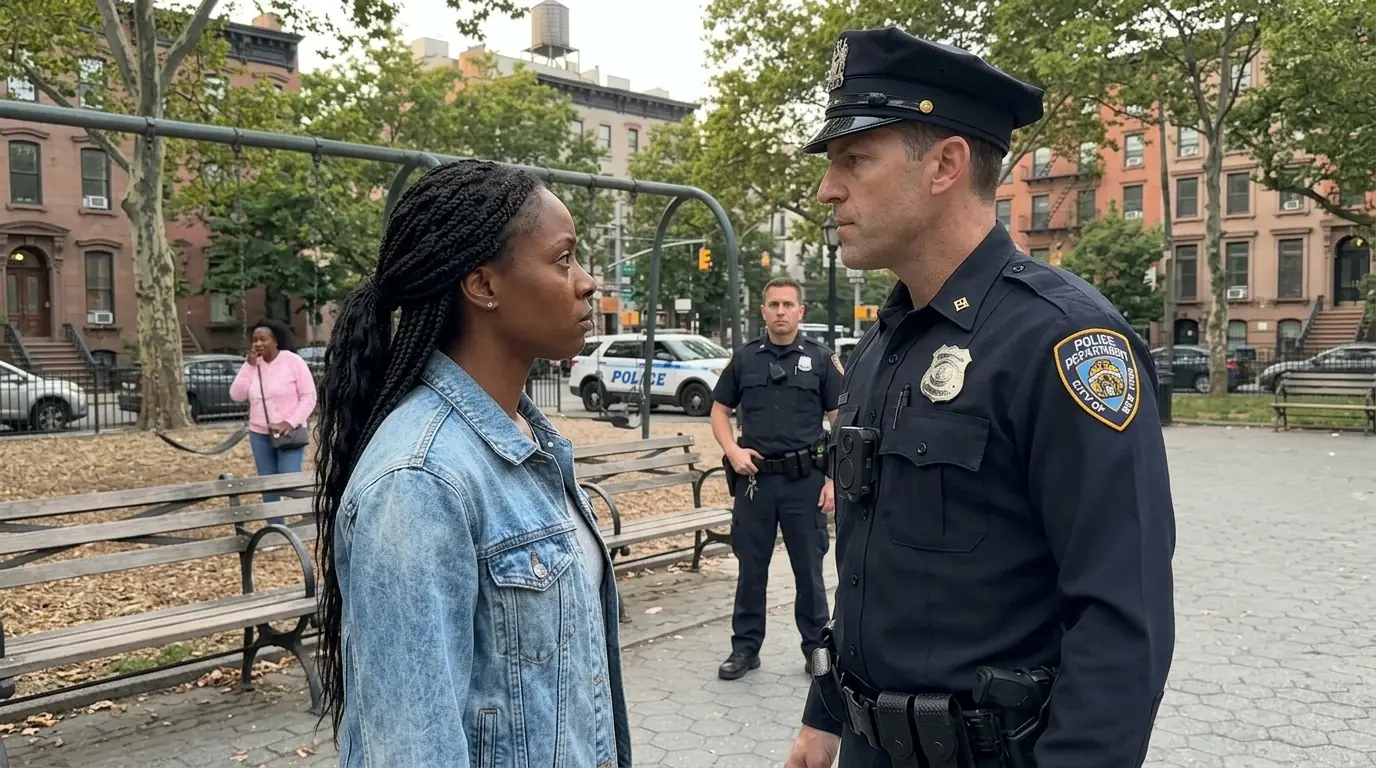
The insult landed across Lincoln Grove Park so sharply that even the children seemed to hear the cruelty before they understood the words. “Take your filthy little welfare kid somewhere else before she ruins this playground for decent families,” Officer Brent Calloway said, loud enough for the parents around the swings to hear every syllable. A soccer ball rolled slowly across the rubber surface and stopped against a stroller wheel while several conversations died at once. On a wooden bench beside the walking path, thirty-five-year-old Renee Carter looked up at the uniformed officer standing over her and said nothing for nearly three full seconds.
Renee wore dark jeans, a gray jacket, and white sneakers that still carried dust from the soccer field where her daughter had played earlier that morning. Her hair was pulled into a simple bun, her phone rested beside her on the bench, and one hand held a half-finished cup of coffee. To anybody watching, she looked like another tired mother spending a Saturday afternoon at a Chicago neighborhood park while her child played. Officer Brent Calloway had no idea that the woman he had chosen to humiliate had spent the previous twenty-two days quietly documenting him.
Renee stood slowly. There was no sudden movement, no raised voice, and no anger visible beyond the tightening of her jaw. “Officer,” she said, “repeat what you just said about my daughter.” Calloway smiled as though the request amused him.
“You heard me,” he replied. “Pack up your little future criminal and get out of here before I decide you’re creating a public-safety problem.” His partner, Officer Lauren Mills, stood several feet behind him and looked toward the playground rather than at Renee. Near the swings, eight-year-old Zoe Carter had stopped moving. “Mom?”
Renee heard her daughter, but she did not turn yet. Instead, her eyes moved once across Calloway’s uniform, taking in the nameplate, district patch, body-camera position, and badge number. Brent Calloway, badge 5831, Chicago Police Department. She stored every detail automatically.
Calloway mistook the silence for fear. “That’s better,” he said, stepping closer. “Maybe you finally understand how this neighborhood works.” Renee’s expression changed slightly, not enough for him to understand why. Then he raised his hand.
The slap cracked across the playground. Renee’s head snapped to the side, and three children screamed before any adult spoke. Phones rose immediately around the benches, while Zoe jumped from the swing and started running toward her mother. Calloway lowered his hand with the casual arrogance of a man who believed his uniform could explain anything afterward.
Renee touched her cheek. Heat spread beneath her skin, and for one moment the only sound she heard clearly was Zoe crying her name. Then she turned back toward Calloway and looked directly into his face. “That was a mistake,” she said.
Three hours earlier, Renee had been tying Zoe’s soccer cleats beside a chain-link fence at a recreation field six blocks away. Zoe complained that the left shoe felt tighter than the right, and Renee reminded her that she had refused to loosen the laces after their last game. It had been a perfectly ordinary disagreement between a mother and an eight-year-old. Renee valued ordinary mornings more than most people knew.
After practice, they stopped at a neighborhood convenience store where the owner, Mrs. Patterson, kept peppermint candies beside the register for children. Mrs. Patterson poured Renee a coffee and asked whether her “government paperwork job” still required weekend hours. Renee smiled and said, “Unfortunately.” That was the version of her work almost everyone in the neighborhood believed.
In reality, Renee Carter was a senior special investigator assigned to a joint FBI and Department of Justice Civil Rights task force. Her background was in federal civil-rights enforcement, public-corruption investigations, and use-of-force review. For nearly a month, she had been working under a deliberately ordinary cover in the area surrounding Lincoln Grove Park. The investigation began after a pattern of complaints against local officers repeatedly disappeared inside administrative review.
Black families said they had been ordered out of public spaces without legal reason. Latino teenagers reported being stopped and searched while playing basketball. Parents described officers threatening child-welfare referrals when they questioned police instructions. One name appeared more often than any other: Officer Brent Calloway.
Calloway had been the subject of more than a dozen citizen complaints in three years. Most were closed as unsubstantiated, several ended with informal counseling, and two disappeared after complainants stopped returning department calls. Each case looked minor when viewed alone. Together, they created a pattern no one inside the district seemed interested in examining.
Officer Lauren Mills appeared in several incidents too. She rarely initiated confrontations and almost never used the same language Calloway did, but witnesses repeatedly described her standing nearby while he escalated situations. That distinction mattered to Renee. Abuse did not survive only because of aggressive people; sometimes it survived because quieter people decided silence was safer.
Lincoln Grove became Renee’s observation point because the complaints concentrated there. She used the same bench when possible, positioned near a tree with clear sight lines to the basketball court, swings, playground entrance, and walking trail. Zoe knew her mother sometimes “worked from the park,” but she did not know the details of the investigation. Renee hated using normal family routines as cover, yet normal family routines were exactly where the alleged misconduct occurred.
The hardest part was recognizing how much Zoe already sensed. A week earlier, her teacher had called because Zoe asked whether police officers could take children away from their parents for asking questions. She had also drawn a picture of a patrol car beside a playground with several children hiding behind a tree. Renee told the teacher that Zoe had been overhearing too many adult conversations.
That answer was only partly true. Zoe noticed the way parents became tense when patrol cars rolled through. She noticed teenage boys leaving the basketball court before officers reached them. Children did not need legal vocabulary to recognize fear.
At 1:52 that afternoon, Renee sent a secure status message to her supervisor. Pattern continuing. Multiple families altering behavior when patrol unit enters park. Recommend surveillance remain active. The reply came back less than a minute later. Approved. Maintain cover. Document escalation only.
Zoe ran toward the swings. “Mom, watch how high I can go.” Renee smiled. “I’m watching.”
She was watching Zoe, but she was also watching a grandmother named Elisa Morales choose a picnic table closer to the park exit than usual. She watched two Black teenage boys end a basketball game the second a marked cruiser appeared near the main road. She watched a father place both hands on his young son’s shoulders and quietly guide him away from a climbing structure. Once someone knew what fear looked like, it became difficult to stop seeing it.
The patrol car entered at 2:41. Calloway drove, while Officer Mills sat in the passenger seat. The cruiser moved slowly along the park access lane, almost like a security vehicle inspecting private property. Several families began packing automatically.
Calloway stepped out first. He was tall, broad through the shoulders, and carried himself with the rigid confidence of someone who expected civilians to rearrange themselves around him. Mills followed more slowly and looked immediately toward the families nearest the playground. Her expression showed discomfort before anything happened.
Renee remained on the bench. Calloway noticed her almost immediately. He stopped several yards away, spoke briefly to Mills, then walked directly toward Renee while ignoring two white families sitting closer to the pathway.
“Afternoon,” he said. The politeness lasted only in the word itself. “We’ve received complaints about people hanging around the park without legitimate reason.”
Renee looked up. “What complaint specifically?” Calloway’s jaw tightened because she had not apologized or explained herself first. Most people, Renee knew, tried to prove innocence before anyone stated an accusation.
“People are uncomfortable,” he said. Renee glanced at the families around her. “With me sitting on a bench?”
“Don’t get smart.” Calloway stepped closer. “There are families here who pay taxes and want to enjoy the park.”
“So do I.”
Calloway gave a small laugh. “Sure.” Behind him, Mills shifted her weight.
Renee kept her expression neutral. “Are you ordering me to leave a public park?” Calloway said he was asking her to cooperate before the situation became more serious. Renee asked what law she was violating.
That question irritated him more than anything else. His voice rose. “You don’t have to violate a law for police to investigate suspicious behavior.”
“What behavior?”
“You sitting here for hours.”
“I’m watching my daughter.”
Calloway looked toward Zoe. “That kid yours?” Renee nodded. He looked back at her clothing, then her shoes, then the backpack beside the bench as if those objects were evidence of something.
“Maybe you should take her somewhere more appropriate,” he said. Renee felt something tighten in her chest, but her voice remained level. “Appropriate for whom?”
Mills finally spoke. “Brent, maybe we can move on.” Calloway did not look at her.
“I’ve got this.”
Then he leaned closer to Renee. “Listen, lady. I don’t know what kind of attitude you think is going to work here, but you need to collect your stuff and leave.”
Renee asked again whether she was being lawfully ordered to leave. Calloway responded by mentioning possible child-welfare concerns. “Kids are supposed to be in safe environments,” he said.
Renee stared at him. “Are you threatening to contact Child Protective Services because I asked you what law I’m violating?” Several nearby parents turned toward them. That was the moment the interaction stopped looking like a routine police conversation.
Calloway noticed the audience but did not step back. “You people always make everything about threats.” Then he pointed loosely toward Zoe. “Look at the environment you’re creating for that child.”
Renee stood. “What environment?”
He looked around the playground. “The kind where decent parents have to wonder who’s sitting near their kids.” Renee waited.
Calloway continued. “Take your ghetto kid somewhere else before she spreads your problems to civilized children.” The park went quiet.
Zoe stopped swinging. A woman pushing a stroller raised her phone. A jogger slowed and removed one earbud.
Renee looked directly at Calloway. “Repeat what you just said about my child.” Her voice was not loud. That made the request feel more serious.
Calloway stepped closer. “You heard me.” Then he added, “Pack up your little criminal before I find a reason to involve somebody who can take her off your hands.”
Zoe called, “Mom?” Renee’s eyes flicked toward her daughter for only a second. When she looked back, Calloway was inches away.
“You are threatening a false child-welfare referral,” Renee said. “You have not identified any legal basis for removing me from the park.” Calloway smiled.
“Big words.”
Mills stepped forward. “Brent, stop.”
He ignored her.
“You know what your problem is?” he asked Renee. “Women like you think memorizing a few rules means you can disrespect police.” Renee answered, “Knowing the law isn’t disrespect.”
That was when Calloway slapped her.
The sound shocked the park more than shouting could have. Zoe screamed and ran. The jogger who had stopped now held his phone directly toward Calloway.
Renee turned back slowly. “Officer Brent Calloway, badge 5831,” she said. “You have just used physical force against an unarmed civilian who posed no threat.” Mills went pale.
Calloway laughed. “Physical force?” Renee kept going. “Multiple witnesses, multiple recording devices, and your body camera are present.”
He touched the body camera unconsciously. “You think anybody’s going to believe you over me?” That sentence later became one of the most important pieces of evidence in the case.
Zoe reached her mother and wrapped both arms around her waist. Renee placed one hand on the back of her daughter’s head. Her other hand remained visible.
Mills grabbed Calloway’s sleeve. “We need to go.” He pulled away.
“Don’t tell me what to do.”
Renee looked toward Mills. “Officer Mills, you witnessed everything that occurred here.” Mills did not answer immediately.
Renee continued. “I am advising you that this incident will be reported through formal channels.” Something in those words finally reached Mills. Her expression changed.
Calloway still did not understand. “Report it to whoever you want,” he said. “People like you file complaints every week.”
The jogger lowered his phone slightly. “Man, you’re still talking?” Calloway spun toward him.
“Stay out of police business.”
The jogger replied, “You made it everybody’s business when you hit her in front of kids.” Several parents murmured agreement. Calloway looked around and realized the crowd had shifted.
Mills stepped between him and Renee. “We’re leaving.” This time she did not ask.
Calloway looked furious. But eventually he walked toward the cruiser.
Renee watched the car leave. Then her legs suddenly felt weaker than they had during the confrontation.
She sat down and pulled Zoe against her. Her daughter was shaking. “Why did he hit you?”
There was no federal-training answer to that question. Renee closed her eyes.
“Sometimes people who are given power use it badly,” she said. Zoe looked up through tears. “Is he a bad police officer?”
“Yes,” Renee said.
She did not say all police officers were bad. She did not lie and say Calloway had simply made a mistake. Children deserved explanations they could survive without explanations that required adults to pretend reality had not happened.
“Are you going to tell somebody?” Zoe asked. Renee looked toward the road where the cruiser had disappeared. “A lot of people.”
What Zoe did not know was that three secure messages had already left Renee’s phone. The first notified her FBI supervisor that her cover had been compromised by direct assault. The second went to the Department of Justice Civil Rights Section. The third instructed the surveillance team to preserve every available recording from the park.
Within forty minutes, Renee’s supervisor had contacted federal prosecutors. Within an hour, investigators were requesting preservation of Calloway’s body-camera footage, dispatch logs, police vehicle telemetry, park security video, and the original incident report. Renee had not yet gone home. The machinery around Calloway had already begun moving.
The public version moved even faster. Mrs. Patterson, who had arrived at the park during the confrontation, posted a shaky but clear video online. The jogger uploaded a second angle twenty minutes later.
A third recording came from a parent standing near the slides. That one captured Calloway’s insult about Zoe almost perfectly. By early evening, local news outlets were asking the police department for comment.
The department issued the kind of statement institutions use before they understand how serious a situation is. We are aware of a video circulating online involving one of our officers at Lincoln Grove Park. The department takes all allegations of misconduct seriously and has initiated an internal review. The statement never mentioned the slap.
Inside District 12, Calloway was writing his report. Officer Mills sat beside him at a shared workstation. Calloway dictated confidently.
“Subject became confrontational when advised to leave the area.” Mills stared at the screen. “Brent…”
He looked at her.
“What?”
“That’s not what happened.”
His expression hardened. “You want to argue about wording?”
“She asked why she was being told to leave.”
Calloway leaned back. “Exactly. Noncompliance.”
Mills said nothing.
He continued. “Subject displayed aggressive posture and made movements toward officers.” Mills stopped typing.
“She never moved toward us.”
Calloway turned his chair toward her. “Lauren, do you want your name attached to a use-of-force complaint where some woman is claiming police brutality?”
“There are videos.”
“There are always videos.”
Mills looked toward him.
Calloway continued. “You write the report based on what we observed, not what some idiot with a phone thinks he saw.”
Then he dictated the sentence that eventually trapped them both. No officer struck or intentionally used physical force against the subject.
Mills stared at the screen. “Brent.”
“Type it.”
She did.
That decision would follow her longer than anything she had done at the park.
Back at home, Zoe finally fell asleep shortly after nine. Renee sat on the edge of her daughter’s bed until the girl’s breathing became slow and even. Then she went into the bathroom and looked at herself in the mirror.
A red mark remained across her cheek. The bruise was beginning to deepen along the edge of her jaw. Renee photographed it with a time stamp.
Her phone buzzed.
Unknown number.
Next time respect the badge before somebody teaches your kid the lesson too.
Renee stared at the message. Then she took a screenshot, forwarded it to the federal case team, and preserved the metadata.
She did not know whether Calloway sent it. Investigators would determine that. Renee had learned years earlier that suspicion and proof were different things.
That night, she barely slept. Not because she feared for herself. Because every time she closed her eyes she saw Zoe running from the swing.
At 7:31 the next morning, Chicago Police Commander Helen Brooks was reading the first online news reports when her office phone rang. The caller identification showed a federal number. She answered immediately.
“This is Commander Brooks.”
“Commander, this is Assistant Special Agent in Charge Melissa Grant from the FBI Chicago Field Office.” Helen straightened.
“What can I do for you?”
“Pull Officer Brent Calloway’s complete personnel and complaint history.”
Helen paused. “This is regarding Lincoln Grove?”
“Yes.”
“We’ve already opened an internal review.”
Melissa’s response was calm. “You also need the original report before any amendments occur.”
Helen frowned. “Why would there be amendments?”
“We’ll discuss that.”
Something in the federal agent’s voice made Helen put down her coffee.
Melissa continued. “The woman Officer Calloway struck yesterday is Senior Special Investigator Renee Carter, assigned to a joint FBI-DOJ Civil Rights task force.” Helen did not respond.
“She has been working undercover in District 12 for twenty-two days,” Melissa added. “The subject of that operation includes discriminatory enforcement patterns involving Officer Calloway.”
Helen sat down.
“I need you to repeat that.”
Melissa did.
The video replayed in Helen’s mind differently now. Renee’s calmness, the legal terminology, the way she memorized the badge number, and the phrase formal channels suddenly made sense. Helen felt physically ill.
“How extensive is the investigation?”
“Extensive enough that yesterday is not the beginning.”
Within an hour, federal investigators were reviewing years of complaints. Names reappeared.
David Johnson, whose fourteen-year-old son had been searched at the basketball court without any contraband found. Marisol Vega, who claimed Calloway threatened immigration consequences despite having no immigration authority. Gloria Thomas, ordered to leave a picnic area because relatives were “making people nervous.”