Your mama ain’t the FBI, little girl. She probably mops their floors.
Officer Derek Sullivan’s voice boomed across the crowded Chicago street. Eighteen-year-old Maya Johnson stood frozen as the white police officer towered over her, his finger jabbing toward her face.
Sullivan snatched Maya’s phone from her hands. His thumb hovered over the delete button as dozens of tourists stopped to watch. Maya’s school journalism project was gone in an instant.
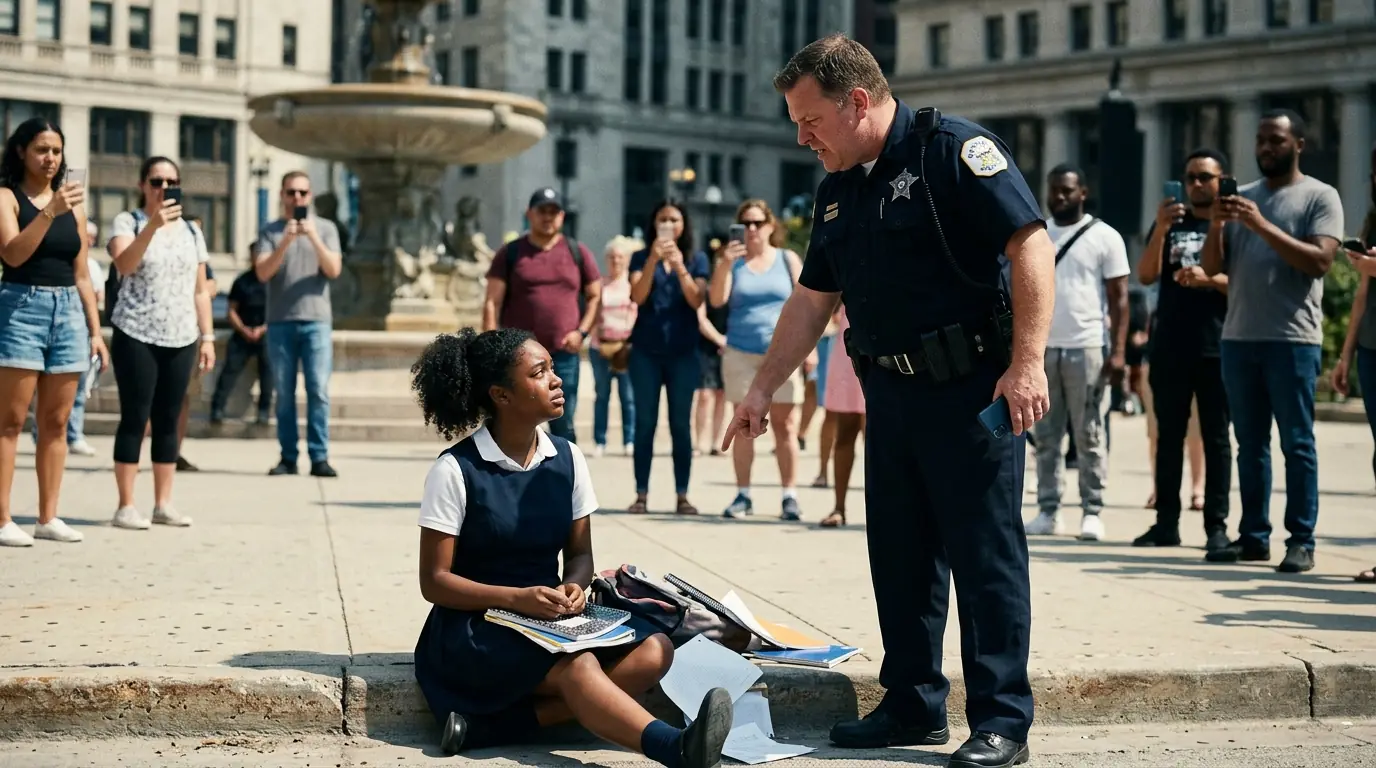
“Sit your ass down on that curb,” Sullivan commanded, pointing at the concrete. “Right now.”
Maya’s legs shook as she lowered herself onto the dirty sidewalk. Passersby pulled out their own phones. Some shook their heads in disgust. Others kept walking.
“My mother works for the government,” Maya whispered, her voice barely audible.
Sullivan laughed.
“Government? Yeah, cleaning government toilets, maybe.”
What Maya didn’t know was that, across the street, a woman in a dark suit had just stepped out of a black SUV. Her badge caught the afternoon sunlight.
Maya Johnson had always been proud of her mother’s work. At eighteen, she was already following in those footsteps as editor of her high school newspaper in Chicago’s Southside. Her journalism teacher, Ms. Martinez, had assigned the class a community relations project.
“Interview real officers,” Ms. Martinez had instructed. “Show both perspectives. Make it authentic.”
Maya spent three weeks preparing. She researched police procedures, studied interview techniques, and even practiced her questions in the mirror. Her mother, Victoria, had been traveling more frequently for work lately, but she always made time to review Maya’s assignments.
“Remember, baby girl,” Victoria had said over breakfast that morning, her government ID badge clipped to her dark blazer, “respect is earned through actions, not demanded through authority.”
Maya nodded, not fully understanding the weight of those words yet.
The Millennium Park area seemed perfect for her project. Officers regularly patrolled the tourist-heavy zone, and Maya figured they would be more approachable there. She had her school’s official permission letter, her student press credentials, and a list of thoughtful questions designed to highlight positive police work.
Officer Derek Sullivan had been patrolling these streets for fifteen years. His partner, Officer Maria Rodriguez, often worried about his approach to the job. She had seen him escalate situations that could have been resolved with conversation. She had also noticed how differently he treated people based on their appearance.
“Derek, maybe we should grab coffee first,” Rodriguez suggested as their patrol car cruised past the park. “It’s been a long morning.”
Sullivan’s jaw tightened as he spotted Maya setting up her phone near the fountain. A black teenager with a camera meant trouble in his mind. He had seen too many viral videos lately showing police in a negative light. These kids thought they could film anything, post it online, and ruin careers.
“Look at this,” he muttered, pulling the patrol car to the curb. “Another one of these wannabe journalists.”
Rodriguez followed his gaze. She saw a well-dressed young woman with school materials spread neatly beside her. Maya wore her student ID on a lanyard and had arranged her notebook, permission letters, and questions in organized piles.
“She looks like a student doing homework,” Rodriguez observed.
But Sullivan was already out of the car. He had dealt with students before. They always claimed to be innocent until their footage went viral and officers lost their jobs. Not on his watch.
Maya looked up from her notes as the patrol car approached. Perfect timing.
She stood up, smoothed her dress, and checked that her permission letter was clearly visible. Her mother had taught her to always be prepared, always be respectful, and always stand up for what was right.
“Good afternoon, officers,” Maya called out with a genuine smile. “I’m Maya Johnson from Lincoln High. I’m working on a school project about community policing. Would you have a few minutes to answer some questions?”
Sullivan sized her up immediately. Confidence, articulate, probably thought she was smarter than the officers. These types were the worst. They acted respectful, but were really looking for ammunition to use against police.
“Let me see some ID,” Sullivan demanded, his tone already shifting toward aggressiveness.
Maya’s smile wavered slightly, but she maintained her composure.
“Of course, officer. I have my student ID right here, and this is my official permission letter from Principal Williams.”
She held out the documents with steady hands. Sullivan barely glanced at them.
“What’s your real purpose here?” he asked, stepping closer. “Who sent you?”
The question caught Maya off guard.
“I’m sorry. My journalism teacher assigned this project. It’s about building bridges between police and community members.”
Rodriguez watched the interaction with growing unease. The girl seemed genuinely innocent, and her materials looked legitimate. She started to intervene, but Sullivan shot her a warning look.
“These school projects always end up on social media,” Sullivan continued, his voice rising slightly. “You people think you can film us, edit it however you want, and make us look bad.”
Maya felt a chill run down her spine.
“You people,” she repeated quietly.
“Young people. You’re all the same. Think you know everything? Think you can change the world with a camera phone?”
But Maya heard what he really meant. She had experienced enough subtle racism in her life to recognize it. Her mother had prepared her for moments like this, though Maya never imagined it would happen during a school assignment.
“Officer, I understand your concern,” Maya said, her voice remaining steady despite her racing heart. “But I’m just trying to complete my homework. My mother always taught me to treat everyone with respect, including police officers.”
“Oh, really?” Sullivan’s eyebrows rose mockingly. “And what does mommy do for a living? Let me guess. She works at the school cafeteria.”
Maya’s cheeks burned, but she kept her voice level.
“Actually, she works for the federal government. She’s an FBI agent.”
The words hung in the air for a moment. Rodriguez looked surprised. Sullivan’s expression shifted from skepticism to outright derision.
“FBI agent.” Sullivan threw back his head and laughed. “Right. And I’m the director of the CIA.”
Maya felt her phone buzz in her pocket. A text from her mother.
Case wrapping up early. Home by 4 p.m. How’s the interview going?
If only Mom could see this, Maya thought. But her mother was probably in some important meeting dealing with real criminals. Maya was on her own.
“I understand if you don’t believe me,” Maya said quietly. “But it’s true. My mom investigates counterintelligence cases. She travels a lot for work.”
Sullivan stepped even closer, invading Maya’s personal space.
“Listen here, little girl. I’ve been doing this job longer than you’ve been alive. I know when someone’s lying to me. Your mama ain’t the FBI. She’s probably some secretary or cleaning lady somewhere, and you’re embarrassed to admit it.”
The words hit Maya like physical blows. Rodriguez finally stepped forward.
“Derek, maybe we should…”
“Stay out of this, Rodriguez,” Sullivan snapped. “I’m handling it.”
Maya’s hands trembled as she gathered her materials. The respectful, hopeful student was being replaced by something harder. Her mother’s voice echoed in her mind.
Sometimes people will try to diminish you because of how you look. Never let them succeed.
“Officer Sullivan,” Maya said, her voice gaining strength, “I’ve been nothing but respectful to you. I showed you my permission letter and my student ID. I explained my assignment clearly. I don’t understand why you’re treating me this way.”
Sullivan’s face reddened. This kid had nerves, talking back to him in front of his partner and all these witnesses. Time to show her who was really in charge.
“You know what? I think you’re creating a public disturbance,” Sullivan announced loudly, making sure nearby tourists could hear him. “Hand over that phone right now.”
Maya’s heart pounded.
“Officer, I haven’t done anything wrong. I’m just…”
“Don’t argue with me.” Sullivan’s voice boomed across the park area. “Give me the phone, or I’ll arrest you for obstruction of justice.”
Several tourists stopped walking and began pulling out their own phones. A middle-aged white couple exchanged concerned glances. An elderly black man shook his head in disgust, but kept walking, unwilling to get involved.
Maya’s hands shook as she reluctantly handed over her device.
“This is my school project. Please don’t delete it.”
Sullivan scrolled through her footage with deliberate slowness, his thumb hovering over the delete button like a threat.
“Looks like a bunch of troublemaking propaganda to me.”
“Derek,” Rodriguez whispered urgently. “She’s just a kid with homework. Her stuff looks legitimate.”
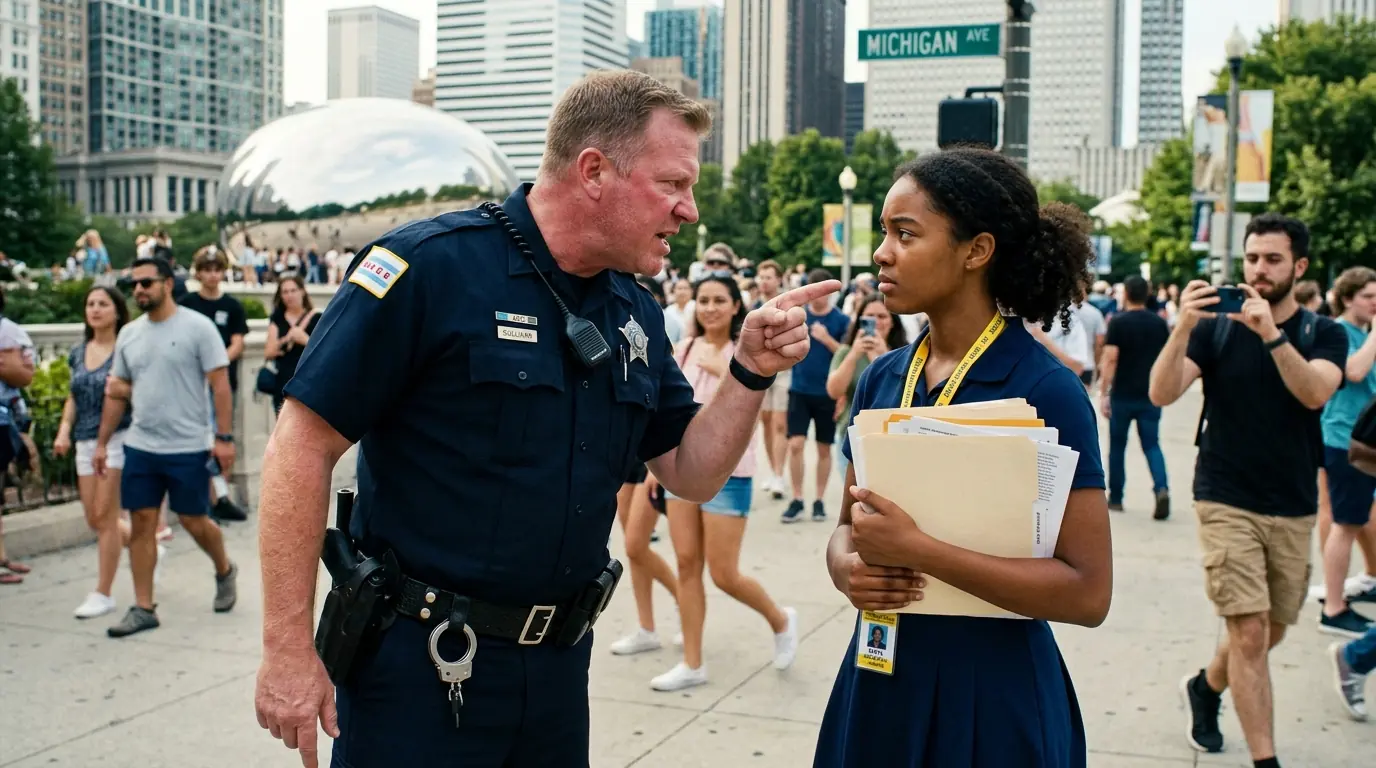
Sullivan ignored his partner completely. He was enjoying the power dynamic too much. Here was this uppity black girl who thought she could waltz into his neighborhood with cameras and attitude. Time to teach her a lesson about respect.
“Sit down on that curb,” he commanded, pointing to the dirty concrete edge. “Right now. Don’t make me tell you twice.”
Maya looked around desperately. Dozens of people were watching now, some filming, others just staring. The humiliation burned in her chest, but her mother’s voice echoed in her mind.
Maintain your dignity no matter what.
She lowered herself onto the curb with as much grace as she could manage. Her school dress caught on the rough concrete, but she adjusted it carefully, refusing to let Sullivan rob her of every shred of dignity.
“That’s better,” Sullivan said with satisfaction. “Now maybe you can learn some respect for authority.”
A young black man approached cautiously.
“Excuse me, officer, but what did she do wrong?”
“Mind your business and keep walking,” Sullivan snapped without even looking at him.
Maya felt tears forming, but blinked them back. She would not cry. Not here. Not in front of all these people, and definitely not in front of Sullivan.
“Officer Sullivan,” she said quietly, “may I please call my mother? She should know where I am.”
Sullivan’s laugh was cruel and loud.
“Oh, here we go. I want to call the FBI agent mommy.”
He turned to the growing crowd of onlookers.
“This eighteen-year-old thinks her mama works for the FBI. Can you believe that?”
A few people in the crowd shifted uncomfortably. A teenage girl whispered to her friend.
“This isn’t right.”
“Let me guess,” Sullivan continued, his voice dripping with mock sympathy. “Mommy’s going to come rescue you? The big tough FBI agent is going to show up in her government car?”
Maya’s phone buzzed with an incoming text. Sullivan glanced at the screen and his grin widened.
“Well, well. Text from Mom.”
He read aloud mockingly.
“Case wrapping up early. Home by 4 p.m. How’s the interview going?”
The crowd grew quieter, sensing the cruelty in Sullivan’s tone.
“Case wrapping up,” Sullivan repeated dramatically. “I bet her case is finishing up the toilets at some office building downtown.”
Rodriguez stepped closer to her partner.
“Derek, that’s enough. Let’s just…”
“I said stay out of this.” Sullivan whirled around, his face flushed red. “I’m dealing with a potential threat here.”
“A threat?” Rodriguez looked at Maya sitting quietly on the curb, her school materials scattered around her. “She’s eighteen years old, doing homework.”
But Sullivan was beyond reason now. The crowd’s attention fed his sense of authority. He was the law here, and everyone needed to remember that.
“You want to know the truth about your FBI mama?” Sullivan leaned down toward Maya, his voice loud enough for everyone to hear. “She’s probably cleaning their offices right now, emptying trash cans, mopping floors. That’s what people like your family do for the government.”
The words hit like physical blows. Maya felt something break inside her chest, but she forced herself to look Sullivan directly in the eyes.
“My mother is a federal agent,” she said clearly, her voice carrying across the silent crowd. “She’s dedicated her life to protecting this country, and she raised me to treat everyone with respect, even people who don’t deserve it.”
Sullivan’s face twisted with rage. This little girl had just insulted him in front of dozens of witnesses. Nobody talked to him that way, especially not some lying teenager from the projects.
“That’s it,” he snarled, reaching for his handcuffs. “You’re under arrest for disorderly conduct and resisting arrest.”
“Resisting arrest?” Maya’s voice cracked with disbelief. “I’m sitting on a curb.”
But Sullivan was already calling for backup on his radio.
“Unit 23 requesting assistance with a belligerent juvenile. The suspect is being uncooperative.”
Maya’s phone, still in Sullivan’s hand, buzzed again. This time, he did not bother reading it aloud.
The text simply said, On my way. Stay calm, baby girl.
Across the street, a black SUV with government plates pulled up to the curb. The engine turned off, and the driver’s door opened slowly.
The backup unit arrived within three minutes, sirens blaring unnecessarily through the peaceful park area. Officer James Mitchell stepped out, looking confused as he surveyed the scene. A teenage girl was sitting quietly on a curb, surrounded by scattered school papers, while dozens of tourists filmed with their phones.
“What’s the situation?” Mitchell asked, clearly puzzled by the apparent lack of any actual disturbance.
“Juvenile suspect was filming police officers without permission, creating a public disturbance, and resisting lawful orders,” Sullivan rattled off, his chest puffed with authority. “She’s been belligerent and uncooperative.”
Maya looked up from the curb, her voice steady despite her racing heart.
“Officer Mitchell, I showed Officer Sullivan my school permission letter and student ID. I was doing homework for my journalism class. I’ve been sitting here quietly since he told me to.”
Mitchell glanced at the scattered papers around Maya. He could clearly see official school letterhead and what appeared to be interview questions. His brow furrowed with confusion.
“Sullivan, her stuff looks like legitimate school materials. What exactly did she do wrong?”
Sullivan’s jaw tightened. His own partner was questioning him, and now backup was doing the same in front of all these witnesses. His authority was being undermined, and he was not going to stand for it.
“She was filming us secretly, trying to create one of those viral videos to make the police look bad,” Sullivan insisted. “And when I asked about her purpose here, she started lying about her family. Claims her mother works for the FBI.”
Several people in the crowd exchanged glances. A woman whispered to her husband.
“Even if she was lying, is that illegal?”
Maya felt heat rising in her cheeks, but she kept her voice respectful.
“I wasn’t filming secretly. I introduced myself, showed my credentials, and asked permission to interview officers. That’s when Officer Sullivan became aggressive.”
“Aggressive?” Sullivan’s voice pitched higher. “I was doing my job, and now you’re sitting there lying about it.”
Rodriguez stepped forward, her conscience finally overriding her loyalty to her partner.
“Derek, she’s telling the truth. She was polite and had all her paperwork ready. She asked nicely if we had time for questions.”
Sullivan spun around, his face flushing red.
“Whose side are you on, Rodriguez?”
“I’m on the side of doing this job right,” Rodriguez replied quietly, but her words carried clearly to the watching crowd.
Maya’s phone, still clutched in Sullivan’s hand, buzzed again. This time, the screen lit up with an incoming call.
The caller ID read simply, Mom, FBI.
Sullivan glanced at the screen, and his sneer returned.
“Look at this. Mom, FBI. This eighteen-year-old even programmed fake contact names to support her lies.”
He held up the phone for Mitchell to see.
“Probably has Dad, CIA, and Uncle Secret Service in there, too.”
A few people in the crowd chuckled nervously, but most remained silent. The cruelty in Sullivan’s voice was becoming impossible to ignore.
Maya’s heart sank as the call went to voicemail. Her mother was trying to reach her, probably worried about the earlier text, but Maya could not answer, could not explain what was happening.
“Officer Sullivan,” Maya said quietly, “may I please just call my mother? She’s expecting me home soon, and she’ll worry if I don’t check in.”
“Your mother,” Sullivan repeated mockingly. “The FBI agent’s mother, right?”
He looked around at the crowd dramatically.
“Should I tell her you got arrested for lying to police officers?”
“Arrested?” Mitchell interjected. “For what exactly? You haven’t told me what law she broke.”
Sullivan’s eyes flashed with anger. He was tired of being questioned by everyone, his partner, backup, even the suspect herself. Time to assert control.
“Disorderly conduct, creating a public disturbance, interfering with police business, resisting arrest,” he listed off rapidly.
“But she’s been sitting quietly,” Mitchell observed. “How is that resisting arrest?”
Maya watched the exchange with growing hope. Officer Mitchell seemed reasonable, professional. Maybe he would intervene and deescalate the situation.
But Sullivan had gone too far to back down now. His reputation was on the line in front of all these witnesses. He could not look weak.
“Mitchell, are you going to help me process this suspect, or do I need to call for a supervisor?”
The threat hung in the air. Mitchell knew challenging a senior officer publicly could hurt his own career. After a moment of hesitation, he stepped back.
“Your call, Sullivan. You’re the senior officer.”
Maya felt her last hope crumble. She looked around at the dozens of faces watching her humiliation. Some showed sympathy, others curiosity, but none of them could help her.
Across the street, the black SUV’s occupant stepped out. The figure was too far away to make out clearly, but several people noticed the professional attire and confident stride.
“All right, let’s go,” Sullivan announced, reaching for his handcuffs. “You’re coming with us to the station until we can verify your identity and contact your real parents.”
“My real parents?” Maya’s voice cracked. “Officer Sullivan, I’ve shown you my student ID with my home address. You have my phone with my emergency contacts. What more do you need?”
“I need you to stop lying,” Sullivan snapped. “No FBI agent’s daughter would be out here making trouble in the streets.”
The racist assumption hung heavy in the air. Several black witnesses exchanged knowing looks. They had seen this movie before.
Maya felt something shift inside her. Her mother’s lessons about maintaining dignity were important, but so were her lessons about standing up for the truth.
“Officer Sullivan, you don’t believe me because I’m black,” she said clearly, her voice carrying across the now silent crowd. “You’ve decided what my family must be like based on how I look.”
“That’s enough,” Sullivan roared, his mask finally slipping completely. “I don’t want to hear another word about racism or discrimination or any of that garbage.”
The crowd stirred uncomfortably. His words were too raw, too revealing. Even Mitchell looked shocked.
“Derek,” Rodriguez whispered urgently. “People are recording this.”
But Sullivan was beyond caring. He had been pushed too far by this uppity teenager who thought she could embarrass him in public.
“You people always play the race card when you get caught doing something wrong,” he continued, his voice carrying clearly to every phone camera pointed at him. “Can’t take responsibility for your own actions.”
Maya felt tears threatening again, but this time they were tears of anger, not fear. She stood up slowly from the curb, her school materials scattered around her feet.
“Officer Sullivan, my mother taught me to respect police officers because they have a difficult job protecting our community. But she also taught me that respect goes both ways. You’ve been disrespectful to me from the moment you walked over here.”
“Sit back down,” Sullivan commanded, his hand moving toward his weapon again.
The crowd gasped. Several people stepped back. Others raised their phones higher, making sure they captured every second.
“I’m not threatening you,” Maya said calmly, remaining standing but keeping her hands visible. “I’m just trying to understand why asking polite questions for a school project has turned into this.”
Sullivan’s radio crackled suddenly with a priority dispatch.
“All units in the downtown area, be advised we have federal agents operating in your sector. Exercise caution and await further instructions.”
Sullivan barely registered the message, too focused on the defiant teenager in front of him, but Rodriguez heard it clearly, as did Mitchell.
Maya’s phone buzzed again in Sullivan’s grip. Another text message appeared on the lock screen.
Maya, where exactly are you? Saw the news about an incident near Millennium Park. Respond immediately.
This time, Sullivan did not read it aloud. Something about the professional tone made him pause. The message did not sound like it came from a cleaning lady or secretary.
Across the street, the figure from the black SUV was walking purposefully toward the crowd, but the gathering of people blocked Sullivan’s view.
“Last chance,” Sullivan announced to Maya. “Apologize for lying. Admit your mother doesn’t work for the FBI, and maybe we can settle this with just a citation.”
Maya looked him directly in the eyes.
“Officer Sullivan, I will not apologize for telling the truth about my family.”
Sullivan’s face twisted with rage.
“That’s it. You’re under arrest.”
He grabbed Maya’s arm roughly, causing her to stumble. The crowd erupted in angry murmurs. Several people shouted objections.
“Hey, that’s too rough,” someone called out.
“She’s just a kid,” another voice added.
As Sullivan wrestled with his handcuffs, Maya’s phone rang again. This time, it was a call, not a text. The screen lit up with that same contact.
Mom, FBI.
And for the first time since this ordeal began, Sullivan heard footsteps approaching from behind him. Confident, measured footsteps that made him look up from his struggling with the handcuffs.
“Excuse me, officer.”
The voice was calm, professional, and carried unmistakable authority.
“I believe you have my daughter.”
Sullivan turned around slowly, his grip still tight on Maya’s arm. Standing five feet away was a black woman in her mid-forties, wearing a crisp dark suit and government-issued sunglasses. Her posture radiated quiet authority, and a gold badge hung from a chain around her neck.
“I’m sorry. Who are you?” Sullivan asked, his voice uncertain for the first time all afternoon.
The woman stepped closer, her movements deliberate and controlled.
“Special Agent Victoria Johnson, FBI Counterintelligence Division.”
She held up her credentials in a leather case, the federal badge gleaming in the sunlight.
“And you are currently restraining my eighteen-year-old daughter without probable cause.”
The crowd fell completely silent. You could hear car engines from the distant street, the splash of the fountain, even someone’s sharp intake of breath. Phones that had been filming now zoomed in closer.
Sullivan’s face went through a series of expressions: confusion, disbelief, then dawning horror as the reality hit him.
Maya felt a surge of relief so powerful she nearly collapsed.
“Mom.”
“I’m here, baby girl,” Agent Johnson said calmly, her eyes never leaving Sullivan’s face. “Are you hurt?”
“No, ma’am. Officer Sullivan made me sit on the curb and took my phone, but I’m not hurt.”
Agent Johnson’s gaze shifted to Maya’s torn dress and the scattered school papers on the ground. Her jaw tightened almost imperceptibly, but her voice remained professionally calm.
“Officer Sullivan, is it? Please release my daughter immediately.”
Sullivan’s mind raced frantically. This could not be happening. The kid had to be lying. This woman, this FBI agent, had to be fake or confused or part of some elaborate setup designed to destroy his career.
“I need to verify your credentials,” Sullivan stammered, still not releasing Maya’s arm. “Anyone can buy a fake badge online these days.”
Agent Johnson’s eyebrows rose slightly.
“Officer Sullivan, are you suggesting that I am impersonating a federal agent in front of dozens of witnesses while my daughter is being unlawfully detained?”
The gravity of what Sullivan was implying hit him like a truck. Accusing an actual FBI agent of impersonation was a federal crime in itself, but he was in too deep now, his pride and panic making him double down on his disastrous course.
Rodriguez stepped forward quickly, recognizing the dangerous territory her partner was entering.
“Ma’am, I’m Officer Rodriguez. Could you please show us your identification one more time?”
Agent Johnson handed over her credentials without hesitation.
Rodriguez examined them carefully. The holographic seals, the official typography, the weight and feel of authentic federal identification. She had seen enough fake IDs in her career to spot them instantly. These were unmistakably real.
“These are legitimate federal credentials,” Rodriguez said loudly, making sure Sullivan and the entire crowd could hear her. “Derek, we need to release the girl right now.”
But Sullivan was still in denial, his worldview crashing down around him. He had spent the last hour publicly humiliating the daughter of a federal law enforcement officer. His career, his pension, his reputation, maybe even his freedom. Everything was suddenly at risk.
“This doesn’t make sense,” he muttered, more to himself than anyone else. “FBI agents don’t live in neighborhoods like… I mean, she was just sitting here doing some school project like any other…”
He stopped himself mid-sentence, but the damage was already done.
“Neighborhoods like what, Officer Sullivan?” Agent Johnson’s voice carried a sharp edge. “Now, please finish that sentence. What exactly were you going to say about where FBI agents and their families live?”
The crowd pressed closer, sensing the power dynamic completely reversing. Phones captured every word, every expression, every moment of Sullivan’s public reckoning.
Sullivan realized his mistake immediately. But it was too late. His racist assumptions had been voiced in front of dozens of witnesses and multiple recording devices. The hole he had dug for himself was getting deeper by the second.
“I didn’t mean…” he started weakly.
“You didn’t mean to reveal your racist preconceptions,” Agent Johnson completed his sentence with surgical precision, “or you didn’t mean to detain a minor without cause based solely on the color of her skin and your assumption about what her family must be like?”
A woman in the crowd called out, “We heard what you said earlier about cleaning toilets.”
“And about you people,” added another voice.
Sullivan’s face flushed red as he realized the entire crowd had witnessed his racist remarks. There was no taking back what he had said, no explaining it away.
Officer Mitchell, who had remained mostly silent during the escalation, finally found his voice.
“Ma’am, I sincerely apologize for this situation. We’ll release your daughter immediately and launch a full investigation into what happened here.”
“Oh, there will definitely be an investigation,” Agent Johnson replied, her tone leaving no room for doubt. “Multiple investigations, in fact. Federal civil rights violations, abuse of authority under color of law, and unlawful detention of a minor. Sullivan, release my daughter’s arm. Now.”
The legal terminology hit Sullivan like a series of body blows. Each charge Agent Johnson mentioned carried serious consequences. Potential prison time, not just job loss.
Sullivan’s hand opened automatically, as if he had forgotten he was still gripping Maya. She immediately moved to her mother’s side, and Agent Johnson put a protective arm around her shoulders.
“Maya, collect your school materials,” Agent Johnson instructed gently. “We’re going home.”
As Maya knelt to gather her scattered papers, Agent Johnson addressed the officers directly.
“Officers Mitchell and Rodriguez, I’ll need your names, badge numbers, and incident report numbers for my complaints to Internal Affairs, the Department of Justice Civil Rights Division, and the FBI’s Public Corruption Unit.”
“Your complaints?” Sullivan’s voice cracked with panic. “Ma’am, this was just a misunderstanding. Your daughter was filming, and I thought she might be trying to create problems for police.”
“Problems for police?” Agent Johnson interrupted, her voice rising for the first time. “Officer Sullivan, my daughter was conducting a school assignment designed to build positive relationships between police and the community. She had official permission from her school principal. She introduced herself politely and asked respectful questions. The only person who created problems here was you.”
She paused, letting her words sink in before continuing.
“But let me address what you really thought. You thought that a well-dressed black teenager with proper credentials couldn’t possibly be legitimate. You thought her claims about her family were lies because you couldn’t imagine a black woman in federal law enforcement. You thought you could intimidate and humiliate her because she looked like someone you assumed had no power or connections.”
Each accusation hit Sullivan like a physical blow. The crowd murmured approval as Agent Johnson laid out exactly what everyone had witnessed.
Rodriguez cleared her throat, her voice shaky but determined.
“Ma’am, I can provide you with our information and ensure that a full report is filed. I witnessed the entire incident.”
“And what did you witness, Officer Rodriguez?” Agent Johnson asked pointedly.
Rodriguez glanced nervously at Sullivan, knowing her next words would end their partnership forever. But she had already decided which side of history she wanted to be on.
“I witnessed Officer Sullivan approach your daughter aggressively without any provocation. I saw him dismiss her school credentials without proper examination, confiscate her phone against her wishes, and order her to sit on the curb like a criminal. I heard him mock her claims about her family background with language that was clearly racially motivated. When she remained respectful throughout the entire encounter, he threatened arrest for disorderly conduct despite no evidence of any actual disturbance.”
Rodriguez took a deep breath before delivering the final blow.
“And I witnessed him escalate the situation when he should have deescalated it, all while your daughter maintained more professionalism than he did.”
Sullivan’s face went white. His own partner had just given testimony that would not only end his career, but potentially send him to prison.
“Rodriguez, you don’t understand what you’re doing.”
“I understand perfectly, Derek,” Rodriguez cut him off, her voice stronger now. “I understand that I’ve watched you treat people differently based on their race for too long. I understand that I should have spoken up sooner instead of being a silent accomplice. And I understand that this young woman and her mother have shown more integrity in the last ten minutes than you’ve shown in fifteen years.”
Agent Johnson nodded approvingly at Rodriguez.
“Officer Rodriguez, your honesty and courage will be noted favorably in all my reports. The FBI values law enforcement officers who uphold their oath to serve and protect all citizens equally.”
Maya stood up, her school materials neatly collected despite the chaos. She looked at Sullivan with something that might have been pity rather than anger.
“Officer Sullivan, my mother really is an FBI agent. She spent twenty years investigating threats against our country and working with police departments across the nation to keep communities safe. She taught me to respect law enforcement because she believes in what police work should represent: justice, protection, and service.”
Maya paused, her young voice carrying more wisdom than Sullivan had shown all day.
“But what you did today wasn’t police work. It was just bullying someone you thought couldn’t fight back. My mom always says the true test of character is how you treat people when you think no one important is watching.”
Sullivan opened his mouth to respond, but no words came out. What could he possibly say? The eighteen-year-old he had spent an hour publicly humiliating had just demonstrated more maturity, wisdom, and grace than he had shown in his entire career.
Agent Johnson checked her watch, a gesture that somehow carried threatening undertones.
“Officer Mitchell, I’ll expect that incident report on my desk within twenty-four hours. My business card.”
She handed him a card with the official FBI seal and her direct contact information.
“Any questions about jurisdiction, procedure, or federal oversight can be directed to my supervisor, Assistant Director Marcus Williams.”
The name carried serious weight in law enforcement circles. Mitchell had heard of Assistant Director Williams, a legend who had cleaned up corrupt departments across the country. This situation was escalating far beyond a simple complaint.
“Ma’am, I want you to know that Officer Sullivan’s behavior today absolutely does not represent our department’s values or training,” Mitchell said earnestly. “We’ll investigate this thoroughly and take appropriate action.”
“I’m sure you will,” Agent Johnson replied, though her tone suggested she would be monitoring that investigation very closely. “Because if you don’t, federal investigators will be happy to do it for you.”
The threat was clear and unmistakable. This was not going away quietly.
Sullivan finally found his voice, though it came out as barely a whisper.
“Agent Johnson, I apologize sincerely. If I had known who you were, if I had known…”
“Stop right there,” Agent Johnson cut him off sharply. “If you had known what, Officer Sullivan? If you had known my daughter was telling the truth about her family? If you had known she was connected to someone with power and authority?”
She stepped closer to Sullivan, her federal authority radiating from every word, every gesture.
“Officer Sullivan, the fundamental problem isn’t that you didn’t know who my daughter was. The problem is that it shouldn’t matter who her parents are, what connections she has, or what her last name is. Every child in this city deserves to be treated with dignity and respect. Every citizen deserves professional, unbiased law enforcement, regardless of their race, their neighborhood, or your assumptions about their background.”
The crowd, which had been silent during this exchange, began to murmur approval. Someone started clapping slowly, and others joined in. The applause was not loud or celebratory. It was the sound of justice being served, of accountability finally arriving, of power being held responsible for its abuse.
Sullivan looked around at the faces surrounding him. Dozens of witnesses had watched his complete downfall. His racist assumptions, his abuse of power, his public humiliation of a teenager. All of it captured on multiple cameras. All of it about to be shared across every social media platform in existence.
His career was over. His reputation was destroyed. And worst of all, he had done it all to himself.
Agent Johnson took Maya’s hand.
“We’re going home now. Officer Rodriguez, thank you for your courage and integrity. Officer Mitchell, I’ll expect that report, along with video footage from any body cameras or dashboard cameras that recorded this incident.”
As they turned to walk away, Maya looked back at Sullivan one more time.
“Officer Sullivan, I hope you learned something from this. My journalism teacher says every story should teach us something important. Maybe the lesson here is that you shouldn’t judge people based on what you think they should be instead of who they actually are.”
And with that, the FBI agent and her daughter walked toward the waiting government vehicle, leaving Sullivan standing in the wreckage of his career, surrounded by witnesses who had just watched justice served in real time.
The black SUV’s doors closed with the solid thunk of government-grade security. As Agent Johnson started the engine, Maya finally allowed herself to exhale the breath she had been holding for over an hour.
“Mom, how did you know where to find me?” Maya asked, her voice still shaky from the ordeal.
Agent Johnson glanced at her daughter through the rearview mirror, her expression softening for the first time since arriving on the scene.
“Baby girl, I’ve been tracking your phone’s location since you texted me about your interview project. When I saw you’d been in the same spot for over an hour without responding to my messages, I knew something was wrong.”
She pulled into traffic, her government-issued vehicle commanding immediate respect from other drivers.
“Plus, our intelligence division monitors social media for any incidents involving law enforcement. Videos of your situation started appearing on Twitter about twenty minutes ago. I was already in my car heading your way when I saw them.”
Maya’s eyes widened.
“It’s already on social media?”
“Honey, everything’s on social media these days. By tomorrow morning, Officer Sullivan’s behavior will be seen by millions of people. That’s not necessarily a bad thing. Accountability works best when it’s public.”
Meanwhile, back at Millennium Park, the aftermath was still unfolding. Officer Mitchell was trying to manage the crowd of witnesses while Rodriguez worked on damage control with the remaining onlookers.
“Ma’am, could I get your contact information?” Mitchell asked a middle-aged tourist who had filmed the entire encounter. “We’ll need witness statements for our investigation.”
The woman nodded enthusiastically.
“Absolutely. That young woman handled herself with such grace. I have children at home, and I can’t imagine them staying that calm under such pressure.”
Rodriguez approached a group of local residents who had gathered to watch the conclusion of the incident.
“I want you all to know that Officer Sullivan’s actions today don’t represent how this department trains its officers,” she said sincerely.
An elderly black man stepped forward, his expression skeptical.
“Officer, with all due respect, we’ve seen this movie before. Bad cop gets caught on camera, department promises investigation, then everything goes back to normal six months later.”
Rodriguez met his gaze directly.
“Sir, this time is different. That wasn’t just any parent who showed up. That was a federal agent whose daughter was violated under color of law. This won’t disappear quietly.”
The man studied Rodriguez’s face, looking for signs of the usual police department lip service. Instead, he saw genuine remorse and determination.
“You could have spoken up sooner,” he said quietly.
“You’re absolutely right,” Rodriguez admitted. “I should have. I’ve watched my partner treat people unfairly for too long, and I chose to stay silent. That makes me complicit. But after today, that changes.”
Back in the SUV, Agent Johnson was explaining the next steps to Maya.
“We’ll go home first so you can decompress and we can talk about what happened. Then I’ll need you to write down everything you remember while it’s still fresh in your memory. Your statement will be crucial for the federal investigation.”
“Federal investigation?” Maya asked.
“Absolutely. What Officer Sullivan did today violates several federal laws. Deprivation of rights under color of law is a serious crime. When a police officer uses their authority to violate someone’s constitutional rights based on race, it becomes a federal matter.”
Agent Johnson’s phone buzzed with an incoming call. She glanced at the caller ID and smiled slightly.
“It’s Assistant Director Williams. He probably saw the social media posts, too.”
She answered with a hands-free hand.
“Victoria here.”
“Victoria, I’ve been watching the videos from your daughter’s incident. Are you both okay?”
“We’re fine, sir. Maya handled herself remarkably well. Better than the officer, frankly.”
“I’ve already called the Chicago Police Commissioner. They’re launching an immediate internal investigation, and we’re opening a parallel federal civil rights case. That officer’s career is over.”
Maya listened to the conversation with a growing understanding of how serious this situation really was. Her mother was not just any FBI agent. She was connected to people who could ensure real consequences.
“Sir, I’ll have my full report to you by tomorrow morning,” Agent Johnson continued. “The whole incident was captured on multiple cameras, and we have several cooperative witnesses.”
“Good. Victoria, make sure Maya knows how proud we are of how she conducted herself today. She showed more professionalism under pressure than many seasoned agents.”
After ending the call, Agent Johnson looked at Maya through the mirror again.
“You heard Assistant Director Williams. You made us all proud today.”
“I was so scared, Mom. I kept thinking about what you taught me about maintaining dignity, but it was really hard.”
“Fear doesn’t make you weak, baby girl. Courage isn’t the absence of fear. It’s doing the right thing despite being afraid. You stood up for the truth even when someone with authority was trying to intimidate you. That takes real strength.”
They pulled into their driveway in a quiet suburban neighborhood. The house was modest but well maintained, with American flags flanking the front door. Maya had grown up here, never fully understanding the dangerous and important work her mother did to keep the country safe.
“Mom, why didn’t you ever tell me exactly what your job involved? I mean, I knew you worked for the government, but…”
Agent Johnson turned off the engine and turned to face her daughter directly.
“Maya, I’ve spent twenty years investigating threats to national security. I’ve seen what happens when people know too much about what I do or where I work. I kept those details private to protect you and give you a normal childhood.”
She paused, choosing her words carefully.
“But after today, some things will change. People will know who you are now. The videos will spread, and your name will be connected to mine. We’ll need to discuss safety protocols and how to handle the attention.”
“Will this really make a difference, Mom? Or will Officer Sullivan just get a slap on the wrist and go back to treating people badly?”
Agent Johnson’s expression grew serious.
“Baby girl, when a federal agent’s child is unlawfully detained based on racial bias and it’s all captured on video, that officer’s career doesn’t survive. Sullivan will face federal charges, lose his job, lose his pension, and potentially serve prison time.”
“What about Officer Rodriguez?”
“Rodriguez chose courage over loyalty today. She stood up for what was right when it mattered most. That will be noted in my report. Good officers who speak truth to power deserve protection and recognition.”
They sat in the car for a moment longer, both processing the afternoon’s events.
“Mom, I want to finish my journalism project, but I want to write about what happened today. About how one officer’s prejudice got exposed, but also about how another officer found the courage to do the right thing.”
Agent Johnson smiled, pride evident in her voice.
“That sounds like exactly the kind of story the world needs to hear. Truth, accountability, and hope for change.”
As they walked toward their front door, Maya’s phone buzzed with notifications. Messages from classmates, friends, and even strangers who had seen the videos online.
“Maya, you’re already trending on Twitter,” Agent Johnson observed, looking at her own phone. “The hashtag is #RespectAndDignity.”
Maya smiled for the first time since the ordeal began.
“Maybe something good can come from all this after all.”
Three weeks later, Maya’s story had spread across the globe. #RespectAndDignity became more than just a hashtag. It became a movement.
Officer Sullivan faced federal charges and lost everything. Officer Rodriguez was promoted to training supervisor, teaching other officers how to find courage when it matters most.
But the real victory was not just Maya’s vindication. It was the ripple effect of the change her story created.
A fourteen-year-old girl in Texas wrote to Maya, “Your story gave me courage to report a security guard who was harassing me. He was fired, and the mall changed their policies. Thank you for showing me that my voice matters.”
Hundreds of similar letters arrived daily. Teachers incorporated Maya’s experience into civil rights curricula. Police departments nationwide reviewed their bias training. Most importantly, young people everywhere began speaking up instead of staying silent.
“Mom, what’s the most important lesson from all this?” Maya asked one evening as they reviewed the impact reports.
Agent Johnson set down her federal case files and looked at her daughter with immense pride.
“Baby girl, the lesson is simple but powerful. Dignity isn’t earned through your connections or your parents’ job. It’s a human right that belongs to everyone, regardless of race, age, or appearance. What Officer Sullivan got wrong, and what too many people still get wrong, is thinking that respect is something you can choose to give or withhold based on your prejudices.”
She paused, choosing her words carefully.
“True strength isn’t having power over others. It’s using whatever power you have to lift people up, protect those who can’t protect themselves, and speak truth even when it’s uncomfortable.”
Maya nodded, understanding the weight of responsibility that came with her platform.
Six months later, Maya appeared on a national news program to discuss the ongoing impact of her story.
“Maya, what’s your message to other young people facing discrimination?” the interviewer asked.
“Know your worth,” Maya replied confidently. “Maintain your dignity no matter how others treat you. Tell the truth even when people don’t want to believe you. And remember, you’re never really alone. Good people exist everywhere, waiting for the courage to do what’s right.”
The interviewer turned to Agent Johnson.
“What would you tell parents watching this?”
“What happened to Maya occurs daily across America. The difference was that my daughter had resources and connections to ensure accountability. But every child deserves that same protection, that same justice. We can’t wait for federal agents to show up. We all need to be the adults who stand up for what’s right.”
Maya’s final interview segment became the most watched clip of the year. Her closing words resonated with millions.
“That day in the park taught me something crucial. Ordinary moments become extraordinary when people choose courage over comfort. Officer Sullivan thought he could intimidate me because he assumed I was powerless. He was wrong about my family, but more importantly, he was wrong to think anyone deserves disrespectful treatment.”
She looked directly into the camera, her voice steady and inspiring.
“Every single one of us has the power to be the person who speaks up, who records the truth, who refuses to let injustice happen in silence. We can be like Officer Rodriguez, who chose integrity over loyalty when it mattered most.”
Maya’s message grew stronger as she continued.
“Respect and dignity aren’t privileges to be earned based on your connections or background. They’re fundamental rights that belong to every human being. If you believe that, if you’ve ever been dismissed because of how you look, or if you want to help create a world where everyone is treated fairly, then you can make a difference.”
The studio fell silent as Maya delivered her final challenge.
“Have you ever witnessed injustice and stayed silent? Have you seen someone treated unfairly because of their race, age, or appearance? What did you do? More importantly, what will you do next time?”
She leaned forward, speaking directly to viewers.
“Change starts with each of us choosing to be better. It starts when we decide that everyone deserves dignity and respect. It starts when we stop being bystanders and become allies.”
Maya smiled warmly at the camera.
“Together, we can make sure that what happened to me becomes a lesson that changes how we treat each other. Thank you for being part of this movement. Thank you for choosing courage.”