The first warm Saturday of spring came to Brookhaven, Georgia, like a blessing that had been promised all winter and finally kept.
By five-thirty that evening, the sun was sliding low behind the oak trees at Mason Creek Park, turning the playground slides gold and stretching long shadows across the grass. Families had spread across the park in loose little islands of blankets, coolers, folding chairs, and laughter. Smoke from charcoal grills drifted through the air, carrying the smell of burgers, chicken thighs, sweet onions, and ribs that had been marinating since morning.
At the picnic shelter closest to the basketball courts, Kenny Carter stood over a black kettle grill with a pair of tongs in one hand and a paper plate in the other. He was forty years old, broad-shouldered, clean-shaven except for a neat line of beard along his jaw, and dressed like every other dad in the park that day: dark jeans, sneakers, and a navy T-shirt with a sauce stain already blooming near the hem.
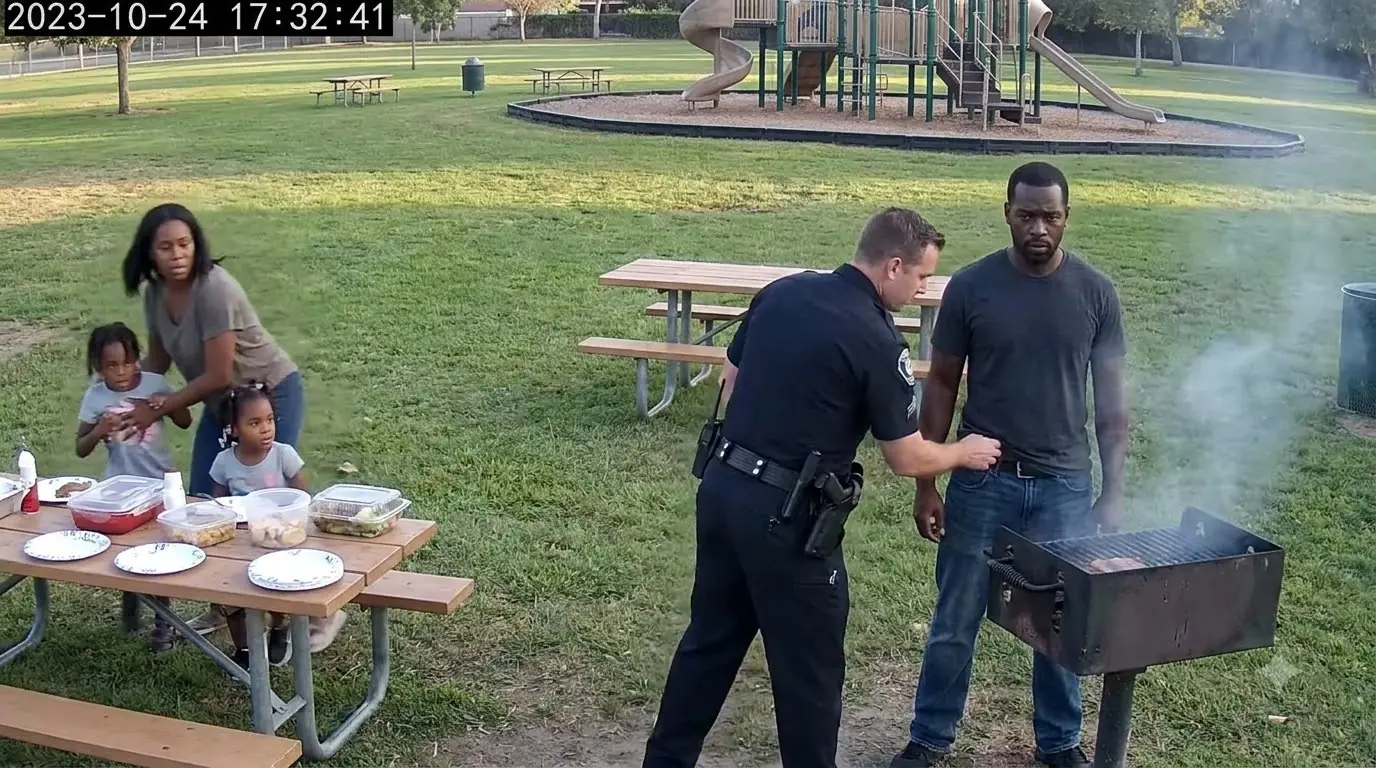
His wife, Tasha, laughed from the picnic table as she tried to keep paper plates from blowing away in the breeze. She was taping down the plastic tablecloth with the concentration of a woman who knew a family cookout could fall apart faster than a court case if someone forgot the napkins. Their twelve-year-old son, Jaden, chased his little sister Ava around the edge of the playground while Ava squealed like the park belonged to her and no one else.
It was supposed to be a quiet evening. Nothing fancy. No speeches. No uniforms. No reporters. No handshakes from city officials who wanted a photo with the new chief before they cared what kind of man he was.
For one weekend, Kenny did not want to be Chief Kenneth Carter, the first Black police chief in Brookhaven’s history. He wanted to be the guy burning one corner of the ribs because he kept turning around to check on his kids.
“Baby, you better not let those burgers get dry,” Tasha called out.
Kenny lifted the lid and let the smoke roll up into his face. “These burgers are in professional hands.”
“They were in professional hands ten minutes ago,” she said. “Now they’re in distracted hands.”
Jaden jogged over, breathless and grinning. “Dad, can I get one now?”
“They’re not ready.”
“They look ready.”
“You also thought toothpaste was frosting when you were five.”
Ava came running behind him. “I want a rib.”
“You don’t even eat ribs,” Tasha said.
“I do today.”
Kenny smiled. This was why he had chosen Mason Creek Park instead of the backyard. The kids needed open space. Tasha needed air. He needed to remember the city he had sworn to serve was not made of policy binders and budget meetings. It was made of afternoons like this.
He had spent the last three weeks inside the police department, learning names, reviewing complaints, looking at old disciplinary files, studying body-camera policies, listening to officers who were nervous about him and residents who were tired of being nervous about officers. He had not made a big speech yet. He had not announced sweeping reforms. He wanted to watch first. He wanted to understand where the cracks were before he started repairing the walls.
What he did not know, as he turned the ribs for the second time, was that one of those cracks was walking toward him.
The siren did not blare at first. It chirped.
A short, sharp sound cut through the park, just loud enough to make heads turn. A Brookhaven patrol car rolled slowly along the paved access road, its lights flashing blue and red against the trunks of the trees. It stopped near the picnic shelter, close enough that the dust from its tires drifted toward Kenny’s grill.
The laughter around the Carter table faded.
Tasha looked up from the plates. “What’s going on?”
Kenny set the tongs on the side shelf of the grill. “I don’t know yet.”
The driver’s door opened, and an officer stepped out. He was white, maybe mid-thirties, tall and lean, with sunglasses hooked into the front of his uniform shirt and one hand resting near his belt. The nameplate on his chest read P. Mallory.
Kenny knew the name. Peter Mallory. Five years on the force. Two citizen complaints in the past eighteen months, both closed as unfounded. One involved a teenager stopped while walking home from a gas station. The other involved a woman questioned outside her own apartment complex because someone said she looked suspicious.
Kenny had read those files on Tuesday.
Mallory did not recognize him.
That, Kenny realized, was about to matter.
The officer walked up with the slow authority of someone who believed every space changed when he entered it. His eyes moved over the grill, the cooler, the folding chairs, Tasha, the children, then back to Kenny.
“You folks can’t barbecue here,” Mallory said.
Kenny wiped his hands on a towel. “Good evening, officer.”
“I said you can’t barbecue here.”
Tasha’s posture stiffened. Jaden stopped near the table. Ava, too young to understand but old enough to feel the temperature change, moved behind her mother’s leg.
Kenny kept his voice even. “This is a public park. There are permanent grills right there. We’re using one of them.”
Mallory glanced toward the grill as if noticing it for the first time, then dismissed it with a slight tilt of his chin. “You need a permit.”
“For a family cookout?”
“For grilling in this park.”
Kenny looked around the area. There were no posted signs near the shelter. No reservation placards. No notices about permits. Two other families were grilling on the far side of the playground, and no police cruiser had stopped beside them.
“Can you show me the posted rule?” Kenny asked.
Mallory’s mouth tightened. “You want to argue?”
“No. I’m asking you to show me the rule you’re enforcing.”
The officer stepped closer. “I got a complaint.”
“From who?”
“That doesn’t concern you.”
“It does if someone called the police because my family is having dinner.”
Mallory’s eyes narrowed. “You need to pack this up and move along.”
Tasha placed a hand on Kenny’s arm. It was a gentle warning. Not because she thought he was wrong, but because she had lived long enough in America to understand that being right did not always keep a Black man safe when an officer decided he wanted to be obeyed.
“Officer,” she said carefully, “we’re just trying to enjoy the evening with our kids. We’re not bothering anybody.”
Mallory did not even look at her. His attention stayed fixed on Kenny.
“I’m not asking again,” he said. “Pack it up.”
Kenny felt something old and familiar settle in his chest. Not fear exactly. He had spent twenty years in law enforcement. He had seen danger in alleys, living rooms, traffic stops, hospital corridors, and domestic calls where every word could be the wrong one. This was not that kind of fear.
This was the weight of recognition.
He knew how this worked. A complaint that might not exist. A rule that could not be named. A public space suddenly becoming conditional. A family forced to shrink itself so someone else could feel comfortable.
He had taken the job of police chief because he believed the badge could still mean protection if the right people were brave enough to hold it accountable. But now, standing beside a grill with his daughter hiding behind Tasha, he was not an administrator studying policy.
He was a father being ordered out of a park.
“I’m not leaving,” Kenny said.
Mallory’s jaw flexed. “Excuse me?”
“We are not leaving unless you can show me a lawful reason we have to leave.”
“You’re trespassing.”
“In a public park during posted open hours?”
“You’re disturbing the peace.”
Kenny looked at the picnic table, the cooler, the children, the uncooked burgers. “What peace are we disturbing?”
Mallory took another step forward, invading the space between them. “Your tone is disturbing mine.”
Tasha inhaled sharply.
Kenny held up one hand, not high, not aggressive, just enough to slow the moment down. “Officer, I’m going to ask you to de-escalate.”
That was the wrong word to use on a man like Peter Mallory.
The officer’s face hardened. “You don’t tell me how to do my job.”
“I’m asking you to do it properly.”
Mallory pointed at the grill. “Turn that off.”
“It’s charcoal.”
“Then put it out.”
“No.”
The word landed clean and final.
People nearby had started watching. One mother gathered her toddler from the sandbox. A man at the basketball court held the ball against his hip and stared. Phones began to appear at waist level, half-hidden but recording.
Mallory noticed. His shoulders lifted slightly, as if the audience required him to perform authority more loudly.
“Sir, turn around and put your hands where I can see them.”
Tasha stepped forward. “For what?”
“Ma’am, step back.”
“Kenny,” she whispered.
He looked at her. In her eyes, he saw the same question he had seen too many times from too many residents in too many community meetings. How far are they going to take this?
He did not know.
But he knew what he would not do. He would not give Mallory the reaction he was looking for. He would not shout. He would not reach for his wallet too fast. He would not use his title like a weapon just to escape what every other man in his position would have been forced to endure.
Not yet.
“My hands are visible,” Kenny said.
“Turn around.”
“No.”
Mallory’s hand moved toward his cuffs. “You’re refusing a lawful order.”
“I am refusing an unlawful one.”
The officer’s face reddened. “Last chance.”
Before Kenny could answer, another vehicle came down the access road.
It was an unmarked black department SUV with municipal plates and tinted windows. It rolled to a stop behind Mallory’s cruiser. The driver’s door opened, and Deputy Chief Raymond Ellis stepped out.
Ellis was sixty-one, white, silver-haired, built like a man who had once played college football and still believed posture mattered. He had served Brookhaven for thirty-two years. He had been interim chief for four months before Kenny was appointed. Some people expected him to resent Kenny for taking the permanent job.
He did not.
Ellis had been the first person to shake Kenny’s hand after the city council vote.
Now he looked from Mallory to Kenny, then to Tasha and the children, and the color drained from his face.