Officer Brett Harland decided Simone Avery looked like the kind of driver no one would believe. She was alone on a black sport bike dressed in a dark riding jacket and protective pants moving through the late evening traffic on the south side of Grey Haven. Her tinted visor hid her face. The motorcycle looked expensive enough to seize and fast enough to make a reckless driving charge sound believable. Harland followed her for six blocks before turning on his lights.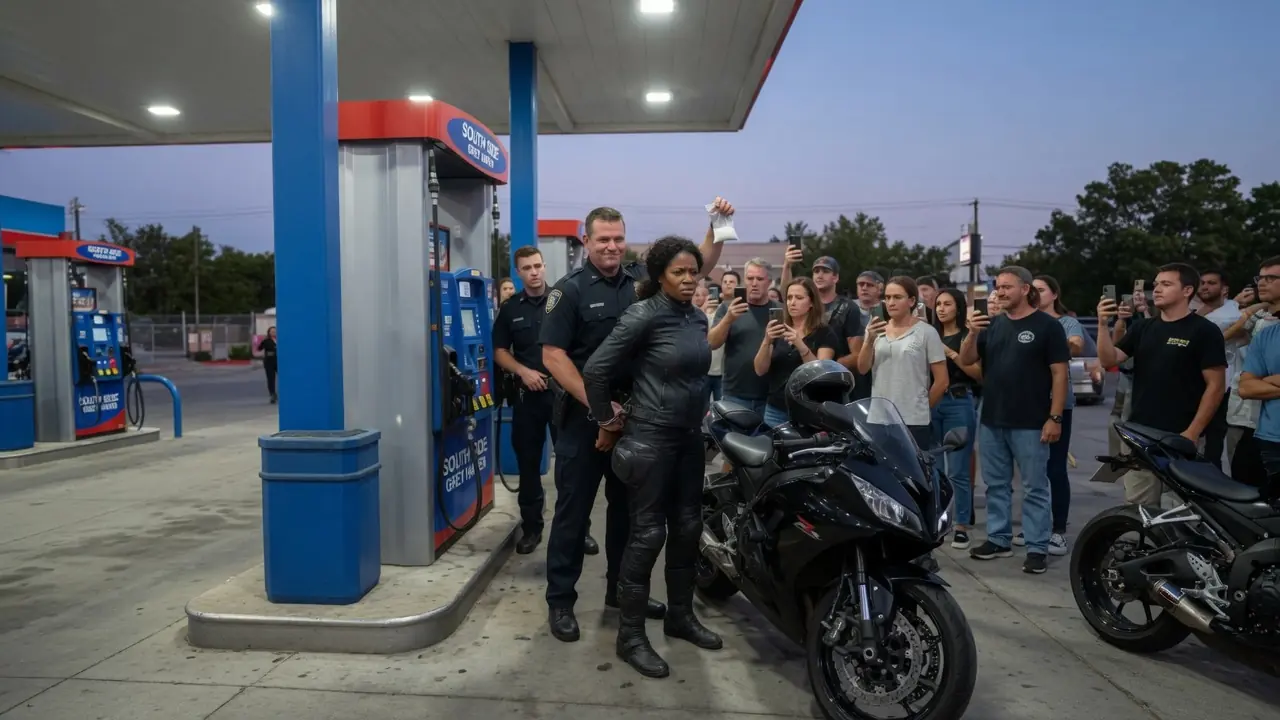
Simone saw the patrol car in her mirrors and pulled into a brightly lit gas station. She parked beside an air pump, removed her gloves, and waited with both hands visible on the handlebars. She had spent the day reviewing sealed applications related to a federal corruption investigation. Several names had appeared repeatedly in the supporting documents. Brett Harland was one of them.
Simone did not know the face of every officer named in the file, but she recognized his voice when he approached. "License and registration," Harland said his tone carried none of the cautious professionalism she expected from an ordinary traffic stop. He sounded like a man who had already decided how the encounter would end. Simone handed over her license. "What was the reason for the stop?" "You crossed the center line." "I did not." Harland looked at her license without reacting to the name in riding gear with her hair tucked beneath a helmet liner.
She looked nothing like the formal portrait displayed on the federal court website. "You calling me a liar?" he asked. "I'm asking for the legal basis of the stop." Harland's jaw tightened. He ordered her off the motorcycle and told her to stand near the front of his patrol car. A younger officer named Caleb Dorsey arrived as backup a minute later.
Caleb had been on the force for less than 2 years. He greeted Simone politely, but Harland cut him off. "Watch your hands." Simone remained calm as Harland circled the motorcycle. In the small mirror mounted near the handlebar, she saw him reach inside his jacket. His body blocked most of the view, but she noticed the movement of his right hand and the way he leaned over the storage compartment beneath the rear seat.
He was not wearing gloves. "What are you doing?" she asked, searching the bike. "You don't have my consent. I smell marijuana." Simone almost laughed. She had never used marijuana in her life, and nothing about the gas station smelled of it.
She resisted the impulse to tell him that false claims about odor appeared in three complaints already buried inside the sealed federal file. Instead, she looked toward Caleb. "Is your body camera recording?" Caleb glanced down. "Yes, ma'am." Harland turned sharply. "Don't answer her questions." He opened the rear compartment and removed a small plastic bag containing white powder.
For a moment, no one spoke. Then Harland held the bag up beneath the gas station lights. "Well," he said. "Looks like tonight just got worse for you." Simone's pulse began to pound, but her voice remained level. Seal that bag before anyone else touches it.
Record the exact time and note that officer Harland handled the compartment without gloves. Caleb looked at Harland. Harland's expression changed. The smugness did not disappear, but something colder took its place. "Turn around," he said.
Several people near the gas pumps began filming. One man shouted, "What did she do?" Harland raised the bag so the cameras could see it. "Drug possession." Simone watched strangers' faces change. Concern became suspicion. A woman who had been recording lowered her phone and whispered something to her husband.
That shift hurt more than the handcuffs. People believed the uniform before they knew the facts. Harland took Simone's phone and placed it in an evidence bag. Then he called for a tow truck from Lyle Recovery, a company Simone recognized from the federal investigation. The company had received nearly every police seizure contract in Grey Haven for the past four years.
As the tow operator lifted her motorcycle, Simone felt an unexpected ache in her chest. The bike had once belonged to her father. Elias Avery had spent 26 years as a police officer. He had taught Simone to ride in an empty church parking lot when she was 17. Years later, after he died, she found the motorcycle beneath a tarp in his garage and rebuilt it piece by piece.
Her father had also died under a cloud of suspicion. Near the end of his career, Elias had refused to alter a report after another officer used excessive force during an arrest. Evidence later vanished from the property room and the blame fell on him. He lost his badge before the truth could be established. Simone became a judge partly because of what happened to him.
She wanted to believe that law properly applied could repair the damage caused by people who abused it. Now a police officer was using the same system to destroy her. At the Grey Haven Police Department, a desk sergeant entered Simone's information into the booking system. He stared at the screen. Then he looked at her.
"Judge Avery." The room became silent. Harland moved behind the desk and read the screen for himself. United States District Judge Simone Avery. His face lost color. Caleb took one step backward.
Simone watched the recognition spread through the room. She expected someone to remove the cuffs. Instead, Sergeant Wade Crowell emerged from a glass office at the end of the corridor. Crowell was broad, silver-haired, and calm in the way experienced men often appeared when they had spent years teaching others to fear them. "Simone recognized him immediately from surveillance photographs attached to the sealed files." He approached slowly.
"So, you're Judge Avery," he said. "Yes." Crowell looked toward Harland, then toward the bag of powder on the booking desk. Where was it found? Under the rear seat, Harland replied. Crowell studied Simone.
"Interesting." He did not sound surprised. He sounded as if he had discovered a new problem that needed to be contained. Simone said, "I want an attorney. You'll get one. I also want the bag sealed in my presence." Crowell smiled.
"You don't run this station." "No," Simone said. "But the Constitution still applies inside it." The smile left his face. Crowell ordered an officer to place Simone in an interview room. He confiscated her phone and told Harland to prepare an additional report stating that Simone had resisted arrest. Caleb stared at him.
"She didn't resist." Crowell turned. "What did you say?" Caleb lowered his eyes. "Nothing, Sergeant." Inside the interview room, Simone tried to control her breathing. She knew what Crowell was doing. A drug charge could be challenged.
A claim that she had assaulted or attempted to disarm an officer would create immediate pressure for her suspension from the bench. It would also poison public opinion before any evidence could be examined. Through the wall, Simone heard Harland say. "She reached toward my weapon." "That's not what happened," Caleb replied. Crowell's voice followed.
"Your report will say what happened." Simone closed her eyes. Her father had once told her that corruption rarely began with a suitcase full of money. It began when one person changed one sentence in one report, and everyone else decided it was easier not to notice. Across town, Mara Avery sat alone in an auditorium waiting for her aunt. Mara was 19 and had just completed her first semester of college.
That night, she was receiving a scholarship named in honor of local public defenders. Simone had promised to attend. When the ceremony ended and Simone's seat was still empty, Mara checked her phone. The video had already begun circulating online. A black woman in motorcycle gear stood handcuffed beside a police car.
An officer displayed a bag of drugs. The caption read, "Federal judge caught with cocaine." Mara played the clip twice. Then she saw Simone's face when the helmet came off. She called repeatedly, but the calls went straight to voicemail. By the time Mara reached the police station, reporters had gathered outside.
She pushed toward the entrance, but an officer blocked her. "That's my aunt." "You need to step back." "She's a federal judge." The officer looked uncomfortable. "That doesn't mean she can't be arrested." Mara knew that. Simone had taught her that no one was above the law. But she also knew her aunt.
Simone would not carry drugs, and she would never miss Mara's ceremony without a reason. Still, as reporters shouted questions and social media filled with accusations, a small doubt crept into Mara's mind. Simone had been secretive for weeks. She had canceled dinners, avoided questions, and warned Mara not to discuss her schedule. Mara hated herself for wondering whether there was something she did not know.
Assistant U. S. Attorney Naomi Vance arrived before midnight with two federal agents and a court-appointed attorney for Simone. Naomi had led the corruption investigation for 8 months. She understood immediately that Simone could no longer participate in the case in any judicial capacity.
She was now a witness and an alleged victim. That distinction mattered. Simone could not sign warrants, direct agents or use her position to punish Harland. Every legal decision would have to go through another judge. When Naomi entered the interview room, Simone looked exhausted but composed.
"They're adding assault on an officer," Simone said. Naomi's face hardened. "Did you touch him?" "No." "Did he have a body camera?" "Yes." So did the younger officer. Naomi paused. Simone.
The camera on Harland's uniform was turned off during the search. Simone had expected that. "What about Dorsey?" His camera recorded part of the stop, but Harland was standing behind the bike. We don't have a clear image of the bag being planted, so it's his word against mine for now. Naomi leaned closer.
There's something else. Crowell has ordered the evidence transferred to the central property facility at 6:00 in the morning. Simone understood immediately. Once the bag left the station, its packaging could be replaced. The identifying marks connecting it to the old evidence room could disappear.
Can you stop the transfer? "We're seeking an emergency preservation order from another judge." "How long?" "Longer than I like." Outside, Caleb sat at a desk staring at the report Crowell had ordered him to sign. The statement said Simone had moved aggressively toward Harland, ignored commands, and reached toward his belt. None of it was true. Caleb remembered Harland turning off his camera.
He remembered seeing a small plastic corner protruding from Harland's jacket before he searched the motorcycle. He had not seen the exact moment the drugs were placed inside, but he knew the official story was false. He also knew what happened to officers who contradicted Crowell. A detective who had complained about evidence handling was transferred to night patrol and later fired for minor paperwork violations. Another officer had been accused of drinking on duty after refusing to participate in an illegal search.
Caleb thought of his wife, their new baby, and the mortgage they had barely qualified for. Then he saw Mara through the station's glass doors. She sat on the concrete steps outside, clutching Simone's helmet to her chest. Someone from the tow company had dropped it near the roadside and a stranger had brought it to her. Caleb looked down at the false report.
He could protect his job or he could protect the truth. He was beginning to understand that he might not be able to do both. At 2:00 in the morning, Naomi received preliminary information from a federal laboratory technician who had examined photographs of the bag. A fragment of a barcode was visible beneath the station's temporary evidence label. The number matched narcotics seized 18 months earlier in a case that had already been closed.
The drugs had come from the Grey Haven Police Department's own evidence room. Naomi brought the information to Crowell. He barely reacted. "A recycled evidence bag proves nothing," he said. It proves your officer's report is false.
Or it proves someone put old packaging in Judge Avery's motorcycle before we stopped her. Naomi looked at him. You expect me to believe a federal judge stored cocaine in a police evidence bag? Crowell folded his arms. "I expect you to prove otherwise." The emergency preservation order was approved at 4:45 in the morning.
By then, the bag was gone. Crowell claimed it had been transferred early due to a scheduling change. The courier van had left the station 30 minutes before the order arrived. Naomi's agents intercepted the van outside the central property facility. The driver insisted he had not opened the sealed container, but the original plastic bag was missing.
In its place was a new evidence pouch with no barcode fragment. For the first time that night, Harland smiled again. Without the original packaging, the strongest physical connection to the old evidence room had disappeared. By sunrise, Simone was released pending further review, but the assault allegation remained open. News helicopters followed her home.
Mara waited in the kitchen. Simone entered slowly, her wrist bruised from the cuffs. For several seconds, neither woman spoke. "Why didn't you call me?" Mara asked. "They took my phone." "Before that, for weeks, you kept cancelling things and telling me you couldn't explain.
I was handling sealed matters. "You missed my ceremony." "I know." Mara's voice broke. Everyone online is saying you use drugs. They're saying you threatened the police because you're a judge. Simone stepped forward, but Mara backed away.
"Tell me the truth," Mara said. "All of it? I can't discuss the investigation. You still can't." "No." Mara looked at her as if the answer had confirmed her worst fear. Simone felt something inside her fracture.
Being doubted by strangers was painful. Being doubted by the girl she had raised since Mara's mother died was almost unbearable. "I have never used cocaine," Simone said. "The officer planted it." "Then prove it." "I'm trying." Mara turned and left the room. Later that morning, Harland met Crowell in the parking lot behind Lyle recovery.
Victor Lyle waited beside Simone's motorcycle. Harland looked at the bike. "We should destroy it." Crowell shook his head. "Too obvious." "The camera could have something." "It's already been removed." Victor held up a small black recording unit. Harland relaxed slightly.
Crowell stepped closer to him. You made a reckless stop. She looked perfect for it. She was a federal judge. I didn't know.
That excuse won't save you. Harland's face hardened. He had joined Crowell's operation 3 years earlier after falling into debt. His younger brother had borrowed money from dangerous people, and Harland had tried to protect him. The first planted bag paid off the debt.
The second financed a new truck. By the 10th, Harland no longer pretended he was doing it for family. Now Crowell had made it clear that if the operation collapsed, Harland would take the blame. "We need Dorsey under control," Crowell said. Harland nodded.
Caleb had already made his decision. He contacted Naomi through an attorney and turned over a private copy of the electronic evidence room access logs. The log showed Harland entering the narcotic storage area less than 3 hours before stopping Simone. His written reason was laboratory transport. No transport had been scheduled.
The logs also showed Crowell approving the access remotely. Naomi now had evidence of preparation, but she still lacked proof that Harland physically planted the drugs. She asked Caleb whether he had seen it happen. "No," he admitted. "Not clearly." Then why should a jury believe you?
Because I heard him tell me to turn off my camera. Your camera was still running. Caleb froze. He had forgotten that his body camera used a 30-second pre-record buffer. Even when officers pressed the stop button, the system retained video without audio for 30 seconds before shutdown.
But Caleb had never pressed the button. He had only looked down, pretending to comply. The recording contained more than he realized. Technicians enhanced the sound. Harland's voice emerged beneath traffic noise.
"Kill your camera." Then several seconds later came the faint scrape of plastic and Harland muttering, ""This one's worth 20 grand."" The amount matched the estimated auction value of Simone's motorcycle. Naomi obtained warrants for the police evidence room, Lyle Recovery, and accounts connected to Crowell's family. The searches uncovered records from 43 vehicle seizures. Most involved drivers arrested after Harland claimed to smell drugs. Many charges were later dismissed, but the vehicles had already been sold or held for storage fees the owners could not afford.
Payments flowed from Lyle Recovery to a consulting company controlled by Crowell's sister. Harland learned about the warrants from someone inside the department. That night, he entered the evidence building using Crowell's access card. He carried replacement seals, blank inventory forms, and a bottle of cleaning solvent. What he did not know was that federal agents had installed temporary surveillance equipment after the first evidence transfer.
Caleb was inside with them. The agents watched Harland open a narcotics locker and remove archived bags. Then he walked to a computer terminal and began altering records. Caleb whispered, ""That's him."" Naomi gave the order. Agents moved through two entrances.
Harland heard the first door open and ran toward the rear corridor. He nearly reached the emergency exit before Caleb stepped into his path. For a second, they stood facing each other. "You think they'll protect you?" Harland said. "You're finished in this department." Caleb's hands trembled, but he did not move.
"Maybe," he said. "But I'm done lying for you." Harland lunged toward him. Agents tackled Harland before he reached the door. As they handcuffed him, Naomi entered the quarter. Harland looked up at her.
"This is because of that judge." "No," Naomi said. "This is because of what you did before you knew who she was." The public hearing was held three weeks later in a packed federal courtroom. Simone sat at the witness table wearing a simple navy suit. She did not wear judicial robes. She did not sit above anyone.
Harland's attorney argued that the investigation was retaliation. He claimed Simone had recognized Harland from sealed materials and used federal power to manufacture a case against him. Then Naomi presented the evidence in sequence. the property room access log, the preserved body camera audio, the barcode photographs, the altered evidence records, the vehicle seizure pattern, the financial transfers, the surveillance video of Harland trying to destroy records. Caleb testified last. He admitted that he had failed to intervene when Simone was arrested.
He admitted he had considered signing the false report. Harland's attorney asked, "So, you lied by omission because you were afraid?" Yes. And now you want this court to view you as courageous. No, Caleb said, I want the court to understand how men like him survive. They survive because people like me stay quiet.
The courtroom remained silent. When Simone took the stand, Harland would not look at her. She described the stop, the search, and the moment the bag appeared. Then Naomi asked why she had not immediately announced that she was a federal judge. Because my title should not determine whether my rights are respected, Simone said.
If the stop was unlawful before they knew my name, it remained unlawful afterward. The hearing ended with Crowell and Victor Lyle taken into custody. Harland faced federal charges for civil rights violations, obstruction, evidence theft, conspiracy, and falsifying records. Over the following months, 43 cases were reopened. Several convictions were vacated.
Families received compensation for vehicles illegally seized and sold. Officers who had participated in the scheme were charged individually, while those who had not been involved remained on duty under independent oversight. Caleb was suspended for failing to intervene and ordered to undergo a disciplinary review. He kept his job only after accepting responsibility and cooperating fully. Simone supported that outcome.
Telling the truth late, she believed, was better than never telling it. But late truth did not erase earlier silence. When Simone's motorcycle was finally returned, the engine had been damaged and the camera removed. One of the original metal panels her father had restored was bent beyond repair. Simone stood in her garage staring at it.
Mara appeared behind her carrying a box of tools. "I'm sorry," Mara said. Simone turned. For what? For doubting you.
You were scared. I should have known. No, Simone replied. You should have been able to trust the evidence. That is what the system is supposed to provide.
Mara placed the toolbox on the floor. "Can it be fixed?" Simone ran her hand across the damaged fuel tank. Not exactly the way it was. Mara opened the box, then we make it something new. They worked together for several weekends.
Simone taught Mara how to remove the damaged fairing, clean the engine, and replace the wiring. She repeated the same instructions her father had once given her. Months later, the motorcycle started again. The sound filled the garage deep and steady. At a community meeting held after the investigation concluded, Simone sat among families whose cars had been seized and whose names had been dragged through courtrooms.
She declined the raised platform prepared for her and chose a folding chair in the front row. When invited to speak, she did not talk about revenge. She spoke about her father, about Caleb's silence, and about the people whose cases had been ignored because they lacked influence. A badge deserves respect, she said, only when the person wearing it respects the law. A robe deserves respect only when the person wearing it remembers that the law belongs to everyone.
After the meeting, Mara waited outside beside the restored motorcycle. Simone put on her helmet and looked back at the courthouse lights. Harland had chosen her because he believed she was powerless. He had been wrong about her identity. But the deeper mistake was believing that innocence required power to matter.
Simone started the engine, and this time Mara climbed onto the seat behind her. Together they rode home.