Jamal sat in his parked Honda Civic at the edge of a Walmart parking lot. Windows cracked, engine off, waiting. He wasn't nervous. 14 months undercover had taught him how to control his breathing, his heartbeat, his thoughts, but he was alert. Because in his line of work, the difference between alert and nervous was the difference between living and dying.
A silver Nissan Alultima pulled into the spot two spaces over. The driver's door opened. A white guy in his mid30s stepped out, twitchy hands, darting eyes, sweat on his forehead despite the cool afternoon air. His street name was Keys. And today, Keys was about to hand over the most important piece of intel Jamal had been chasing for over a year.
Keys slid into the passenger seat and shut the door without a word. The air inside the car immediately felt heavier, smaller, like the walls were closing in. "You got it? " Jamal asked, voice low and steady. Keys nodded, wiping his palms on his jeans. "Yeah, yeah, I got it.
But listen, man. If they find out I gave you this, I'm dead. Not arrested. Not roughed up, dead. Jamal didn't blink.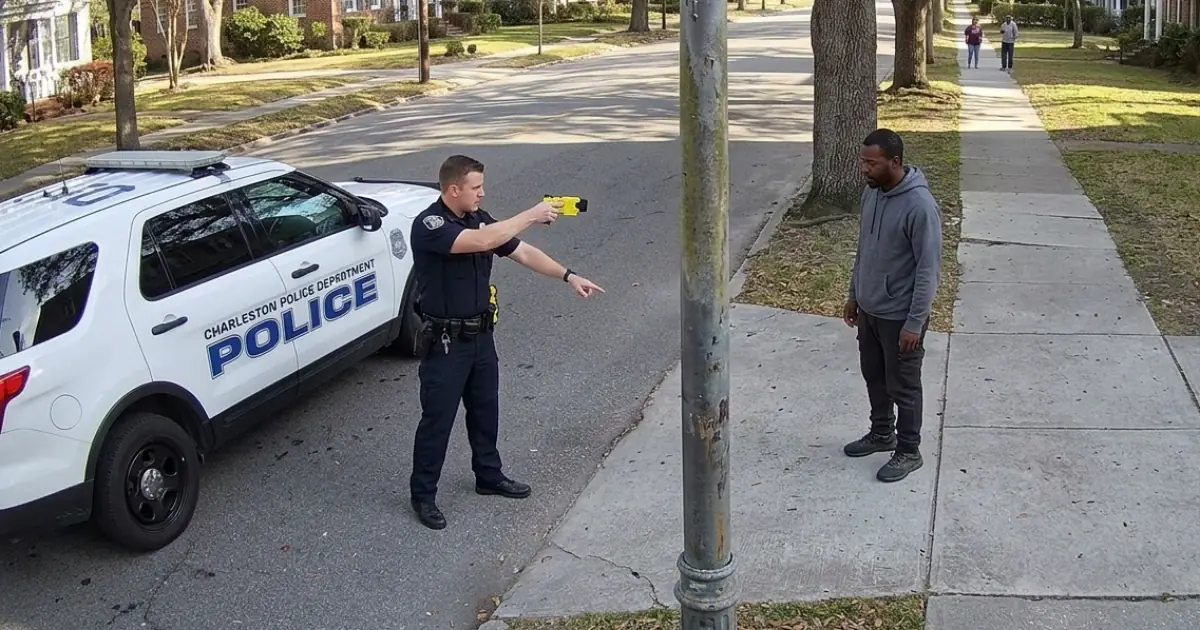
He'd heard that line a hundred times. Then don't get caught. Keys reached into his jacket and pulled out a folded piece of paper. Small, wrinkled, edges worn like it had been opened and closed too many times. He handed it over like it was a live grenade.
Jamal unfolded it carefully. A time stamp. A drop location. A code name scrolled in faded ink. Sandstorm.
This was it. 14 months of living a double life. 14 months of pretending to be someone he wasn't. 14 months of dangerous meetings, risky conversations, and walking a razor thin line between justice and survival. And this piece of paper was the payoff.
This was the key to dismantling a weapons trafficking network stretching from Charleston to Atlanta. Guns moving through ports, warehouses, back roads. Nobody watched. Guns that ended up in the hands of people who used them to destroy lives. Jamal folded the paper and slipped it into the inside pocket of his gray hoodie.
"We done? " Keys asked, already reaching for the door handle. "We're done? " Keys paused, looked at Jamal one last time. "You're a good dude, man. I hope I hope this works. " Jamal said nothing. There was nothing to say.
Keys got out, walked back to his Altea, and drove away without looking back. Jamal sat alone for another 60 seconds. Long enough to make sure no one was watching. Long enough to let his heart rate settle. Long enough to remind himself that the hardest part wasn't getting the intel, it was getting home with it.
A jogger in expensive running shoes did a double take, slowed his pace, then sped up and passed him quickly. A man washing his car in his driveway stopped mid-spray, hose still running in his hand, and just watched. Jamal kept his head down, hands visible, shoulders loose, posture non-threatening. But it didn't matter because to some people, a black man in a hoodie didn't need to do anything wrong. He just needed to be.
Jamal was halfway down the block when he heard it behind him. An engine, slow, deliberate, following. He didn't look back. Not yet, but his stomach tightened because he recognized that sound. A patrol car.
And then, chirp, short, sharp, territorial. The cruiser rolled up behind him. Lights flashing, but no siren. Just the slow, intentional crawl of authority announcing itself. Jamal's hand instinctively moved toward the evidence slip in his pocket.
Not now. Not today. The patrol car stopped. The door opened. Boots hit pavement hard.
Hey, you in the gray hoodie. Jamal froze. He knew that voice. He'd heard it twice before. Officer Ryan Callaway.
And just like that, everything Jamal had worked for. 14 months, one piece of paper, one chance to take down an entire weapons network was about to be put at risk. Not by criminals, not by traffickers, but by a cop who saw a threat instead of a person. Officer Ryan Callaway stepped out of his patrol car with the kind of swagger that came from 8 years wearing a badge and zero accountability. Jamal recognized him immediately.
This was the third time. The first time Callaway had stopped him outside a Publix, accused him of loitering in the parking lot. Jamal had been loading groceries into his trunk. The second time at a Shell station. Callaway said he was acting suspicious by looking around too much.
Jamal had been checking his mirrors before pulling out. Both times Jamal had stayed calm, polite, compliant. Both times Callaway had let him go with a warning that felt more like a threat. And now here they were again. Callaway didn't recognize Jamal or didn't care.
His hand hovered near his belt, fingers twitching close to his holster. "I need to see some ID," Callaway said, his tone sharp, clipped like he was already convinced of guilt. Jamal turned slowly, hands visible, palms open. Marine training kicked in. "Control the situation by controlling yourself. " "Yes, sir," Jamal said evenly.
"I'm reaching for my wallet now. Inside pocket, left side. He moved with deliberate precision, every motion slow, visible, predictable, but Callaway's eyes weren't on Jamal's hands. They were locked on the folded evidence slip peeking out from his jacket pocket. What's that?
Callaway's voice sharpened. What are you carrying? Jamal's pulse stayed steady. It's just a note, officer. Nothing.
Drop it. Callaway barked. Hands where I can see them now. Jamal froze, not because he was afraid, but because he knew what happened when scared cops made bad decisions. Across the street, a woman walking her dog stopped, stared.
Two kids on bikes paused at the corner, wideeyed. A man on his porch lifted his phone, started recording. Callaway noticed the crowd forming, his jaw tightened. "You don't live around here, do you? " Callaway said, stepping closer. I do actually," Jamal replied calmly.
"Then why are you so calm? " Callaway's voice rose. Innocent people get nervous when cops stop them. "You hiding something? " Jamal fought the urge to shake his head. There it was. The logic that didn't make sense.
"Be nervous, you're guilty. Be calm, you're guilty. Be black, you're guilty. " "Officer, I'm just trying to get home," Jamal said. Callaway grabbed the evidence slip from Jamal's pocket before he could react. He unfolded it, stared at the handwritten timestamp, the address, the code name.
His eyes narrowed. What is this? A drug deal? Burglary instructions? No, sir.
I can explain. Shut up. Callaway's hand moved to his holster. Turn around. Hands behind your head.
The crowd murmured. Phones rose higher. A mother pulled her child behind her. Jamal calculated his options in milliseconds. If he resisted, even legally, his cover was blown.
14 months of undercover work destroyed. If he complied, Callaway might escalate anyway. Scared cops were dangerous cops. If he revealed his identity now, the traffickers could be watching. The network would scatter.
In his pocket, Jamal's FBI communication device buzzed silently. Two short pulses. His team was checking in. He couldn't respond without blowing everything. Callaway's breathing quickened.
His hand gripped the holster tighter. I said, "Turn around. " Jamal obeyed slowly, hands rising behind his head. But Callaway wasn't satisfied. What's a guy like you doing in a neighborhood like this? Callaway's voice dripped with suspicion and something uglier.
A voice from the crowd. He's not doing anything. Callaway spun toward the crowd. All of you back up. This is police business.
But the phones kept recording and Callaway's hand, shaking now, moved to his gun. The holster unnapped. Leather creaked. Metal gleamed in the afternoon sunlight. Jamal's entire body went still because Officer Ryan Callaway had just drawn his weapon, and it was pointed directly at Jamal's back.
A child's voice cut through the tension. Mommy, why does that policeman have his gun out? The street held its breath. Jamal didn't move, didn't speak, just waited because the next 60 seconds would determine whether he lived or died. And Officer Callaway, hand trembling, fear masking itself as authority, had no idea he was aiming at the wrong man.
The gun was out, pointed at Jamal's back. Officer Ryan Callaway's hand shook, not from control, but from adrenaline and fear. The kind of fear that made men with badges do irreversible things. Jamal raised his hands higher, palms open, fingers spread wide. His voice stayed calm, measured, deliberate.
Officer Callaway, I need you to stay calm. Don't tell me what to do, Callaway screamed. Don't move. Don't you dare move. The contradiction didn't escape Jamal.
Callaway was giving orders that couldn't all be followed. Don't move. Turn around. Face me. Drop it.
This wasn't a man in control. This was a man panicking. And panicking men with guns killed people. The crowd grew. A dozen phones recording now.
A woman gasped audibly. The man on the porch shouted, "He's not doing anything wrong. Shut up. " Callaway spun toward the crowd, gun still raised. All of you shut up or I'll arrest every one of you for obstruction. But the phones stayed up.
Jamal counted his breaths. Four in, four out. Marine Corps discipline. The same technique that kept him alive in Fallujah when mortar rounds shook the earth. Stay calm.
Control what you can control. Survive the next 60 seconds. In his pocket, the FBI device buzzed again. Two short pulses, then two more. Emergency protocol.
If he didn't respond in 5 minutes, his team would assume he was compromised. They'd flood the scene. His cover would be blown. The traffickers would scatter. 14 months gone.
But if he reached for his pocket now, Callaway might shoot. Callaway stepped closer. The muzzle was less than 4 ft away now. Jamal could see the sweat on Callaway's temple, the tremor in his trigger finger, the wild look in his eyes, fear disguised as authority. "You know my name," Callaway said suddenly, voice cracking.
"How do you know my name? Who sent you? Who are you working for? " Jamal's mind raced. He's spiraling, making connections that aren't there, turning suspicion into conspiracy. Officer, Jamal said slowly, clearly.
I'm not a threat. I'm going to reach for my identification. Slowly, you need to let me show you who I am. Stop lying. Callaway's voice broke.
You move and I will shoot. A mother pulled her child behind a parked car. The dog walker backed away, phone still recording. Someone in the crowd whispered, "This is going on the news. " Callaway heard it. His eyes darted toward the phones, then back to Jamal.
He was realizing too late that the world was watching and he was trapped. If he lowered the gun now, he looked weak. If he kept it raised, he looked guilty. If he pulled the trigger, Jamal saw the calculation in Callaway's eyes. And he made a choice.
"Officer Callaway," Jamal said, his voice dropping. No longer a plea, but a command. Lower your weapon right now before you make a mistake you can't undo. Callaway's jaw clenched. His finger hovered over the trigger.
I'm reaching into my jacket, Jamal said. For my badge. You're lying. I'm not. Jamal's hand moved slow, deliberate, controlled toward his inside pocket.
Callaway screamed, "Freeze! Don't you move! " But Jamal didn't stop because stopping now meant letting fear win. And Jamal, DeAndre Carter, had faced worse than Ryan Callaway. His fingers closed around a slim black wallet. He pulled it out, flipped it open, and everything changed.
The wallet flipped open. Sunlight caught the gold shield. FBI credentials. Official photo. Bold letters.
Federal Bureau of Investigation. The crowd gasped. Callaway stared, blinked. His brain couldn't process what his eyes were seeing. The gun stayed raised, but his hand trembled worse now.
"That's That's not" Callaway stammered. "You can't be special agent Jamal DeAndre Carter," Jamal said, his voice ice cold and steady. "Badge number 4719, United States Marine Corps veteran, 14 months undercover, and you just aimed a loaded weapon at a federal agent. " The words hung in the air like a verdict. Callaway's face drained of color, his mouth opened, closed. No words came out.
Someone in the crowd shouted, "Oh my god! " Another voice. "Are you serious right now? " The dog walker yelled, "I got it all on video. " Phones raised higher, fingers tapped screens. The footage was already uploading. Callaway stumbled backward, the gun finally lowering. Not because he chose to, but because his body gave out.
His hand shook so badly he nearly dropped the weapon. He fumbled it back into his holster, eyes still locked on the badge. "I didn't. I didn't know. " Callaway whispered. "How was I supposed to? " Jamal cut him off.
"You weren't supposed to pull a gun in the first place. " Callaway's jaw worked, searching for words, for excuses, for anything that would undo the last 5 minutes. I was doing my job. You matched a description. I had reasonable reasonable suspicion. Jamal's voice was sharp now.
Controlled fury beneath the surface. Of what? Walking while black. The crowd murmured. Agreement rippled through them.
Callaway's radio crackled on his shoulder. Unit 12. What's your status? He didn't answer. Couldn't.
Jamal pulled a small communication device from his pocket and pressed a button. This is agent Carter. Badge 4719. I need immediate backup at Sycamore Road and Elm. Officer involved incident.
My cover is compromised. Repeat, cover is blown. Static. Then a calm voice. Copy.
Agent Carter. FBI units on route. ETA 2 minutes. 2 minutes. In 2 minutes, federal agents would flood this street.
In 2 minutes, Callaway's life as he knew it would be over. In 2 minutes, the video circulating online would have 50,000 views. Sirens wailed in the distance. Not local PD. Federal response.
Louder. Closer. Faster. The kind of sirens that didn't ask permission. Callaway looked at Jamal.
Really looked at him for the first time. Not as a suspect, not as a threat. As a man, a decorated veteran, a federal agent, someone who had every right to walk down the street without a gun in his face. I was just, Callaway's voice cracked. I was doing my job.
Jamal didn't respond. He didn't need to. The first FBI vehicle rounded the corner, lights blazing, engine roaring. Three black SUVs followed. Tactical gear, federal authority, justice arriving in real time.
Callaway stood frozen as the convoy stopped. Doors opened. Agents emerged, crisp, professional, armed. But they didn't approach Callaway first. They went to Jamal.
Agent Carter, are you injured? Jamal shook his head. No, but the operation is compromised. An FBI supervisor stepped forward, eyes locked on Callaway. Officer, I'm going to need you to step over here.
FBI agents moved with precision. No shouting, no chaos, just controlled authority that made Callaway's earlier aggression look like amateur theater. They formed a protective perimeter around Jamal. Hands on holsters, eyes scanning the crowd, treating him with the respect he'd been denied 5 minutes ago. An agent carefully took the evidence slip from Callaway's hand, sealed it in a plastic evidence bag.
Another scanned the crowd, making notes of witnesses and recording devices. Jamal removed his gray hoodie. Underneath, a faded USMC t-shirt with a purple heart pin on the collar. The crowd saw it. Murmurss spread.
He's a veteran. A marine and FBI. That cop is done. The FBI supervisor, a sharp-eyed woman in her 40s named Agent Reeves, approached Callaway with the kind of calm that preceded a storm. Officer Callaway, I need you to hand over your body cam now. " Callaway hesitated.
"I have rights. I don't have to. " "You aimed a weapon at a federal agent during an active undercover investigation," Reeves said flatly. "Your body cam is evidence. Hand it over or we'll get a warrant and take it anyway. " Callaway unclipped the camera with shaking hands and gave it to her. Reeves turned to an agent beside her.
"Secure this. I want the footage reviewed within the hour. She turned back to Callaway. You're not under arrest yet, but you're being detained for questioning. You'll ride with us to the field office.
Detained? Callaway's voice cracked. I was doing my job. He matched a suspect description. I had reasonable suspicion.
The dog walker stepped forward. That's a lie. I watched the whole thing. He wasn't doing anything wrong. The man from the porch.
I recorded it. He was calm the entire time. You escalated everything. A teenager on a bike. You pulled a gun on him for walking.
Agent Reeves held up a hand. We'll collect all witness statements. If you recorded footage, we'll need copies. Phones were already out. Links being shared.
The video spreading like wildfire. Jamal sat in the back of an SUV, door open, staring at the evidence slipped through the plastic bag. 14 months gone. Agent Reeves sat beside him. "Jamal, I'm sorry.
We'll do everything we can to salvage the operation, but they've seen it by now," Jamal said quietly. "The video is already online. The traffickers will scatter. Change the drop location. Burn the network. " Reeves pulled out her tablet, checked social media.
The video had 89,000 views. 23 minutes old. Hashtags were already trending. At justice for Jamal had Marine veteran hat FBI. She sighed.
We might still have a window. The drop isn't for 6 hours if we move fast. Jamal looked up. You think the intel's still good? Maybe if they haven't seen the video yet.
If they think it's just another police incident. If we get lucky. Jamal stood. Marine posture. FBI focus.
14 months wasn't going to die without a fight. Then let's move. Across the street, Callaway was escorted into an FBI vehicle, not in handcuffs, but flanked by agents who made it clear he had no choice. He looked back at Jamal once. No anger, no defiance, just the crushing weight of realization.
He'd pulled a gun on a decorated marine, a federal agent, on camera in front of witnesses, and there was no walking this back. The door closed. The vehicle pulled away. And Officer Ryan Callaway's life as he knew it was over. The FBI moved fast.
Using Jamal's intel, they hit the weapons drop 6 hours later. A warehouse outside Savannah, rusted metal walls, no security cameras, perfect for criminals who thought they were invisible. They weren't. Eight arrests, 12 crates of illegal firearms, three kingpins in federal custody. Jamal wasn't allowed on the raid.
Protocol wouldn't permit a blown agent in the field, but he listened to the comms from FBI headquarters, headset on, heart pounding with every clear that came through. When the final confirmation came, all suspects in custody, operation successful, Jamal exhaled for the first time in hours. 14 months hadn't been wasted after all. Three weeks later, officer Ryan Callaway's body cam footage was released to internal affairs and leaked online within hours. The world watched every moment, every word.
Every second of aggression, fear, and bias caught in high definition. The video showed Callaway's hand on his holster before Jamal even turned around. Showed him yelling conflicting commands. Showed the moment he drew his weapon on a calm, compliant man who was doing nothing wrong. The public reaction was immediate.
National news picked it up. Cable networks ran segments. Hashtags exploded. Protests organized outside the Charleston Police Department. Callaway was suspended without pay pending a full investigation.
His police union issued a statement. Officer Callaway believed he was acting in accordance with department policy and feared for his safety. Nobody was buying it. Internal affairs dug deeper. 16 complaints in four years.
All dismissed, all involving black men. Callaway had stopped black residents at three times the rate of white residents in his district. The pattern was undeniable. FBI headquarters formal ceremony. Jamal stood in full dress uniform, Marine Cors Blues, medals displayed, FBI pashiam clipped to his belt.
The director stepped forward. Special Agent Jamal DeAndre Carter maintained operational integrity under life-threatening circumstances. His intel resulted in the largest weapons trafficking bust in the Southeast in 5 years, eight federal indictments, 12 illegal firearms off the streets, three criminal networks dismantled. Applause filled the room. Handshakes, photos, commendations, but Jamal's face remained unreadable.
This wasn't victory. This was a validation he never should have needed. Outside the ceremony, a reporter approached with a microphone and camera crew. Agent Carter, what do you want people to learn from this? Jamal paused.
The scripted answer was ready. The PR friendly soundbite that wouldn't make waves. He discarded it. I don't know, Jamal said honestly. I'm still figuring out what I'm supposed to learn from it.
The reporter pressed. Do you think Officer Callaway should lose his job? Jamal looked directly into the camera. I think he should ask himself why he saw a threat instead of a person. And I think a lot of people should ask themselves the same question.
He walked away before they could ask another. Final hearing. Charleston Police Department Review Board. The room was packed. Press witnesses, community activists.
Callaway sat at a table with his lawyer and union rep. The evidence was presented. Body cam footage, witness testimony, complaint history, traffic stop data. The decision came swiftly. Officer Ryan Callaway was terminated effective immediately.
His lawyer argued, "This man served his community for 8 years. One incident shouldn't define his career. " The FBI representative responded, "This wasn't one incident. It was a pattern, and it nearly resulted in the shooting of a decorated marine and federal agent. " Callaway was escorted out. No badge, no gun, no uniform. He didn't look back.
One month later, Jamal returned to Sycamore Road. Not undercover, not hiding, just walking. Same hoodie, same pace, same street. The elderly woman who'd crossed the street before was outside her house watering flowers. She saw him, hesitated, then waved.
Jamal nodded back. The man who'd been washing his car was outside again. He recognized Jamal immediately. "Hey, you're that agent, right, from the news? " "Just a guy heading home," Jamal said. The man smiled.
"Well, welcome to the neighborhood for real this time. " Jamal continued walking. He reached his house, no longer a safe house, just his house, and sat on the porch. He looked at his forearm, the Marine Corps tattoo. Seerfi inked in bold letters.
Then at his FBI credential sitting on the table beside him, two identities, two uniforms, two ways he'd served his country. But on Sycamore Road 3 weeks ago, none of it had mattered because to officer Callaway, he'd just been a black man in a hoodie. Jamal stood, walked inside, and closed the door. The street was quiet, peaceful, ordinary, but the conversation was far from over.