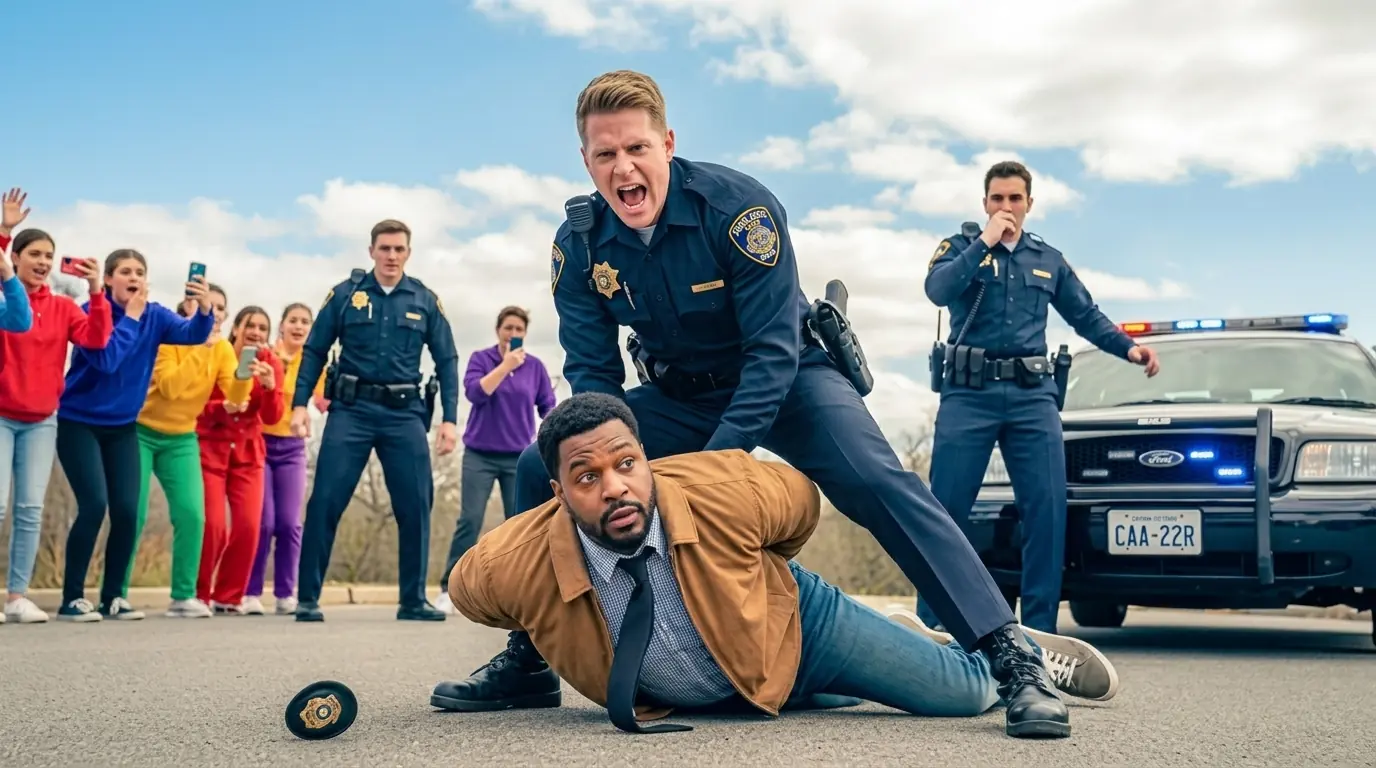
Hands shoved against hot asphalt, face down, a decorated detective became just another Black man.
Samuel lay motionless as Officer Brennan ransacked his car, tossing case files and personal items onto the street with calculated indifference. The afternoon sun beat down mercilessly on Samuel’s back.
“Hands where I can see them. You match the description of a robbery suspect,” Brennan barked, his knee pressing harder into Samuel’s spine.
Samuel’s police badge tumbled from his jacket pocket.
Brennan’s boot swiftly kicked it away.
“That looks fake. Probably bought it online,” he sneered.
Smartphones emerged from the growing crowd of onlookers, recording as a fifteen-year veteran detective with multiple commendations lay handcuffed on the ground like a common criminal.
What Officer Brennan did not realize was that today’s traffic stop would permanently alter both their careers.
Samuel Wilson navigated his unmarked sedan through the tree-lined streets of Oakridge, an affluent neighborhood on the city’s north side. The tension in his shoulders began to ease. After three weeks of undercover work infiltrating a drug trafficking operation, he was finally heading home.
His casual attire, worn jeans and a navy button-up, replaced his usual crisp suit, a necessary adjustment to blend in with his targets.
Two miles back, Officer James Brennan noticed the dark sedan and ran the plates without thinking. His dashboard computer displayed a BOLO alert.
Black male, thirty to forty, driving dark sedan, wanted for questioning in connection with armed robbery.
The actual description contained additional details: height, distinctive clothing, a specific car model. But Brennan’s eyes locked onto the simplified pattern.
Samuel spotted the patrol car in his rearview mirror. He had been followed before. His driving became a textbook demonstration of perfection. Turn signals activated well in advance. Complete stops at every sign. Precisely at the speed limit.
A familiar routine.
Brennan trailed the sedan for four blocks, searching for a reason to initiate contact. He did not wait for dispatch to respond to his plate query before activating his lights.
His right hand instinctively rested on his holster as he called in the stop.
“Possible 10-31 suspect, dark sedan, single occupant, male,” he reported, voice tight with anticipation.
The dispatcher’s voice crackled through his earpiece with registration details, but Brennan had already committed to his narrative. His body camera’s red light blinked as he stepped from his cruiser.
Samuel placed both hands on the steering wheel, visible through the window. His department ID sat in his wallet, badge in his jacket pocket. His heartbeat remained steady despite the familiar rush of adrenaline.
He took a deep breath.
“Third time this month,” he muttered to himself. “Same routine, different day.”
He mentally rehearsed the procedure he knew by heart.
Announce all movements before making them. Maintain a respectful tone regardless of provocation. Remember every word exchanged. Document everything.
As Brennan approached with his hand on his holster, his body camera captured every calculated step toward a confrontation neither man would forget.
Brennan positioned himself strategically behind the driver’s window, right hand still hovering near his weapon. He scanned the vehicle’s interior with practiced suspicion.
“License and registration,” he demanded flatly, offering no greeting or explanation for the stop.
Samuel kept his hands visible on the steering wheel.
“Officer, I’m going to reach for my wallet slowly.”
His voice carried the measured calm he used when de-escalating volatile suspects.
“Just hurry up,” Brennan cut him off, impatience sharpening his tone.
Samuel moved with deliberate precision, retrieving his wallet with his right hand while his left remained in plain sight.
“May I ask why I’m being pulled over today?”
Brennan ignored the question, eyes narrowing as he studied Samuel’s license. His expression flickered with confusion at the address, a high-end neighborhood that did not match his mental profile of the man before him.
“You match the description of a suspect in a robbery that occurred earlier today,” he finally responded, gaze shifting between Samuel and the license.
Samuel recognized the tactic: vague justification designed to provoke a reaction.
“Officer, I’m actually…”
“Step out of the vehicle,” Brennan interrupted sharply.
“May I ask why that’s necessary?”
“Step out now, or I’ll remove you.”
Brennan’s hand tightened around his holster.
Samuel weighed his options, knowing escalation served no one. He complied, movements slow and telegraphed.
“Officer, I’m a detective with Metro.”
The explanation died as Brennan grabbed Samuel’s arm, twisting it behind his back with unnecessary force.
“I said turn around. Hands on the car.”
Samuel felt himself being shoved against his own vehicle, the cool metal pressing against his cheek. The sudden movement caused his jacket to shift, his badge case sliding from his pocket.
“I’m telling you, I’m a police detective,” Samuel tried again, keeping his voice level despite the growing pressure on his arm.
Brennan saw something falling from Samuel’s pocket. A quick movement that triggered his trained response.
As Samuel’s badge hit the pavement, Brennan’s boot pinned his wrist to the ground, mere inches from the proof that could end this charade.
“On the ground. Now.”
Brennan forced Samuel down, driving a knee into his back with practiced efficiency.
Samuel’s cheek pressed against the scorching asphalt, the heat burning his skin. His badge lay just beyond his fingertips, glinting in the afternoon sun like a cruel taunt.
“I’m Detective Samuel Wilson, Major Crimes Division,” he stated through gritted teeth, maintaining his professional demeanor despite the growing pressure on his spine.
Brennan snorted dismissively.
“Yeah, and I’m the police commissioner.”
The handcuffs closed around Samuel’s wrists with a metallic click, tightened a notch beyond necessary.
Across the street, a woman stopped, phone raised. Others joined her, forming a semicircle of silent witnesses, their devices capturing each moment of Samuel’s public degradation.
A teenage boy whispered to his friend, eyes wide with uncomfortable fascination.
With Samuel secured on the ground, Brennan turned his attention to the sedan, yanking open the door without consent. He began rifling through the contents, tossing items onto the street with casual disregard.
A leather portfolio containing case files. A gym bag. A framed family photo that landed face down on the curb.
“Officer, you need a warrant or my consent to search my vehicle,” Samuel said, his voice strained but controlled.
The familiar weight of public humiliation settled over him, not just as a man wrongfully detained, but as a law enforcement officer treated like a common criminal before an audience of citizens he had sworn to protect.
“Probable cause,” Brennan responded with dismissive confidence, “looking for weapons or contraband related to the robbery.”
Among the onlookers, a woman with serious eyes recorded intently, methodically capturing different angles of the scene. Samuel noticed her, the only witness seemingly concerned with documentation rather than spectacle.
Their eyes met briefly. He saw determination in her gaze.
Brennan’s search uncovered Samuel’s police radio and secured department phone in the glove compartment. He held them up like trophies.
“What’s this? Police scanner? You impersonating an officer, too?”
His tone carried a hint of uncertainty now, the first crack in his confident facade.
“That’s department-issued equipment,” Samuel replied evenly. “My badge is on the ground right there. If you just look.”
Brennan’s boot connected with the badge case, sending it skittering beneath the car.
“That toy badge? Probably bought it online with the fake radio.”
Pulling out his phone, Brennan photographed Samuel’s ID, pretending to verify it through official channels. His movements had slowed, betraying the growing realization that he might have miscalculated.
But rather than correct course, he doubled down.
Samuel felt the rough pavement against his face, watched his professional dignity scattered across the street like the contents of his car. In this moment of forced frustration, a decision crystallized within him.
This would not be dismissed with an insincere apology. This would not disappear into administrative limbo like the other incidents.
This ends today.
As Brennan’s radio demanded a status update, Samuel noticed the officer had muted his body camera, but the dash cam’s unblinking eye still recorded everything.
Brennan pulled Samuel to his feet, keeping the handcuffs secured. Samuel stood tall despite the restraints, his eyes cataloging details with professional precision.
Officer J. Brennan. Badge number 6472. Central Division.
Every word, every action imprinted in his memory with crystal clarity.
A second patrol car arrived, lights flashing but silent. Sergeant Rivera stepped out, her expression tightening as she surveyed the scene. The scattered belongings, the recording bystanders, the handcuffed Black man standing with uncommon dignity.
“What’s going on, Brennan?” she asked, approaching cautiously.
“Robbery suspect, resisting. Possible police impersonation,” Brennan responded tersely, the clipped phrases revealing his growing uncertainty.
Rivera studied Samuel more carefully, her experienced eyes catching what Brennan had missed. The composed stance. The evaluating gaze.
Recognition flickered across her face.
“Sir, what’s your name?” she asked directly.
“Detective Samuel Wilson, Major Crimes Division, badge number 8541.”
His voice carried the unmistakable authority of command presence.
Rivera’s expression shifted immediately.
“Brennan, uncuff him now.”
“But Sarge…”
“Now, Officer.”
Her tone left no room for debate.
The handcuffs released with a metallic click. Samuel rotated his wrists slowly, the skin already showing signs of bruising where the metal had bitten too deep.
“My badge is under the vehicle,” he stated matter-of-factly.
Rivera knelt without hesitation, retrieving the badge herself. She examined it briefly before returning it with an apologetic nod.
“Detective Wilson.”
Brennan stood frozen, the color draining from his face as realization dawned.
Samuel straightened his clothes with deliberate movements, dignity reassembling with each gesture. He addressed Rivera directly, as though Brennan had ceased to exist.
“I’d like the incident number for this stop, please.”
“Look, there was a misunderstanding,” Brennan interjected, panic edging into his voice.
Samuel turned to him with ice in his gaze.
“Officer Brennan, this conversation is now between myself and your supervisor.”
Rivera provided the information while Brennan retreated to his cruiser, shoulders hunched in defensive posture.
Samuel collected his scattered belongings, placing each item back in his car with methodical care, particularly the family photo now bearing a cracked frame.
Once seated in his vehicle, doors closed against the outside world, Samuel allowed himself three deep breaths.
Then he reached for his phone.
The first call went to Captain Reeves, his direct supervisor. Samuel provided a clinical account of the incident: time, location, officer information, witnesses, potential evidence.
The second call was to Leon Harris, his friend of twenty years and a prominent civil rights attorney.
“Leon, it’s Sam. I need your help.”
His voice remained steady, controlled.
“No, I’m okay, but it’s happening again. This time, we have witnesses, recordings, and a dash cam.”
Through the rearview mirror, Samuel watched Brennan and Rivera engaged in tense conversation beside their patrol cars. His hands gripped the steering wheel tightly, then deliberately relaxed, one finger at a time.
“No, not like before,” he continued, resolution hardening his voice. “This time, we’re going all the way.”
Across town, Captain Reeves ended Samuel’s call and immediately dialed the police commissioner’s private line, reserved only for extraordinary circumstances.
The next morning, Samuel entered the precinct dressed immaculately in his detective suit, charcoal gray, perfectly tailored, badge and ID prominently displayed.
Officers parted before him in the hallway, word of yesterday’s incident having spread through the department like wildfire.
He proceeded directly to Internal Affairs, a manila folder tucked under his arm containing his official complaint.
Inside, he detailed the encounter with surgical precision: timestamps, exact quotations, specific actions, all recounted with professional detachment that made the events more damning than any emotional plea could.
Meanwhile, across the building, Officer Brennan sat rigidly in Lieutenant Morris’s office, sweat beading at his temples despite the aggressive air conditioning.
“Do you have any idea who you detained yesterday?” Morris asked, fingers steepled before him.
Brennan shrugged with false nonchalance.
“Some guy claiming to be a cop. I didn’t believe him.”
Morris slid a personnel file across the desk. The photo of Samuel Wilson stared up at them.
Fifteen years of distinguished service. Multiple commendations. Currently heading the Riverside Drug Trafficking Task Force.
Brennan’s eyes widened slightly, but his posture remained defensive.
“The description matched. I was doing my job.”
“Your body cam was muted during the search,” Morris’s voice hardened. “Care to explain?”
“Technical issue. Must have hit it accidentally.”
The lie hung awkwardly in the air.
“Internal Affairs received his complaint this morning,” Morris leaned forward. “And the commissioner’s office has personally requested the dash cam footage.”
Brennan’s confident facade cracked visibly.
“It was a routine stop.”
“Nothing about this is routine anymore,” Morris said, his tone grave. “Wilson isn’t just any detective. He’s part of the department’s new Accountability Division, handpicked by the commissioner herself.”
The color drained from Brennan’s face.
In the commissioner’s office, Samuel reviewed the dash cam footage alongside Captain Reeves and Commissioner Daniels. The video played with damning clarity. Samuel’s repeated attempts to identify himself, Brennan’s escalating aggression, the badge being kicked away.
“This isn’t about me,” Samuel said as the footage ended. “This is about every person who doesn’t have a badge to flash when they’re wrongfully detained.”
Commissioner Daniels nodded gravely.
“How do you want to proceed?”
Samuel’s response came without hesitation.
“By the book. No special treatment. No cover-ups. Just the policies as written, applied equally.”
As Samuel exited the commissioner’s office, his phone buzzed with a text from an unknown number.
Footage from three bystanders uploaded online. It’s going viral.
The video exploded across social media platforms within hours. News outlets picked up the story with blazing headlines.
Decorated Black Detective Profiled, Handcuffed by Officer.
Samuel’s name and face appeared on screens nationwide, his composed dignity contrasting sharply with Brennan’s aggressive tactics.
Samuel maintained media silence, returning to his regular caseload the following day. He declined special assignments or administrative leave, instead working methodically through the Riverside drug trafficking investigation as though nothing had changed.
Only the respectful nods from colleagues and the occasional whispered conversation that stopped when he entered a room betrayed the department’s awareness.
Across town, Officer Brennan sat in the police union office, tension radiating from his rigid posture as his representative delivered unwelcome advice.
“Just apologize,” the union rep urged, frustration evident in his voice. “Admit you made an error in judgment. Agree to sensitivity training. We can salvage this.”
Brennan shook his head stubbornly.
“I followed procedure based on the information I had. If he’d identified himself properly from the start…”
“The dash cam shows he tried,” the rep interrupted, tapping the laptop screen where the footage played on loop multiple times.
“Everyone’s overreacting.”
Brennan paced the small office.
“If this was just some regular guy, nobody would care.”
The rep sighed heavily.
“But he wasn’t just some regular guy. And that’s the whole point they’re making.”
Meanwhile, in a downtown law office, Samuel met with Leon, his attorney friend. They reviewed options spread across a conference table: department procedures, civil actions, potential reforms.
“The internal investigation is proceeding correctly for once,” Leon noted, adjusting his glasses. “But there’s a bigger opportunity here.”
Samuel looked up from the documents.
“I’m listening.”
“This could be the catalyst for the policy changes you’ve been pushing for years,” Leon said, eyes gleaming with strategic possibility. “Mandatory body cam usage, independent review of stops, data tracking for racial patterns.”
“Using my position as leverage,” Samuel said thoughtfully.
“Using your unique perspective as both victim and officer,” Leon corrected firmly. “You bridge two worlds. That’s power.”
In her university office, Dr. Maya Peterson, the woman who recorded the incident, uploaded a detailed analysis to her academic website. As a sociology professor specializing in police-community relations, she broke down the interaction with methodical precision.
Her post concluded: This isn’t an isolated incident. This is systemic, and the only reason we’re talking about it is because the victim had a badge of his own.
As Samuel prepared for the disciplinary hearing, a folder arrived on his desk containing evidence that Officer Brennan had a history of similar stops, all mysteriously lost in the system.
Samuel carried the unmarked folder into Captain Reeves’s office, placing it carefully on the desk between them.
The captain opened it, eyes narrowing as he examined the contents.
“Six complaints in three years, all from Black or Hispanic drivers,” Reeves said, flipping through the documents. “All dismissed for insufficient evidence or procedural issues.”
He looked up sharply.
“Where did you get this?”
“Anonymous source in records,” Samuel replied, standing with hands clasped behind his back. “Someone who’s been watching but afraid to speak up until now.”
Across town, Officer Brennan hunched at a corner table in the Blue Line, a bar frequented by law enforcement. He was surrounded by a small circle of supporters, officers who viewed him as a victim of political expediency.
“They’re hanging you out to dry,” Officer Mercer said, his twenty years on the force evident in the lines etched around his eyes. “Making an example because the media got involved.”
Brennan nodded, staring into his untouched beer.
“I was following training. Split-second decisions. You know how it is.”
Mercer clapped his shoulder with heavy solidarity.
“We’ve got your back. The union’s prepared to fight this all the way.”
Meanwhile, Dr. Peterson’s analysis gained traction beyond academic circles, cited by news outlets and advocacy groups alike. Her university email filled with speaking requests. The most significant arrived from city hall, an invitation to address the upcoming city council meeting on police reform.
Samuel received an identical invitation the same afternoon. He stared at it, pen tapping rhythmically against his desk as Captain Reeves stopped by his workstation.
“You going to accept?” Reeves asked, nodding toward the invitation.
Samuel’s pen continued its steady rhythm.
“If I speak publicly, they’ll say I’m just looking for attention or advancement.”
“And if you don’t?” Reeves challenged gently.
The tapping stopped as Samuel met his captain’s gaze, understanding the implicit message.
Silence serves no one.
At police headquarters, Commissioner Daniels held a press conference addressing the incident without naming names. Camera flashes punctuated her carefully measured statements, announcing a departmental review of traffic stop procedures and bias training.
“We are committed to ensuring that all citizen interactions are conducted with professionalism and respect,” she concluded.
A reporter stood, cutting through the practiced rhetoric.
“Is this just damage control because the victim happened to be one of your own?”
The commissioner paused, composure briefly slipping.
“It shouldn’t take a badge for someone to be treated with dignity and due process. That’s exactly the problem we’re addressing.”
The night before the disciplinary hearing, Samuel’s phone illuminated with a text from an unknown number.
Brennan’s dash cam footage from past six months shows a pattern. Check your email.
The disciplinary hearing convened in a sterile conference room. Fluorescent lights cast harsh shadows across tense faces.
Officer Brennan sat ramrod straight, flanked by union representatives in identical dark suits. Across the polished table, Samuel maintained a composed presence beside Captain Reeves, his expression revealing nothing.
The three-member panel, a deputy commissioner, a civilian oversight representative, and a senior Internal Affairs investigator, reviewed preliminary findings.
The room fell silent as the dash cam footage played on a wall-mounted screen, documenting the encounter in unforgiving detail.
When questioned, Brennan maintained his position.
“I acted on information provided in the BOLO. The suspect description matched, and I followed department protocols for a high-risk stop.”
His voice carried well-rehearsed conviction, but his fingers betrayed him, tapping nervously against his thigh beneath the table.
When Samuel’s turn came, he approached the testimony with the same methodical precision he brought to homicide investigations. He recounted the events factually, without embellishment or apparent emotion.
Then came the moment that shifted the atmosphere in the room.
“Detective Wilson,” the panel chair said, “for the record, could you explain your current assignment within the department?”
Samuel straightened imperceptibly.
“For the past eight months, I’ve been serving on the newly formed Justice and Accountability Task Force, a joint initiative between our department, the FBI, and the Department of Justice.”
Brennan shifted uncomfortably in his chair.
“The task force,” Samuel continued, voice steady and clear, “was created to investigate patterns of misconduct and civil rights violations within law enforcement agencies, including our own.”
The room fell silent, the implications settling like dust.
“My role includes experiencing our department’s procedures firsthand as both an officer and a citizen. I drive unmarked vehicles through different neighborhoods, observing how patrol officers conduct themselves when they believe no one is watching.”
Brennan’s face drained of color, his union representative leaning forward with sudden intensity.
“I’ve been stopped seventeen times in eight months.”
Samuel’s precise tone gave the number devastating impact.
“Only twice was I asked for my reason for being in the neighborhood before being ordered from my vehicle. Only once was I addressed as sir rather than with immediate hostility.”
He placed a folder on the table with deliberate care.
“This isn’t about one incident or one officer. This is about a pattern that exists throughout our department. Officer Brennan’s actions are a symptom of a larger problem.”
The folder opened beneath his steady hands.
“With the commissioner’s authorization, I’ve compiled data from Officer Brennan’s past six months of traffic stops.”
The pages inside contained meticulously organized statistics, color-coded graphs, and time-stamped images.
“Eighty-three percent were minorities, predominantly Black males. The average stop duration for white drivers was seven minutes. For Black drivers, twenty-four minutes. Searches were conducted in seventy-one percent of stops involving minorities versus fifteen percent for white drivers.”
Brennan stood abruptly, chair scraping against the floor.
“This is a setup. You’re twisting numbers to fit your agenda.”
“These aren’t my numbers, Officer Brennan,” Samuel responded, voice remaining measured despite the outburst. “They’re yours, from your own reports and dash cam footage.”
The panel members exchanged significant glances.
“I’m not here seeking punishment for Officer Brennan,” Samuel continued, surprising everyone in the room. “I’m here because our training, our culture, and our systems failed him as much as they failed me, and they’re failing our community every day.”
He closed the folder with finality.
“This case isn’t unique. It’s just uniquely visible because of my position. I represent thousands of citizens who experience these interactions without the protection of a badge, whose complaints vanish into administrative black holes, whose dignity is compromised without consequence, whose trust in law enforcement erodes with each unnecessary escalation.”
Samuel’s gaze swept the room, landing finally on Brennan.
“The question isn’t whether one officer acted inappropriately in one instance. The question is why our system makes such actions routine, expected, even rewarded, until they happen to one of our own.”
The civilian oversight representative leaned forward.
“What would you recommend, Detective?”
“Structural reform,” Samuel replied without hesitation. “Not scapegoating individuals, but transforming the metrics we use to evaluate policing success. Not just punitive measures, but proactive redesign of how we engage with our communities.”
As murmurs filled the room, Samuel noticed Dr. Peterson sitting quietly in the back row, her keen eyes missing nothing. Their gazes met briefly, professional recognition between two people committed to documentation and analysis rather than spectacle.
As the room erupted in commotion, Dr. Peterson discreetly passed Samuel a folded note.
The city council wants us both at tomorrow’s emergency session on police reform.
The disciplinary panel’s decision came swiftly.
Officer Brennan suspended without pay, pending a comprehensive investigation of his conduct history.
The police union issued an immediate statement defending Brennan while simultaneously distancing themselves from any potential impropriety, a contradiction that betrayed their weakening position as more evidence emerged.
Samuel exited the hearing room, avoiding the cluster of reporters stationed in the lobby. He found Dr. Peterson waiting in a quiet alcove away from prying eyes and cameras.
“Detective Wilson.”
She extended her hand.
“Dr. Maya Peterson, sociology department at City University. I specialize in police-community relations.”
“You were recording at the scene,” Samuel noted, recognition flickering in his eyes.
“One of several,” she confirmed. “But perhaps the only one with fifteen years of research data to contextualize what happened.”
They found a quiet conference room where Dr. Peterson spread charts and graphs across the table. Her analysis presented Samuel’s seventeen traffic stops against broader patterns throughout the city.
“Your experience isn’t unique,” she explained, indicating color-coded districts where stop disparities ranged from troubling to egregious. “But your position makes it impossible to ignore. You’ve created a perfect case study. Same person, same car, different outcomes based solely on perception of authority.”
Samuel studied the data with a detective’s trained eye.
“The system protects itself until it can’t.”
“Exactly.”
She tapped a particularly damning chart.
“Which is why tomorrow’s city council session matters. This isn’t just about one officer or one incident. It’s about using this moment to push for structural change.”
The city council chambers overflowed the following day, cameras broadcasting the proceedings live across multiple platforms. Samuel testified not as a victim seeking redress, but as an expert proposing solutions.
“We need mandatory body cams with automatic activation during stops,” he stated, voice carrying easily through the packed room. “We need data tracking to identify patterns of bias. We need community oversight boards with real power. And most importantly, we need to change how we measure police success, from number of stops and arrests to community trust and constitutional compliance.”
Commissioner Daniels followed his testimony, publicly supporting these measures. Her endorsement represented a significant political calculation, recognizing both the shifting public sentiment and the opportunity to position the department as reform-minded rather than resistant.
“Our officers deserve clear guidelines and metrics that align with our true mission, serving and protecting all citizens equally,” she concluded, careful to balance reform language with support for the rank and file.
Behind closed doors, resistance emerged from predictable quarters. Senior officers nearing retirement resisted changes to systems that had defined their careers. Union representatives interpreted reforms as implied criticism of their members. Middle managers worried about implementing new metrics and technologies with limited budgets.
Officer Brennan, suspended but still defended by union attorneys, made calculated appearances on sympathetic media outlets.
“I was doing my job the way I was trained,” he told a host known for pro-police commentary. “Now they’re changing the rules and blaming me for following the old ones.”
Samuel refused to engage in this personalization of the issue. When reporters ambushed him outside his apartment seeking response to Brennan’s claims, he remained focused on systemic concerns.
“This isn’t about one officer’s actions,” he stated calmly into the forest of microphones. “It’s about a culture that encourages those actions and a system that protects them.”
In his downtown office, Leon drafted policy language for the proposed reforms, translating conceptual goals into actionable regulations. City council members, sensing the public mood and the political advantages of championing change, competed to attach their names to various provisions.
The mayor, initially cautious about antagonizing the police union in an election year, pivoted toward reform after polling data revealed overwhelming public support. She announced a special commission co-chaired by Samuel and Dr. Peterson to oversee implementation of the new policies.
“This commission will ensure that changes aren’t just on paper, but in practice,” she declared at a press conference, positioning herself as a bridge between community concerns and law enforcement needs.
Behind closed doors, the police union negotiated frantically, trying to minimize substantive changes while saving face. They proposed cosmetic reforms, additional bias training sessions, voluntary body cam programs, non-binding community feedback mechanisms.
Samuel stood firm during these discussions.
“Half measures won’t work. We need real change, not window dressing.”
His position gained surprising support from Commissioner Daniels, who recognized that token reforms would only delay the inevitable while damaging the department’s credibility.
Her alliance with Samuel created fractures in the department’s old power structure, with younger officers and those from diverse backgrounds increasingly vocal in supporting meaningful change.
Several officers privately approached Samuel, sharing their own concerns about practices they had witnessed but felt powerless to address. These quiet conversations happened in parking garages, at coffee shops away from police hangouts, through encrypted messages, revealing the depth of dissatisfaction within the ranks themselves.
“I joined to help people,” a young patrol officer confided during one such meeting. “But the way we’re trained, the way we’re evaluated, it’s all about numbers, citations, stops, arrests. Nothing about whether we’re actually making the community better or safer.”
Dr. Peterson organized community feedback sessions throughout the city, ensuring reforms reflected actual community needs rather than administrative convenience. These meetings revealed consistent themes across diverse neighborhoods: desires for respectful interaction, transparent processes, and accountability when violations occurred.
“The community isn’t anti-police,” she reported to the commission. “They’re anti-abuse. They want officers who know their neighborhoods, understand their cultures, and treat them with basic dignity.”
The media narrative evolved from a single inflammatory incident to a movement for structural change. Samuel’s dual perspective, respected officer and profiled civilian, made him uniquely persuasive. He could speak the language of law enforcement while authentically representing the experience of those subjected to its abuses.
National attention followed. Other departments requested briefings on the proposed reforms. Civil rights organizations offered resources and expertise. Law enforcement journals published analyses of the emerging Metro Model of Constitutional Policing.
Throughout this whirlwind of activity, Samuel maintained his regular caseload, solving a double homicide in the Riverside case and coordinating with federal authorities to dismantle the drug trafficking operation he had infiltrated.
This visible commitment to his primary duties undermined critics who attempted to dismiss him as a publicity-seeking malcontent.
The city council unanimously passed the reform package after six weeks of intense negotiation.
The comprehensive policy included mandatory body cameras with automatic activation during all stops, searches, and arrests. Quarterly analysis of stop data to identify patterns of potential bias. An independent civilian review board with investigative authority. Revised evaluation metrics prioritizing constitutional compliance and community feedback. Enhanced training on de-escalation and implicit bias. Transparency requirements for complaint investigations. Early intervention systems to identify and address problematic officer behavior.
Implementation began immediately, with Samuel and Dr. Peterson’s commission overseeing the rollout. Initial resistance gave way to cautious adaptation as officers navigated the new expectations and technologies.
“Change this fundamental doesn’t happen overnight,” Samuel acknowledged during a department-wide briefing. “But it does happen if we commit to the process rather than just the paperwork.”
As the final vote on reforms approached, Samuel received an anonymous text message.
Back off or everyone learns about Santiago.
A case from his past that could undermine everything he had built.
Officer Brennan’s full disciplinary hearing convened three months after the initial incident. The intervening weeks had transformed both the department and public perception. What began as a single controversial traffic stop had catalyzed a city-wide reckoning with policing practices.
Brennan entered the hearing room with diminished presence, his once confident stride now hesitant. The row of union representatives flanking him appeared more obligatory than supportive, their expressions revealing the shifting political calculus within the department.
The evidence against him unfolded methodically, not just Samuel’s incident, but a pattern established over years. The panel presented a comprehensive analysis: targeted stops based on minimal justification, disproportionate force applied to minority subjects, procedural violations ranging from minor to significant.
Most damning was the technology evidence. Body camera footage accidentally muted during contentious moments. Dash cam angles conveniently obscured. Reports that minimized or mischaracterized civilian behavior to justify escalation.
As the evidence mounted, Brennan’s defense strategy shifted visibly from denial to deflection.
“I followed department culture,” he claimed, voice tinged with desperation. “I did what my field training officers taught me. I did what my sergeants expected. Everyone does the same things. I’m just the one who got caught.”
The panel chair leaned forward.
“Are you saying misconduct is acceptable if it’s common?”
Brennan’s posture collapsed slightly.
“I’m saying I was trained this way by FTOs who told me this is how real policing works. By supervisors who praised my proactive approach and high stop numbers.”
From his seat at the witness table, Samuel observed silently.
There was undeniable truth in Brennan’s words. He was partly a product of a flawed system that incentivized precisely the behaviors now being condemned.
The panel deliberated while Brennan waited in a small anteroom, his union representative preparing him for potential outcomes.
“They’re making an example of you,” the rep said frankly. “Best-case scenario, suspension without pay, sensitivity training, and probation. Worst case, termination.”
Brennan’s carefully maintained anger finally fractured, revealing the fear beneath.
“This job is all I have. I’ve got child support, a mortgage.”
His voice trailed off.
When called back in, Brennan stood stiffly as the panel delivered their decision.
Termination effective immediately.
The formal language, repeated violations of department policy, failure to activate required recording equipment, and actions unbecoming an officer, felt almost anticlimactic.
After months of escalating consequences, Brennan surrendered his badge and service weapon without comment, the ceremonial stripping of his professional identity performed under fluorescent lights rather than with the dignity of a retirement ceremony.
As he exited the hearing room, he passed Samuel in the hallway. Their eyes met briefly, the corridor suddenly empty despite its crowded benches.
“You’ve ruined my career,” Brennan said, voice low and bitter.
Samuel held his gaze steadily.
“You had seventeen opportunities to ruin mine before I even had a badge. Think about that.”
Later that evening, Samuel received a call from Captain Reeves regarding the threatening text about Santiago.
The investigation traced it to a former partner of Brennan’s, a desperate attempt to derail the reforms by hinting at professional misconduct.
The irony emerged as Reeves explained. The Santiago case, rather than being Samuel’s secret shame, stood as one of his finest professional moments.
Five years earlier, Samuel had testified against his own partner when he witnessed the officer planting evidence on a suspect. He had broken the unwritten code, the blue wall of silence, choosing justice over loyalty to a corrupt colleague.
“They thought Santiago would discredit you,” Reeves said. “Instead, it proves exactly why you’re the right person to lead these reforms.”
Samuel placed his phone down, staring at the wall of commendations in his apartment, recognition of cases solved, lives saved, justice served.
Among them hung a simple framed note from the Santiago family, thanking him for having the courage to speak truth when every institutional pressure pushed toward silence.
The next morning’s news carried Brennan’s termination as a footnote rather than a headline, evidence that the story had evolved beyond individual punishment to systematic transformation.
As news of Brennan’s termination spread through the department, Samuel received an unexpected message.
Brennan wants to meet privately, away from lawyers and reporters.
Six months after the incident, the reforms took visible root throughout the department. Body cameras activated automatically when officers exited their vehicles, the small lights blinking steadily during every civilian interaction.
Weekly traffic stop data appeared on public dashboards, analyzed for patterns that might indicate bias or problematic officer behavior.
The newly established civilian oversight board met in a renovated conference room at city hall. Its diverse members reviewed body camera footage, interviewed officers and complainants, and issued binding recommendations.
Their authority, initially contested by the union, now operated with grudging acceptance from even veteran officers.
Samuel led training sessions twice weekly, incorporating his experiences from both sides of the badge. New recruits and seasoned officers alike sat in rows as he presented real-world scenarios, teaching not just tactical approaches, but constitutional awareness and recognition of implicit bias.
“The goal isn’t to make you hesitate in dangerous situations,” he told them. “It’s to help you accurately identify which situations are truly dangerous versus those where your training or assumptions might be misleading you.”
The department’s success metrics had undergone fundamental revision. Computer screens that once displayed arrest totals and citation counts now tracked constitutional compliance rates and community satisfaction scores.
Promotions increasingly considered these new metrics rather than traditional enforcement statistics.
Dr. Peterson’s research documented the early impact. Six months of data showed complaints down thirty percent. Use-of-force incidents reduced by twenty-five percent, while serious crime clearance rates remained stable.
Her academic papers on the Metro Model gained national attention, cited by police departments and civil rights organizations alike. Delegations from other cities arrived weekly to observe the transformed systems.
Samuel found himself speaking at police academies across the country, sharing not just the mechanics of the reforms, but the philosophy behind them.
“The goal isn’t to make policing weaker,” he explained to a class of cadets in a neighboring state. “It’s to make it more just, more constitutional, and ultimately more effective. Constitutional policing isn’t just morally right. It’s practically superior because it builds the community trust that makes solving crimes possible.”
Not everyone embraced the changes. A cadre of older officers opted for early retirement rather than adapt to new expectations. Some veteran supervisors claimed the new approach was soft on crime or created unnecessary paperwork.
But younger officers, especially those from diverse backgrounds, thrived under standards that aligned with their original motivations for joining the force.
Dr. Peterson transitioned from external observer to permanent adviser on community relations. Her academic rigor complemented Samuel’s practical experience. Together, they developed training modules that transformed abstract concepts like procedural justice into concrete daily practices.
Samuel’s promotion to lead the permanent Accountability Division came without ceremony. A simple email from the commissioner confirmed his appointment. The role ensured the reforms would outlast any single administration or political moment.
In a quiet moment between meetings, Samuel and Captain Reeves shared coffee in the break room.
“The badge didn’t protect me that day,” Samuel reflected, turning his credential case in his hands. “But it gave me the platform to protect others who don’t have one.”
Reeves nodded thoughtfully.
“The system changes slowly, but it does change when pushed from within.”
As Samuel left the precinct that evening, he spotted a familiar face across the street.
Officer Brennan, now in a private security uniform, watched him from the shadows.
The evening air carried the first hint of autumn as Samuel crossed the street toward the figure standing in the shadow of a downtown office building.
Brennan looked different, the assertive posture of his police days replaced by something more subdued. His security uniform fit poorly, as though designed for someone else entirely.
“Detective,” Brennan acknowledged stiffly as Samuel approached.
“It’s just Samuel today,” he replied, maintaining a comfortable distance between them. “Off duty.”
An awkward silence stretched between them, filled with the ambient sounds of the city: passing cars, distant conversations, the electronic hum of streetlights flickering to life.
“I saw you on the news,” Brennan finally said, gaze fixed somewhere beyond Samuel’s shoulder. “Talking about the reforms.”
Samuel waited, letting the moment breathe. The confrontation he once anticipated no longer seemed necessary.
“You could have made it personal,” Brennan continued, the words coming with evident difficulty. “Made it all about me. But you didn’t.”
Samuel shrugged slightly.
“It was never about you. You were just doing what the system rewarded.”
Brennan’s eyes finally met his.
“That doesn’t excuse it.”
“No,” Samuel agreed simply. “It doesn’t.”
The silence returned, less tense than before. A taxi honked in the distance. Two pedestrians passed, oblivious to the significance of the exchange they were witnessing.
“I’m in a program,” Brennan said eventually, shifting his weight. “For former officers. Counseling, bias training, conflict resolution. It’s…”
He searched for the right word.
“Opening my eyes.”
Samuel nodded.
“Good.”
“I can’t get my badge back,” Brennan continued, his tone a complex mixture of resignation and emerging purpose. “But I’m working with at-risk youth now, trying to build bridges instead of walls.”
He hesitated, then added, “I owe you an apology.”
“You owe an apology to every person you stopped without cause,” Samuel corrected gently but firmly. “I’m just the one who had the power to make it matter.”
Brennan absorbed this, nodding slowly.
“Fair enough.”
They parted without ceremony, not as friends, but as two men acknowledging a shared humanity that had once been obscured by badges and biases.
Samuel watched Brennan return to his post, then continued his walk home, the weight on his shoulders somehow lighter.
The following week, Samuel and Dr. Peterson spoke at a community forum hosted in a church basement. The audience represented the city’s diverse neighborhoods, faces attentive as they discussed the ongoing implementation of reforms.
During the question period, a young Black man stood.
“What’s the point of reforms if the problem is the system itself? Aren’t we just putting a fresh coat of paint on a crumbling foundation?”
Samuel considered this thoughtfully.
“Systems are made of people. Change the people, their training, their incentives, their accountability, and you change the system.”
Dr. Peterson added, “And when you can’t change people from within, you create external pressures that force adaptation. That’s why community involvement in these reforms isn’t optional. It’s essential.”
As attendees mingled afterward over coffee and cookies, Samuel noticed a patrol officer through the window handling a situation on the street outside.
The officer spoke with a group of teenagers, posture relaxed, body camera blinking, interaction conducted with evident respect on both sides.
“That’s why we do this,” he told Dr. Peterson, nodding toward the scene. “For that kid who won’t be humiliated today, because an officer learned a better way.”
Samuel returned to his apartment, passing the framed commendations on his wall, now joined by news clippings documenting the reforms. He ran his finger along the edge of his badge, feeling the weight of both its authority and its responsibility.
Tomorrow would bring another training session, another committee meeting, another opportunity to translate painful experience into meaningful change.
The work continued.