"Back up from the door. Hands where I can see them."
"You're already in my face. This is my car. Key fob's right here."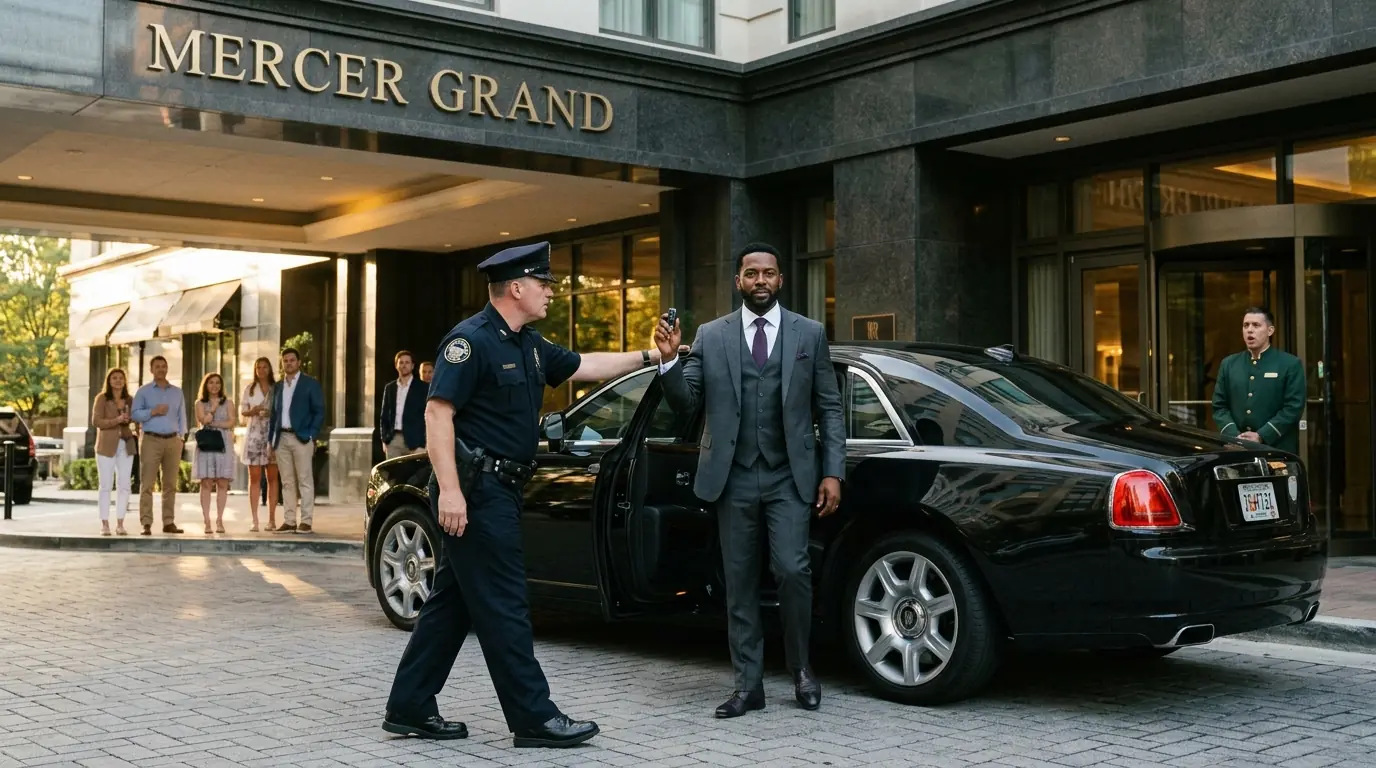
"Yeah, you fit the suspect description. Step away or I'll put you in cuffs."
"Check the plate first. I'm not moving just because you're yelling."
"Last warning."
"Then do it."
Officer Scott Lemon pulled up to the Mercer Grand in Buckhead, Atlanta, looked across the pavement, and decided a Black man in a tailored suit stepping out of a Rolls-Royce Ghost was a problem that needed handling. He got out of his patrol car, marched straight toward DeShawn Mercer, threw out a suspect description that nobody could verify, and ordered him to step away from the vehicle like he was a criminal standing outside someone else's property.
DeShawn Mercer didn't step back, didn't lower his voice, and didn't give Officer Scott Lemon a single inch. What that officer didn't know, as he stood there puffed up with a badge and a bad assumption, was that the name on the building directly above his head was the same name on the business card in the man's pocket—and that this moment was about to detonate his entire career.
It was a warm Friday evening in Buckhead, and the streets outside the Mercer Grand were doing what they always did at that hour. Valets cut across the forecourt, a town car idled at the curb, and guests flowed in and out through the revolving glass doors while Atlanta hummed behind them. It was the kind of evening where everything looks polished and nothing looks complicated.
Just off the entrance, a bellman named Andre was working the tail end of a check-in: three suitcases, a garment bag, and a guest who couldn't decide whether he wanted the cart brought around or the bags carried up separately. Andre handled it the way he handled everything—quietly and without complaint—stacking the last bag onto the brass cart and steering it toward the entrance with the efficiency of someone who had done this particular job several thousand times.
DeShawn Mercer was forty-four years old, and he had been building things since before most people his age had figured out what they wanted to build. He grew up in Southwest Atlanta, the kind of neighborhood that teaches you early that nothing is handed to you and everything worth having requires you to outwork the room. He put himself through Georgia State on a combination of scholarships and sheer stubbornness, spent his twenties grinding through commercial real estate deals that most people his age wouldn't have had the nerve to attempt, and by his mid-thirties had converted a single property investment into a hospitality group that now operated four luxury hotels across the Southeast.
The Mercer Grand was his flagship. Twelve stories of glass and stone sitting at the top of Buckhead's most coveted stretch, it bore his name above the entrance in brushed gold letters three feet tall. He didn't come here to be seen; he came here because it was his.
He stepped out of the Ghost in a charcoal suit, moving with the unhurried confidence of a man who had nowhere to be except exactly where he already was. He handed his keys to the valet without breaking stride, exchanged a quick nod, and turned toward the entrance.
He made it three steps.
Officer Scott Lemon had been working the Buckhead corridor for six years. He knew the hotels, the restaurants, the rhythm of the neighborhood, and somewhere in those six years, he had developed the kind of instincts that had less to do with actual police work and more to do with a deeply ingrained sense of who he thought belonged in certain spaces and who didn't. He was parked half a block down when the Ghost pulled up. He watched the car, watched the door open, watched DeShawn step out in that suit and move toward the entrance like he owned the place, and something shifted in Lemon's chest that he probably would have called gut instinct—and that everyone watching the footage later would call something else entirely. He was out of his vehicle and moving across the pavement before DeShawn had taken his third step.
"Hey, stop right there." Lemon's voice cut clean across the forecourt.
DeShawn slowed and turned. Lemon was already closing the gap, one hand loose at his side, posture tight, eyes fixed.
"We've had reports in this area. You match a description. I'm going to need you to step away from the vehicle."
DeShawn looked at him—calm, measured, without a flicker of panic. "What description?"
"Sir, step away from the vehicle."
"I heard you," DeShawn said, his voice low and controlled. "I'm asking what description. Because that's my car and I'm not going anywhere."
Lemon stepped closer, deliberately shrinking the space between them. It was a move designed to make people feel small, to make them take a step back and recalibrate. DeShawn didn't take a step back. He held his ground, his eyes locked on Lemon's, his voice so steady it almost sounded rehearsed.
"I'm not stepping away from my car, and I'm not going to stand here and be intimidated."
Lemon's jaw tightened. His hand moved to his radio. "I'm going to need you to calm down."
"I am calm," DeShawn said. "You're the one who stopped me for nothing."
The words landed flat and precise. A few feet away, a couple who had just stepped out of the hotel stopped walking. A valet froze mid-stride. The forecourt that had been humming with routine evening activity thirty seconds ago had gone very, very quiet.
Andre had pushed the brass luggage cart through the entrance doors and was halfway across the lobby when something made him look back through the glass. He stood there for exactly two seconds, long enough to understand what he was seeing. Then he turned toward the front desk and walked fast.
Outside, Officer Scott Lemon had no idea what had just been set in motion. The forecourt of the Mercer Grand had gone quiet in the way that public spaces go quiet when something uncomfortable is happening and nobody knows whether to intervene or pretend they aren't watching. The couple near the entrance hadn't moved; the two valets stood frozen near the car bay. The town car that had been idling at the curb hadn't shifted in over a minute. Everyone could see what was happening, but nobody was doing anything about it yet.
Officer Scott Lemon was still talking, still issuing instructions in that clipped, authoritative tone designed to signal that the conversation was not a conversation. It was a set of directions, and DeShawn Mercer was expected to follow them. He wanted ID, he wanted DeShawn away from the vehicle, he wanted compliance, and he wanted it now.
DeShawn reached into the inside pocket of his jacket slowly and deliberately, the way a man moves when he knows he is being watched and wants every motion on record. He pulled out a card and held it out. It was not his driver's license; it was a business card. Clean white stock, minimal design, his name printed across the center in a clean black font.
Lemon took it with two fingers and looked at it for about half a second before his eyes came back up. "I'm going to need actual identification, sir."
"You have my name," DeShawn said. "Look it up."
Lemon wasn't interested in looking anything up. He pushed the card back and repeated his demand for a government-issued ID, his voice carrying that practiced edge that made requests sound like final warnings. DeShawn didn't reach for his wallet. He stood exactly where he had been standing since this started and looked at Lemon with an expression that wasn't anger and wasn't fear. It was patience—the particular kind of patience that comes from a man who already knows how this ends and is simply waiting for everyone else to catch up.
That was when the front doors of the Mercer Grand opened.
James Caldwell had been the general manager of the Mercer Grand for four years, and in those four years, he had handled situations that most hotel managers never encounter in an entire career. He was not a man who moved quickly without reason, but when Andre had come across that lobby and told him what was happening outside, James had not stopped to ask follow-up questions. He came through those doors with his jacket on and his eyes already on DeShawn, moving across the forecourt with the kind of purposeful stride that told everyone watching that he knew exactly where he was going and exactly why.
He didn't look at Lemon first. He walked directly to DeShawn, extended his hand, and said, "Mr. Mercer, I'm sorry about this. We've been expecting you."
The shift in the air was immediate. Lemon's posture changed slightly—a small adjustment, barely visible, but there. His chin came down a fraction. His eyes moved between James and DeShawn, and then back again.
James turned to face him then, professional and composed, and introduced himself as the hotel's general manager. He explained calmly and without any particular urgency that the man Officer Lemon had stopped was DeShawn Mercer, the founder and owner of the Mercer Grand, and that he had arrived for a scheduled visit to the property.
Lemon looked at James the way people look at information they have decided in advance not to accept. "Sir, I'm going to need you to step back. This is a police matter and I'm not finished."
"I understand," James said, not moving. "I just want to make sure you have the full picture."
Lemon didn't want the full picture. He wanted the situation to resolve in the direction he had already decided it was going to go, and the arrival of a hotel manager with a calm voice and a firm posture was not part of that plan. He told James again to step back. He reached for his radio and called for a second unit, framing it as standard procedure for a stop that was escalating, even though the only thing that had escalated was the number of people who could now see that he had no legitimate reason for any of this.
Andre had come back out through the entrance doors by then and was standing just behind James, close enough to be present and far enough back to be professional about it. A second valet had drifted over without quite meaning to, drawn by the gravity of something that was clearly more than a routine interaction. The small crowd that had been watching from a polite distance wasn't so distant anymore.
DeShawn hadn't said a word since James came out. He didn't need to. He stood with his hands relaxed at his sides and let the scene speak for itself, watching Lemon work through the situation with the slow, grinding energy of a man who had committed to a position and didn't know how to walk it back without losing face. Every order Lemon issued, every attempt to reassert control, every time he told someone to step back or called this a police matter—it all looked worse than the thing before it because none of it was connected to anything real.
There was no suspect. There was no description. There had never been either of those things. What there had been was a Black man stepping out of an expensive car in front of an expensive hotel, and an officer who had looked at that image and decided it required his intervention.
James tried one more time. He told Lemon directly and without aggression that he could confirm DeShawn's identity, that DeShawn was not a guest at the hotel but the owner of it, and that whatever report had prompted the stop, it did not involve the man standing in front of him.
Lemon's response was to tell him that he would sort out the details once he had finished conducting his stop, and that until then, everyone needed to give him space to do his job.
It was at that point that a woman standing near the entrance of the hotel, who had been watching the entire exchange from the moment Lemon crossed the forecourt, quietly raised her phone and pressed record. She wasn't the only one. Across the street, a man who had slowed down on the pavement when he noticed the commotion had been filming for the last several minutes already, his phone angled through the gap between two parked cars, steady and uninterrupted.
Lemon didn't notice either of them. He was too busy managing a situation that had already slipped entirely out of his control, though he hadn't admitted that to himself yet. He was still issuing instructions, still talking about procedure and protocol and the right way to handle a stop, still standing in front of DeShawn Mercer with the full weight of his badge and his assumptions, completely unaware that both of those things were about to be examined very carefully by a very large number of people.
DeShawn watched him and said nothing. He had made his position clear from the first moment, and he hadn't moved from it once. The car was his. He wasn't stepping back. He wasn't going to be intimidated. Everything else that needed to happen was already in motion, set off the moment Andre walked back through those lobby doors and picked up the phone.
The second unit Lemon had called for was still two minutes out. A lot was going to change in two minutes.
The second patrol car rolled up to the Mercer Grand with no sirens, just headlights cutting across the forecourt as it pulled to a stop behind Lemon's vehicle. Officer Dana Reeves stepped out, took one look at the scene in front of her, and went still for just a moment. Not long—just long enough to read the room.
There was a man in a charcoal suit standing beside a Rolls-Royce Ghost, a hotel general manager standing three feet away with his arms at his sides, a small crowd that had stopped pretending not to watch, and Scott Lemon in the middle of all of it, radio in hand, jaw tight, holding a position that was getting harder to justify with every passing second. Reeves walked over to Lemon and spoke to him quietly, her voice low enough that the crowd couldn't hear. She asked him what he had. Lemon told her about the reports, the description, the stop.
Reeves looked at DeShawn while Lemon talked. Then she looked back at Lemon. Whatever he saw in her expression, it wasn't the backup he was expecting. She asked him one question: "What exactly was the description?"
Lemon answered.
Reeves was quiet for a moment. Then she said, again very quietly, "Scott, that's not a description. That's a general physical characteristic shared by half the men in this city."
Lemon told her he was handling it. Reeves took a small step back and said nothing more to him. She wasn't going to fight him in front of an audience, but she wasn't going to stand beside him and pretend the stop made sense either. She positioned herself just off to the side, arms folded, and watched. Her presence was professional; her silence was its own kind of statement.
James Caldwell had been watching the exchange between the two officers. He had given Lemon every reasonable opportunity to course-correct, and Lemon had declined every single one. So James reached into his jacket pocket, pulled out his phone, and opened the browser. He pulled up the Mercer Grand's official website, navigated to the leadership page, and walked the three steps toward Lemon with the screen facing outward.
"Officer," he said, steady and direct, "I need you to look at this."
Lemon looked at the phone the way he had looked at everything else James had offered him—with the practiced skepticism of a man who had decided the outcome before examining the evidence. But he looked, and what was on that screen didn't give him anywhere to go.
The Mercer Grand website, the about page: a professional photograph of a man in a charcoal suit—the same suit, the same face—standing in what was clearly the lobby of the hotel directly behind them, the brushed gold lettering visible through the glass in the background. Underneath the photograph, in clean black text: *DeShawn Mercer, founder and chief executive officer, Mercer Hospitality Group.*
Lemon stared at the screen. Nobody spoke. The forecourt was so quiet that the ambient noise of Buckhead traffic two blocks over was suddenly audible. Lemon's eyes moved from the phone to DeShawn, and then back to the phone. His jaw worked slightly, like he was chewing on something that wasn't going down easily.
DeShawn watched him look at that screen and didn't say a word. He didn't smile, didn't shift his weight, didn't do anything that could be read as triumphant or theatrical. He just stood there and let the information land at whatever speed it was going to land. It took Lemon a few seconds longer than it should have.
When he finally looked up from the phone, his entire bearing had changed. The clipped authority was gone—the forward lean, the tight jaw, the hand near the radio. All of it had quietly deflated, replaced by something that was trying very hard to look like composure and not quite getting there. He cleared his throat, looked at DeShawn, and then did the thing that people do when they have run out of road but haven't yet figured out how to admit it. He tried to pivot like nothing had happened.
"Mr. Mercer," he said, and the shift to the formal address was so abrupt it was almost jarring. "I apologize for any inconvenience. We did receive reports in this area, and I was following standard procedure for—"
"What did the suspect look like, officer?" DeShawn's voice was quiet, not raised, not aggressive—just seven words dropped into the middle of Lemon's pivot like a stone dropped into still water.
Lemon stopped talking.
"You told me I matched a description," DeShawn said, using the same measured tone, the same unhurried pace. "I'd like to know what that description was. Because I've been standing here for fifteen minutes and you haven't been able to tell me once."
Lemon opened his mouth, then closed it. The crowd that had gathered along the edge of the forecourt had gone completely still. Officer Reeves was looking at the pavement. James Caldwell stood exactly where he had been standing, phone still in his hand, watching.
"I was acting on information I received," Lemon said finally.
"What information?"
Another silence followed, longer this time. DeShawn let it sit there. He didn't fill it. He didn't push further or raise his voice or give Lemon anything to react against. He simply stood in the silence and let Lemon drown in it at his own pace, because the silence was the answer. The silence was the whole story. There was no description. There had been no report. There was a Black man who stepped out of an expensive car and an officer who decided that image needed explaining, and everything that had happened in the last fifteen minutes had flowed directly from that single, baseless decision.
The woman near the entrance still had her phone raised. The man across the street hadn't moved. Both of them were getting everything on video.
Lemon tried one more time to find solid ground. He told DeShawn that he understood he was the owner of the property, that he had no intention of making this into something it wasn't, and that he hoped they could put this behind them. He was talking faster now, the words coming out slightly ahead of his thoughts, trying to close a door that had been blown completely off its hinges. He mentioned procedure twice more. He used the word 'unfortunate'. He looked at a point somewhere between DeShawn's shoulder and the middle distance, because looking directly at the man he had just spent fifteen minutes trying to push around had apparently become too difficult.
DeShawn listened to all of it without interrupting. When Lemon finished, he was quiet for a moment. Then he said simply and without heat, "You stopped me because of what you assumed when you saw me get out of that car. Everything else you've said tonight has been an explanation built around that assumption, and we both know it."
Lemon said nothing.
"I want your badge number," DeShawn said, "and your supervisor's name."
It wasn't a request delivered with anger. It wasn't a threat or a performance. It was a man who had been through something that should never have happened, who had kept his composure through every second of it, and who was now methodically collecting what he needed.
Lemon recited his badge number, his voice flat. James wrote it down on his phone without being asked.
Reeves had not said a word since her exchange with Lemon at the start. She stepped forward now, introduced herself to DeShawn, gave him her own badge number before he even asked for it, and told him that she understood if he wanted to file a formal report and that she would not stand in the way of that process. It was a small gesture, but in the context of what had just happened, it carried weight.
DeShawn acknowledged her, looked back at Lemon one final time, and then turned toward the entrance of the Mercer Grand. James fell into step beside him. Andre, who had come back outside at some point during the exchange and had been standing near the door, pulled it open as they approached.
DeShawn walked through the entrance of his own hotel without looking back.
Behind him, Officer Scott Lemon stood on the forecourt in front of a building that bore another man's name, in front of a crowd that had seen everything, in front of two phones that had recorded all of it, and tried to figure out what to do with himself. There was no good answer to that question. There was no version of the next few hours that was going to be comfortable.
The video was already moving. He just didn't know it yet. Across the street, the man with the phone lowered it, looked at the footage he had captured, and opened his social media app.
It was 7:43 in the evening in Buckhead, Atlanta. By midnight, Officer Scott Lemon's name would be known across the country.
The video didn't go viral slowly. It didn't build over days or trickle through shares until it found an audience; it detonated. By 10:00 that Friday night, it had been viewed over two million times. By midnight, it had been picked up by three national news outlets. By Saturday morning, Officer Scott Lemon's name was known in every major city in the country, and the comment section of every platform that carried the footage was saying the same thing in a thousand different ways: that what people had watched was not an isolated mistake, but a pattern with a face on it.
The Atlanta Police Department released a statement on Saturday afternoon. It was carefully worded in the way that institutional statements always are when the institution is trying to say as little as possible while appearing to say something meaningful. They acknowledged the incident. They said it was being reviewed. They used the word 'thorough' twice and the word 'accountability' once, and committed to absolutely nothing concrete. It satisfied nobody.
What came next moved faster than the statement did. By Sunday, Internal Affairs had opened a formal investigation into the stop. The footage had been reviewed, the timeline reconstructed, and the central finding was the same one that everyone watching the video had reached within the first thirty seconds: there was no suspect description on record for that area that evening. There had been no report called in. There was nothing on file that gave Officer Scott Lemon any legitimate basis for that stop. He had approached DeShawn Mercer on assumption alone, and everything he had said during the stop had been constructed around that assumption in real time.
On Monday, the Atlanta Police Department announced that Officer Scott Lemon had been suspended without pay pending the outcome of the Internal Affairs review. The announcement was brief, bureaucratic, and deliberately stripped of anything that sounded like genuine accountability. But the suspension was real, and the absence of a paycheck had a way of making things real in ways that statements did not.
The forced public apology came four days later. Lemon read it from a sheet of paper at a press conference that lasted eleven minutes. He expressed regret for how the situation unfolded. He said the stop was not motivated by bias. He used the word 'professional' three times in reference to himself. Nobody in the room believed him, and the footage of the apology was immediately cut alongside the footage of him on that forecourt, so that anyone who watched one watched both. The contrast did not help his case.
DeShawn Mercer gave one interview. He sat down with a journalist five days after the incident—calm, precise, dressed in a dark suit—and he said what needed to be said without theatrics and without rage. He talked about what it felt like to stand in front of his own building and be treated like a threat. He talked about the employees who watched it happen and the guests who stood on that forecourt and witnessed a man being profiled in plain sight.
He said that the most dangerous thing about what Officer Lemon did was not that it happened to someone who owned the hotel. It was that it happens every day to people who don't—people who don't have a general manager who can walk out and confirm their identity, people who don't have a website with their photograph on it, people who have nothing but the truth and have to stand there and hope that's enough.
He didn't file a lawsuit. He didn't hold a rally. He gave that one interview, made his position clear, and then he went back to work.
The video kept speaking without him. That was the thing about the footage; it didn't need narration or commentary or anyone to explain what it showed. Fifteen minutes of a man standing in front of his own hotel being told he didn't belong there—that was the whole story. Everything Lemon said, every order he issued, every attempt to justify a stop built on nothing, it was all there, unedited, in full.
DeShawn Mercer had built something real in a city that told people like him to aim lower. He had put his name on a building and filled it with people he employed and guests he welcomed and a standard of excellence that spoke for itself every single day. Officer Scott Lemon had looked at all of that and seen a problem.
The only problem that existed that Friday evening in Buckhead was the one Lemon brought with him when he got out of his car.