The first child started crying when Officer Wade Keller picked up the garden hose.
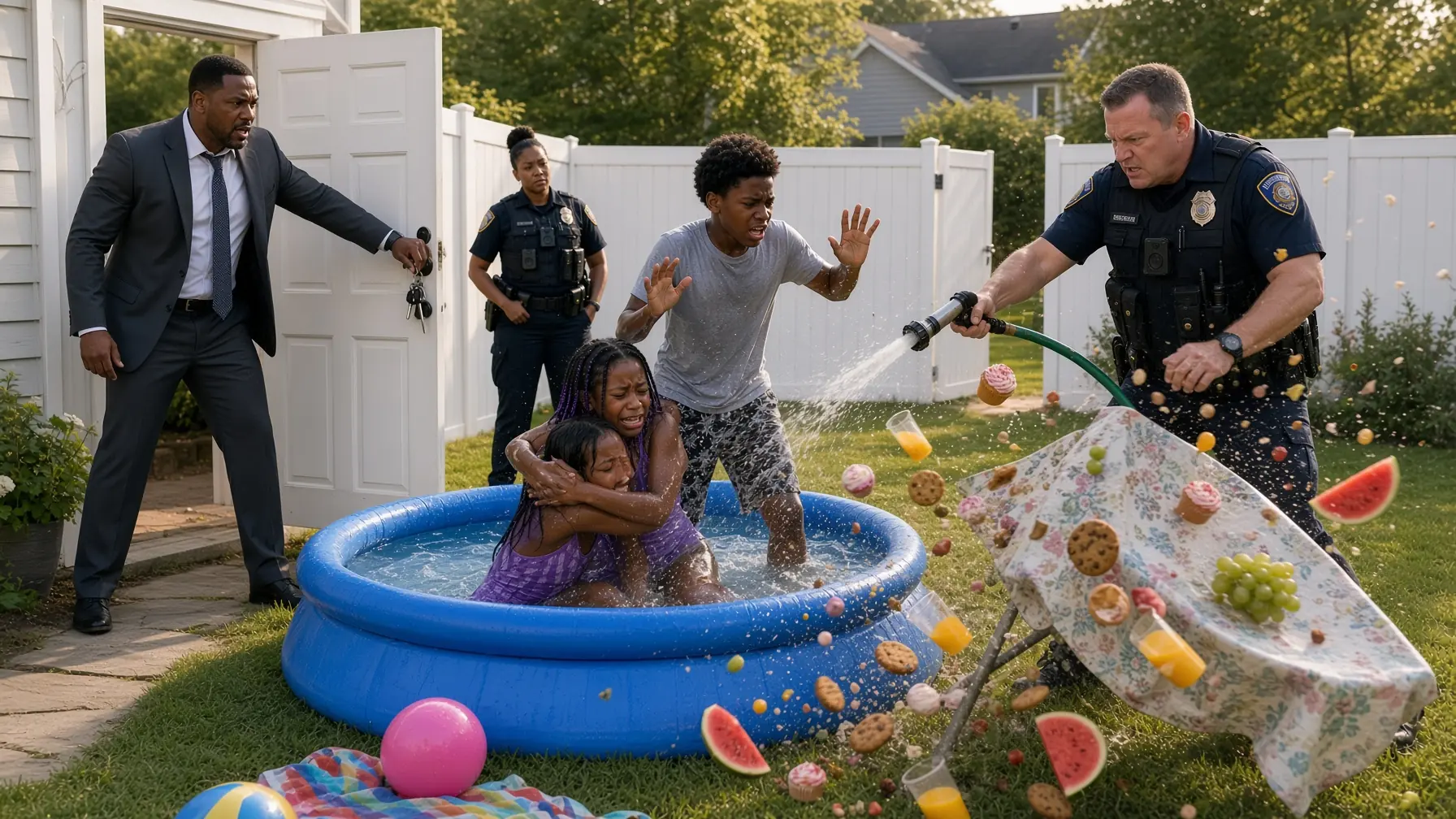
Until that moment, seventeen-year-old Malik Reed had believed the situation could still be explained. There were two police officers standing inside his family’s fenced backyard without permission, yes, and one of them had already ordered eight children out of the swimming pool as though they were suspects instead of kids spending a Saturday afternoon together. But Malik kept telling himself that somebody would check the address, realize there had been no emergency, and leave. Then Keller twisted the brass nozzle, aimed it toward the patio, and sent a hard stream of cold water directly across three children who were standing beside the pool in dripping swimsuits.
Eleven-year-old Maya screamed.
Nine-year-old Noah threw both hands over his face.
A smaller girl named Sophie slipped backward against a lounge chair and began crying so loudly that the music still playing from the outdoor speaker disappeared beneath her sobs. Keller lowered the hose only long enough to shout, “I told you all to move away from the pool!” Then he sprayed again, sweeping the stream across their legs and torsos as if the children were animals he was trying to push out of a yard.
Malik stepped forward.
“Stop spraying them!”
Keller turned the nozzle toward him.
“Back up.”
“They’re kids!”
“I said back up.”
The water struck Malik in the chest.
His white T-shirt flattened against him instantly.
For a second, nobody moved.
Then Officer Travis Monroe, Keller’s younger partner, said quietly, “Wade, that's enough.”
Keller did not even look at him.
Instead he threw the hose onto the concrete, marched toward the long folding table beside the patio, and shoved it sideways with both hands.
Watermelon wedges slid first.
Then bowls of strawberries.
Cupcakes.
Cookies.
Candy.
Paper plates.
Two glass drink dispensers tipped over and shattered near the table legs. Lemonade spread across the patio in a pale yellow sheet while a tray of chocolate brownies landed frosting-side down beside the pool. Eight children stared at the destruction with the peculiar silence children sometimes fall into when something feels too wrong to understand.
Twelve-year-old Ava Reed looked at the ruined food.
Then at Keller.
“That was ours.”
Keller pointed toward the back door.
“Inside. All of you.”
Ava’s face crumpled.
Malik moved between the officer and his little sister.
“You can't come into our house.”
Keller gave him a hard smile.
“Son, I’m already on your property.”
Malik looked toward the side gate.
It hung open behind the officers.
Nobody had invited them through it.
Then Keller said the sentence that would later become the center of an internal-affairs investigation.
“Your father isn't here, your mother isn't here, and right now I’m the adult in charge.”
Malik stared at him.
He knew his father would be home soon.
What he did not know was that Marcus Reed was already turning onto Willow Crest Drive.
And Officer Wade Keller had just chosen the worst possible moment to demonstrate exactly what he believed a badge allowed him to do when no other adult was watching.
The Reed family lived in Hawthorne Lakes, an upper-middle-class neighborhood outside Richmond, Virginia. The subdivision had two man-made ponds, sidewalks, a clubhouse, and large detached homes arranged along streets with names like Willow Crest, Linden Chase, and Fox Hollow. There was no gate and no private security, but residents sometimes behaved as though the entrance sign represented an invisible border between people who belonged and people who required explanation.
Marcus Reed had bought 318 Willow Crest six years earlier.
The backyard was the reason.
It was not enormous, but the previous owner had installed a rectangular in-ground swimming pool surrounded by a broad concrete patio and a six-foot privacy fence. Marcus had almost walked away from the house when he saw the maintenance estimate. His children had stared at the water through the sliding glass doors as though they had discovered an ocean.
He bought the house.
By the time Malik was seventeen, the pool had become the unofficial center of his group of friends.
Marcus had rules.
No swimming alone.
Nobody under thirteen without an older teenager present.
No diving into the shallow end.
No glass near the pool.
Phone stayed charged.
Emergency contacts on the refrigerator.
If someone brought alcohol, drugs, or a weapon, the party ended immediately and Marcus wanted to know.
That Saturday, the rules were almost laughably well followed.
Marcus’s wife, Denise, had died four years earlier after a long illness, so the household consisted of Marcus, Malik, twelve-year-old Ava, and Marcus’s younger son Caleb, who was ten. Malik had grown up faster than Marcus wished, but he was responsible enough that Marcus occasionally allowed small gatherings while he was away for short periods.
The pool party was Malik’s idea.
Not a birthday.
Not a graduation.
No special occasion at all.
School had ended two weeks earlier, the temperature was ninety-one degrees, and the children had spent the first half of summer complaining that there was “literally nothing to do.”
Marcus agreed on three conditions.
“No more than ten people.”
Malik nodded.
“No leaving the property.”
Another nod.
“And I want the patio cleaner when I get home than it is right now.”
Malik looked toward the table covered in food preparation.
“That sounds impossible.”
“Then cancel the party.”
“Patio will look surgical.”
Marcus smiled.
He had to leave for approximately two hours to attend a Saturday professional-development session downtown, then planned to stop at a grocery store for more ice and hamburgers. Malik would supervise until he returned.
Eight kids eventually came.
The oldest besides Malik was sixteen.
The youngest was nine.
Three were Malik’s friends.
The others were Ava’s and Caleb’s.
They spent most of the afternoon swimming, playing basketball in the pool, eating fruit, arguing over music, and attempting to throw foam noodles over the fence without understanding why this game was supposed to be entertaining.
Nothing about it resembled an emergency.
At 2:48 p.m., someone put music on.
At 3:03, the volume went up.
At 3:11, Malik lowered it after a neighbor texted him that it could be heard from the sidewalk.
At 3:26, Caleb and Noah began splashing one another so aggressively that Malik ordered both boys out of the water for five minutes.
At 3:31, Ava carried a bowl of strawberries from the kitchen to the patio.
Across Willow Crest Drive, Evelyn Trask watched almost all of it.
Evelyn was sixty-one, white, retired from a commercial insurance company, and unofficially considered herself the neighborhood’s early-warning system. She had lived in Hawthorne Lakes for seventeen years and could identify nearly every house by owner, lawn service, and approximate delivery schedule.
She did not like surprises.
The Reed children’s friends counted as surprises.
Evelyn saw several Black teenagers walking toward 318 Willow Crest.
Then two younger Black children.
Then a white girl she did not recognize.
Then another teenager carrying a Bluetooth speaker.
At 3:34 she opened the neighborhood social-media group.
Does anyone know why there are a bunch of unsupervised teenagers at the Reed house?
A neighbor replied within two minutes.
Pool day, I think. Marcus mentioned Malik was having friends over.
That could have ended it.
Instead Evelyn walked to her front window.
She watched.
The word unsupervised had already settled into her interpretation, and every scene afterward seemed to support it.
A teenager carrying food became evidence of no adult.
Children screaming during a pool game became possible distress.
A towel thrown onto a chair became disorder.
At 3:41, Evelyn called the police non-emergency line.
The dispatcher asked what was happening.
“There are a lot of kids at a house with a swimming pool and I don't think there's an adult there.”
“How many children?”
“Maybe fifteen.”
There were eight guests plus the three Reed children.
“Are any children injured?”
“I can't tell.”
“Do you hear anyone calling for help?”
“No.”
“Any fighting?”
“They’re being very loud.”
“Do you see weapons?”
“No.”
“Alcohol?”
“I don't know.”
“Do you know the homeowner?”
“Yes. Marcus Reed.”
“Did he tell you the gathering wasn't authorized?”
“No.”
“Do you know where he is?”
“No.”
The dispatcher paused.
“What specifically makes you believe the children are in danger?”
Evelyn looked through the window.
Ava jumped into the pool.
Children cheered.
“I just don't think somebody should leave all those children around a pool alone.”
The call was coded as a welfare check.
Not burglary.
Not child drowning.
Not assault.
Not noise emergency.
A welfare check.
That distinction should have controlled what happened next.
Officer Travis Monroe understood it that way.
Officer Wade Keller did not.
Keller was forty-five, had served fourteen years with the county police department, and carried himself with the confidence of someone who had spent enough time in uniform to stop noticing when certainty replaced information. He had handled domestic violence, overdoses, child-abuse complaints, traffic fatalities, and hundreds of calls that began with incomplete information.
Sometimes assuming the worst kept people alive.
Sometimes it made Keller believe every uncertainty gave him permission to control the scene until reality proved him wrong.
Monroe had four years on patrol.
He read the dispatch screen while Keller drove.
“Caller never actually saw anything happen.”
“Kids alone around a pool.”
“Seventeen-year-old there according to caller.”
“Seventeen isn't an adult.”
“No.”
Monroe looked at the notes.
“But it’s not automatically illegal either.”
Keller glanced at him.
“You want to wait until one drowns?”
“That’s not what I said.”
Keller turned onto Willow Crest.
Children could be heard laughing behind the Reed fence.
The sound was normal.
The side gate was closed.
No one in the front yard.
No screaming.
No visible emergency.
Keller parked.
Monroe expected him to knock on the front door.
Instead Keller walked directly toward the side yard.
Monroe followed.
“Wade.”
Keller tested the gate latch.
Unlocked.
He opened it.
Monroe stopped.
“We should knock.”
“We're checking the pool.”
“We have no exigency.”
“You hear children?”
“Yes.”
“You hear an adult?”
“That isn't the standard.”
Keller looked at him.
“If somebody's drowning, you want to spend five minutes debating standards?”
Nobody was drowning.
But Keller had transformed the possibility that something could be wrong into proof they needed immediate access.
He walked through the gate.
Monroe followed because leaving his partner alone inside an unknown backyard created its own risk.
That decision would bother him later.
Malik saw uniforms first.
He immediately turned down the music.
“Can I help you?”
Keller looked toward the pool.
“Everybody out.”
Children stopped playing.
Malik frowned.
“Why?”
“Police. Everybody out of the water.”
“There’s no emergency.”
“Did I ask?”
Monroe stepped closer.
“We got a welfare call. Who lives here?”
“I do. My dad owns the house.”
“How old are you?”
“Seventeen.”
“Where's your father?”
“Coming home.”
“When?”
“Soon.”
Keller looked around.
“Any adults here?”
“No.”
“There it is.”
Malik stared.
“There what is?”
Keller pointed at the pool.
“You can't have a bunch of little kids swimming unsupervised.”
“I am supervising them.”
“You're a kid.”
“I'm seventeen.”
“Exactly.”
Ava climbed from the pool.
She reached for a towel.
Keller barked, “Everybody over there.”
She froze.
“Where?”
“Patio.”
Malik stepped toward his sister.
“You don't have to yell at them.”
Keller looked at him.
“Don't tell me how to do my job.”
Monroe said quietly, “Wade, we should call the father.”