“Hands off the truck and step away from it.” 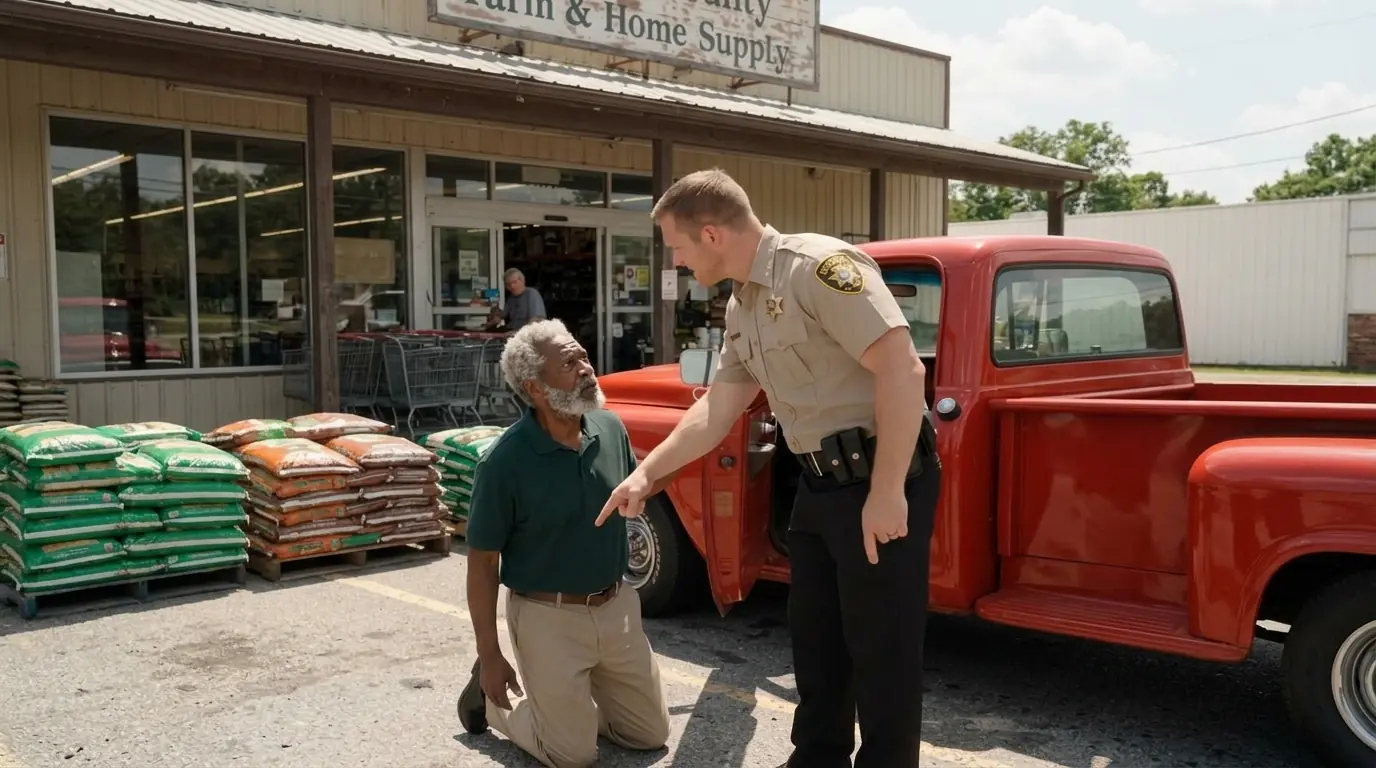
Sixty-four-year-old Malcolm Reed turned slowly beside the restored red Ford pickup and looked at the young deputy crossing the Juniper County Shopping Center parking lot with one hand already resting on his weapon. Malcolm wore a faded olive polo, canvas work pants, and the same brown boots he used whenever he drove down from the capital to visit the rural county where his father had once lived. “Deputy, this truck belongs to me, and everything you need to verify that is inside the glove compartment.”
Deputy Tyler Vance stopped ten feet away and looked from Malcolm to the gleaming truck as though the two simply did not belong in the same picture. “Don’t insult me with fake paperwork,” he said, loud enough for shoppers near the farm-supply store to hear. “A truck this clean gets reported stolen, then I find you climbing out of it twenty minutes later, so you can save the story for booking.” Malcolm’s expression barely changed as he answered, “Then run the plate, check the VIN, and let evidence do the work your assumptions are currently doing.”
The red Ford had belonged to Malcolm’s father, Samuel Reed, who bought it used in 1989 and spent twenty-seven years hauling lumber, church supplies, lawn equipment, and half the neighborhood’s furniture across Juniper County. Malcolm had spent nearly nine thousand dollars restoring the engine, paint, chrome, and interior after Samuel died, while deliberately leaving a shallow dent behind the passenger-side wheel because his father had refused to fix it. To Malcolm, the truck was not expensive transportation so much as a piece of family history that still smelled faintly of leather conditioner, old wood, and the peppermint candies Samuel kept beneath the radio. To Vance, it looked like something a Black man in worn clothes should have needed an explanation to possess.
A patrol cruiser had entered the parking lot forty-three seconds after Malcolm shut off the engine. Vance swung his vehicle across the space at an angle that boxed the Ford between a cart return and a row of parked SUVs, then stepped out before checking anything on the computer mounted inside the cruiser. The red and blue emergency lights immediately drew attention from customers loading animal feed, gardening soil, and hardware into their cars. By the time Vance shouted his first command, a dozen people were already watching.
Malcolm had spent more than four decades in law, beginning as a civil-rights attorney before serving as a federal prosecutor, state solicitor general, and eventually the elected attorney general of the state. He had questioned organized-crime witnesses, prosecuted corrupt officials, argued constitutional cases, and stood beside grieving families while announcing charges no public official ever wanted to explain. None of those experiences made the sight of an armed officer treating him like a thief feel theoretical. The difference was that Malcolm knew exactly how quickly one bad decision by someone with a badge could become a tragedy nobody could reverse.
Vance pointed toward the Ford and told Malcolm the vehicle had been reported stolen less than ten minutes earlier. Malcolm asked for the report number and immediately offered to retrieve the registration, insurance card, maintenance records, and title copy from the glove compartment. Instead of accepting the simplest possible verification, Vance told him to keep his hands visible and accused him of trying to reach for something inside the cab. Malcolm raised both hands and said, “Then you retrieve the documents yourself while I stand exactly where you can see me.”
A second cruiser arrived before Vance answered. Sergeant Dennis Colter stepped out, a heavyset man in his early fifties with gray at his temples and the tired confidence of someone who had learned that rank often ended arguments faster than facts. He walked around the Ford once, glanced at Malcolm, and asked Vance what he had. “Stolen truck, suspicious driver, questionable ownership,” Vance said, while Malcolm calmly replied, “Registered owner standing three feet from you.”
Colter looked at Malcolm’s clothes, then at the restored Ford. “That your story?” he asked. Malcolm said it was not a story but a fact that could be confirmed in less than sixty seconds. Colter gave the truck another slow look and muttered, “Sure is a nice vehicle.” The meaning beneath the sentence was clear enough that Malcolm did not ask him to explain it.
Vance finally permitted Malcolm to open the glove compartment, but only after ordering him to move slowly and narrate every motion. Malcolm reached inside and removed a brown leather folder containing the original restoration invoices, insurance paperwork, state registration, and photocopies of the title. He held the folder out with both hands so nobody could claim a sudden movement. Vance snatched it away, opened the first page, and barely looked at it before his mouth curled.
“This could be anything,” Vance announced. Malcolm told him the registration carried a state seal, VIN, plate number, and address matching the identification in his wallet. “Or it could be forged,” Vance replied, then swept his arm downward and sent the entire folder spilling across the asphalt. Registration papers fluttered beneath shopping carts, invoices slid under a minivan, and one photograph of Samuel Reed standing beside the truck thirty years earlier landed face-down beside a storm drain.
A collective gasp moved through the small crowd. Malcolm looked down at the scattered documents but did not bend to retrieve them, because both officers were watching him for any movement they could reinterpret. Vance smiled and said, “Wind must’ve caught your paperwork.” Malcolm looked directly into his eyes and replied, “No, Deputy, your hand caught it, and several cameras just recorded that.”
The manager of the farm-supply store, Connie Walsh, stood just inside the automatic doors with both hands pressed around a ring of keys. Her security system covered every part of the parking lot, including a camera mounted above the garden-center awning and another attached to a light pole. Connie had already watched Vance scream at Malcolm before running a plate or reading any paperwork, and she had now watched him deliberately scatter the documents. She wanted to step outside, but Juniper County had taught business owners that challenging the sheriff’s department could create inspections, delayed permits, towing problems, and suddenly attentive code officers.
Vance moved closer until his chest nearly touched Malcolm’s shoulder. “You think cameras scare me?” he asked. Malcolm said cameras did not scare honest officers and repeated his request that they run the VIN. Colter folded his arms and said, “You don’t tell deputies how to investigate their own county.” Malcolm answered, “Then investigate it instead of performing it.”
That sentence stripped away the last of Vance’s restraint. He shoved Malcolm backward against the open driver’s door hard enough to make the window frame strike his shoulder, then accused him of being disrespectful when Malcolm remained upright. Several phones rose in the crowd. Malcolm felt pain spread through his back and said quietly, “You just used force against a man who has not threatened you, resisted you, or attempted to leave.”
Vance’s face turned bright red. Before anyone understood what he was doing, he slapped Malcolm across the face with an open hand. The sound cracked across the parking lot and silenced every voice within twenty yards. Malcolm’s cheek burned, but he did not touch it, because he could almost feel Vance waiting for the reflex that would let him say the older man had raised a hand.
“Hands behind your back,” Vance ordered. Malcolm asked for the charge, and Vance answered, “Resisting and obstruction.” Malcolm looked at Colter, who made no move to intervene, and said, “Sergeant, your deputy has just created a charge to justify force he already used.” Colter told him to stop talking and cooperate.
Vance twisted Malcolm’s arm behind his back and pushed him against the Ford. Malcolm turned his body slightly to protect a shoulder damaged years earlier in a car accident, but he did not pull away. “I am not resisting,” he said clearly for the phones and cameras around them. “I am complying while documenting that you are hurting me.”
Vance told him pain was the consequence of refusing orders. Malcolm closed his eyes for half a second and memorized the badge number on Vance’s chest, the unit number on Colter’s cruiser, the direction of every visible camera, and the exact time shown on the dashboard clock inside his Ford. He had spent a lifetime teaching young prosecutors that memory became evidence only when details survived emotion. Today he was applying that lesson to himself.
Before Vance closed the cuffs, Malcolm asked Colter to retrieve a second leather case lying on the passenger seat. Colter smirked and asked whether it contained another set of fake registrations. Malcolm said, “Open it before anyone touches this truck again.” Something in his tone made the sergeant walk around the vehicle.
The case sat beside Malcolm’s water bottle exactly where he said it would. Colter picked it up, unzipped it, and expected insurance or perhaps another title. Instead he found Malcolm Reed’s official state credentials beneath the gold seal of the Attorney General’s Office. His face lost color so quickly that Vance finally noticed.
“Dennis?” Vance called. Colter did not answer at first because he was reading the card again, moving his eyes between the photograph and the man pressed against the truck. “Tyler,” he finally said, and his voice had changed completely. “Take your hands off him.”
Vance tightened his grip instead. “What?” Colter walked closer with the credential case held in both hands and whispered, “This is Attorney General Malcolm Reed.” The parking lot became so quiet that the automatic doors of the store could be heard sliding open and closed behind them.
Vance stared at Malcolm. For several seconds, his mind seemed unable to reconcile the man he had just slapped with the name he had heard on news broadcasts and election coverage. “That’s not possible,” he said. Malcolm straightened his shirt when Vance finally released him and asked, “Would you like to run the credentials now, or is evidence still something you only trust when it agrees with you?”
Colter read the identification a third time. Vance looked toward the people recording, then toward the papers scattered across the parking lot, then at the red mark on Malcolm’s cheek. His arrogance did not disappear all at once; it collapsed in stages, replaced first by confusion, then fear, then the desperate need to find a new explanation. “There was a stolen-vehicle alert,” he said.
Malcolm nodded. “Good, because that alert is the first thing I intend to examine.” Connie Walsh stepped through the store entrance and finally spoke loud enough for everyone to hear. “Our cameras recorded everything from the minute he pulled in.”
Vance immediately told her to stay out of police business. Malcolm turned toward Connie and said, “Please preserve the footage exactly as it exists, including the thirty minutes before I arrived.” Connie nodded. That simple exchange was the first time Vance appeared to understand that authority in the parking lot no longer flowed exclusively from his uniform.