The board at Wick Park had been painted green so many times that the corners had gone soft and round, like a bar of soap that had been used for a year. It stood on two posts by the gate to the public courts, under a little shingled roof somebody had built for it in the eighties, and it was the only thing in the park that everyone agreed on, which was to say that everyone complained about it.
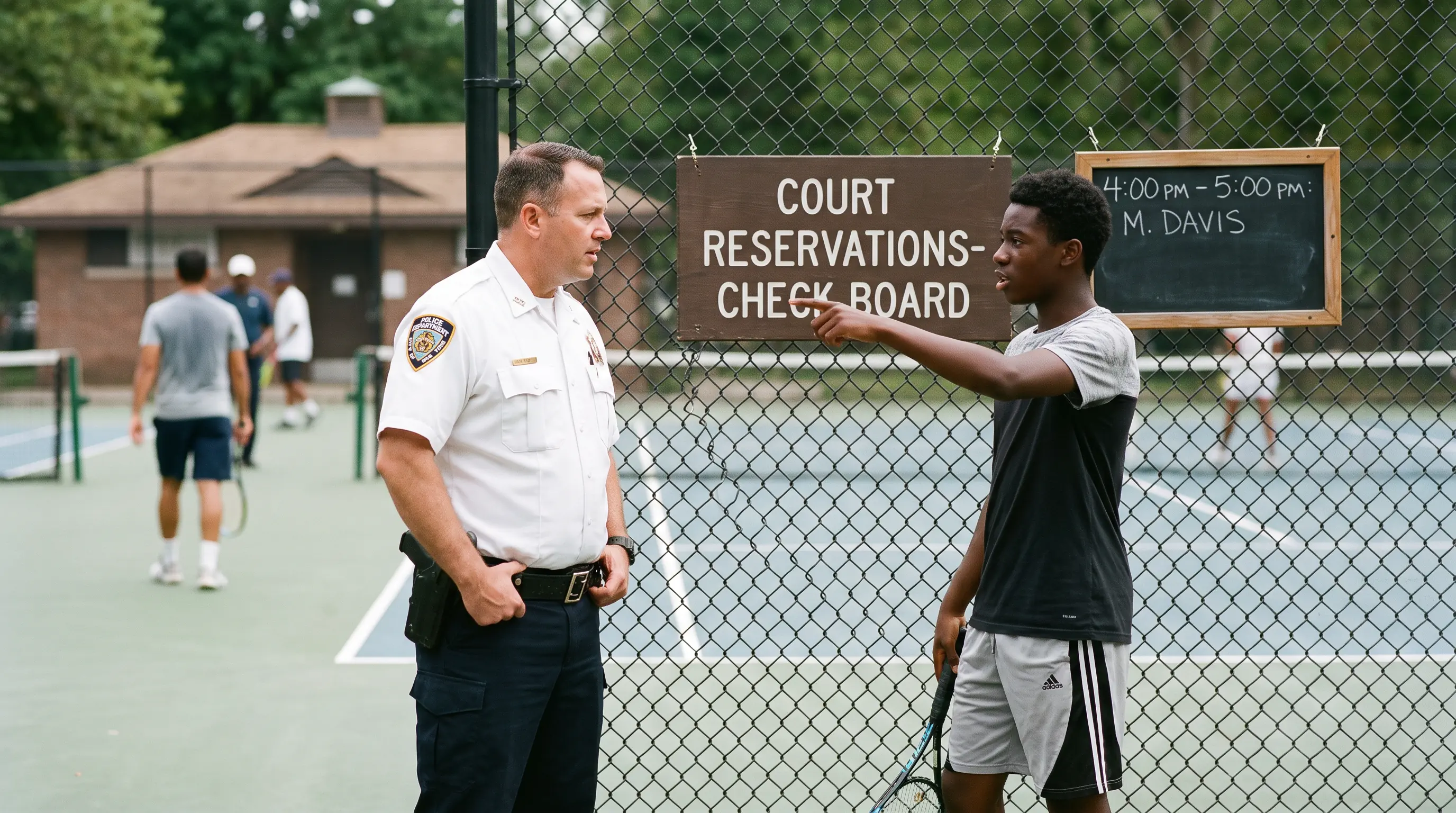
It was a plywood rectangle about the size of a door laid on its side. Four columns, one for each court. Down the left edge, the hours, painted in white block numbers from 7 to 9, and then the evening hours, 5 to 9, because the courts had no lights after nine and the city did not pay anybody to stand there at noon. Under each hour, under each court, there was a black rectangle of chalkboard paint, and into that rectangle you wrote your name. A coffee can full of chalk hung from a hook on the left post. A rag hung from a hook on the right post. The rules, painted in a strip along the bottom, were short. One hour per name per day. Write your own name, not your friend's. Names written before 7 a.m. do not count. If you are not on the court ten minutes past the hour, the slot is open. Do not erase what you did not write.
Ruel Abara had read those rules for the first time when he was eleven, standing beside his grandmother, who read them out loud to him slowly as though they were a passage from Scripture she expected to be tested on. That last line, she told him, is the only one that matters. Everything else is about tennis. That one is about people.
He was sixteen now, and on the second Saturday in October he got to the park at 6:52 in the morning, which was eight minutes early, because the rule said names before seven did not count and he did not want to be the kind of person who stood around with a piece of chalk in his hand waiting for the second hand to swing over. He wanted to be the kind of person who was already there, sitting on the bench, retying his shoes, when the time came.
The air was cold enough that his breath showed. The leaves on the big sycamores along the fence had turned the color of old pennies, and some of them had come down overnight and lay flat and wet on Court 1, which meant somebody would have to push them off with a squeegee before anyone could play there. Court 4, the one at the far end, the one nearest the creek, was clean, because the wind came across it from the other side and kept it swept.
At seven o'clock by his phone he stood up, took a piece of yellow chalk from the coffee can, and in the Court 4 column, in the rectangle beside the painted 8, he wrote R. ABARA in square capitals. Under it, in the rectangle beside the 9, he wrote nothing, because that would be two hours and the rule said one.
Then he looked at the little painted strip above the Court 4 rectangles for 8 and 9, the one he always looked at, because he had wondered about it for five years and nobody he asked had ever known the answer.
It was a band of white paint, older than the green around it, so that the green had been carefully cut in around its edges by somebody with a small brush and a steady hand. On it, in hand-lettered red capitals that had faded to the color of a scab, it said: SAT 8-10 CT 4 YOUTH HOLD. And under that, smaller, in black: SPONSOR F-217. ASK AT DESK.
There was no desk. There had not been a desk at Wick Park since the recreation building had been closed and boarded up when Ruel was in second grade. The building was still there, behind the courts, with plywood over its windows and a poster on its door about a community meeting that had happened in 2021. But the painted strip was still on the board, and every Saturday the 8 and 9 slots on Court 4 were supposed to be held for anyone under eighteen, and because almost nobody under eighteen came to Wick Park at eight on a Saturday morning anymore, the adults wrote their names in those slots and nobody stopped them.
Ruel stopped them. Not with words. Just by coming.
He went back to the bench and sat down and took his racket out of its bag. The racket was a Wilson that his grandmother had bought used from a man in her church for forty dollars when Ruel was thirteen, and the grip had been rewrapped so many times that the handle had gotten fat, and Ruel had learned to like it fat. He had three balls in a can that hissed when he opened it, which meant they were new, which meant he had spent seven dollars of the money he made bagging at Kroger on Thursday nights, which meant he was going to make these three balls last until Thanksgiving.