“Put both phones on the table.”
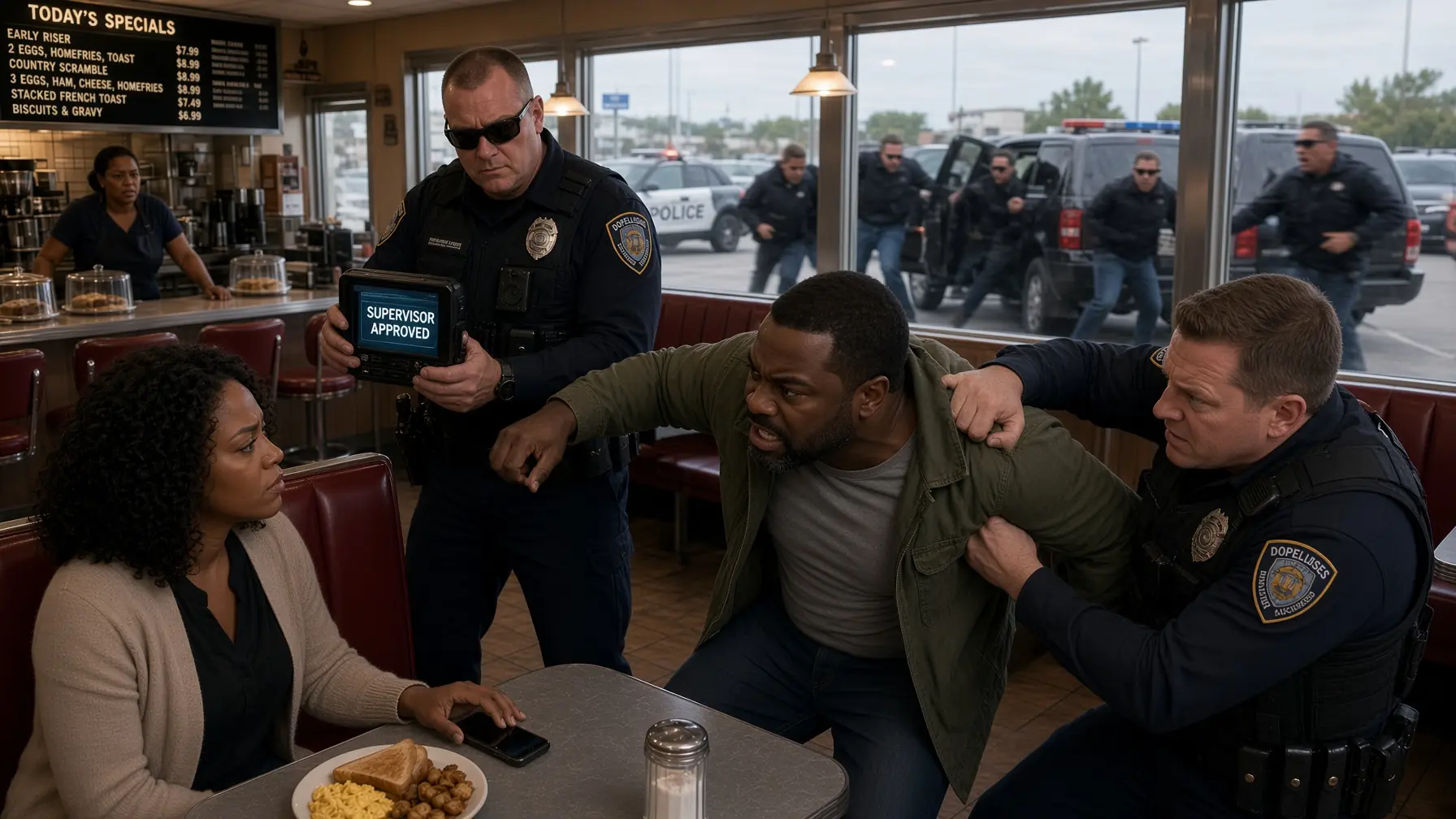
Desmond Hale stopped with one hand wrapped around his coffee mug. Across from him, Alicia did not move at first. Officer Brent Sutter stood at the end of their booth inside Lawson’s Counter, blocking the aisle with his body angled slightly toward Desmond and his right thumb hooked inside his duty belt. The diner’s morning noise had begun to die around them one conversation at a time, forks pausing halfway to mouths as customers realized the officer had not entered for breakfast. Behind the counter, Beatrice Lawson lowered the receipt she had just printed and stared at Sutter with open disbelief. “Officer, nobody called you,” she said. Sutter did not look at her. “I’m making the contact now.”
Desmond placed his phone beside the sugar jar. Alicia followed, setting hers near the edge of a plate containing two untouched triangles of toast. Both screens remained dark. She wore a gray cardigan, inexpensive jeans, and the tired expression of someone who had been awake most of the night. Desmond’s faded canvas jacket had a grease stain near one pocket, and the old sedan visible through the window had a dented rear bumper, dull paint, and an out-of-county plate. Everything about them had been selected to look ordinary enough to be ignored. That had been the point until Brent Sutter walked in.
“What business complaint are you documenting?” Alicia asked.
Sutter looked from her to Desmond. “I’m asking the questions.”
They had arrived shortly after sunrise following an overnight surveillance shift that had lasted nearly eighteen hours. For ten minutes they had been only a Black married couple sharing eggs, toast, and burnt diner coffee in a booth beside the front window. Their sedan was part of the cover. So were the clothes, the prepaid debit card, the canvas jacket, and Alicia’s inexpensive phone case. They had been watching one thing only: how Briar Glen police officers handled ordinary people when they believed nobody important was present. The operation had already produced three months of data, but what Sutter was doing now was more direct than anything Desmond had expected to collect over breakfast.
Before noticing them, Sutter had entered Lawson’s Counter and ordered a family out of the booth nearest the front window because he said the position interfered with “officer visibility.” The hostess moved them without argument even though Sutter never sat down. He stood near the register, scanned the room, looked at the customers, then focused on Desmond and Alicia. There had been no call from the diner, no report of theft, no disturbance, no wanted-person description, and no merchant fraud complaint. Sutter’s attention appeared to begin with two Black adults sitting quietly beside a window while periodically looking toward both exits. That behavior could look unusual. It was also exactly what tired investigators did after eighteen hours of watching doors.
Sutter pointed toward their phones. “Unlock them.”
Desmond kept his voice low. “Is this a voluntary contact?”
Sutter’s jaw shifted. “You’ve been sitting here watching the exits. Your vehicle has an out-of-county plate. You paid with a card issued somewhere else.”
Beatrice Lawson stepped closer to the end of the counter. “The payment cleared. I own the merchant account. There is no fraud.”
Sutter finally turned toward her. “Go back behind the counter.”
Beatrice held his gaze for one second longer than he expected. Then she stepped back, but not before Desmond saw the small shake of her head. She was fifty-eight, Black, had owned the diner for nineteen years, and had agreed six weeks earlier to cooperate with Operation Glass Ledger after investigators discovered that several suspicious-person contacts in Briar Glen appeared to originate at businesses that later denied ever making complaints. Beatrice was not an undercover operative. She was a witness who had become tired of officers putting words into her mouth.
Desmond looked toward the mobile terminal Sutter had placed near the end of the booth. A new contact screen was open. OFFICER INITIATED. The civilian complaint field remained empty. The observed offense field remained empty. Sutter began typing only after Desmond asked what offense he had observed, entering POSSIBLE PAYMENT FRAUD / BUSINESS RECONNAISSANCE even though Beatrice had just confirmed the card cleared and no complaint existed. At the counter, a white customer worked on a laptop beside an open catalog displaying wireless camera systems. Sutter had walked past him without slowing.
Alicia glanced toward the blinking security camera above the register. “We ordered breakfast. We paid for breakfast. The owner has confirmed both.”
“You’ve also been studying the room.”
“So have you.”
Sutter stepped closer.
The diner went completely quiet.
His hand came down on Desmond’s shoulder, not hard enough to leave an immediate mark but hard enough to make the hierarchy of the moment unmistakable. “Identification.”
Desmond looked at the hand and then at Sutter. “What is the call number?”
“There was no call,” Beatrice said from behind the counter.
Sutter increased the pressure on Desmond’s shoulder. “Your refusal is becoming part of the problem.”
Desmond did not pull away. He had spent four months reviewing Briar Glen contacts that began almost exactly this way: vague concern, officer-created narrative, missing civilian complainant, a person who asked why, and a report written afterward describing those questions as suspicious behavior. The language changed by the time the document reached a supervisor. “Asked why he was being stopped” became evasive. “Declined consent” became uncooperative. “Requested a supervisor” became escalating. None of those words were automatically improper, but in too many Briar Glen reports the video did not match them.
Near the second booth, Keisha Monroe lowered her phone beneath the table and started recording. She was thirty-four, an elementary-school teacher eating pancakes with her eight-year-old son, Micah. Keisha had no connection to Operation Glass Ledger and no idea who Desmond and Alicia really were. She simply saw a police officer put his hand on a Black man who had been quietly drinking coffee and decided somebody should preserve what came next. Micah watched Sutter’s hand on Desmond’s shoulder with the wide, silent attention children have when adults suddenly become dangerous.
Alicia said, “If you are detaining us, identify the suspected offense.”
“Possible fraud.”
“The merchant says there is no fraud.”
“Possible reconnaissance.”
“For what?”
Sutter looked at her. “I don't have to explain my entire investigation to you.”
“You have to have one.”
Sutter’s hand moved from Desmond’s shoulder toward his wrist.
That was when the diner door opened again.
Sergeant Nolan Pike entered without removing his sunglasses.
He was forty-eight, broad through the middle, with twenty-three years in the Briar Glen Police Department and a reputation among younger officers for being the man who could “make a stop work” after somebody else had begun it poorly. His name had appeared twenty-seven times in Operation Glass Ledger before that morning. Sometimes as approving supervisor. Sometimes as reviewer. Sometimes only as the person who changed a classification after the original officer had failed to identify a crime.
Pike listened while Sutter described “two suspicious subjects conducting possible reconnaissance and refusing lawful identification.” He did not ask Beatrice what had happened. He did not inspect the receipt. He did not speak to Desmond or Alicia before reaching for Sutter’s terminal. Desmond watched Pike review the blank complaint field, the empty initial observed-offense field, and the later-added fraud language.
“No complainant is listed,” Desmond said.
Pike selected a different incident category.
DISORDERLY CONDUCT REVIEW.
Alicia looked at the screen. “What disorderly conduct?”
Pike’s finger hovered above the authorization field. “Your continued resistance is establishing the basis.”
Desmond’s eyes sharpened.
That sentence mattered.
Resistance to what?
They had not shouted. They had not touched Sutter. They had not refused to leave a business after being asked by the owner. Beatrice had asked nobody to leave. Their payment was complete. The only “resistance” consisted of questions and refusing to unlock personal phones.
“Are you authorizing removal with no complainant on file?” Desmond asked.
Pike pressed the button.
A line appeared beneath the blank fields.
SUPERVISOR APPROVED.
Alicia’s eyes met Desmond’s.
The contact was no longer only Sutter’s decision.
Pike had put the department beneath it.
Sutter removed his handcuffs.
A small electronic tone sounded from his body camera as it finally activated automatically through the restraint sensor. The recording light appeared. Pike noticed it. He tapped the mobile terminal, opened the body-camera status page, and changed the upload category to PENDING SUPERVISOR REVIEW. There was nothing inherently improper about that setting by itself. Supervisors used it in some legitimate cases involving sensitive evidence. But Operation Glass Ledger had already identified that the same status appeared disproportionately in contacts later associated with missing footage or altered narratives.
Alicia placed one finger against the side of her phone.
It looked like nervousness.
It was not.
Her phone remained locked, but a recessed pressure sequence along the case transmitted a silent coded signal through a separate secure device hidden beneath the battery shell. Twenty-six miles away, inside a temporary operations room maintained by the state attorney general’s Public Integrity Section, one line on a monitoring dashboard changed from green to red.
GLASS LEDGER — INTEGRITY BREACH — ACTIVE CONTACT.
Nobody in Lawson’s Counter heard anything.
No sirens activated.
No tactical team came racing through the door.
That was not how the operation was designed.
The alert simply told the outside team that two undercover investigators had become subjects of an active police contact and that preservation protocols needed to begin immediately.
Sutter turned toward Alicia. “Stand up.”
She remained seated. “Am I under arrest?”
“You’re being detained.”
“For what?”
“I just told you.”
“No. You changed labels twice.”
Pike stepped closer. “Ma’am, if you continue arguing, you’re going to turn a simple identification check into an arrest.”
Alicia looked at him.
“Sergeant, asking the legal basis for a detention is not obstruction.”
Pike removed his sunglasses.
The expression beneath them was calmer than Sutter’s, which made him more dangerous in a different way. “You sound like you know just enough law to get yourself in trouble.”
Desmond almost smiled.
Alicia did not.
She had spent fourteen years as a detective, six of them in financial-crimes and public-corruption work, and had testified in state and federal courts more times than Pike knew. Before Operation Glass Ledger, she had helped dismantle a procurement scheme involving three county contractors and a zoning official. She knew enough law to understand exactly what Pike was trying to do.
She also knew this was not the moment to win an argument.
It was the moment to preserve one.
“Then state clearly for the record,” she said, “whether I am free to leave.”
“No.”
“Thank you.”
Pike frowned.
He expected protest.
Gratitude made him suspicious.
Sutter ordered Desmond to stand.
Desmond did.
“Hands behind your back.”
“Am I being arrested?”
“Temporary detention.”
“Then why handcuffs?”
“Officer safety.”
“What fact suggests I’m armed?”
Sutter stepped closer. “You keep reaching toward your jacket.”
Desmond looked down.
His hands were visible at waist level.
Body camera had been active for almost ninety seconds.
“Which movement?”
Sutter’s face hardened.
“Turn around.”
Desmond complied.
Metal closed around his wrists.
Across the diner, Micah whispered, “Mom, why is he arresting him?”
Keisha put one hand over her son’s. “I don't know.”
Pike heard.
He looked toward her phone.
“Ma’am, are you recording?”
Keisha froze.
Pike pointed. “Put the phone away.”
She lowered it slightly.
“Am I doing something illegal?”
Pike’s eyes narrowed.
The question was becoming contagious.
“No, but you're interfering with an active investigation.”
“I’m sitting at my table.”
“Then keep sitting.”
Keisha did.
The phone continued recording from beneath the edge of her purse.
Sutter cuffed Alicia next.
Not violently.
Too tightly.
She immediately said, “Right cuff is pinching.”
He checked it with one finger.
“It’s fine.”
“I’m telling you it isn’t.”
“You'll survive.”
Desmond turned his head.
Sutter said, “Face forward.”
Desmond did.
This was already worse than what the task force needed.
The purpose of the operation had never been to bait officers into misconduct. Desmond and Alicia had entered the diner because surveillance suggested Sutter regularly stopped there near the end of his shift and because Lawson’s was one of several businesses where documented police “complaints” did not match owners’ accounts. Their instructions had been simple: behave lawfully, do not manufacture confrontation, do not reveal identity unless safety required it, and terminate the cover immediately if the encounter moved toward serious physical danger.
Handcuffs alone did not cross that threshold.
Sutter’s next decision came closer.
“Search them.”
Alicia turned slightly. “No.”
Pike looked at her.
“You don't consent?”
“No.”
“Then stop moving.”
“I’m not moving. I’m expressly refusing consent.”
Sutter started with Desmond’s jacket.
Wallet.
Keys.
Small notebook.
A prepaid card.
Nothing else.
Then he reached into the interior seam of the jacket and felt the hardened edge of something flat.
Desmond’s pulse changed.
Not because the item was dangerous.
Because it was operational.
A laminated emergency credential sat inside a concealed sleeve beneath a stitched cover. If Sutter removed it, the undercover identity would end immediately.
“What’s this?”
Desmond said, “Personal property.”
Sutter worked his fingers deeper into the seam.
Pike watched.
Alicia looked toward Desmond.
He gave the smallest possible shake of his head.
Not yet.
Sutter could not free the credential without tearing the liner, so he abandoned it and moved to Alicia’s purse.
She said, “Do not search that bag without legal authority.”
Pike answered, “Search incident to arrest.”
Alicia looked directly at him.
“You just said we were temporarily detained.”
Pike stopped.
Sutter stopped too.
There it was.
A contradiction created in real time.
Pike recovered quickly. “You’re now under arrest for obstruction.”
“What act constitutes obstruction?”
“Refusal to identify and interference with the investigation.”