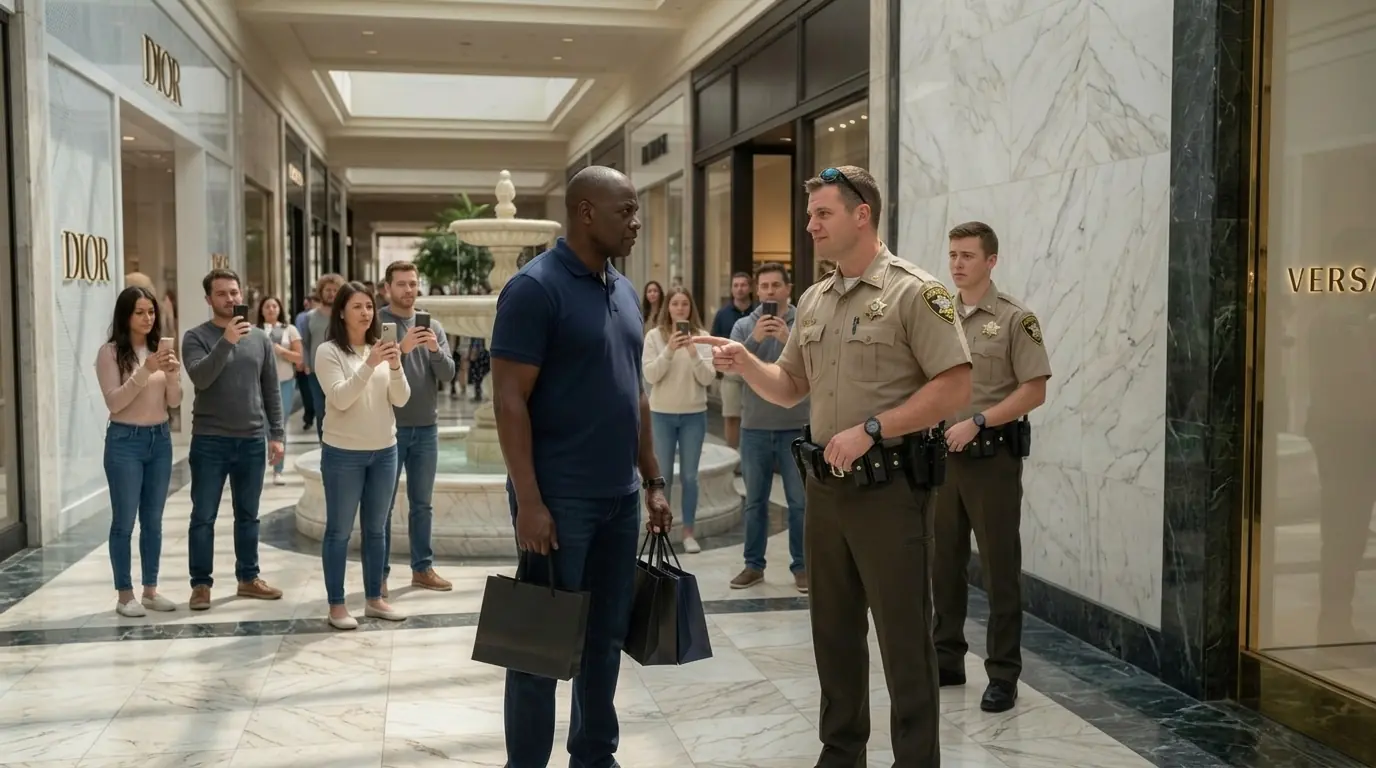
Noon at Ridgemont Galleria Mall.
50 shoppers stare in silence. Not one steps forward. Have you ever watched an innocent man lose everything in 60 seconds simply because of the color of his skin? 3 hours earlier the world looked nothing like this.
Byron Shaw stood in his kitchen at 6:00 in the morning. The house was quiet. Pale light crept through the window above the sink. Coffee dripped slow and steady into a glass pot. The smell of dark roast filled the small room.
He poured a cup and leaned against the counter. The television played the morning news at low volume. A weatherman pointed at a map of Virginia. Clear skies, mid-70s, a perfect Saturday. Byron was 44 years old, broad shoulders, clean-shaven, calm eyes that had seen more than most people would in two lifetimes.
22 years as a Deputy United States Marshal. He had tracked fugitives across state lines. He had walked into rooms most men would run from. He had put his life on the line for a country that didn't always love him back. But today was not about any of that.
Today was about his daughter. Aleah was turning 12. She had been talking about a silver charm bracelet for weeks. She circled it in a catalog and taped the page to the refrigerator. Byron smiled every time he saw it.
Footsteps padded down the hallway. Nora appeared in the doorway wearing a bathrobe, her hair wrapped in a silk scarf. She yawned and reached for his coffee cup. He let her take it. 20 years of marriage had its own language.
"Don't forget the bracelet," she said. "That's the only reason I'm getting dressed today. And pick up something for yourself. You never do." "I don't need anything."
She gave him a look. He kissed her forehead. She smiled against his chest. Byron walked to the bedroom closet. He reached past his suits and his marshal's uniform, grabbed a navy polo and jeans.
He looked in the mirror. Just a man, no badge, no title, just a father buying his daughter a birthday gift. He stopped at the hallway safe, pressed in the combination. Inside sat his service weapon, his marshal's badge, and his federal identification. He looked at them for a moment, then picked up only his personal firearm, a compact 9 mm he was legally permitted to carry anywhere under the Law Enforcement Officer's Safety Act.
He holstered it beneath his shirt. The badge stayed in the safe. Today, he was just dad. His SUV sat in the driveway, a dark gray Ford Explorer, 5 years old, clean but unremarkable. Nothing about it said federal agent.
The drive to Ridgemont Galleria took 25 minutes. He rolled the windows down. The morning air was warm and sweet with cut grass. A gospel station played softly. He hummed along without thinking.
The mall sat on the edge of Whitmore County, a wealthy suburb where lawns were wide and neighborhoods were quiet. The parking lot was filling up. Families with strollers, teenagers in groups, couples holding hands. Byron parked near the south entrance and walked inside. Cool air hit his skin like water.
The atrium stretched before him. Polished marble floors, three levels of shops, a glass elevator rising through the center. A fountain bubbled near the food court. Piano melody drifted from hidden speakers. He felt at ease.
He had been here before. A normal place on a normal day. He walked into a jewelry store on the first floor. A young clerk greeted him with a warm smile. He pointed to the charm bracelet in the display case.
The one Aleah had circled. "Beautiful choice." The clerk said. "Someone special?" "The most special person I know."
Byron said. She wrapped it in a velvet box and placed it in a bag. He paid with his credit card and tucked the receipt into his wallet. Two stores down, he bought a silk scarf for Nora. Deep blue with gold edges.
She would love it. He paid, took his receipt, slid it beside the first. Two bags, two receipts, two gifts for the two people he loved most. Meanwhile, in the parking lot outside, a county sheriff's cruiser sat idling near the east entrance. Deputy Derek Caldwell leaned back in the driver seat.
Mirrored sunglasses reflecting the windshield. His partner, Deputy Trent Howard, sat quietly beside him. Caldwell had been assigned to the mall's enhanced patrol. A new county program targeting retail theft. But Caldwell treated it like territory.
His territory. He scanned every face that walked through those doors. And when Byron Shaw passed the glass entrance carrying two shopping bags, Caldwell sat up straight. "See that?" He said to Howard.
"Let's go have a conversation." Byron Shaw walked through the atrium with nothing to hide and nothing to fear. He had no idea that in less than 15 minutes, everything would be taken from him. Byron was standing near the center court fountain when he heard the footsteps behind him. Quick, heavy, deliberate, the kind of steps that don't belong in a shopping mall on a Saturday afternoon.
He didn't turn around right away. He had spent 22 years reading the sounds of danger. These footsteps carried intent. Hey, stop right there. Byron turned slowly.
Two deputies stood 6 ft behind him. The one in front was tall, early 30s, square jaw, mirrored sunglasses pushed up on his forehead. His nameplate read Caldwell. His hand rested on his belt, inches from his holster. His chin was tilted up the way men tilt when they want you to feel small.
The second deputy stood slightly behind, younger, thinner. His nameplate read Howard. His eyes moved between Byron and Caldwell like a dog watching two wolves. Can I help you, officer? Byron said.
His voice was level, polite, the same tone he used when speaking to judges and attorneys. Caldwell didn't answer the question. Instead, he looked Byron up and down, slowly, from his shoes to his face, the way someone inspects something they've already decided is worthless. What are you doing here? Shopping, Byron said.
He lifted the two bags slightly. Just finished, actually. Shopping. Caldwell repeated the word like it tasted sour. Where'd you come from?
I'm sorry? I asked where you came from. What part of town? Byron felt the shift. He had felt it a hundred times in his life.
That invisible wall that drops between a black man and a white man in uniform when the uniform decides the conversation is no longer civil. I live in Whitmore County, Byron said calmly, about 25 minutes from here." Caldwell smirked. He glanced at Howard. Howard didn't smile back.
"Whitmore County," Caldwell said. "Right, and I'm the governor." Two women with shopping bags slowed down as they passed. They looked at Byron, then at the deputies, then kept walking. A man in a polo shirt stopped near a bench and watched from a distance.
"I'm going to need to see some ID," Caldwell said. "Of course." Byron reached slowly toward his back pocket. "Slowly," Caldwell snapped. His hand moved to his holster.
"Real slowly." Byron pulled out his wallet with two fingers. He opened it and held out his Virginia driver's license. Caldwell snatched it from his hand. He didn't look at it right away.
He held it at his side like it didn't matter. "What's in the bags?" "A bracelet and a scarf. Gifts for my family." "You got receipts?"
"I do. They're in my wallet." "I didn't ask where they are. I asked if you have them." Byron paused.
He breathed. He spoke as if explaining something to a child who refuses to listen. "Yes, officer, I have receipts for both items. I purchased them less than 15 minutes ago from stores in this mall. I'd be happy to show you."
Caldwell stared at him. Then he turned to Howard. "He matches the description." Byron's stomach tightened. There it was, the phrase.
He had heard it before. Every black man in America has heard it before. Three words that turn an innocent person into a suspect without a single piece of evidence. "What description?" Byron asked.
"We got a report. Black male, medium build, shoplifting from stores on the first level." "Officer, I just told you I have receipts for everything I'm carrying." "And I just told you that you match the description. So, we're going to figure this out right here.
Byron looked around. More people had stopped. A teenage girl across the atrium was holding up her phone. The fountain behind him continued to bubble, calm and indifferent. "Am I being detained?"
Byron asked. Caldwell stepped closer, close enough that Byron could smell the coffee on his breath. "You're being whatever I say you're being." "Then I'd like to know the specific reason for this stop. I've identified myself.
I've offered to show receipts. I've cooperated fully." Caldwell's jaw tightened. He wasn't used to hearing someone speak this way, not someone in Byron's position, not someone who looked like Byron. "You don't ask the questions here," Caldwell said, his voice dropping low.
"I do." He pointed toward the wall beside a storefront. A blank stretch of marble between a window display and a potted plant. "Against the wall. Hands flat.
Spread your feet." Byron didn't move immediately, not out of defiance, out of discipline. He had been trained to assess situations, and this situation had crossed a line. "Officer, I want to be clear. I am complying, but I want everyone here to know that I have done nothing wrong."
He said it loud enough for the gathering crowd to hear. Then he turned and walked to the wall, placed both palms flat against the cold marble, spread his feet, lowered his head. A man with 22 years of federal law enforcement service, standing spread-eagle in a shopping mall, held against a wall by a deputy who never once looked at his receipts. Caldwell moved in behind him and began the pat-down. Rough hands pressing down his sides, his waist, his pockets.
Byron stayed still. He controlled his breathing the way he had been trained. In through the nose, out through the mouth. Then Caldwell's hand stopped. Right side, just above the hip.
His fingers pressed against the hard outline beneath the polo shirt. A gun. What happened next took less than 3 seconds, but felt like an hour. Caldwell jumped back, drew his weapon. His voice exploded through the atrium like a grenade.
Gun! He's got a gun! The mall erupted. Shoppers screamed. A woman grabbed her daughter and ran.
A man knocked over a chair trying to get away. The fountain kept bubbling. The piano music kept playing. But everything human in that space turned to panic. Howard drew his weapon, too.
His hands were shaking. His eyes were wide and wet. Byron didn't move. His palm stayed flat on the wall. His voice came out steady and clear.
I have a legal concealed carry permit. I am a federal law enforcement officer. I am authorized to carry this weapon under federal law. My credentials are in my wallet, which you are holding. Caldwell wasn't listening.
He was performing. His weapon was aimed at Byron's back. His feet were wide apart. His voice was loud enough for every phone camera in the atrium to capture. On the ground, face down, now!
Byron lowered himself slowly. First to his knees, then flat on the marble floor. The cold stone pressed against his chest. His cheek rested against the polished surface. He could see the feet of shoppers frozen in place.
Small shoes, sneakers, heels. All still. Caldwell holstered his weapon and moved in fast. He grabbed Byron's wrists and wrenched them behind his back. The handcuffs bit into his skin.
One click. Two clicks. Tight. Too tight. Byron's shopping bags had fallen during the commotion.
The velvet box holding Aleah's bracelet slid across the floor and came to rest near a trash can. The silk scarf spilled out of its bag like a blue river on white marble. Caldwell reached under Byron's shirt and pulled the firearm from its holster. He held it up above his head for the crowd to see. Like a trophy.
Like proof. "This is what happens when these people think they can just walk around armed." These people. The words hung in the air. Nobody gasped.
Nobody challenged them. The silence of the crowd was its own kind of violence. Howard stood behind Caldwell. He looked at the gun. He looked at Byron on the floor.
He looked at the scattered shopping bags and the receipts poking out of the open wallet on the ground. He saw everything. And he said nothing. Caldwell yanked Byron to his feet. The movement was rough enough to make Byron stumble forward.
Caldwell grabbed the back of his shirt to steady him, then shoved him toward the main corridor. "Walk." And so Byron Shaw, a decorated United States Marshal who had served his country for more than two decades, was marched through the Ridgemont Galleria Mall in handcuffs. Past the fountain. Past the food court.
Past the jewelry store where a young clerk stood behind the counter with her hand over her mouth. She recognized him. She had sold him the bracelet 20 minutes ago. She said nothing. Past families who pulled their children closer.
Past teenagers who filmed with their phones. Past an elderly couple who looked away as if the sight of a black man in handcuffs was too familiar to be worth their attention. The walk was 200 yards. It felt like 200 miles. Byron kept his head up.
His back is straight. His eyes forward. He did not speak. He did not cry. He did not beg.
But inside, somewhere behind the training and the discipline and the years of service, something cracked. Not because of the handcuffs, not because of the humiliation, but because after 22 years of protecting strangers, he could not protect himself from this. The mall security office sat at the end of a gray corridor behind the food court. No windows. Fluorescent lights buzzing overhead.
The walls were bare except for a fire evacuation map and a clock that ticked too loud. The room smelled like stale air and old carpet. Caldwell shoved Byron through the door. Byron stumbled but kept his footing. His hands were still cuffed behind his back.
The metal had already left red lines on his wrists. Greg Patterson, the mall manager, sat behind a small desk. He was a soft man in his 40s with thinning hair and a wrinkled shirt. He looked up when Byron came through the door and his face went pale. "What's going on?"
Patterson asked. "Armed suspect," Caldwell said. "Caught him in the atrium with a concealed weapon. Non-compliant. Possibly connected to the theft reports."
"What theft reports?" Patterson asked. Caldwell ignored the question. He pushed Byron into a metal folding chair in the center of the room. The chair scraped against the floor with a sound like a scream.
"Sit down. Don't move. Don't talk." Byron sat. He looked at Patterson.
Patterson looked away. Howard entered the room behind them and closed the door. He stood in the corner near the filing cabinet with his arms crossed. His jaw was tight. His eyes stayed on the floor.
Caldwell dropped Byron's belongings onto the desk. The two shopping bags, the wallet, the car keys, the phone, and the firearm, still in its holster, placed down like an exhibit in a courtroom. Caldwell picked up the wallet first. He opened it slowly, pulling out each item like a man peeling layers off a lie he wanted to build. Driver's license, Byron Shaw, Virginia resident, concealed carry permit, valid, current, two receipts, one from the jewelry store, one from the accessories boutique, both dated today, both time stamped less than an hour ago.
Then Caldwell's fingers stopped. He pulled out a card. Thick, official, laminated. The seal of the United States Marshal Service printed in gold on the front. Below it, a photo of Byron Shaw in uniform.
Below that, the words Deputy United States Marshal. Caldwell stared at it. The room was silent except for the buzzing lights and the ticking clock. Howard saw it, too. His arms uncrossed, his lips parted slightly.
He took half a step forward. Caldwell looked at the card for three full seconds. Then he slid it back into the wallet, closed the wallet, set it on the desk, and said nothing. He had seen it. He had read it.
He had held the truth in his hands, and he chose to bury it. Byron watched every movement. He saw the card go back into the wallet. He saw the decision happen in real time. And in that moment, he understood something clearly.
This was no longer a mistake. This was a choice. Caldwell turned to Byron and leaned down, close. His breath was hot and stale. So, where'd you get the gun?
I've already told you, Byron said. I'm a federal law enforcement officer. I'm legally authorized to Federal? Caldwell laughed, a short, hard sound with no joy in it. You?
Federal? That's the best story I've heard all week. It's not a story. My identification is in the wallet you just searched. I saw an expired gym card and a library pass.
That's what I saw. Byron's chest tightened, but his voice stayed even. You and I both know that's not true. Caldwell straightened up. He looked down at Byron the way a man looks at something stuck to the bottom of his shoe.
Here's what I know. I know you were walking through a high-end mall with a loaded weapon. I know you resisted a lawful stop. I know you've got no proof you bought anything in those bags. The receipts are on the desk, right next to my wallet.
Receipts can be faked. Then call the stores. They'll confirm my purchases. I don't take suggestions from suspects. Caldwell turned to Howard.
Run him. Full check. Warrants, priors, everything. Howard hesitated. He looked at the wallet on the desk.
He opened his mouth to speak. Derek. What? I think we should maybe look at the wallet again. There was a card in there that I looked at the wallet.
There's nothing in it. Run him. Howard stared at Caldwell. Caldwell stared back. The silence between them was heavy and sharp.
Howard looked down first. He pulled out his radio and called dispatch. Requesting a full background check. Last name Shaw. First name Byron.
Date of birth He leaned over to read the driver's license on the desk. November 3rd, 1981. While they waited, Caldwell began what he called an inventory. He picked up each of Byron's belongings one at a time. Slowly, deliberately, like a man enjoying a meal he didn't deserve.
He opened the jewelry box first, pulled out the bracelet, held it up to the light. The silver chain dangled and caught the fluorescent glare. Nice, Caldwell said. Real nice. What's something like this cost?
200? Three? It's for my daughter's birthday, Byron said quietly. Your daughter. Caldwell set the bracelet on the desk, not gently.
It clattered against the surface. Expensive taste for a man who can't explain how he got a gun. Byron said nothing. Caldwell picked up the scarf next, unfolded it, held it between two fingers like it was evidence of a crime. And this?
Who's this for? Your girl on the side? My wife. Wife? Caldwell dropped the scarf onto the desk.
Right. He picked up Byron's phone. The screen lit up. Three missed calls, all from the same contact, Nora. Nora, Caldwell read aloud.
She worried about you? She should be. I'd like to call her, Byron said. No. I have the right to make a phone call.
You have the right to sit there and be quiet. That's the only right you have in this room. Byron looked at Patterson. The mall manager had been sitting behind his desk the entire time, watching everything, saying nothing. His hands were clasped in front of him.
His knuckles were white. Sir, Byron said to Patterson, you have security cameras in this mall. You can pull the footage right now and verify every word I've said. Patterson glanced at Caldwell. Caldwell shook his head once.
Patterson looked back at Byron. I'm sure the deputy has everything under control, Patterson said. Byron closed his eyes for a moment. When he opened them, they were dry and clear. The phone on the desk buzzed again.
Nora, fourth call. Caldwell picked it up and pressed the side button. The screen went dark. He set the phone face down on the desk. Annoying, he said.
20 minutes passed. The background check came back clean. No warrants, no priors, no criminal record of any kind. Byron Shaw was exactly who he said he was, a law-abiding citizen with a spotless history. Howard read the results off his radio.
He looked at Caldwell when he finished, waiting, expecting the cuffs to come off. Caldwell didn't move. "That doesn't explain the gun," he said. "Derek, the carry permit is valid. The background check is clean.
There's no theft report matching his description. Maybe we should Maybe you should let me do my job. Howard fell silent. Caldwell pulled out his own phone and began typing. He was drafting an incident report.
Byron could see the screen from where he sat. Caldwell typed the words, "Suspect was aggressive and non-compliant. Suspect refused multiple lawful orders. Concealed weapon discovered during search." Every word was a lie, and every lie was being written 6 ft from the man it was about.
Byron watched the words appear on the screen. His jaw tightened. His wrists burned under the cuffs, but he kept his breathing steady. Outside the security office, the world was already moving. In the mall atrium, a 16-year-old girl named Hannah had posted her video to social media 12 minutes ago.
The video was 43 seconds long. It showed Caldwell grabbing Byron. It showed Byron being forced against the wall. And it captured, with perfect clarity, Caldwell's voice saying, "This is what happens when these people think they can just walk around armed." The video had 300 views in the first 5 minutes, 1,000 in the first 10.
A local activist shared it with a single comment, "This is Ridgemont. This is today. Watch." By the time Caldwell finished typing his fake report, the video had crossed 50,000 views and was climbing fast. Sandra Wells, a reporter at WVBC News, saw it on her feed while eating lunch at her desk.
She put down her sandwich, picked up her phone, and called her cameraman. Get the van. Ridgemont Galleria. Now. And in a quiet house 25 minutes away, Nora Shaw stared at her phone.
Five calls. No answer. Byron always answered. She called one more time. Voicemail.
Then she opened her contacts and scrolled to a name she had only used once before, three years ago, when Byron was late coming home from a fugitive operation in Baltimore. Captain Elaine Foster, US Marshals Service. She pressed call. The phone rang twice. Nora?
Is everything all right? Elaine, I can't reach Byron. He went to the mall two hours ago. He's not answering his phone. Something is wrong.
The line was quiet for two seconds. Then Foster's voice returned, sharp, controlled, and carrying the weight of a woman who had spent 30 years commanding men and women who carried guns for a living. Give me the name of the mall. Ridgemont Galleria, Whitmore County. Stay by your phone.
I'll call you back in 10 minutes. Foster hung up. She pulled up Byron's federal GPS tracker on her computer, a system that pinged every marshal's personal device in real time during active hours. Byron was off duty, but his phone was still registered. The dot appeared on her screen.
Ridgemont Galleria Mall, stationary for over 40 minutes. Foster picked up her desk phone and dialed the Whitmore County Sheriff's Department dispatch. The gears of something much larger than Derek Caldwell had ever imagined had just begun to turn. Captain Elaine Foster did not waste a single second. She dialed Whitmore County Sheriff's Department dispatch.
The phone rang once. Foster cut through the greeting like a knife. This is Captain Elaine Foster, United States Marshal Service, Eastern District of Virginia. Badge number 4416. One of my deputies is being unlawfully detained at Ridgemont Galleria Mall.
Patch me through to whatever unit is at that location. Now. The dispatcher hesitated, then the line clicked. Inside the security office, Caldwell was leaning back with his boots on the desk, scrolling his phone. Byron sat motionless.
His wrists had gone numb. Howard stared at the wall like a man trying to disappear. Caldwell's radio crackled. Unit 14, standby for a direct patch. Federal authority on the line.
Caldwell frowned. He looked at Howard. Neither moved. Then the voice came through. Deputy Caldwell, this is Captain Elaine Foster, United States Marshal Service.
I am going to speak and you are going to listen. Caldwell sat up. His boots came off the desk. You are currently holding Deputy United States Marshal Byron Shaw in unlawful custody. Marshal Shaw is a 22-year veteran of this agency.
He is federally authorized to carry a concealed weapon in all 50 states under the Law Enforcement Officer Safety Act. You had no probable cause for the stop, no legal basis for the search, and no authority to place him in handcuffs. Dead silence. The fluorescent lights buzzed. The clock ticked.
Caldwell's face drained of color. You will remove his restraints immediately. You will return every item of his personal property. You will preserve all evidence, body camera footage, written reports, radio communications. Federal agents are en route.
They will arrive within 20 minutes. Do not leave the premises. Do you copy? Caldwell's hand was shaking. The radio trembled against his palm.
"Copy." He whispered. He set the radio on the desk. The plastic clicked against the surface. It was the loudest sound in the room.
Byron sat in the metal chair and looked straight ahead. His face showed nothing. But his eyes held 22 years of service, 22 years of sacrifice, and the quiet fury of a man proven right in the worst possible way. Caldwell stood. His movements were slow and mechanical.
He reached for his handcuff key. His fingers fumbled twice before finding the lock. The cuffs clicked open and fell to the floor with a dull clang. Byron brought his hands forward. Red grooves circled both wrists like bracelets made of pain.
He rubbed them slowly. He did not look at Caldwell. He did not speak. He simply waited. 18 minutes later, two black Chevrolet Suburbans pulled into the parking lot.
No sirens, no lights, just the quiet authority of federal power arriving without announcement. Four agents in dark suits and tactical vests walked through the mall entrance. Shoppers parted without being asked. The agents moved with the kind of purpose that makes crowds go silent. They reached the security office.
The lead agent opened the door without knocking. He looked at Byron first. "Marshal Shaw, are you injured?" "No, I'm not." The agent turned to Caldwell.
"Deputy Derek Caldwell, Deputy Trent Howard, you are both subjects of a federal investigation. Charges under consideration include unlawful detention of a federal officer, deprivation of civil rights under color of law, Title 18, Section 242, and deliberate suppression of exculpatory identification." Caldwell's voice cracked. "I was just doing my job. He matched a description."
The agent raised one hand. There was no description, no theft report filed at this mall today. We confirmed that with mall security and county dispatch before we walked through that door. You fabricated probable cause. You conducted an illegal search and you concealed a federal identification that would have resolved this in 30 seconds.
Caldwell's face collapsed all at once like a building losing its foundation. Your firearm, your badge. Now. Caldwell's hands moved to his belt. He unclipped his holster and set the gun on the desk.
Then he unpinned his badge. He held the small gold shield in his palm, the thing that had made him feel untouchable for years. Then he set it beside the gun. The desk held two badges, two guns, two very different careers. One was beginning to heal.
The other had just ended forever. Byron stood from the chair for the first time in over an hour. He straightened his shirt, picked up his wallet, keys, and phone. He picked up the velvet box with Aleah's bracelet and held it for a moment. Then he picked up the blue silk scarf and folded it carefully.
He looked at Caldwell one final time. Their eyes met across the small gray room. Byron said nothing, not a word. The silence carried more weight than any sentence ever could. Then he walked out the door.
Byron walked out of the security corridor and into the mall atrium. The fountain still bubbled. The piano still played. But every pair of eyes turned toward him. The shoppers who had watched him get dragged away in handcuffs were still there.
The teenage girl with the phone was still filming. Nobody spoke. Byron walked past the mall with his head up, two shopping bags in his hands. The same man, the same walk, but everything around him had changed. Behind him, the world Derek Caldwell had built was falling apart one piece at a time.
The lead federal agent separated Caldwell and Howard into different rooms. Standard procedure. Isolate, interview, compare, find the cracks. Howard cracked first. He sat in a folding chair in a storage closet that smelled like cleaning supplies.
His hands clasped between his knees. His voice is low and unsteady. "I saw the marshal ID in the wallet." Caldwell pulled it out and looked at it. "Then he put it back and acted like it didn't exist."
"And you said nothing." The agent replied. Howard looked at the floor. "I should have. I know."
"Yes, you should have." In the other room, Caldwell was making excuses. His voice had lost all authority. Thin and rushed like air leaking from a tire. "I didn't see any marshal ID.
The guy was armed in a public space. I followed protocol." The agent placed the wallet on the table, opened it, pulled out the laminated marshal's identification card, set it face up. "This was in his wallet. The wallet you personally searched.
You didn't see this?" Caldwell's mouth opened, closed, opened again. "Things were moving fast. There was a lot going on." "You spent over an hour with this man in custody.
You inventoried every item he owned. You read his daughter's bracelet receipt. You commented on his wife's scarf, but you missed this." Silence. "That's not a mistake, deputy.
That's a choice." Meanwhile, Greg Patterson cooperated fully. He handed over access to every security camera. 14 angles, high definition, timestamped. The footage was devastating.
Camera one showed Caldwell approaching Byron. No radio call beforehand. No report received. Just a deputy walking toward a black man with shopping bags. Camera four showed the pat down.
Byron's hands flat against the wall. His voice audible. "I am complying. I have done nothing wrong." Camera nine showed the security office.
Caldwell opening the wallet. His fingers pausing on the Marshal ID. Three seconds of stillness. Then the card sliding back inside. Patterson also handed over two written warnings he had previously issued to Caldwell.
Both for aggressive behavior toward black and Latino shoppers. Caldwell had signed both. "I should have reported him to the sheriff's department." Patterson said quietly. "I didn't.
That's on me." The county sheriff was notified within the hour. The press statement was clear. Deputy Derek Caldwell immediately suspended without pay pending federal and internal investigation. Deputy Trent Howard placed on administrative leave.
Both ordered the surrender all department issued equipment. By sunset, Caldwell walked out the mall's back entrance carrying a cardboard box of personal items from his patrol car. No badge. No gun. No radio.
No authority. He climbed into his white pickup truck and sat in the driver's seat for a long time without starting the engine. On the other side of the parking lot, Byron sat in his gray Ford Explorer. The engine hummed softly. The two shopping bags rested on the passenger seat.
His phone buzzed. Nora. "I'm okay." He said. "Byron, what happened?
Elaine called and said federal agents were" "I'll tell you everything at home. But right now I need you to know I'm okay. And I got the bracelet." Silence. Then Nora's voice thick with tears, "Come home."
"On my way." He put the car in drive. The gospel station was still playing this morning. He didn't hum along this time. He just drove.
The video hit 1 million views by Sunday morning. By Monday, it had crossed 5 million. By Wednesday, 12 million. The 43 seconds that a 16-year-old girl recorded on her phone had become the most watched video in the country. Sandra Wells at WVBC News broke the full story Monday evening.
She stood outside Ridgemont Galleria with the mall entrance behind her, the glass doors reflecting red and blue from the news van lights. What began as a routine shopping trip for federal law enforcement officer ended in humiliation, illegal detention, and what investigators are now calling a deliberate suppression of evidence by a county deputy. The story spread like wildfire. Every major network picked it up within 24 hours. Cable News ran it on loop.
The headline wrote itself. Off-duty US Marshal handcuffed while shopping for daughter's birthday. Social media erupted. The clip of Caldwell's voice, "This is what happens when these people think they can just walk around armed." Was isolated, replayed, remixed, and shared millions of times.
It became a symbol, not just of one man's abuse, but of a system that allowed it to happen again and again. Then the prior complaints surfaced. Sandra Wells obtained records through a public information request showing that Caldwell had been the subject of four separate racial profiling complaints over 3 years. Four complaints, four investigations. Four times the internal review board had cleared him.
The first involved a black teenager detained in the mall parking lot for sitting in his own car. Caldwell had claimed the boy was casing vehicles. The boy was waiting for his mother to finish her shift at the department store inside. The second involved a Latino father stopped while carrying a television he had just purchased. Caldwell demanded a receipt.
The man showed it. Caldwell told him the receipt didn't look right and held him for 40 minutes. The third involved a black woman accused of stealing a handbag she was carrying into the mall, a bag she had owned for 2 years. The fourth involved a black college student forced to empty his backpack on the sidewalk outside the east entrance. Nothing was found.
No report was filed. No apology was given. Four people, four lives interrupted, four stories buried in a filing cabinet and stamped "Resolved. No action required." Until now.
Wells interviewed each of them on camera. Their faces, their voices, their pain still raw, still present, still waiting for someone to listen. The FBI and the Department of Justice Civil Rights Division opened a formal investigation. Agents visited the mall, the sheriff's department, and the homes of all four prior complainants. Evidence was collected, cataloged, and sealed.
Six weeks after the incident, a federal grand jury returned an indictment. Derek Caldwell was charged on four counts. Count one, deprivation of rights under color of law, Title 18, United States Code, Section 242. Count two, filing a false police report. Count three, unlawful search and seizure.
Count four, deliberate suppression of exculpatory evidence. The trial began on a gray Tuesday morning in the United States District Court for the Eastern District of Virginia. Judge Arthur Coleman presided. He was a tall man in his 60s with silver hair and wire-framed glasses. He had served on the federal bench for 19 years.
He was known for two things: fairness and zero tolerance for officers who abused their oath. The courtroom was packed, every seat filled. Reporters lined the back wall. Two sketch artists sat in the front row. The prosecution opened with the mall security footage.
14 cameras, every angle, every second. Projected onto a screen large enough for the entire courtroom to see. The jury watched Caldwell approach Byron without cause. They watched the pat down. They watched the handcuffs.
They watched the walk through the mall. And they watched, in a close-up shot from camera nine, as Caldwell found the Marshal ID, read it, and slid it back into the wallet. Several jurors shifted in their seats. One woman in the back row covered her mouth. The prosecution then called the four prior complainants.
One by one they took the stand. Their testimony was brief, but devastating. Different faces, different days, the same deputy, the same words, the same contempt. Then Byron took the stand. He wore a dark suit and a blue tie.
His badge was not visible. He did not need it. His presence alone filled the room. He spoke calmly, factually, without drama or embellishment. He recounted every detail, from the moment Caldwell grabbed his arm to the moment the handcuffs were removed.
He described what was said, what was done, what was ignored. The defense attorney challenged him on cross-examination, tried to suggest Byron had been uncooperative, that his behavior could have been perceived as threatening, that Caldwell had acted within the bounds of reasonable suspicion. Byron listened to each question, then answered each one the same way, with precision, patience, and the kind of quiet authority that cannot be manufactured. The prosecutor asked one final question on redirect. Marshal Shaw, you have served this country for 22 years.
You have risked your life to protect strangers. On that Saturday afternoon in that mall, what were you? Byron paused. He looked at the jury. I was a father buying his daughter a birthday present.
That's all I was, and it should have been enough. The courtroom was silent. Closing arguments lasted 2 hours. The jury deliberated for less than four. Guilty, all counts.
Judge Coleman scheduled sentencing for 3 weeks later. When the day arrived, the courtroom was just as full. Coleman looked at Caldwell over the rim of his glasses. Deputy Caldwell, you swore an oath to protect and serve all citizens equally. You violated that oath.
You targeted an innocent man because of the color of his skin. You fabricated a cause where none existed. You discovered evidence of his innocence and buried it. You chose power over principle, and you did it all while wearing a badge that was supposed to mean something. He paused.
This court sentences you to 4 years in federal prison. You are permanently barred from holding any law enforcement position in the United States. Your certification is revoked effective immediately. Caldwell stood motionless. His attorney placed a hand on his shoulder.
Caldwell did not react. He stared straight ahead at nothing. Howard received a suspended sentence of 18 months and 2 years of supervised probation. His cooperation with the investigation was noted as a mitigating factor. But Judge Coleman made clear, "Silence in the face of injustice is not innocence."
The final order came down 1 week later. The United States Department of Justice placed the Whitmore County Sheriff's Department under a federal consent decree. The terms were strict. Mandatory bias training for all officers, an independent civilian review board, body camera compliance audits every 90 days, and a zero tolerance policy for racial profiling complaints. The decree would remain in effect for 5 years minimum.
3 months later, on a quiet evening in October, Byron Shaw sat on the front porch of his home. The sun was sinking behind the trees. The air was cool and smelled like fallen leaves and fresh-cut wood from a neighbor's yard. Aleah was inside doing homework. He could hear her humming through the open window.
On her wrist, the silver charm bracelet caught the last light of the day. She hadn't taken it off since her birthday, not once. Nora came through the screen door carrying two cups of coffee. She handed one to Byron and sat beside him on the wooden bench. Their shoulders touched.
Neither spoke for a while. They didn't need to. "You ever think about that day?" Nora asked. "Every day," Byron said.
"Does it get easier?" He took a sip of coffee, looked out at the street. A boy rode past on a bicycle. A dog barked somewhere down the block. "It doesn't get easier," he said, "but it gets clearer."
She looked at him, waiting. "I used to think the badge protected me, that everything I'd done, every case, every fugitive, every year of service meant something. That it made me different from the next black man on the street." He shook his head slowly. It doesn't.
Not to someone like Caldwell. To him I wasn't a marshal. I wasn't a veteran. I wasn't a father shopping for his daughter. I was just a black man in a space he decided I didn't belong.
Nora put her hand on his. But here's what I've learned, Byron continued. The badge didn't save me that day. The truth did. The cameras did.
The people who refused to look away did. Nora, you did when you made that call. She squeezed his hand. That's what justice looks like. Not one hero.
Not one moment. It's ordinary people choosing to do the right thing when it would be easier to stay silent. The next morning Byron stood in front of his bedroom mirror. He buttoned his white dress shirt, straightened his tie, clipped his marshal's badge to his belt. The gold caught the morning light that came through the window.
He picked up his service weapon from the safe, holstered it, checked his reflection one last time. The same man who had been forced to the ground in a shopping mall now stood in full authority. Nothing had changed about him. Everything had changed around him. Nora leaned against the doorframe.
"Be safe," she said. "Always." He walked toward the front door, then stopped, turned back. "And if I'm not home by 6:00, call Elaine." Nora laughed.
A real laugh. The kind that fills a house and makes it feel whole. Byron smiled. Then he stepped outside, climbed into his gray Explorer, and drove to work. The gospel station played softly.
This time he hummed along. The Whitmore County Sheriff's Department completed its first round of bias training eight weeks after the consent decree was signed. 93% of officers passed. The 7% who didn't were reassigned to administrative duty pending retraining. The independent civilian review board held its first public meeting in January.
46 residents attended. 12 of them were people of color who had previously filed complaints that went nowhere. For the first time, they were heard. Body camera compliance across the department reached 98% within 6 months. The 2% who failed to comply were disciplined immediately.
No exceptions, no delays. Derek Caldwell began serving his sentence at a federal correctional facility in Central Virginia. He filed one appeal. It was denied. Trent Howard completed his probation and resigned from law enforcement.
He took a job with a non-profit organization that provides legal aid to victims of police misconduct. He has never spoken publicly about what happened. But those who work with him say he carries it with him every day. And the video, those 43 seconds filmed by a teenage girl with a steady hand and the courage not to look away, remains online. It has been viewed over 30 million times.
It is shown in police academies. It is discussed in law schools. It is cited in three federal rulings on civil rights enforcement. 43 seconds that changed a county, that ended a career built on cruelty, that proved something Byron Shaw had always believed but never needed to say out loud. Justice is not a gift.
It is not guaranteed. It does not arrive on its own. Justice is built by every person who refuses to stay silent when silence is the easiest choice. If this story moved you, share it with someone who needs to hear it. Leave a comment below.
Hit subscribe so you never miss a story where justice wins. And ask yourself this. If Byron Shaw, a decorated United States Marshal with 22 years of service, was not safe from this, what does that tell us about the millions who don't carry a badge? What would you have done if you were standing in that mall?