"You're all set. Badge and bar card. Anything else on you I need to know about?"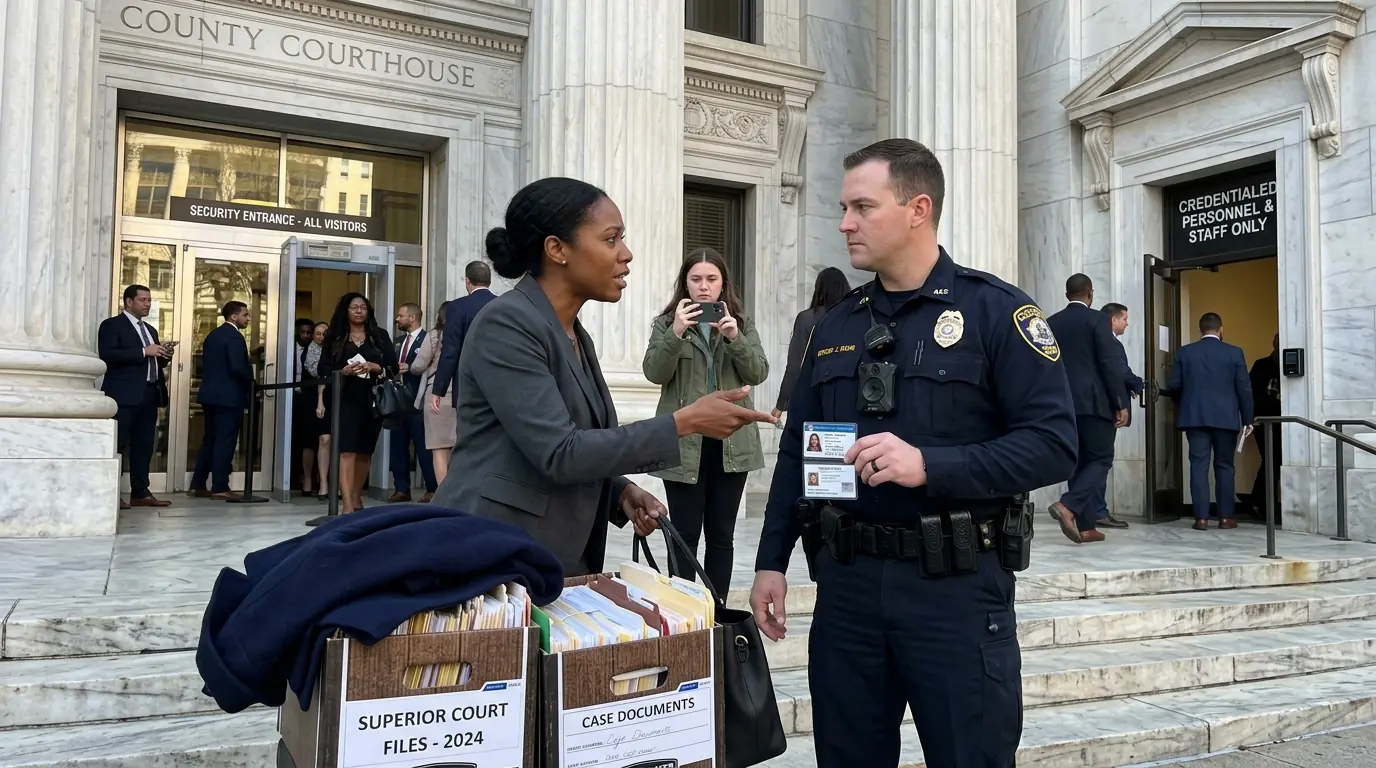
"You know exactly who I am. And you know I won't forget the way you did this. Not one bit of it."
On the morning the county courthouse opened, a woman stood handcuffed to a marble column, her case files scattered down the steps. Three cameras were recording her; not one of them was hers. The officer told the crowd the badge in her coat was stolen.
She looked at him—calm, cuffed, out of time—and said the only sentence that mattered:
"Pull the docket for Courtroom 4. Read the prosecutor's name out loud."
To understand what that sentence cost him, we have to go back thirty-one minutes.
Camille Hargrove had walked through the doors of that courthouse for nine years. She was an assistant district attorney, and not a junior one. She carried the cases other prosecutors quietly handed back: the ones with frightened witnesses and patient, careful men on the other side of the courtroom. She had a conviction record that made defense attorneys reschedule vacations, and a habit the security officers all knew: she came in early, she carried too much, and she never let an intern touch her trial boxes.
That morning, she was carrying the heaviest case of her year: The State v. Ellis Rayne, a man accused of hurting three women over three years in three different apartments, each time convinced no one would connect him to anything. Camille had connected him to everything. The evidence she had assembled was the entire case.
And at 9:00 that morning in Courtroom 4, Rayne's defense team was asking a judge to throw all of it out: a suppression hearing. If Camille was there, the evidence survived and Rayne stood trial. If she wasn't—if the state's chair sat empty when the judge took the bench—the motion could be heard without her. The evidence could die on a technicality, and a man accused by three women could walk out of the building by lunch.
She had prepared for six weeks. She had slept four hours. She parked three blocks away because the county garage was full, stacked two file boxes in her arms with her coat folded over the top, and started walking toward the marble steps she had climbed a few thousand times.
Clipped inside that coat were two pieces of plastic: her bar card with her name and license number, and her county credential—the laminated badge that identified her as an officer of the court, issued by the district attorney's office. The kind you flash at the side entrance so you don't stand in the public line with two boxes of evidence about a violent man.
Remember those two cards. Everything that happens next happens because one man refused to read them.