Isaiah Montgomery knew the officers had made up their minds before the first handcuff closed around his wrist.
The realization did not frighten him.
It disappointed him.
There was a difference.
At fifty-eight, Isaiah had spent most of his adult life sitting in courtrooms where people entered convinced they already understood what had happened.
Witnesses.
Attorneys.
Police officers.
Defendants.
Victims.
Corporate executives.
Neighbors.
Parents.
Almost everyone believed their first version of events was the clearest.
His work had taught him something else.
Certainty was often what people carried into a room before evidence forced them to become careful.
That Tuesday morning, two officers on Willow Creek Lane had not yet become careful.
“Hands behind your back.”
Officer Blake Higgins said it sharply.
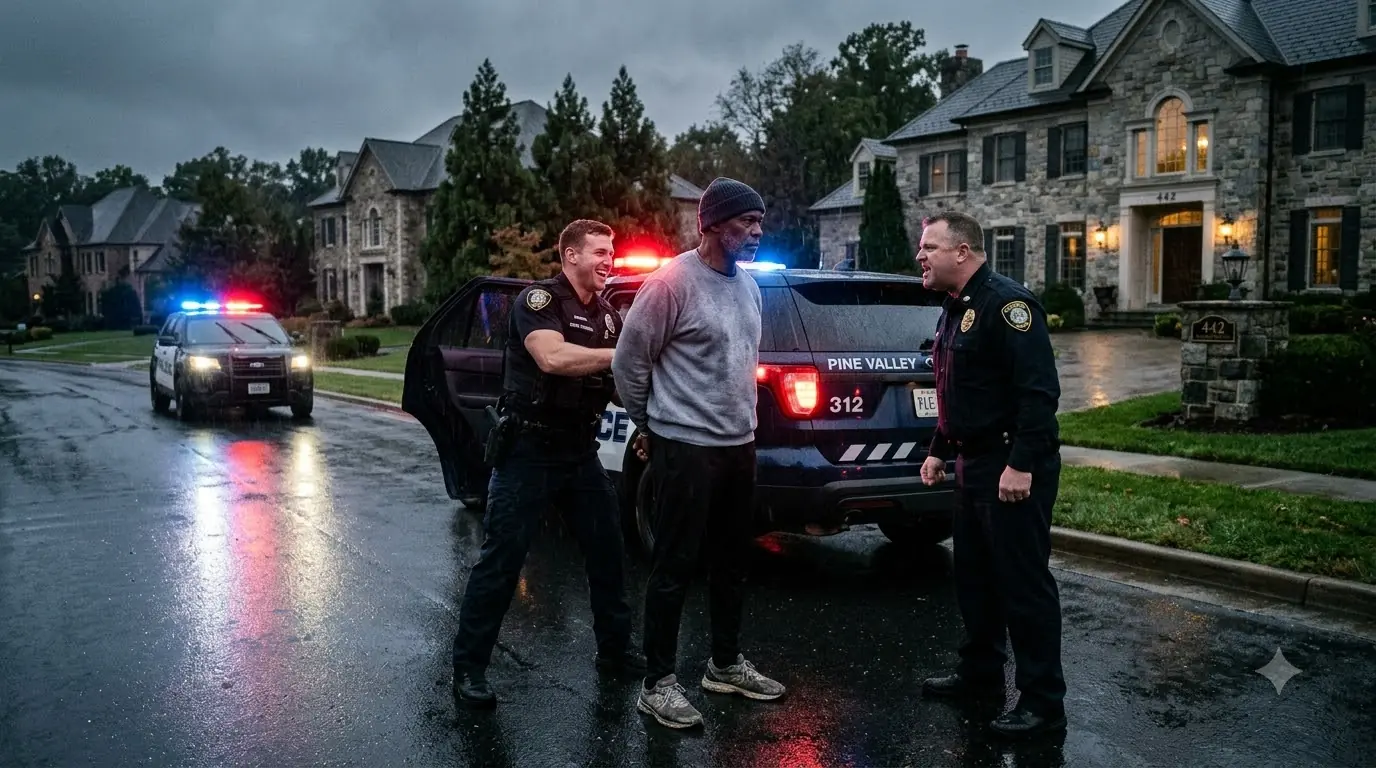
Isaiah stood beside the hood of the patrol cruiser, palms flat against cold metal.
His breath turned white in the February air.
The neighborhood was almost unnaturally quiet.
Large stone houses sat behind clipped hedges and black iron gates. Bare trees rose above enormous lawns. Porch lights still glowed against the gray before sunrise.
Isaiah had been running for forty-seven minutes.
Six miles had been the goal.
He was half a mile from home.
He wore black running pants, worn gray shoes, a faded gray sweatshirt, and a dark knit cap pulled over his salt-and-pepper hair.
No wallet.
No phone.
Only a brass house key secured in a zippered pocket.
That had apparently become suspicious.
Isaiah slowly moved his hands behind him.
Blake seized his right wrist.
The officer was thirty-one.
White.
Short brown hair.
Athletic.
Energetic in the way some younger officers were when a routine encounter began to feel important.
Sergeant Mitchell Carter stood several feet away holding a paper coffee cup.
Mitchell was forty-six.
Stockier.
Older.
Experienced enough, Isaiah thought, to know better.
That was the more troubling part.
Blake closed one cuff.
Metal tightened.
Then the second.
Too tight.
Isaiah flexed his fingers.
“Officer.”
“What?”
“These are overly tight.”
Blake checked them without actually loosening them.
“They’re fine.”
“They are not.”
“You’ll survive.”
Mitchell looked away.
Isaiah turned his head slightly.
“Sergeant Carter.”
Mitchell sighed.
“What?”
“I’m requesting that you check the cuffs.”
Mitchell took another sip of coffee.
“Higgins knows how to cuff somebody.”
“That was not my question.”
Blake pushed Isaiah lightly between the shoulders.
“Enough.”
Isaiah turned his head.
Not his body.
“You are making a mistake.”
Blake laughed.
“Everybody says that.”
“I imagine they do.”
“You think that means something?”
“Yes.”
Blake stared.
Isaiah continued quietly.
“It should encourage verification.”
Blake’s jaw tightened.
“Save the lecture for the judge.”
Isaiah looked at him.
For the first time that morning, something almost resembling humor entered his eyes.
Mitchell noticed.
“What’s funny?”
“Nothing.”
Blake opened the rear door.
“Get in.”
Isaiah remained standing.
“Before you place me inside that vehicle, I am asking one more time that you verify 442 Willow Creek Lane.”
Blake shook his head.
“We already asked where you were going.”
“I told you.”
“You said you live there.”
“I do.”
Mitchell glanced toward the houses.
442 stood perhaps eight hundred yards away.
A low stone residence behind a line of white oaks.
Unlike most houses in Pine Valley, it was single-story.
Isaiah had chosen it for that reason.
Wide front entrance.
No stairs.
Level hallways.
Large bathroom.
Open kitchen.
Enough sunlight to make the rehabilitation equipment feel less institutional.
His daughter Leah would see it for the first time that afternoon.
That thought irritated Isaiah more than the cuffs.
He had been preparing for her arrival for three weeks.
Dr. Leah Montgomery was thirty-two.
A pediatric trauma surgeon.
Eleven months earlier, she had been driving home after an overnight shift when a drunk driver crossed the center line.
The collision destroyed the lower portion of her right leg.
Three surgeries later, doctors amputated below the knee.
Leah survived.
That was the important fact.
She also hated people describing survival as though it automatically made everything afterward easy.
Isaiah had watched her learn to stand again.
Walk again.
Drive with modified controls.
Accept a prosthetic.
Reject another.
Learn when pain was physical and when it came from the fact that strangers now looked at her differently.
Her apartment in Washington had three exterior steps and a narrow bathroom.
Leah insisted she could manage.
Isaiah quietly bought 442 Willow Creek Lane.
He did not call it a gift.
He called it an option.
Leah called it interference.
They had argued.
Then she saw photographs of the windows.
She stopped arguing quite as loudly.
She was coming home from rehabilitation at four that afternoon.
Isaiah had promised pancakes the next morning.
Instead, he was being pushed toward the back of a police cruiser because two officers did not believe he lived on her street.
Blake placed a hand on his shoulder.
“In.”
Isaiah looked at Mitchell.
“Sergeant.”
Mitchell sighed.
“What now?”
“Drive me to the address.”
Blake laughed.
“We’re not your taxi.”
“It is less than one mile.”
“You are detained.”
“For what specific offense?”
Blake’s expression hardened.
“Suspicious behavior.”
Isaiah waited.
“That is not an offense.”
“Here we go.”
Mitchell rubbed his forehead.
Isaiah continued.
“What conduct are you investigating?”
Blake stepped closer.
“We’ve had burglaries.”
“Yes.”
“You match the description.”
“What description?”
Blake hesitated.
Mitchell answered.
“Male.”
Isaiah stared.
Mitchell continued reluctantly.
“Black male.”
“Age?”
“Unknown.”
“Height?”
“Approximately six feet.”
Isaiah nodded.
“Clothing?”
“Dark clothing.”
Isaiah looked down at the light-gray sweatshirt.
Blake interrupted.
“Beanie.”
Isaiah looked at his hat.
“Excellent.”
Blake’s face tightened.
Isaiah continued.
“Vehicle?”
“Suspect was reportedly on foot.”
“Direction?”
“Various.”
“Time?”
“Early morning.”
Isaiah looked between them.
“So the description is an adult Black man wearing ordinary winter clothes while outside before sunrise.”
Blake said:
“You’re getting real comfortable.”
Isaiah’s voice remained calm.
“No.”
“I’m getting precise.”
Mitchell should have stopped it there.
He would think about that moment many times afterward.
Instead he said:
“Isaiah, just cooperate.”
Isaiah turned toward him.
“I have cooperated.”
“You don’t have identification.”
“I offered an address.”
“You got defensive.”
“No.”
“You questioned us.”
“Yes.”
Mitchell shrugged.
“That makes things harder.”
Isaiah’s eyes narrowed.
“Questions make policing harder?”
Mitchell did not answer.
Blake pushed him toward the cruiser.
Isaiah finally sat.
The rear compartment was cold.
Plastic seat.
Metal divider.
Little room for his knees.
Blake closed the door.
The locks engaged.
Isaiah sat upright.
Hands behind him.
Wrists burning.
Outside, Blake and Mitchell stood near the hood talking.
They did not know the rear microphone picked up most of their conversation.
Blake laughed.
“Guy thinks he owns one of these houses.”
Mitchell said:
“Maybe he works around here.”
“He said owns.”
“I heard.”
“Come on.”
Blake gestured toward the mansions.
“Look at him.”
Mitchell said nothing.
Blake continued:
“Running through Pine Valley at five-thirty with no ID?”
“Exactly what the burglary calls have been about.”
Mitchell finally said:
“Calls said somebody checking garages.”
“Did you see him checking one?”
“No.”
“Then?”
Blake lowered his voice.
“He was slowing near driveways.”
Isaiah heard that.
He had slowed near two driveways.
One because a car backed out unexpectedly.
Another because his left shoelace was loose.
Blake continued:
“I say bring him in.”