The first officer knocked the barbecue plate out of Marcus Holloway’s hand before asking him a single question.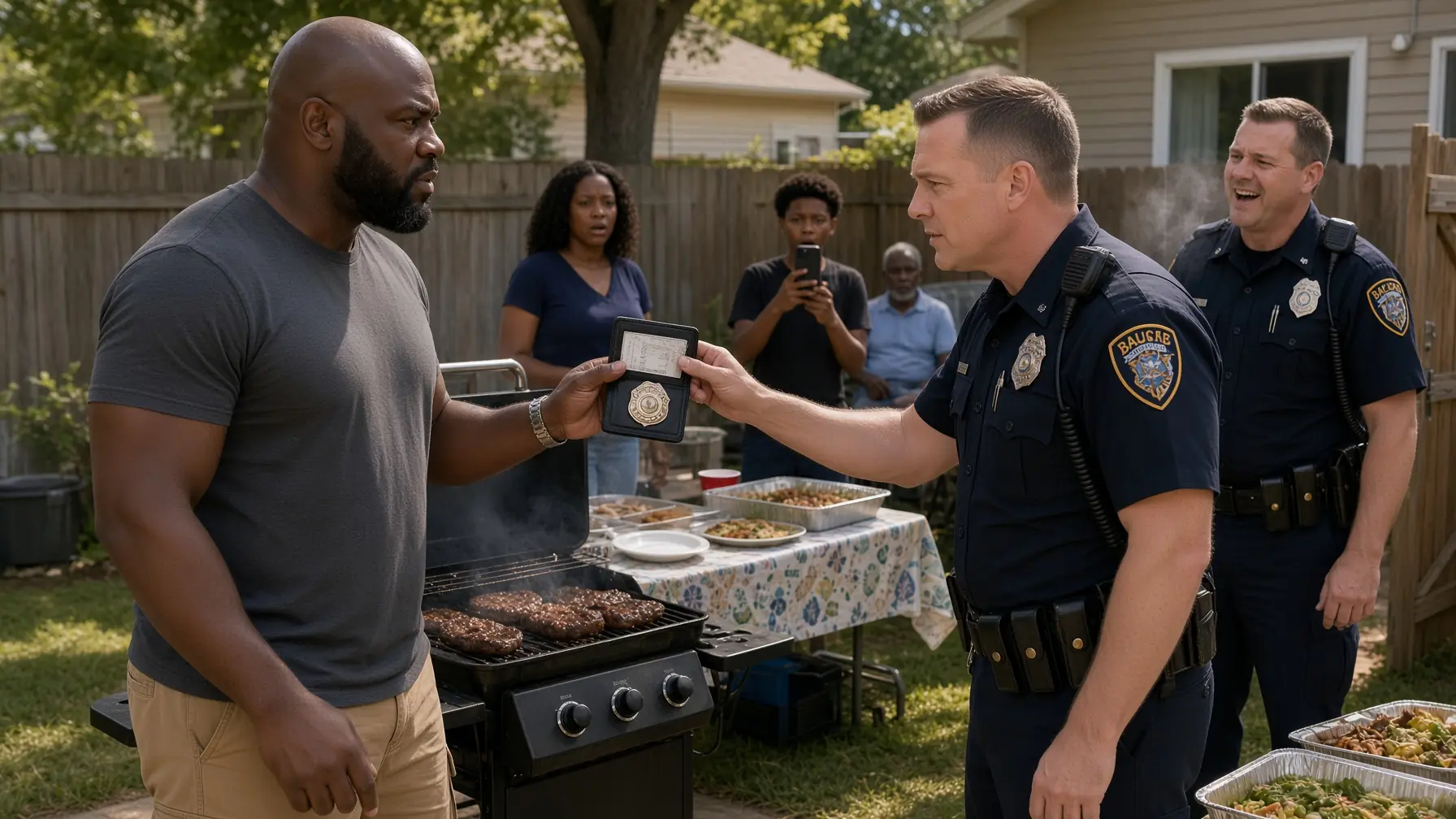
Ribs hit the grass.
Corn rolled beneath the patio table.
A streak of barbecue sauce splashed across Marcus’s white T-shirt.
For half a second, the entire backyard went silent.
Marcus looked down at the food scattered near his shoes.
Then he slowly raised his empty hands.
Officer Brent Lawson stepped closer.
“Keep them where I can see them, big man.”
Marcus said nothing.
He was fifty-four years old, six feet five, nearly 270 pounds, with broad shoulders, a shaved head, and the kind of build that made strangers assume he had spent his life playing football.
He had not.
His size came mostly from thirty years of early mornings in gyms, a military habit he had never lost.
That Saturday afternoon, he wore faded jeans, running shoes, a white T-shirt and a navy-blue apron that said:
HOLLOWAY’S BBQ — NO COMPLAINTS AFTER SECOND HELPINGS
There was sauce on the apron.
Smoke from the grill drifted through the yard.
Music played softly from a speaker near the deck.
Children had been throwing water balloons ten minutes earlier.
A tray of chicken sat beside the smoker.
Nearly forty friends and relatives had gathered at Marcus’s home to celebrate his daughter’s graduation from law school.
And now two police officers stood in the middle of his backyard treating him like an intruder.
Officer Lawson pointed toward the patio.
“Sit.”
Marcus looked at him.
“This is my house.”
Lawson gave him a tired smile.
“Sure it is.”
Marcus’s expression did not change.
“It is.”
The second officer, Ryan Cole, walked toward the grill and glanced around the yard.
Several guests had stopped eating.
Marcus’s sister Denise stood near the kitchen door holding a bowl of potato salad.
His nineteen-year-old nephew Andre had already pulled out his phone.
Marcus gave him a tiny shake of the head.
Not yet.
That gesture bothered Lawson.
“Who are you signaling?”
“My nephew.”
“Tell him to put the phone away.”
Marcus looked at Andre.
“Keep recording.”
Lawson took one step forward.
“I just told him to put it away.”
“And I told him he may record.”
Something tightened in Lawson’s face.
“You want to make this difficult?”
Marcus’s voice remained low.
“No.”
“Then start cooperating.”
“I have been cooperating since you walked through my gate.”
Lawson looked around at the crowd.
Then back at Marcus.
“Sit down.”
Marcus could have argued.
Instead, he pulled out a patio chair and sat.
That confused people later.
His daughter especially.
They asked why a man his size had obeyed an officer who had entered his property, knocked food from his hand and refused to listen to him.
Marcus always gave the same answer.
Because he knew exactly how quickly a large Black man could go from homeowner to “aggressive suspect” in somebody else’s report.
And because he knew something Officer Lawson did not.
Every inch of that backyard was being recorded.
Not only by Andre’s phone.
Marcus had six security cameras around the property.
The camera above the garage.
One beside the pool.
One overlooking the patio.
Another mounted underneath the second-floor eave.
Two more covered the side gates.
They recorded sound.
They backed up automatically.
And unlike Marcus, cameras did not become angry.
They did not raise their voices.
They did not forget.
They simply watched.
So Marcus sat.
And let Officer Brent Lawson keep talking.
The afternoon had begun four hours earlier.
Marcus woke before sunrise, as he always did when he was cooking for a crowd.
By six o’clock, three racks of ribs were already in the smoker.
By seven, he had seasoned the chicken.
By eight, his younger brother Terrence arrived carrying two coolers and complaining that Marcus had once again bought enough food for twice the number of guests.
“You know forty people are coming, right?” Terrence asked.
Marcus looked at the six trays of meat.
“People take leftovers.”
“You’re feeding a battalion.”
“Then don’t eat.”
Terrence immediately stole a piece of sausage.
Marcus slapped his hand away.
The party was for his daughter, Jasmine.
At twenty-seven, Jasmine Holloway had just graduated from Georgetown Law.
She was the first person in the family after Marcus to attend law school.
Marcus had tried not to make too much of that fact.
He failed.
He had ordered a banner.
Jasmine hated the banner.
It stretched almost twelve feet across the deck.
CONGRATULATIONS, JASMINE — ESQUIRE LOADING…
“Dad.”
“What?”
“I haven’t passed the bar yet.”
“That’s why it says loading.”
“It’s embarrassing.”
“You graduated law school. I paid for the banner. We both survived.”
Jasmine laughed and hugged him.
Marcus held on a little longer than she expected.
Her mother, Renee, had died nine years earlier.
Breast cancer.
She had been forty-six.
There were certain milestones Marcus still automatically imagined sharing with her.
Jasmine’s law-school graduation had been one.
He could almost hear Renee beside him that morning.
Don’t burn the ribs because you’re showing off.
He did not burn them.
By noon, the backyard was full.
Cousins.
Neighbors.
Old friends.
Several of Jasmine’s professors.
Marcus’s former military friends.
A few attorneys.
Two judges.
One retired state trooper.
And one woman who arrived quietly in sunglasses and blue jeans carrying a bakery box.
Her name was Commissioner Laura Bennett.
Most people in the city recognized her only when she was in uniform or standing behind a podium.
That afternoon, she looked like anybody’s aunt arriving late to a family barbecue.
Marcus had known Laura for twenty-three years.
Long before she became police commissioner.
Long before Marcus’s own career took the strange path that eventually brought them into the same professional circles.
Laura handed him the bakery box.
“Peace offering.”
“What did you do?”
“Nothing yet.”
Marcus opened it.
Peach cobbler.
“You’re forgiven.”
“For what?”
“I’ll decide later.”
They laughed.
Laura went inside to find Jasmine.
Marcus returned to the grill.
At 1:43 p.m., someone called the police.
Marcus would not learn who until later.
Her name was Patricia Leland.
She lived across the street and three houses down.
Patricia had moved into the neighborhood eleven months earlier.
Most residents knew her as someone who noticed everything.
Cars parked too close to mailboxes.
Trash bins left out overnight.
Music after eight.
Children riding bicycles across lawns.
She had complained twice about Marcus’s guests parking along the street.
That afternoon, she called the non-emergency line.
She said there was “a very large gathering.”
Then she said something more important.
She told the dispatcher she had seen “a huge Black man acting aggressively around the property.”
According to the later recording, the dispatcher asked:
“Is he threatening anyone?”
Patricia answered:
“I can’t tell, but he doesn’t look like he lives there.”
“How do you know?”
“I know the neighborhood.”
“Is he attempting to enter a home?”
“He’s going in and out of the house.”
“Could he be a resident?”
Patricia paused.
“I really don’t think so.”
She also claimed vehicles were blocking emergency access.
That was enough to send a patrol unit.
Officers Lawson and Cole arrived at 2:06.
There were cars along both sides of the street.
None blocked the roadway.
One vehicle sat slightly close to a fire hydrant.
That could have been handled in thirty seconds.
Instead, Lawson saw Marcus near the side gate.
Marcus was carrying a platter of ribs.
Lawson approached him.
“Hey.”
Marcus turned.
“Yes?”
“What’s going on here?”
“Graduation barbecue.”
“Whose?”
“My daughter’s.”