James Harris was eighty-two years old, and nothing about him suggested he was in a hurry.
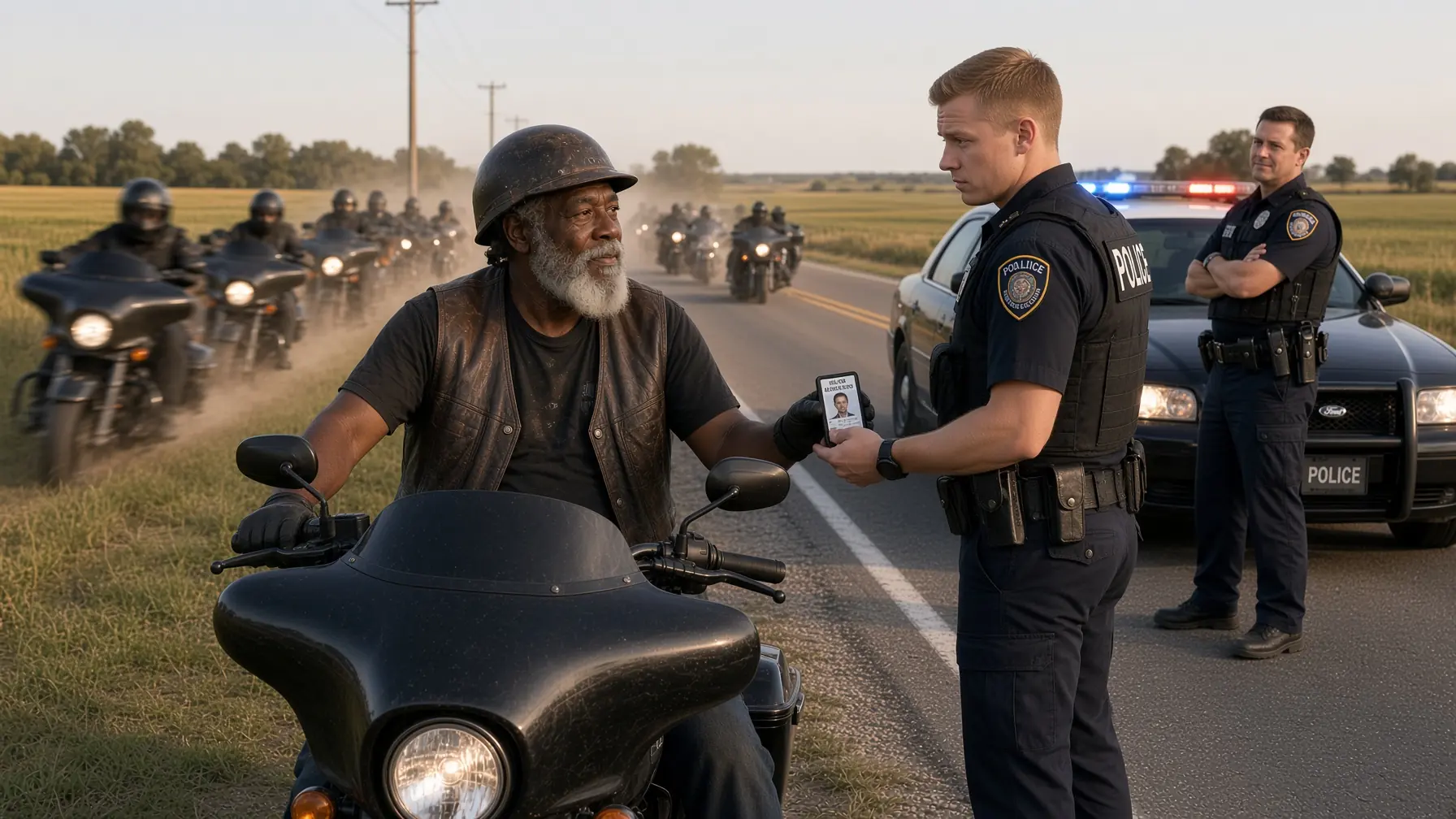
He rode a dark blue 1978 Harley-Davidson FLH that had been rebuilt so many times it was difficult to say which parts were original anymore. The chrome was no longer mirror-bright. One saddlebag had a small crease near the bottom from a parking-lot fall in 1996. The leather seat had been replaced twice, the carburetor three times, and James kept a folded shop rag tucked beneath the left side cover because the old machine still marked its territory with an occasional drop of oil.
He loved it anyway.
At 7:06 on a cool September morning, James left his farmhouse outside Cedar Ridge, North Carolina, wearing faded jeans, brown riding boots, a black leather vest over a long-sleeve shirt, and a white open-face helmet that looked almost comically clean against his gray beard. His wife had died eleven years earlier, his children lived in different states, and his doctor had been attempting for two summers to convince him that an eighty-two-year-old man did not need a motorcycle weighing more than seven hundred pounds.
James’s answer never changed.
“I don't need one.”
Then he rode it.
That morning was different from most.
Inside the right saddlebag was a pressed dark-green Army dress jacket wrapped carefully in plastic.
Inside the left was a small wooden box.
The box mattered more.
James had built it himself from walnut harvested on his brother’s property forty years earlier. On the lid, he had carved one name by hand:
THOMAS A. HARRIS
His younger brother.
Killed in Vietnam in 1968.
James had spent fifty-six years learning how to say that sentence without stopping afterward.
The state National Guard was dedicating a renovated veterans memorial that morning at Camp Redstone, a training facility thirty-eight miles east of Cedar Ridge. A convoy of Guard vehicles would travel from the old armory through several towns before arriving at the memorial grounds. The route had been chosen partly because it passed the communities represented on the memorial wall.
James had been asked to attend for a simple reason.
His brother’s name was one of the names being rededicated.
He had been asked for another reason too, though most people outside military circles would never have known it.
James Harris had spent thirty years in the United States Army.
He enlisted at eighteen.
Served two tours in Vietnam.
Stayed after the war.
Became a mechanic, then a platoon sergeant, then a first sergeant, and eventually retired as a command sergeant major in 1990.
He did not put that title on his motorcycle.
He did not wear medals to grocery stores.
He did not introduce himself by rank.
On most days, he was simply James.
That was all he intended to be that morning.
He was supposed to meet the convoy at a roadside staging point near Route 41, where a Guard public-affairs officer would escort him to the memorial. James had insisted on riding his motorcycle instead of being picked up.
“Your brother would laugh if I showed up in a government sedan,” he had told the organizer.
At 7:29, James turned onto Route 41.
He was under the speed limit.
The road was almost empty.
A county sheriff’s cruiser came up behind him two minutes later.
James noticed it in his mirror and moved slightly right within his lane.
The cruiser stayed there.
Then another appeared.
Blue lights came on.
James sighed.
He signaled.
Reduced speed.
Found a wide gravel turnout beside an abandoned feed store.
Stopped the motorcycle.
Killed the engine.
Placed both boots down.
And waited.
The first deputy out of the cruiser was young enough that James privately wondered whether he had been alive when the motorcycle was built.
His nameplate read Deputy Cole Mercer.
He approached from the left rear with one hand near his belt.
“License and registration.”
James nodded.
“Morning.”
“License and registration.”
“Yes, sir.”
James moved slowly.
“Wallet is inside my vest. Registration is in the right saddlebag.”
“Don't reach yet.”
James stopped.
Mercer looked at the motorcycle.
“Whose bike?”
James glanced down.
“Mine.”
“How long?”
“Forty-three years.”
Mercer gave a short laugh.
James looked at him.
“Something funny?”
“That thing is older than I am.”
“Most things are.”
The second deputy arrived.
Deputy Ryan Holt was older, maybe mid-forties, and did not laugh.
He stood near the rear of the motorcycle and looked at the license plate.
“Cole.”
“What?”
“Tag's coming back weird.”
Mercer turned.
“What do you mean?”
“Dispatch says no current match on the plate format.”
James heard that.
He spoke without turning around.
“It's an antique registration.”
Mercer looked at him.
“I didn't ask you.”
James nodded once.
Holt keyed his radio again.
The plate was an older North Carolina specialty registration that had been renewed under an antique classification years earlier. The characters were faded but legible.
Mercer stepped closer.
“Off the bike.”
James looked back.
“Why?”
“Because I told you to get off.”
James waited.
Mercer’s face changed.
“You having trouble hearing?”
“No.”
“Then get off the motorcycle.”
James looked toward the gravel.
Then toward the bike.
Getting off was not impossible.
But at eighty-two, dismounting a heavy motorcycle on uneven gravel required more planning than it had at forty.
He put the kickstand down.
Shifted his weight.
And slowly swung his right leg over the seat.
Mercer smiled faintly.
“Take your time, grandpa.”
Holt looked at him.
“Cole.”
James stood beside the motorcycle.
He did not respond to the comment.
“Can I get my license now?”
Mercer held out a hand.
James reached carefully into the inside pocket of his vest.
Wallet.
License.
Then he opened the right saddlebag and handed over the folded registration.
Mercer compared them.
“James Harris.”
“Yes.”
“Address current?”
“Yes.”
“Any weapons?”
“Pocketknife.”
“Anything else?”
“No.”
“Firearm?”
“No.”
Mercer glanced at the vest.
There were patches on the back.
One was an old 1st Cavalry Division patch.
Another read:
VIETNAM VETERAN
Below it, smaller:
1967–1969
Mercer looked at it for a moment.
“You actually serve?”
James turned his head slightly.
“Yes.”
“What branch?”
“Army.”
“Unit?”
“Several.”
Mercer smiled.
“That's convenient.”
James looked at him now.
“You think I'm lying?”
“I think people buy those patches online.”
Holt spoke from behind them.
“Cole, just run him.”
Mercer looked irritated.
“I am.”
He walked back toward his cruiser.
James remained beside the motorcycle.
Holt stayed nearby.
For almost a minute neither spoke.
Then Holt asked, “You headed somewhere?”
“Yes.”
“Where?”
“Camp Redstone.”
Holt looked at him.
“Guard base?”
“Training facility.”
“What for?”
“Memorial ceremony.”
Holt nodded.
“Family?”
“My brother.”
Holt’s expression softened.
“Sorry.”
“Long time ago.”
“Doesn't always matter.”
James looked at him.
That was the first useful thing anybody had said since the lights came on.
Mercer returned.
His expression had changed.
Not softer.
More suspicious.
“License is valid.”