Who are you? Huh? Car stealing ... or just another scammer crying for cash? In a remote forest, two white cops tied a black woman to a tree, mocking a lynching in modern times. They shouted, filmed her, laughed, never caring who she was. Hours later, they would destroy their careers with the same hands that held the rope. This isn't a story about a victim. It's a silent war cry that forced America to bow its head. Because the real question is who truly held the rope and who got unmasked right where they thought they were untouchable.
The wind blew down from the hillside, sweeping through rows of pine trees that stood like vertical spears, carrying with it the dry scent of dust and blood. The air here had always been thin due to the altitude and isolation, but now it felt thick with something unnamed, as if this land had seen too many buried things. The tall trees stood rigid like weapons jammed into the rock, rustling with the wind like the ancient whispers of a forest too used to silence after screams.
By the side of an empty mountain road, where the ground was scattered with gravel and the faint tracks of a vehicle that seemed to have tried to flee too late, a black woman was tied to an old tree with rusted steel cuffs. The bark was dry, cracked like the skin of a weary creature, powerless against the scene it was forced to witness. Her forehead was smeared with blood, streaks running down her torn black shirt, stained with dirt and pinebar. One side of the collar had been ripped open, revealing bruised skin caused not by a fall, but by the pressure of a boot.
She did not scream, did not plead. Her eyes stayed open, breathing shallow and quick, but her gaze remained fixed on the canopy overhead, where rays of sunlight pierced through dense leaves like the watchful eyes of someone observing from another realm. It could have been a person, a memory, or maybe herself in some distant dream she never thought she'd return to.
A police SUV was parked crooked on the roadside, door ajar, engine humming softly as if unsure whether it was a shield or a weapon. The younger officer, Garrett Cole, stood before her, shouting like he had uncovered a terrifying secret the world had to hear, though really he was just trying to convince himself of the power in his hands. He wore no vest, only a tight police shirt stretched across his muscles, sleeves rolled up, collar wide open, exposing sunburned, angry skin. His face flushed, lips pressed tight, eyes bloodshot, sweat beating on his forehead. Not from heat, not from fear, but from a thrill that bordered on sickness, the rush of punishing without interruption.
Clutching a mud-stained rope, Cole leaned in and spat the words, “Tell me who you are. A car stealing [ __ ] or some scam artist crying for cash.” He rose from one knee and kicked the tree behind her, shaking the trunk violently. The branch broke and fell, but she didn't move. Her eyes stayed fixed, not in defiance, but as a refusal to grant him any reaction.
Cole sneered, leaning closer to inspect that expression. “Registration doesn't match the ID. No papers. Fake license. You people think that the victim card covers everything?”
No one answered. She stayed silent as if long past believing truth could save her. Her blood-matted curls stuck to her cheek. No one brushed them aside. No one asked her name. No one asked why the blood was already there before the cuff.
A few steps away, Dylan, the backup officer, was rummaging through her bag, leaner, younger than Cole, but with no softness in his eyes. His hands moved quickly, but with precision, like someone who had done this hundreds of times, like a habit that stripped people of their humanity. He glanced briefly at Cole as if about to step in, but held back.
He pulled out a dead phone, an empty wallet. His voice came low, almost like he was talking to himself. “Clean. Like she was carved from thin air. Not a thing on her.”
Cole nodded, face nearly satisfied. “I know this type. Cold eyes, chin up, thinking they're untouchable. We've handled dozens.”
He turned back to the woman, this time from above, his boots almost touching hers. Sunlight hit the side of his face, highlighting sharp features and a glow that looked like fire. He leaned down and whispered, “I'll remember this face. Not because you're special, but to make sure you never get the chance to come back again.”
The wind swept through the forest again, but it no longer carried the cool breeze of the hills. It brought with it the stench of decay, the kind that comes from unchecked power and secrets buried too deep for too long. It was the scent of history repeating itself through people who seemed new, yet acted the same as before.
Blood kept dripping at the base of the tree, soaking into the dirt, blending with the smell of rotting leaves. The woman remained motionless, her head tilted slightly as if to balance a body fighting against its weight. But her eyes stayed open. They did not look at the officers nor the ground. They looked up at the canopy where the light flickered like it was sketching out another reality, one without handcuffs, bruises, or threat, a place she once believed existed.
Cole paused only for a second. That look stopped him like an invisible barrier. It was not a plea. It was not hatred. It was the look of someone who had moved beyond fear. And that more than anything made Cole step back.
He pulled out his phone and turned on the camera, whistling slightly as he spoke. “Look up. I want your face clear in the clip I'm sending to the crew. Let them see what new criminals look like. Dressed in black, clean sneakers, thinking they can walk through here like it's nothing.”
At that very moment, a small refrigerated delivery truck rolled up and slowed when the driver saw the officers. The man, a middle-aged brown-skinned driver in a denim jacket with a sunworn face, stuck his head out the window and asked, “Everything all right, officer?”
His tone was gentle, not confrontational, but Dylan had already drawn his gun before the sentence ended. His voice was cold as metal. “Keep driving, unless you want to make the news as a body with no name.”
The driver froze, then slowly pulled his head back in and eased the truck forward. Yet in his rearview mirror, his eyes darted back toward the girl tied to the tree, standing like a stone statue, silent, slumped, yet unmistakably human.
Cole burst out laughing. “Told you they know how to survive by shutting up and driving away.”
He turned back and kept filming. The wind picked up, slicing through the woods, kicking up dust that whipped against her clothes. A leaf fell and settled on her shoulder. She did not flinch, did not react. Her breathing was ragged, but her gaze did not shift.
Cole saw that gaze, and for the first time all day, he said nothing. Not out of regret, but because he had just realized some looks need no voice to make a man turn away.
Garrick Cole slowly activated the body cam on his chest, his thumb pressing the record button with deliberate intent, as if he had just finished cleaning the set before the real scene began. The tiny red light blinked steadily, its glow quiet but absolute.
To Cole, it wasn't just a technical signal. It was the switch between two versions of the same man, the violent interrogator and the trained officer. He adjusted his expression like a seasoned actor, loosening his jaw, lowering his brows for composure, and widening eyes that had just been narrowed in fury. Now perfectly fit for a rapid response team under unexpected threat.
His voice rang out crisp and measured like addressing an oversight panel. “Subject resisted when asked to present ID. We had to restrain her to prevent escalation.”
No one saw what came before. No one witnessed the kick against the tree, the yelling, the twisted grin when the blood started to run. Now everything lived only on screen, clean and well-framed as if the lie had been neatly staged and recorded in high definition.
Behind him, Dylan crouched beside the woman's car. Sunlight filtered through the leaves, making the brown leather wallet on the passenger seat gleam unnaturally. It was left slightly open, empty inside, as though deliberately purged of identity. A void between documents and existence.
No ID, no license, nothing to prove who she was.
Dylan glanced at Cole, about to speak, but the cold look on his partner's face kept him silent. He only frowned faintly, a muted response in a scene already too loud with clarity.
Cole stepped forward and yanked the wallet like he had discovered new evidence, holding it up to the lens. “Unregistered items, possible intent to flee. Subject stopped in the middle of the mountain road, possibly illegal transport,” he declared.
His voice echoed in the quiet forest, blending with the steady wind whispering through the pines. The damp scent of earth mixed with engine oil rose from the ground, fusing into an air that smelled of machines and flesh. A dry, emotionless cold didn’t pause.
He turned the body cam toward the woman, still cuffed, her face streaked with blood. One long dried line had darkened along the bridge of her nose. “Injury appears to be self-inflicted during resistance,” he read aloud, clinical, like prescribing treatment, pretending a baton wound could be explained away by convenient phrasing.
He lowered his voice so only Dylan could hear. “That’s enough for the file. Got a clip too, so no one in the unit can say I kept it to myself.”
Dylan stepped away from the car, fists clenched, unsure where to put them. He walked slowly toward Cole, eyes drifting to the still-recording camera. “Might need to call it in,” he muttered, voice drawn from dust and something unspoken.
Cole didn’t reply right away. He stared at the woman as if calculating the worth of a package ready to be sealed. Then he turned back to the lens and spoke like reading the closing line of a report. “Caught in the act. Quick response. Assault on an officer.”
Only after making sure the body cam had captured enough did he lean toward Dylan and lightly pat his shoulder as if brushing off invisible lint. “Hold the call for now. I want to check the car more thoroughly before anyone else ruins the setup.”
Dylan nodded and backed away, but his eyes stayed on the woman. Her face had gone pale from blood loss. Her neck slumped to one side like an overburdened branch leaning off a cliff. But her eyes, they were still open, not to see the world, but to hold on to herself.
Something buried in that gaze made Dylan shudder, then turn away, as if afraid to look again.
A silence spread. No sirens, no engines, just the wind rustling the pines above. That silence was not peace. It was the perfect canvas for a tragedy dressed in the guise of standard procedure.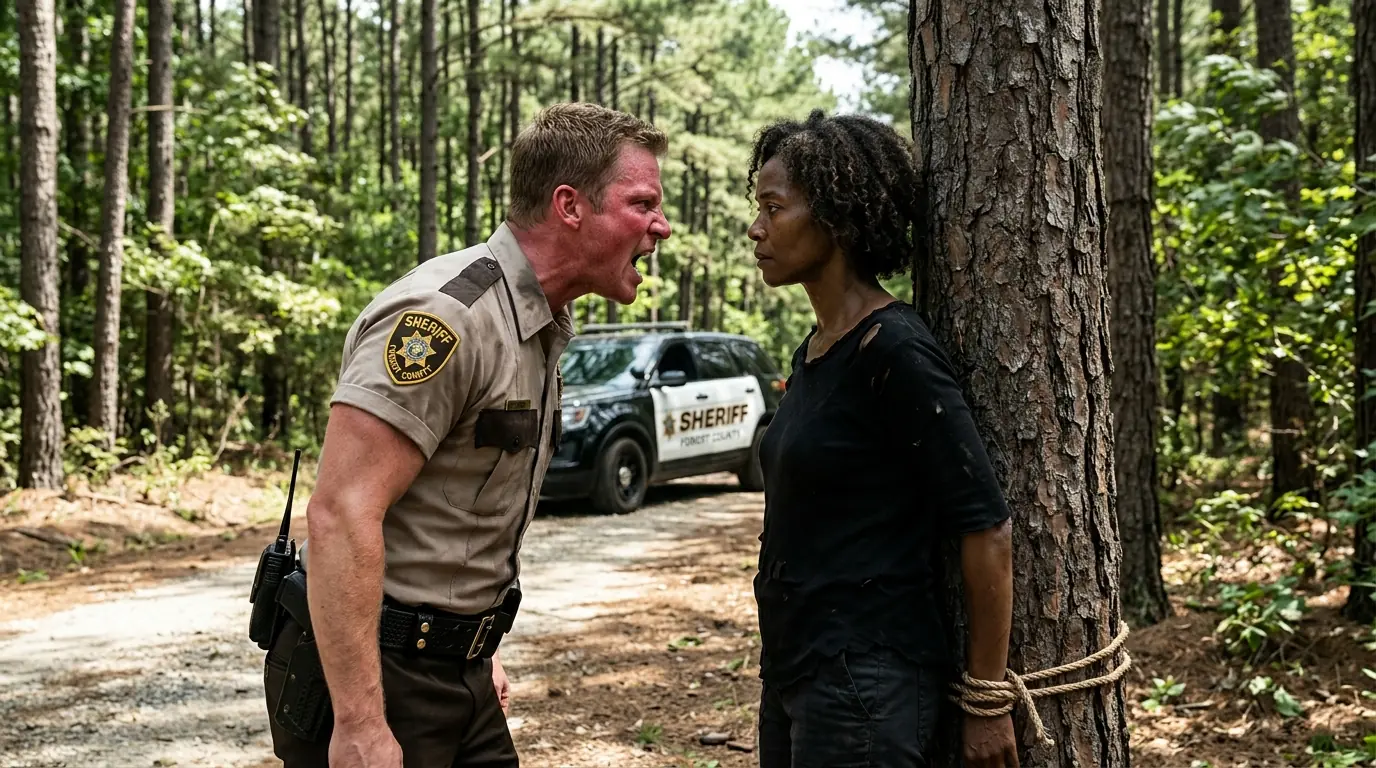
The police station sat on the edge of town, nearly three miles from the main road, where cases deemed requiring temporary control were often handled quickly before being escalated. Inside the main work area, Lieutenant Harris was reviewing shift reports when the dispatch room door opened.
Dylan entered with an evidence bag in hand, glancing briefly at her before looking toward the interrogation room. Harris closed the file, stood, and walked to the frosted glass window. The black woman, who had been tied earlier, was now in the isolation room. Hair still wet with blood, wrists marked by the cuffs, standing upright without leaning on the chair.
Harris frowned, her gaze settling on the woman’s high forehead and straight nose. Something felt off. That posture, that face. She had seen them before, not on television, not in the papers, but in a large room filled with digital boards where high-level strategists came to speak with law enforcement.
She stepped back, opened her drawer, and pulled out an old folder labeled from a conference nearly three years ago. On page eight was a group photo featuring the participants and the keynote speaker.
“Oh God,” she whispered, turning to Dylan. “I saw her at the crisis response conference. She’s not just anyone. I think she’s a federal adviser.”
Dylan froze. He hesitated, glancing at the glass, then shook his head. “She didn’t give her name. No ID either. And Cole’s not going to go along with this.”
Harris moved quickly to the operations room, where Cole was taking off his gloves and wiping sweat with a damp towel. She threw the folder on the desk and pointed at the photo.
“I believe she spoke at the federal conference. I remember that look. She said something that made the whole room stand and applaud.”
Cole looked up and scoffed. “You mean one of those media girls who take a few courses and call themselves experts? There are hundreds of them. Don’t make up stories because a face seems familiar.”
“This is serious,” Harris insisted. “If she’s federal and we—”
Cole cut her off, his voice sharper. “If she’s federal, why didn’t she say so? Why didn’t she flash a badge? Because she’s a fraud, taking advantage of soft policies to dodge consequences.”
He snapped the folder shut and pushed it aside. “I’m not letting a look at a three-year-old photo mess with my head.”
Harris didn’t answer. She took a few steps back, eyes still fixed on the woman’s face through the glass. Time may have passed, and the current situation was far from that of a conference, but the feeling in that gaze hadn’t changed.
There was a kind of composure that couldn’t be faked, a posture that couldn’t be rehearsed, and some people, regardless of the setting, made others reconsider themselves. Harris didn’t need Cole to believe her. She only needed to be sure she hadn’t misread that face.
And this time, her instinct wasn’t knocking to warn. It was demanding proof.
The isolation room sat deep within a quiet hallway, completely separated from the public area and regular holding cells. The walls were painted gray, the fluorescent lights dim, and the chair pressed against the wall faced a tilted ceiling camera.
The woman sat there, wrists still marked from the rope, dried blood at her hairline and jaw. She had been uncuffed, but not treated, not cleaned, not spoken to by staff. The report form in front of her remained blank. The phone on the table unlocked, ready to call out if she wanted, but for thirty full minutes, she hadn’t touched a thing.
She sat upright, hands resting lightly on her thighs, eyes fixed on a spot on the discolored wall ahead. Her face showed no clear emotion, as if she had shut off every reactive mechanism and let the world turn on its own.
A security officer assigned to monitor the feed noted in the log: Subject remains completely silent. No communication, no resistance. Posture stable. Breathing steady.
Upstairs, Lieutenant Harris still couldn’t shake the unease. After Cole dismissed her concern, she didn’t return to her desk, but instead headed back to the archive room, searching through old files from the federal conference held in the state capital three years ago.
Each file was numbered and coded, but most of the images had faded due to poor printing and careless storage. Harris patiently flipped through each page until she stopped at the photo appendix section. Portraits of special guests who weren’t part of law enforcement but had spoken at the conference.
One photo appeared, showing five people standing in a row, all dressed in civilian clothes. The third person in line had a face that struck a painful chord. Lightly curled long hair, eyes angled slightly to the right rather than at the lens, a straight nose, and a modest high-collared shirt all perfectly matched the woman being held in the basement.
There was no mistaking it.
Harris pulled the photo closer, intending to check the names below, but paused. The caption read clearly from left to right: Mark Wyn, Lisa Rowan, Data Blur, Dr. Evan Hol, Naomi Fielding. The third name, right where the woman’s face appeared, had been partially blacked out with a thin swipe, as if someone had tried to erase it, but not completely.
The name was hidden, but the gaze remained.
Harris felt a chill run down her spine. She picked up the photo and walked slowly toward the surveillance room, where live footage from the isolation chamber played.
The woman sat perfectly still, unmoving.
A guard nearby asked if she needed assistance, but Harris simply gestured for silence. She stared at the screen, then lowered her voice and murmured, “I don’t know who you are, but the way you sit there, that’s not someone being held. That’s someone watching a mistake.”
From that distance, every movement the woman made seemed intentional. She didn’t speak, didn’t argue, didn’t resist, but her presence thickened the air in the room like a question hanging unanswered, one even her captors weren’t brave enough to confront.
Harris knew what she had to do next. Not report to Cole, but find out which system the woman belonged to. Because if her instincts were right, today’s error wasn’t a minor incident. It was the spark that could ignite a reckoning no statute had ever prepared for.
Garrett Cole had never considered anyone his superior except his father. Raymond Cole had been the city’s chief adviser for nearly two decades, a man who could orchestrate internal transfers, interfere with departmental investigations, and silence public outrage before it reached mainstream media.
Cole’s reassignment three years ago had been labeled a technical internal matter, but those who witnessed it firsthand remembered clearly. A young Asian man knocked unconscious after stopping his car as instructed, offering no resistance. Cole was the only officer who gave chase and the only one who struck.
The neighborhood surveillance cameras were down that day, and the blood on the victim’s shirt was recorded as contact with a metal fence. When federal investigators asked about the deep gash on the man’s cheek, Cole gave a short reply: “He fell.”
No charges were filed. Two weeks later, he was transferred to his current town. Same rank, plus a bonus for decisively handling a high-risk situation.
Harris had read that report, and she knew the descriptions were too polished to be real. Cole had never shown remorse. To him, every act was justified if it secured his position.
In a recent off-duty gathering with Dylan and a few younger officers, he leaned back in his chair, feet on the table like giving a lecture to trainees. His tone was both amused and smug.
“I’ve handled minorities since academy days, and no one’s touched me yet.”
No one responded. One tried a forced laugh. Others stared at their phones. Dylan looked at the floor, twisting a bottle cap between his fingers.
Cole went on, needing no agreement. “Problem is, they’re used to being accommodated. The moment they meet someone who won’t bend, they crack. You think the law was made to protect them? I once heard justice is blind, but no one said it wasn’t afraid.”
He glanced at Dylan, not asking, but commanding. “You agree, right?”
Dylan gave a small nod, not too fast, not too slow.
In his mind, the image of the bound woman returned. Not in the orderly pattern Cole used. This incident didn’t match the others. She hadn’t cried, cursed, or collapsed.
Cole thought he was following a familiar script, but something this time felt out of place.
Upstairs, Harris sat at her computer, reopening Cole’s internal discipline records. Hidden entries appeared when she used an old access code from her days at central command. Words like violation of intervention protocol, failure to log initial warning, and body cam inactive during pursuit came up in sequence.
Below, a scanned handwritten note from the original file read: “Recommend extended observation for six months. Emotional response beyond permissible threshold.”
Harris read it, pulled out her phone, then paused. She looked toward the isolation room through the glass, feeling something she thought she had long buried. Fear for the detainee and deep distrust toward the man holding power. Not because she hadn’t seen Cole do worse, but because this time the one he tied down might not need to speak to shake the whole system.
The department’s internal archive system was set to auto-sync at the end of each shift. All body cam footage is uploaded to the server and stored for 48 hours before encryption and file coding. Yet that night, Garrett Cole’s footage was flagged: format error, unrecoverable. A simple message appeared on screen. Data corrupted. Partial sync failed.
No one noticed the warning. For some tech staff, such errors were common, especially when a device had been disconnected or tampered with mid-recording.
What no one expected was that a short clip not yet deleted had remained on a backup terminal where a tech assistant had tried downloading it earlier for a signal test.
It was a 19-second video. No audio enhancements, no edits. The image shook slightly, frame tilted left, but clear enough to see Cole standing beside the black woman tied to the tree.
In the clip, Cole leaned forward, gripping her hair with his left hand and yanking her head back. She didn’t resist. Her neck arched, exposing bruises, and her arm scraped the bark so hard the skin nearly split.
He didn’t look at the camera. His face was hidden behind her shoulder. But his voice reached the mic just clear enough to be recovered.
The sentence tore through the screen like a slash.
“If you make it through the night, you’re lucky.”
His voice wasn’t raised, wasn’t shouted, but lowered just enough to turn it into either a promise or a threat, depending on how one chose to hear it.
That line wasn’t part of any procedural tactic. It wasn’t taught in any training course. It was the kind of thing said when someone believed their power was strong enough to make the law just another piece of decoration.
The technician watching paused the footage at that very moment, not daring to skip forward. He wasn’t sure if he had the authority to keep it, nor did he know who to report it to. Still, he copied the clip to a separate USB drive and labeled it with a simple code name: tree.
At that exact moment, Cole remained unaware that the recording hadn’t been deleted. He paced the room like a man waiting for someone to confirm he was right.
In his mind, the situation had already been logged the old way. A non-compliant woman, no identification, a threatening posture, identity unverified. Everything aligned with the precedents he had long relied on.
But what he didn’t realize was that this time, not everything remained in his control.
That tiny fracture, the 19 seconds left behind, was quietly expanding like a seed that couldn’t be crushed from within.
In the surveillance room, Harris received a message from the technician. “I’ve got a clip, but not sure it’s clear enough.”
She opened the laptop, plugged in the USB, and hit play. The screen flickered with distorted images and jittery frames. Then she heard the exact sentence.
Her body froze as if ice had been poured down her spine. It wasn’t the violence that stunned her. It was the ease with which he had spoken. A sentence not aimed at a person, but at everything that had stayed silent around him.
Harris didn’t blink through the entire clip. When the screen faded to black, she still sat motionless. She knew what she had just watched wasn’t evidence. It was a warning.
And if no one spoke up, what happened at the base of that tree wouldn’t be the last time.
The silver-gray car was towed to the impound lot near dawn, resting silently among a row of vehicles, mostly held for expired registration or speeding violations. A temporary sticker on the windshield read plainly: “No ownership documents pending verification.”
A night shift attendant named Reggie was assigned to perform the initial inspection before the vehicle was passed on to the technical unit. Wearing gloves, he opened the driver’s door and shined a flashlight across the interior.
But what caught his eye first was a neatly packed cloth bag tucked beneath the seat. Inside the bag was a thickly encased rubber phone. Its screen was black, entirely unresponsive to touch.
Beside it lay a magnetic ID card with a QR code and the letters D.O.D. printed on the back.
Reggie lifted the card toward the light. Under the matte overlay, small lettering appeared more clearly: Authorized clearance tier 2, non-civilian.
He held his breath, placed both items back in the bag, and glanced around nervously as if someone might have seen.
Reggie returned to the file room, opened the intake form, and began typing, but paused at the special notes section. One question echoed in his mind.
How could someone arrested for lacking documentation be driving with federal clearance and a military-grade device?
Either she was impersonating something dangerous, or they had just detained someone with access far above local authority.
Before he could finish the note, the terminal flashed a sync request from headquarters. He hurriedly stored the bag, sealed it, but did not send it. No one asked.
The next morning, a new staff member on rotation opened the storage unit and noticed the black woman’s vehicle file hadn’t yet been processed. Pulling out the bag, he used a scope light for a quick scan.
Next to it, pressed tightly against the passenger seat wall, was a small round black tracking device, nearly identical to those used within special government branches. He touched its shell, feeling faint residual heat. A concealed LED blinked once, subtly, then went dark. The sync session had likely just ended.
He looked up. The vehicle bay was silent, yet it suddenly felt stifling. Routine impounds didn’t involve internal tracking, and no one with military-grade equipment should be found cuffed on the roadside for lacking a driver’s license.
He crouched by the seat, took a photo with his phone, then deleted it immediately. His hands were sweating, throat was dry. He didn’t report it, not out of fear of being wrong, but out of a clear instinct that this wasn’t something he should be the first to uncover.
At the end of the inventory, the device was wrapped securely, marked with a pending inspection slip, and pushed into non-priority storage. No report, no data transmission. But two people had seen, and one of them knew that what he had chosen not to say could be the beginning of a mistake that could not be undone.
In the duty log, Reggie’s final handwritten note read: “Vehicle 45B-LE untouched until formal directive. Do not access internal data.”
Late that evening, a video clip under 30 seconds surfaced from an anonymous account, shot from the balcony of a house above the mountain slope. The footage was blurry, slightly shaky due to the distance and silent, but what appeared in frame stopped millions in their tracks.
A black woman, handcuffed with one wrist bound to a thick tree trunk, stood alone on the edge of an empty mountain road. Two white police officers entered the shot, one of them, Cole, yelling into her face.
Sunlight cut through the pines, revealing a trail of blood running from her forehead to her collar. No one else was in the frame. No civilians, no witnesses, no context. Just a bound body, a lifted chin, and a pair of eyes staring straight at the man holding the cuffs.
The video was shared nearly 50,000 times within four hours. The original account disappeared shortly after, but the content had already spread across the platform.
Viewers began asking, at first with simple questions like, “What’s happening here?” and “Is this really America?” Then gradually shifting into widespread outrage.
No one needed to know her name, hear the full story, or see how it ended. They only felt the weight in their chest when watching the scene.
And it was the ambiguity that made everything worse. Because if no one knew exactly what this was, it meant something like, “It could happen anywhere to anyone.”
The hashtag “Who was she?” began trending after a communication student wrote, “We know the cop’s name, the car number, the time and place, but no one knows the name of the woman tied up.”
That line was quoted thousands of times and soon evolved into a bigger question. Why didn’t anyone stop it?
Human rights forums spoke out. Civil rights activists questioned whether the incident had been deliberately buried. Many pointed out that the blood on her forehead was already dry in the footage, meaning the violence occurred before the recording began, not during the restraint.
Others compared the image to historical lynching photos from the past century, captioned with, “It never ended. It just changed form.”
Mainstream media could no longer stay silent. By the next morning, three major news networks aired the clip in their breaking news segment, raising questions about the woman’s identity and the conduct of law enforcement.
A spokesperson for the local police department declined to comment, citing the incident as under internal review, but silence no longer worked. The public was not waiting for investigative conclusions. They had already seen enough.
Across social platforms, countless users changed their profile pictures to a still from the video, the frame where the woman stood in the woods, one arm suspended, eyes looking skyward.
No one knew her name, where she came from, or why she was there. But millions said the same thing.
“I don’t need to know who she is. I only know I saw it, and I can’t forget.”
The movement spread not because any celebrity spoke out, but because that feeling of unease struck deep into the collective memory of a nation long accustomed to looking away from violence. And this time, the image had surpassed the reach of erasure.
Around midnight, the main gate of the police station shook with the sound of a heavy engine, slow and deliberate, like a wordless warning. A matte-black armored SUV drove straight into the internal parking zone without flashing lights, without a license plate.
The gate officer assumed it was a tactical response vehicle, but no scheduled transfer appeared on the logs. The headlights cut off the moment the vehicle stopped, and the door opened with a calm so cold it triggered the emergency lights across the front lot by automated security reflex.
The first to step out was a black female officer, likely in her early 40s. Tall, lean, and sharp enough in presence that no rank insignia was needed for people to straighten up.
She wore a white shirt with no epaulets, a charcoal coat, low-cut leather shoes, and her hair tied neatly behind her head. Her eyes scanned the lot once, stopping squarely at the main entrance.
She said nothing, asked for no directions, and walked straight into the administrative wing, leaving the two personnel with her standing still beside the vehicle as if their assignment lay elsewhere.
The glass doors parted, and she approached the central command desk. No one had time to ask her name. Each step echoed in the tense silence of the late hour.
At the desk, she neither introduced herself nor made a request. From her inner jacket pocket, she pulled a card with a silver anti-forgery layer and placed it on the wooden counter, slowly pushing it toward the on-duty officer.
Under the light, embossed text became clear: Deputy Director, Federal Counter-Coercion Unit. Below it was the federal seal and an individual clearance code, a sequence no local staff held authority to verify.
The officer touched the card lightly with a fingertip, as if to confirm it wasn’t counterfeit. The back of the card still held warmth, showing it had just been removed.
She did not request to speak with anyone, nor did she ask to be escorted. After a brief stunned pause, the officer pointed to the internal elevator leading to the isolation area.
She nodded, retrieved her card, and walked off, neither quickly nor slowly.
Hallway cameras recorded her every move. There was no sign of tension, no anger in her expression. Her entire body language said one thing only. She wasn’t here to ask permission.
Her presence shifted the unspoken hierarchy within the station. Officers began glancing at each other. The data technician pulled out a phone to text someone, and the internal groups started pinging again after nearly an hour of silence.
Someone whispered, “Who just walked in?”
But no one had a clear answer. They only knew that from the moment the unmarked SUV appeared, every action would now require recalculation.
And what they thought was already arranged for the next morning was no longer under their control.
Because the card left on that desk wasn’t a nameplate. It was a redefinition of everyone’s position in that room.
The file opened on the command table at 1:00 a.m. Beneath layers of restricted access, a name appeared. Moren E. Blake.
Title: Command Major, Strategic Operations, under the Federal Counter-Coercion Unit.
Her operational record spanned six combat zones, four international civilian extraction campaigns, and two direct command missions within level-five conflict areas.
The attached documents were all classified for federal agencies and above, with keywords such as decentralized intervention, advanced humanitarian response, and soft intrusion alert.
Moren was not part of any civil administrative system. She was a strategic-level security coordinator operating under interagency authority.
Before becoming a recognized figure in non-traditional tactical strategy, she had led the Federal Witness Protection Coordination Unit and was known as someone who appeared on no public surveillance systems.
All civilian records associated with her were encrypted, including her credentials and residential data. That explained why the station’s verification system had failed to identify her from the start, and why treating her as an unidentifiable civilian had now become a categorical mistake.
After the senior female officer placed her badge on the command desk, every department within the station was forced to switch all operations to federal-level monitoring.
Every action, from physical contact to file processing, was automatically backed up and covertly transmitted to Washington.
The internal security system, long accustomed to local protocols, couldn’t keep up with the retrieval speed of federal servers, causing a temporary overload.
In less than 10 minutes, those inside the station shifted from a position of control to complete submission.
Moren was not escorted out of the isolation room by ambulance or a loud convoy. She walked out on her own, posture upright, breathing slow and steady. Her face calm as water, facing forward.
The person beside her carried no gun, no handcuffs, and didn’t need to maintain control.
Moren said nothing throughout the entire walk up from the basement.
When she reached the command desk, the light reflected off the dried blood around her wrists, her wrinkled shirt, and her left arm still swollen from the force of the restraints.
Every officer present stopped what they were doing when she stepped into the center of the lobby. They waited for her to speak, to issue a command, request disciplinary action, or at the very least make a legal threat.
But Moren did none of those things.
She simply took a breath, looked directly at the highest-ranking officer in the station, and said clearly,
“I will not let silence be an excuse for violence ever again.”
The statement carried no dramatic emotion, no bitterness, no anger. It was a period without explanation and at the same time the beginning of a chain of consequences that could no longer be avoided.
One sentence was enough to trigger a national security audit, not to protect her, but to protect themselves from a mistake too clearly documented to ignore.
And from that moment on, everyone in the station understood.
Moren Blake wasn’t seeking revenge. She only needed the system to reflect on itself in the eyes of someone who had seen more than just violence and still chose to remain sane.
Less than 24 hours after Moren Blake’s identity was made public through the media, a post on the Georgia State University Law Student Forum unexpectedly drew attention.
The writer was a senior named Leila Mendes, who had participated in an inter-campus exchange program in the town where Cole was stationed.
In the post, Leila recounted an incident from two years earlier, when Cole had pulled her out of class mid-lecture, claiming suspicion of illegal recording activity on academy property.
She had no equipment besides her phone, but was still taken to the station with her hands cuffed behind her back.
Leila had filed a complaint with internal affairs, requesting footage from the classroom and hallway to prove she had done nothing wrong. The case was closed quickly with the conclusion: “No grounds to confirm procedural violation.”
She didn’t give up. A year later, Leila filed a civil suit against Cole, but the case was dismissed due to lack of evidence, since the classroom cameras were under maintenance at the time.
When the story was buried, Leila nearly gave up, until she saw the image of Moren tied to a tree online.
In her nearly 1,000-word post, Leila ended with one short line.
“I don’t know who she is, but I know the man who tied her up.”
“He once used that same rope of power to choke me legally.”
The post was shared tens of thousands of times, prompting others with similar stories to come forward. A woman in Texas named Marley Grant spoke in a live stream, describing how Cole struck her car trunk with a baton after she asked for a search warrant.
There were no witnesses, no complaint, only a brief report stating, “Subject displayed resistance upon vehicle approach.”
The third was a nurse from Florida named Rosalyn James. She recalled being pulled over on an overpass and ordered out of her car at night for a security check. When she refused, Cole dragged her out with his bare hands and pushed her into the grass.
She dislocated her shoulder and missed two weeks of work, but without video and no immediate medical report, the incident was handled internally and disappeared.
The last was a former trainee from a Montana security academy named Kevin Shu. He recalled Cole calling him out during a drill and striking him down for displaying non-compliance with command. A split lip, bruised ribs, and a closed-door meeting with instructors led him to leave the academy.
All four had once tried to speak up. All were dismissed due to a lack of evidence.
But this time, they stood together.
They posted simultaneously under a shared hashtag named “By Silence.” The opening line was identical in every post.
“He once laid hands on me, and I once stayed silent. But today, I choose not to be.”
Media outlets reported the phenomenon as one of the strongest waves of disclosure the state law enforcement system had ever seen. Individuals previously unconnected, hurt in different times and places, all shared one point of contact, a badge-bearing hand that always found a legal excuse not to be held accountable.
Moren’s story unintentionally became the spark for a collective memory to rise, where what was once deemed too small to speak of now formed an undeniable foundation.
The anger was no longer centered on a single incident. It began to orbit one pressing question.
How many times had he done this before being stopped?
And this time, those once forced into silence chose to speak, not for revenge, but to ensure the world would not forget.
After receiving a request for internal investigation support from the Special Office for Police Conduct Oversight, the Federal Technical Division proceeded to retrieve all data from the backup server of the local police station.
They discovered a video file stored in the wrong format, unencrypted, located in a temporary folder awaiting transfer to the main security system.
When the footage was opened at the inter-agency processing center, the room fell completely silent.
On screen, Moren Blake was visible, her hands bound behind her back, her body pressed against the trunk of a large tree at the roadside. A streak of blood ran from her forehead down to her collar. Sunlight filtering through the leaves cast a scene both stark and haunting.
Garrett Cole stood facing her, aggressive in posture, his words captured clearly on the recording mic.
“I’ll ask you one more time. Who are you? If you make it through the night—”
The video ended with a harsh yank that forced Moren’s shoulder downward. No sound recorded after, but the image left no room for any valid justification.
Once the timestamp and data integrity were verified, the footage was sent to the Department of Justice, then rapidly circulated to national media outlets.
Within four hours, every major news network aired the video under the same headline.
“Police tie black woman to tree. She was a federal special agent.”
No visual effects were needed. No background music required. The raw clip alone was enough to bring the nation to a halt.
Millions across television, social media, and news platforms saw the same image, a woman publicly restrained in broad daylight by a man in uniform who believed no one would dare ask what he was doing.
The entire state was immediately shaken. Universities held open discussions. Civil rights attorneys demanded urgent investigations. And citizens gathered in protest outside city halls, holding hand-lettered signs that read,
“If she hadn’t spoken out, would anyone survive to tell the story?”
Politicians who had remained silent were now forced to speak, at the very least to avoid losing voter support ahead of midterm elections.
On internal forums, a wave of officers submitted temporary resignations, citing they did not want to be part of a moral collapse.
Yet, amid the uproar, Garrett Cole appeared on a local radio program where he had long been a regular guest, billed as a model officer in the fight against illegal immigration.
When asked about the video and public reaction, Cole did not dodge. He stared straight into the camera, voice unwavering.
“I did my job. If they won’t say who they are, then who are they? No ID, no response, suspicious behavior. I followed my training. I’m not apologizing.”
That statement, instead of calming the public, only fueled the fire. News broadcasts quickly clipped his quote and ran it as a lead, highlighting what many had long suspected but no one had said outright.
The system doesn’t admit fault because it never learned how to.
Cole’s words were no longer just a personal defense, but a raw declaration of the kind of power long assumed to be righteous, no matter who had been trampled.
And now he had spoken it aloud while every eye was watching. No denial, no hesitation.
That was the moment when not just one person, but an entire state began to understand.
The tying didn’t end at the tree. It began with everything that had once been called procedure.
In the capital, as civil society organizations debated how far the case should go, a statement from the Special Veterans Alliance issued during a closed-door press briefing changed the entire course of the case.
The organization spokesperson, a retired lieutenant colonel, stood straight before a line of microphones and declared clearly,
“We know her. She once led training for the elite counterterrorism unit at a classified federal camp. What you saw in the video is not just a disgrace to policing. It’s a disgrace to this nation.”
That information was verified just hours later by a brief release from the Federal Strategic Security Agency, confirming that Moren Blake had served as a central commander in a multinational special response unit responsible for oversight, counterintelligence, and crisis mitigation across three high-risk global regions.
She was not merely a government employee. She had once protected the lives of hundreds of American citizens abroad and participated in top-tier interdepartmental operations under complete secrecy.
The partially unsealed record rendered every previous excuse about unidentified suspect status absurd.
Within 12 hours, media outlets shifted tone unanimously, no longer asking what happened, but instead,
“What does this represent?”
A wave of political cartoons spread, one depicting Moren tied to a tree alongside a torn American emblem, a stark warning about a line that had been crossed.
But the sharpest blow didn’t come from the press. It came from a question raised at an emergency congressional hearing.
“If an elite special ops commander, someone sworn to defend this nation, can be treated this way in broad daylight, then what must regular citizens do to avoid being chained?”
That question was not part of the hearing script. It came from a Black representative, voice trembling but eyes unflinching.
The entire chamber fell silent for several seconds. The head of the judiciary committee was forced to call a recess to deliberate, as the implications of that moment extended beyond the session’s original scope.
It was that moment that would be clipped, replayed endlessly as a symbol of the collapse of a trust that lengthy reports had tried to preserve.
Later that same day, a photo circulated widely across social media, Moren three years earlier leading a training session with cadet officers. The caption from the official page of the counterterrorism force read,
“Integrity before reaction.”
Amid the chaos, people began digging up old stories. Each time a Black individual was beaten without anyone asking their name. Each case dismissed due to a lack of evidence.
But this time, it didn’t fade. It pierced the very core that the system had tried to protect, the belief that wearing a badge guaranteed safety.
The congressional question was not just about one event. It became a test of a nation’s courage to choose between preserving institutional image or stepping out of comfort to confront the truth.
And because the woman chained once trained those sworn to protect the country, that act of restraint no longer symbolized personal humiliation. It became the final signal that unless change begins at the root, the system will continue producing more people left hanging under the daylight of the country they vowed to defend.
Garrett Cole was handcuffed right outside the internal affairs office, his eyes blazing with unfiltered rage. As two officers moved in to hold his arms, he thrashed and shouted like he still had control over the situation.
“You’re all fools. One day you’ll need me. When the riots break out, who’s going to stand on the front line? Who’s going to do the dirty work for you?”
His words didn’t stop anyone. Those who used to stay silent around him no longer turned away like before. They simply watched, saying nothing.
But that silence said everything.
A young officer behind the camera quietly pressed record without orders, without needing to ask permission. History needed to witness the moment when someone who once thought himself untouchable had to stand still and hear the charges read aloud.
News of Cole’s arrest spread across networks in less than an hour. Split-screen broadcasts showed him in earlier days, proudly patting a superior’s back with a victorious grin, contrasted with a current image of him being shoved into a car, eyes lost and scattered.
At the bottom of the screen was the only caption:
“Officer Garrett Cole detained for abuse against a federal duty officer.”
No one applauded, but social media flooded with reactions. People didn’t call Moren by name, nor did they discuss her rank much. What circulated widely was one truth.
Justice had finally reached someone who once seemed beyond its grasp.
At a nearby military base, Moren sat alone in a temporary office. A small TV on the wall was playing the news, though she wasn’t watching. But when Cole appeared, yelling into the camera and being forced into the vehicle, she tilted her head, eyes narrowing slightly.
A faint smile crossed her face, not one of triumph, but the quiet expression of someone who had witnessed enough injustice to know that real change doesn’t come from taking someone down, but from the moment the entire system is forced to listen to what is right.
In that moment, Moren didn’t think of herself. She thought of the times her reports were dismissed. The decisions made without her because she wasn’t soft enough. The emergency calls she couldn’t answer because she lacked the authority.
And now, with one simple act of holding her ground in silence, she had created a resonance louder than any speech.
It all began at a black locust tree on a hillside where blood seeped into the roots, and ended in a station hallway where old power was stripped from the shoulders of a man who believed he was the law.
That afternoon, the phone in Moren’s office rang, but she didn’t answer. A secretary walked in, intending to remind her of a command briefing, but stopped at the look in her eyes.
Moren gave a slight nod, signaling that everything was in its place. There was no need to push further, no declarations left to make. What needed to be said had already been spoken by society itself.
And if anything remained, it was the responsibility of those who would come next to make sure this flame would not be smothered by hands that had long learned to live in the dark.
At the federal courthouse, Cole sat facing the charges that had been under review for several weeks. His name appeared on the official document alongside seven indictments, including torture, intentional humiliation, violation of civil rights, abuse of authority with racial bias, fabrication of a false scene, misuse of public service equipment for personal gain, and the most serious charge, torture under the guise of public duty.
In front of him, the nearly 30-page indictment summarized everything that had once been dismissed, hidden, or labeled a personal error. For the first time, an officer like Cole could no longer hide behind rank or family status. He was simply a defendant.
Reporters packed the courthouse hallway. Yet, no one spoke when the team of prosecutors exited with solemn expressions. Behind them, citizens of every age, profession, and background stood quietly, exchanging glances that carried the same unspoken question.
Without the footage from the secondary camera, would the truth have ever surfaced?
In the crowd, a middle-aged man held a small sign with handwritten words:
“If it isn’t recorded, does it mean it never happened?”
That question spread like a slow flame, not just for today’s trial, but for the hundreds of past cases buried for lack of physical evidence.
Immediately after the charges were read, a journalist turned to a nearby citizen. The young woman, a law student, replied calmly but firmly,
“We shouldn’t need video for justice.”
But by now, even the system must admit that without evidence, victims’ voices are always at a disadvantage.
That statement was quoted across countless post-trial analyses as an unavoidable truth. The legal system had long used the absence of information to shield misconduct.
Meanwhile, inside the old precinct where Cole had once commanded, the wall that displayed his commendations was cleared. Old memos were pulled for review, and the internal audit was expanded statewide.
A special investigative team from the Department of Justice was deployed to assess past complaint procedures. Preliminary findings revealed more than 20 previously dismissed reports showing signs of administrative interference, many of them directly connected to Cole.
Elsewhere, Moren stood inside a Federal Academy classroom, looking out the window toward the training field. Her current role was to oversee a new curriculum: nonviolent response in civilian engagements.
The cadets sat upright, diligently taking notes. She never spoke of what had happened. Everyone already knew.
And because they knew, they listened differently, not with admiration, but with accountability.
One male cadet asked, “If no one had recorded that moment, would you still be here?”
Moren answered simply,
“The better question is, why was there only one person recording?”
It wasn’t a warning or a rebuke. It was a reminder of duty, of bearing witness, and of courage in moments that seemed too small to matter.
The young delivery woman who once trembled on a roadside at night as Cole smashed her package with a baton in search of drug evidence now stood in court in a formal black suit, hair tied neatly, eyes steady but not hardened.
She was no longer a threatened bystander, but a certified attorney with credentials from the state’s human rights bar. Her name appeared on the list of specially approved witnesses.
In the voluntary statement she submitted to the court, she wrote,
“I’m not here to reclaim justice for myself, but to make clear that the actions once overlooked had led me to believe silence was safety.”
That sentence was read aloud in court, and for a moment, the entire room stood still.
In her testimony, she recounted the details of that incident years ago. Cole had ordered her out of the car for having a suspicious face, then forced her to kneel by the roadside for a search despite having no warrant.
A dash cam had captured the event, but the footage was later deleted from the records due to a device malfunction.
Today, facing the man who had nearly cost her both her career and her dignity, she did not flinch. She ended her testimony with a single question directed at the court.
“If that day I hadn’t survived in my mind, then who would be standing here today to tell the story?”
Outside the courthouse, thousands stood in silence, firm and resolute. Every person held the same sign.
“We saw it.”
The phrase was printed on a plain white background, no logos, no extra words. That simplicity made the message even more powerful.
In this era, anyone can be a witness if they choose not to look away.
The media were barred from reporting inside the courtroom due to a special order from the judge to protect certain victims’ identities, but national news outlets were stationed outside, live streaming the atmosphere of a trial that, even without images, had already shaken the nation.
Among the crowd were former police officers, longtime silent victims, and even high school students carrying human rights essays as class projects.
One 12th-grade boy stood at the security barricade holding a small sign above his head:
“If we see it, we must speak it.”
That line later became the slogan of a statewide education campaign against abuse of power.
The boy was invited to speak at the closing session of the year-end legislative meeting, and when he stepped up to the podium, he repeated only his original sentence. No additions, no edits.
Inside the courtroom, Cole no longer held his arrogant posture. He stared at the floor as witnesses described each act he once dismissed as petty, wielded as a joke in a power play.
Every testimony pieced together the shattered mirror of who he was, not a peacekeeper, but a man who used a uniform to trample those without means to fight back.
In the gallery, Moren sat quietly. She didn’t need to speak. Every testimony, every crowd reaction, every printed banner served as proof of what she had once said.
Silence was no longer a neutral choice. It was complicity.
And today, as those once afraid stepped into the light, truth no longer belonged to one side. It belonged to those who dared to remember, to speak, and to confront.
In the closed courtroom, when the judge delivered the sentence, no one applauded.
The final three words echoed with sharp finality.
“30 years.”
The ruling stated clearly: “Federal prison, no parole, no eligibility for sentence reduction under any condition.”
It was a sentence for the willful torture of a citizen while acting under the color of law, abuse of authority, causing severe psychological harm, obstruction of a federal investigation, and violation of the anti-discrimination statute in public service.
The court ruled after all body cam footage, witness testimony, and investigative reports from three independent agencies had been reviewed and verified.
Cole stood upright without a lawyer at his side, having chosen to represent himself. The defiant look on his face remained unchanged, even after hearing the verdict.
When the federal marshal stepped forward to handcuff him again for transfer to a high-security facility, Cole gave a quiet scoff.
He looked straight into the camera and spoke just one sentence.
“Fine. Now I’ve made it into history.”
His voice was low, not boastful, almost proud, as if the chain of actions he had committed, from tying Moren to dragging a student from her classroom, had been forged into the kind of twisted legacy he had always wanted to leave behind.
The courtroom atmosphere remained still. No one argued with him. No one needed to.
The statement was later cut from all broadcast footage, deemed an incitement, but it didn’t matter. It was recorded on officer training forums.
Cole’s words became the textbook example for the term “executioner’s syndrome,” a psychological condition in which individuals delude themselves about their role in enforcement, mistaking inflicted harm as a badge of power.
Outside the courthouse, a group of high school students held a reading of the verdict on their school lawn. They didn’t read the news. They transcribed the federal court’s official conclusion word for word and posted it on a public board under the heading:
“Justice is what’s written so others won’t have to guess.”
The sentence wasn’t just Cole’s punishment. It became an archived echo for a system that once stayed silent when it should have spoken.
As for Moren, she appeared in no interviews after the trial. The press kept sending requests, all declined.
Only one image was ever seen, taken at a military training base. She stood among a group of recruits holding a whiteboard with the title of the first lesson in a special course on power abuse prevention.
The board read:
“Reputation does not earn respect. How you hold power is what people remember.”
No one confirmed when the photo was taken, but when compared to the time Cole entered prison, it was revealed that the two moments were exactly 48 hours apart.
History will record his name just as he hoped, but not as a law enforcer, and certainly not as a hero.
Rather, as an exclamation mark crossed out from the shared sentence of a generation.
And the rest of the story will not be told for revenge, but as a reminder.
No one has the right to define another person forever with handcuffs.
Because in the end, what gets remembered is not the name of the one who inflicted the pain, but of those who stood back up from it.
At the federal security training facility, nestled deep among secluded hills, a special class was launched as part of a program to restructure ethical conduct in law enforcement.
On the digital board, the session’s title was displayed clearly: “How to treat a person whose name you don’t know.”
The instructor was not a celebrity or former general, but an independent adviser who had served on the internal investigation team.
Throughout the session, he never mentioned the victim’s name, nor showed any video footage. Instead, he recounted timelines, the system’s reactions, and the consequences of seemingly minor actions that had triggered changes significant enough to require rewriting parts of the institutional curriculum.
Trainees were divided into groups to discuss hypothetical scenarios, most of which subtly mirrored elements from the Moren Blake case without referencing it directly. Some recruits appeared uneasy as they recognized the parallels between the lessons and reality.
But what silenced the room was a final writing exercise.
Each participant received a small notebook and was asked to write a single sentence describing their emotion upon witnessing someone with no known identity being detained or treated as a potential threat.
Among the dozens of handwritten responses, one excerpt was kept for internal ethics training. The writer did not include a name, only a trainee ID code, but their words left the entire ethics council in prolonged silence.
The sentence read:
“I don’t remember her face clearly, just a blur of tangled hair and a quiet posture, but I remember the tree she was tied to. I remember how it stood alone behind the station, and I know I never want to see anyone tied to it again.”
The statement came without legal citations or formal analysis. Yet, it was chosen as the opening quote for the next year’s course, not to glorify a victim or condemn a perpetrator, but to remind everyone that amid hundreds of procedures, what stays deepest is not always in the reports, but in the image that refuses to leave the mind of someone who witnessed it.
In the months that followed, the tree behind the old station was removed from its spot. Not chopped down, but carefully transplanted to the training facility grounds as a silent piece of evidence.
There was no plaque, no memorial marker. But recruits who walked past it often slowed their steps, glanced at it, and turned away, carrying their unspoken questions. Some wrote them down. Others kept them private.
But none mentioned Cole.
His name gradually disappeared from exams and training materials. In its place, ethical frameworks were redesigned around the unknown individual scenario, establishing it as a new golden rule in the justice profession.
The story of Moren Blake was never taught as a personal case study. She never returned to give a speech, never sent a message or shared a formal reflection.
But from that silence, others were compelled to ask themselves:
In a moment of chaos, what will stop you from being the one who tightens the restraints?
And if you once stood and watched it happen, do you have the courage to ensure it never happens again?
Reyes arrived at the hearing room on time. His steps were steady and calm, as though he had walked that path a thousand times in his mind.
The city that morning was damp and chilly, typical of the first days of the season, with mist lightly covering the low rooftops and the streets still wet from the previous night’s rain.
Reyes was dressed in a white shirt, a light gray tie, and an unadorned suit jacket. Two days prior, he was the first to submit a request to voluntarily provide testimony before the Federal Oversight Committee.
The short letter he sent contained only three lines:
“I was present when she was handcuffed. I did not intervene. I want to talk about that.”
His name was not prominent on the list of internal witnesses. He was a police officer who had been on the job for just three years, with a clean record, no violations, and no commendations.
Perhaps that was why he was the only one with the courage to admit that he had done nothing.
No one expected his appearance. His name didn’t stand out in the list of internal witnesses. He was a young officer with less than three years in the force, a clean but unremarkable record. No medals, no investigations, a silent soldier in a line of those who simply followed orders.
Perhaps because of this, he became the only one with enough courage to speak about his silence.
The hearing room was cold and closed, with white lights shining directly on the table, reflecting on Reyes’s face, young yet weary. It might have been from lack of sleep, or perhaps something heavier, something that had never been named, weighing down his neck.
The people in the room remained neutral, neither frowning nor kind. They had heard many justifications. They were ready to hear yet another one.
When asked about the details of the day Moren was handcuffed, Reyes did not hesitate. He recounted each step the patrol team took, how the radio crackled with a signal, how the SUV turned onto the hill, how everything unfolded like part of a training drill too familiar.
His voice was clear and unwavering. There was nothing remarkable in his account, until one of the board members asked,
“Your feeling at the moment Cole tightened the cuffs?”
Reyes paused. A long silence stretched between those who were used to waiting for a reasonable response.
Then he spoke slowly.
“When he tightened the cuffs, I saw her eyes. She didn’t struggle. She wasn’t panicked. What I saw was pity. Not for her, but for us, the ones standing there and doing nothing.”
One of the board members quietly shifted their pen, but didn’t write anything.
Reyes’s words didn’t blame anyone, didn’t accuse anyone. But it was precisely because of that that they cut deeper, because they exposed what everyone wanted to hide.
Indifference masked by following orders.
The hearing was not recorded, nor were statements released to the public, but the minutes of that meeting were filed under a special code reserved for cases involving ethics restructuring in the industry.
In those minutes, Reyes’s testimony was transcribed verbatim, with no alteration.
One member of the board later made a note in the margins:
“For the first time since the Cole case, an officer did not defend himself with circumstances, orders, or fear. He simply admitted that he did not act, and that that was the first step.”
After the hearing, Reyes did not return to his former unit. He requested a transfer to the internal legal consulting center to assist rookies in the new training course.
A colleague asked if he regretted volunteering to testify, and he simply replied,
“I never want to see that look again, not even in a dream.”
That statement was not quoted or turned into a slogan. However, during the ethics class the following week, the instructor shared Reyes’s words as an example of courage in silence.
They did not call it a heroic act, nor did they use the term atonement. They simply said:
“Sometimes the right thing to do is to stop and say, ‘I saw it.’”
In a system that had once proudly boasted quick reflexes and strict discipline, the story of a young officer admitting his silence was perhaps the most shocking. Not because it condemned anyone, but because it forced everyone to reflect on themselves.
Amidst countless wrongdoings that had been overlooked, what was needed more than anything was not someone shouting out. It was someone brave enough to stand up and say,
“I did nothing, and I realize I was wrong.”
That is when silence no longer becomes an excuse, but rather the beginning of change.
Reyes walked out of the hearing room without waiting for praise or encouragement. He quietly signed the resignation letter he had prepared in advance and left it on the committee’s desk without setting a date to return.
In the letter, he wrote,
“I was not forced. No one threatened or punished me. I am leaving because I no longer want to wear the uniform that I once allowed myself to ignore when I saw something wrong.”
He also did not ask to retain a clean record or request any compensation. The only thing he took with him was a copy of his testimony stamped with official approval, as a reminder that silence comes at a price, one that he had learned to bear on his own.
There was no press conference after his resignation decision. Local TV stations did not report on it because Reyes had never been a prominent or controversial figure. His former colleagues read the information through the internal network and continued their shifts as usual.
But in another place, nearly 300 miles away, Reyes’s testimony unexpectedly appeared in a special class at the Oregon State Police Academy. It was the first session of a new course titled “Reflexes and Professional Ethics,” added after the Moren Blake incident.
The instructor began by reading Reyes’s description of the look Moren gave when she was handcuffed. The class was silent, not because they didn’t understand, but because no one expected such a precise and painful description of indifference.
A student asked, “Was the officer stripped of his power?”
The instructor shook his head, saying, “He wasn’t stripped of his power. He chose not to hold on to it anymore.”
From that day, Reyes’s lesson became mandatory in the curriculum, not as an example of bravery, but as a landmark to remind everyone that in this profession, sometimes acknowledging inaction carries more weight than a wrongful action.
Months later, a group of students from the academy came to visit Reyes, now living in a small town on the border, working at a community legal aid center.
They didn’t interview or film. They simply came to say that his lesson had made them reconsider why they chose this profession.
One of the group members recounted,
“We read the part where you said she pitied us, and we knew it wasn’t an accusation. It was your way of pulling yourself out of the darkness.”
Reyes didn’t respond. He just wiped the dust off a photo frame on the table, a photo of a training camp with the tree where everything had begun.
No monument was erected for Reyes. His name was not mentioned in the media or on online forums. But every year, at the start of the new term, the first lesson at the Oregon State Police Academy still begins with a question:
“Are you willing to say, ‘I stood still’?”
And Reyes’s name is mentioned as someone who chose to step out of silence on his own, without waiting for orders, without needing applause.
A simple exit, but perhaps the bravest one.
In her effort to trace the times Cole had been involved in violence but managed to avoid punishment, an independent journalist named Alicia Frell dug through old records from various states where Cole had worked on temporary assignments.
What she discovered was not a mere coincidence.
In at least four cases, complaints had been filed, witnesses were present, and even medical reports confirmed injuries. Yet the conclusions always contained the same cold line:
“Insufficient grounds to open an investigation.”
When Frell sent requests for clarification to the legal offices involved, she received roundabout replies, citing procedures for delegating authority, internal regulations, or simply a decision not to disclose further.
Frell did not stop there. She reached out to the witnesses who had spoken out, including one woman who had been strangled by Cole during a traffic stop, but her complaint was dismissed because she was not a government official and therefore not within the priority scope.
Another witness, a former Border Patrol employee, claimed to have seen Cole beat a young Central American man in a holding cell. She had written an internal report, but that record had never received a response.
The documents Frell gathered were later submitted to the federal oversight committee, which was reviewing the internal monitoring role of the executive branch.
There, a question was posed not with an interrogative tone, but with bitter skepticism:
“Who defines what qualifies as sufficient grounds?”
“And why is the right to protection reserved only for those carrying badges, rather than for those being oppressed by the very system itself?”
The question caused the room to fall silent.
One board member responded that it was due to the authority delegation between investigative levels. Another suggested reconsidering the recommendations in exceptional cases.
But no one could provide a definitive answer to the basic question:
Who has the right to determine the value of a cry for help?
From the hearing room, excerpts of Frell’s testimony and independent investigation documents began to spread across alternative media platforms.
The public, especially from minority communities, started sharing personal experiences, most of which had been sidelined simply because they did not meet the criteria to be heard.
A restored old video from a local TV channel showed Cole appearing on a community training program, stating:
“My department has the right to decide who deserves protection, because we are the front line between order and chaos.”
His words now echoed like a declaration from a world where the boundary between protection and oppression had been distorted.
When Frell was invited to speak at a civil rights seminar at Georgetown University, she did not talk about specific cases or investigative evidence. Instead, she projected the question from the hearing:
“Who decides who is qualified to be protected?”
Then she stepped down from the podium, leaving the room to confront what a reporter could not answer for them, the responsibility of making the law, and the responsibility of questioning that law when it had strayed from what is right.
During a special three-hour hearing at Congress, an unexpected figure took the stand to testify.
He was Thomas Greley, a former senior commander of the Federal Police Force, a retired white man who had been out of service for nearly a decade.
No one expected his appearance, let alone that he would speak out against what he had once defended. But he stood there without hesitation, his voice steady and deep as he read his testimony.
“We were taught to protect the image of the organization at all costs. The first step when handling internal complaints was to check the personnel file of the accused. If they had a clean record, the next instinct would be, ‘Don’t let a few minor incidents affect their career progression.’”
He paused, his gaze sweeping across the committee members, and then slowly spoke, as if emphasizing each word.
“The problem is right there. We assume that what isn’t big doesn’t need to be addressed. But every deviation starts with one allowed.”
That statement was not part of the prepared transcript, but when it was broadcast on national television, it became a hot topic of discussion, not just about who was wrong, but about how the entire system had been trained to overlook what were deemed insignificant deviations.
Immediately following the hearing, a bipartisan group of lawmakers introduced a new resolution. The text was short, without the verbose legal language, but its content was shocking.
“Any citizen subjected to coercive measures outside the legal framework, including handcuffing, binding, coercion, and threats, shall have the right to request an investigation into the public service, regardless of title, rank, or form of resistance at the time of the incident.”
This proposal was named the Blake Civil Response Act, as a way to acknowledge the indirect but decisive role of Moren Blake in clarifying the limits of power.
In the following days, discussions about this provision attracted unprecedented attention. A representative from North Carolina exclaimed,
“We are redefining the relationship between the people and the state.”
A member of the state security council opposed it.
“This is a dangerous step, as it could lead to frivolous lawsuits.”
But the majority of the public supported it on social media platforms. Hundreds of thousands of comments in support poured in under the hashtag “Accountability starts now.”
At a policy seminar, Professor Miranda Yates from Stanford University made a notable statement.
“The issue isn’t the number of cases, but the system that makes the nameless untrustworthy. When someone is handcuffed and no one knows who they are, it doesn’t diminish their rights.”
The statement spread to international forums and was quoted in a New York Times editorial as a sign that democracy, to be maintained, must begin by protecting those without the privilege of speaking.
At the same time, a nonprofit organization founded by former officers and citizens launched the Civic Trace app, allowing anyone subjected to coercive measures to record the incident, submit it to a neutral storage system, and request an independent investigation group to assess the situation.
The app received more than 200,000 downloads within its first week.
In a rare interview, Moren Blake was asked if she believed her actions would lead to such a significant change. She simply replied,
“I didn’t do this to become a symbol. I just refused to become a shadow.”
Then she turned away, leaving the story for others to choose how to see it, not as a person being bound, but as a society learning again to shed the habit of silence.
In a social studies class at a public high school in Vermont, teacher Amber Whitmore began the first lesson of the semester with a quiet story.
There were no slides, no handouts. She simply asked the students to close their eyes and listen to a short account of an event that had shocked the nation.
A black woman tied to a tree, yelled at in broad daylight in a modern America.
She did not mention the victim’s identity, nor did she name any of the individuals in the audio clip she played for the class.
When the excerpt ended, she handed out blank sheets of paper with one request.
“If you had to give a name to this woman, what would you call her and why?”
The class sat in silence for nearly 10 minutes. Some students bent their heads and wrote immediately, while others stared at the blank paper.
Amber did not urge them, nor did she offer suggestions. She let the silence unfold naturally as part of the lesson.
At the end of the period, the papers were submitted with no names written on them.
One of the lines that made her pause the longest was from a blonde boy sitting at the back of the class, who usually wore headphones during class. He wrote,
“She is the one who made me ashamed forever, thinking that the police were always right.”
The line wasn’t elaborate, nor was it long-winded, but it captured the essence of what Amber had hoped education could do, not just deliver facts, but spark a real dialogue with oneself.
That lesson was not filmed, not reported, and not posted on the school website. But after class, a group of students proposed starting a club to discuss the relationship between power and social responsibility.
What was remarkable was that more than half of the students in the group were those who had previously remained silent when others were mocked because of their skin color.
News of the unusual lesson spread through the students’ social media. A story post featuring an image of the blank sheet with the handwritten line was shared tens of thousands of times within 2 days.
Other schools began adopting a similar approach, telling an unnamed story, not only to foster empathy, but also to compel students to define their values through the language they choose.
In a subsequent educational seminar, Amber told her colleagues,
“We cannot teach students how to be human just through grades and tests, but we can give them a moment to ask themselves, if they witness injustice, what will they do?”
In her view, the story of Moren Blake didn’t need to be repeated like a history lesson. It needed to be relived, each time a young person realized that justice doesn’t have a fixed form, but changes according to how we view it.
Amber had never met Moren, but when she saw the look in the boy’s eyes as he handed in the paper, she knew the lesson had already begun to take root, not in books, but in awareness. And that, to her, was the most important thing a teacher could leave behind.
In a civic politics class for 12th graders at a high school in New Jersey, the teacher chose to begin the new semester not with theories about government structures, but with a short video recorded by a civilian security camera.
The video had no name tags, no clear time markings, just blurry images of a woman being forced to stand against a tree, her hands tied high, her neck held tight, and her face covered in blood.
The class sat in silence for the 5 minutes the video played. Some eyes looked down, others looked up. No one laughed. No one spoke.
After the video stopped, the teacher did not offer any further explanation, but instead asked the students to write a short reflection, not too long, not about right or wrong, but it had to be honest.
On one of the submitted papers, there was a shaky but clear sentence.
“She is someone I don’t want to become, but I am very afraid I will.”
The writer was Malik, the only black student in the class, who had been misunderstood multiple times simply for wearing a hoodie in the library.
That sentence made the teacher pause longer than usual. It was no longer just a short assignment or a personal reflection. It was a confession from a generation that had heard much about equality, but had witnessed many counterexamples.
That day, the class ended without anyone raising their hand to speak, nor was there a closing summary.
But the next day, the teacher announced an important decision.
The story of that woman would become the main topic of a 3-week unit in the “Politics and Power in Modern Society” curriculum.
From that point on, the story of Moren Blake was no longer just a piece of news or a viral video. It was included in the curriculum, not because she was the main character, but because she had once been considered unworthy of mention.
What happened to her reflected a system that had operated on the assumption that only those with status deserved protection. Bringing that story into the textbook was a public acknowledgment that this had once been allowed, covered up, and intentionally overlooked.
In the first lesson of this unit, the students did not learn about the legislative process or how laws are passed. Instead, they were asked to list all the classes, occupations, or groups they thought were least protected by the system.
The list was unexpectedly long.
And at the top of Malik’s list were three words:
“Black women.”
When the teacher asked why, he answered with a sentence that needed no explanation.
“Because she has all the traits that make people overlook her. No uniform, no title, and no one standing by her.”
At the end of the unit, instead of a multiple-choice test, the class was asked to design a community campaign with a single message:
“If you don’t know who that person is, treat them as if they are the most important person you’ve ever met.”
Many groups chose to make videos. Some wrote letters to the city council suggesting reforms in the arrest process.
Malik’s group recreated the original scene, but changed the ending. A young student steps forward, raises their hand to stop the police officer, and asks,
“Why is she being handcuffed?”
The project was shared at school and then spread to other places.
No one in Malik’s group mentioned Moren Blake’s name, but everyone knew that if the story was not retold properly, the system would continue to operate as it had before, including a person who had been denied in the education program was not to make her a symbol, but to remind every generation that the system only changes when shame becomes awareness and awareness becomes action.
The tree where Moren Blake had once been tied still stood at the small intersection south of town.
The leaves had changed color with the season, but the old scars on the tree’s trunk remained, like a wound that time could not erase.
After the trial and the wave of public outcry across the state, the locals, without any call to action or the backing of any organization, quietly began bringing white stones to place around the tree.
Each stone was a different shape, with no engravings. But within a few weeks, the area had become a circle of stones, regularly kept free of weeds, becoming a stopping point for those who didn’t necessarily need to know exactly what had happened, only that something had once been wrong.
One afternoon, as the sun cast long shadows on the worn pavement, an 8-year-old girl walked past the tree with her mother.
The girl stopped, her innocent eyes looking at the circle of stones. Then she looked up and asked,
“Why are there stones around the tree, Mom?”
The mother stopped, still holding her daughter’s hand. A gentle breeze swept through, carrying the distant sound of children’s bicycles, and the whole town seemed to pause for a moment.
The mother finally bent down, placed a hand on her daughter’s shoulder, not explaining with words, but subtly slowing her steps, as if to let her daughter feel rather than remember.
It was not a historical monument or a location marked by a brass plaque, but it carried more weight than any statue.
A week later, in an online community group, someone posted a picture of the girl standing by the stone circle with a simple caption:
“She will grow up with this memory without needing to know the name of that woman.”
The post spread quickly, not because of the image’s appeal, but because of the shared feeling that the silence at that place, this time, was not one of ignoring, but a way of allowing space for the truth to exist in its simplest form.
Many of the town’s people had been silent witnesses that day. They didn’t tie the woman up, but they didn’t intervene either.
Now, they didn’t speak, didn’t appear in the media, but chose to tend to the grass around the tree every Saturday afternoon. Some brought a small watering can. Others added another smooth stone from the riverbank.
No one asked anyone. No one gave orders. It was simply an unspoken agreement among those who had seen and who had remained silent.
When a reporter from a major newspaper came to town to interview the locals, many refused to comment. Some just smiled, placed a hand on the nearest stone, and walked away.
The journalist later wrote in the article,
“This is where I learned that not all change begins with shouting. Some things simply need to be preserved.”
Therefore, the circle of stones around the tree was not a monument, but a continuous, nameless act with no clear starting point and no end date.
It was a reminder that pain does not always need to be carved into a plaque, but must still be kept where people once chose to turn away.
And it was this persistent presence, as quiet as a breath, that transformed a tree, once symbolizing abuse of power, into a living testament to awakening, not just of a community, but of an entire generation.
One early morning, when dew still clung to the grass and the white stones around the tree were still wet from the night’s rain, a high school student happened to walk by and noticed a faint pencil-written line on the tree’s trunk.
The handwriting was shaky but clear, placed right between the scar on the wood where the handcuffs had once scratched.
The line read,
“When viewed closely, where silence once proved complicity,”
No one claimed to have written it. No cameras recorded it, but from that moment, the old tree was no longer an unnamed tree surrounded by white stones.
It became a quiet destination for those who had once avoided facing it.
The written words did not cause a media frenzy or appear in the headlines, but they became the focal point of quiet discussions among the community.
Some of the elderly in the neighborhood whispered that it might have been a student or someone who had witnessed everything but could not intervene.
Whoever it was, the act did not seem destructive, but more like an acknowledgment that sometimes silence is not innocent.
Many people visited the tree, stood by it to read the words, and then left without commenting or taking photos.
They left behind a moment of stillness, as if allowing the words to seep into a space already filled with many memories.
A week later, the city government held an internal meeting and proposed installing a small sign at the base of the tree to explain its significance to passersby.
The draft for the sign referenced the Moren Blake incident, summarizing the trial and the subsequent changes in federal law.
However, as soon as the proposal was made public, a group of residents voiced their opposition.
They were not against the memorial, but they believed the site did not need any official explanation.
One resident spoke at the community hearing,
“We don’t need a metal sign to remind us. We need that tree to retain its true marks, so anyone passing by will have to ask and answer for themselves.”
The opposition did not cause an uproar, but it was strong enough for the city council to withdraw the proposal.
Instead of installing a sign, they decided to preserve the landscape as it was, neither adding nor removing anything.
The sanitation crew was instructed not to erase the pencil-written words, not to repaint the tree trunk, and not to clean the stone path as though it were a public work of art.
Everything was kept as it had formed, by anonymous hands, unacknowledged but undeniable.
The following month, a local high school organized a field trip for students combined with a civic education lesson.
Instead of going to the library or a museum, they visited the tree.
The teacher did not lecture, but simply asked the students to observe, read the words, and write a few lines of reflection.
One male student wrote in his notebook,
“I don’t know who that woman is, and I don’t know what happened, but if there ever comes a time I choose to remain silent, I will remember this tree.”
The tree and the stones were no longer just sad relics. They had become a form of community conscience.
No one needed to be reminded by flags or speeches. The truth sometimes endures the longest, not because it is honored, but because enough people choose not to let it be covered up again.
At the annual Federal Executive Conference, the room buzzed with quiet sounds, pens tapping, papers shifting, and occasional coughs.
For two hours, no one mentioned Moren Blake. Despite her case shaping the entire department’s direction that year, silence hovered like an unspoken rule.
Official documents referred to it only as “the September event” or “a situation beyond control.”
There were no mentions of the tree, the video, or public reaction. On paper, it was managed. In reality, it was avoided.
During the open-floor session, a young officer stood up, Elliot Kaine, four months into his role at the Federal Traffic Supervision Unit.
His voice wasn’t loud, but it stilled the room.
He didn’t cite data or reports. He just shared a moment from a late-night shift.
“Watching the video, everyone tried to forget. I don’t need to know who she is,” he said. “I just need to know that I don’t want to be the one who tied her up.”
There was no applause, just silence, one that cut through denial rather than masked it.
In the back, a senior officer lowered his head, tracing his wedding ring. Some shifted in their seats.
In that moment, small gestures spoke louder than ranks.
Elliot quietly sat down, knowing that sometimes a clear conscience outweighs a long speech.
It took three calls for the next speaker to pick up the mic, only to read a policy excerpt, trying to steer the room back into routine.
During the break, someone shook Elliot’s hand, not a commander, but a logistics staff member.
“I was there that day,” he said softly. “And you said what I’ve been too afraid to say for 12 months.”
In the weekly internal newsletter, Elliot’s name appeared at the bottom of the speaker list, with no quotes or highlights.
But in the unedited version, his words were italicized with a handwritten note:
“This is the first time someone has mentioned that event in an official meeting.”
There were no headlines, no formal orders. Yet changes began quietly.
Police academies in several states adjusted their curricula. Some removed the “handling suspicion” module entirely.
Slides on “immediate response to unidentified threats” were replaced with nonviolent scenarios and verbal de-escalation techniques.
At Vermont State Academy, a reaction psychology instructor replaced all examples in class. He didn’t explain why. He just posed a scenario.
“You meet someone in the middle of the night. No ID, no words. What’s your first move?”
Previous students might have said, “Subdue.”
The new class stayed silent longer. One offered,
“Try to make eye contact.”
No one laughed. The instructor nodded.
In Oregon, a staff notice quietly appeared with italicized words:
“The best reflex is not the quickest action, but the right action.”
No author was named. A teaching assistant later confirmed it came from Elliot Kaine’s journal.
Moren’s name was never mentioned, but everyone knew she was the reason things were changing.
New officers started posting reflections on a private forum. One wrote,
“I thought acting fast was a strength. Now I know sometimes standing still is braver.”
These words didn’t trend online or make it to the press, but spread quietly, reshaping law enforcement not through policy, but through introspection.
The conference left no public record, but from the moment Elliot spoke and the chairperson nodded, the industry could no longer pretend it hadn’t seen.
From then on, teaching wasn’t just about making decisions in three seconds. It was about ensuring those three seconds wouldn’t become a lifetime mistake.
The first offer came from a national television network, with a detailed script already prepared to turn the case into a multi-part documentary.
Then came independent networks, YouTube channels with millions of followers, and even a major streaming platform willing to pay a six-figure advance to secure the rights.
All of them wanted one thing: an exclusive interview with Moren Blake.
They believed that her face, her story, would be the highlight that would force the nation to confront a blemish in the system that everyone wanted to overlook.
Moren didn’t respond immediately. She continued with her daily routine, still training at the military base as before, still attending professional meetings with a calm and concise demeanor.
After a few weeks, she sent a short letter to her legal office with only one line:
“I will not accept any interviews under any circumstances.”
She offered no explanations, no justifications, nor did she cite security reasons or military obligations.
She remained silent, as if those invitations were not worth her attention.
An experienced film producer known for his work on investigative documentaries tried to reach out through family and former colleagues.
After several rejections, he was finally allowed to send her a single question.
He chose to ask directly,
“Do you want a public apology from the department?”
Moren took a day to respond, then sent back just one line:
“An apology won’t undo the cuffs.”
That reply quickly leaked online, sparking a viral hashtag across social media platforms.
However, Moren did not engage in any discussions. She did not comment under articles, did not respond to open letters from human rights organizations, nor did she make any public statements on her own behalf.
The media called it arrogant silence.
But those who had served alongside her called it the decision of someone who had gone far enough to know that the truth doesn’t need a microphone to be heard.
At the base, new trainees would often whisper to each other about the case, but no one dared ask directly, until one rookie accidentally revealed his question in an assignment:
“Should justice be sought by speaking out?”
Moren simply looked at him, then answered with a line that wasn’t in any textbook:
“True justice isn’t about who speaks out. It’s about whether the system dares to repeat that act.”
From that day on, the case study exercises in her class were no longer hypothetical scenarios.
They were copies of old files where the victim’s name was only coded by the first letter.
The students were not to know the identity. The only task was to read carefully, analyze the behavior of the responding forces, and answer one question:
“Do you see fairness here?”
As the answers began to shift from theory to self-reflection, Moren understood that she no longer needed to speak.
Because the most important thing she had wanted to do from beginning to end wasn’t to make anyone bow their head.
It was to ensure that the system never lifted its face to indifference again.
In the Monday morning edition, amidst a sea of sensational headlines from major media outlets, a small newspaper from the Midwest unexpectedly caught attention.
No cover photo, no introduction, no commentary, just one line placed in the middle of the white front page:
“She said no.”
That was enough.
The small italicized text printed carefully stood as a commitment that needed no further words.
For the readers who had followed the case, they didn’t need an explanation to understand who she was.
For those who had never heard of it, the sentence still evoked a sense of contemplation.
The newspaper didn’t run any further analysis or editorials on Moren Blake. They quietly let her rejection stand alone as a clear boundary between honor and commerce.
While national media outlets continued to find ways to exploit the aftermath of the event, Moren chose an unexpected path.
She submitted volunteer applications to a series of small police academies in remote areas where budgets were tight and the curriculum still relied on old printed materials.
She did not use her real name. She did not include her military rank. She did not mention her history of being restrained.
She only took the role of behavioral situation adviser in emergency zones, a title vague enough to conceal any part of her past that others might want to dig into.
In her first meeting with the teaching staff at an academy nestled in a remote valley in Utah, she introduced herself briefly, without smiling and without nodding too long.
When asked why she chose this place, Moren replied,
“Because they haven’t learned how to be wrong yet.”
Her words caused the room to fall silent for a moment before an older instructor nodded, as if understanding something that no one dared to say aloud.
She didn’t bring projectors or presentations with diagrams. Moren’s training sessions were simply stories of situations not found in the official curriculum, open-ended questions, assumptions that were hard to answer, and conclusions without a definitive solution.
Each class had only a few dozen people. But after each session, some students quietly stayed behind, writing in their personal notebooks lines that had never appeared in any lesson before.
During a session at a border academy, a young student asked her if one day her case would be included in textbooks, would she object?
Moren responded,
“You don’t need to write about me. Write about the places that once thought that handcuffing was a necessary reflex. Write about why today’s students have to relearn how to see a person, not through their title or the color of their skin.”
She declined all invitations to speak at legal forums or military conferences.
But quietly, she sent internal documents to schools that had students with violations. No signature, no request for a reply, only summaries of situations followed by one line at the bottom of the page:
“The question is not who was wrong, but why we once thought this was right.”
Moren Blake never wanted to become a symbol.
And it was precisely that fact that made many people start changing their understanding of symbols, not the person who is mentioned, but the one who is brave enough to step back so the system can learn to listen in silence.