The buzzing neon lights of a lonely Texas gas station flickered like a warning. Two corrupt deputies believed they had found the perfect victim: an exhausted, isolated truck driver traveling alone through the darkness. They were about to make the greatest and final mistake of their miserable careers.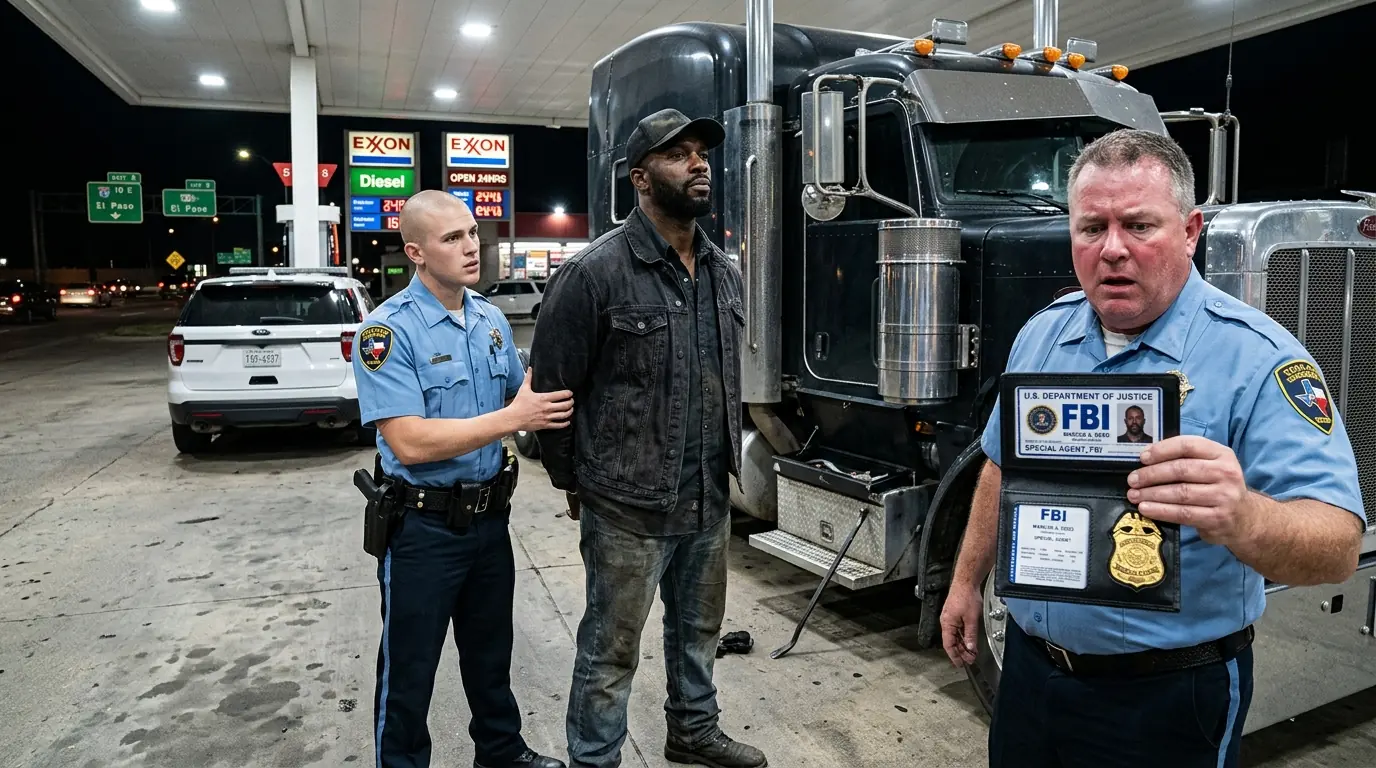
The air along State Road 87 was heavy with humidity and the smell of heated asphalt. Crickets chirped inside an overgrown roadside ditch, their steady rhythm the only sound until the powerful engine of a custom Peterbilt 389 shattered the silence. Behind the wheel sat Marcus Ellington. To the rest of the world, Marcus appeared to be another long-haul trucker struggling through the final leg of a demanding cross-country route. He wore a faded denim jacket, a grease-stained baseball cap pulled low over his eyes, and the exhausted expression of a man who had spent far too long staring at the white lines of an endless highway. He had the body of someone who did not tolerate disrespect easily: broad shoulders, powerful arms, and calloused hands.
For the operation to succeed, however, Marcus needed to appear tired, vulnerable, and completely alone. He guided the enormous 18-wheeler into the cracked concrete parking lot of Rusty's Travel Plaza, a decaying gas station positioned at the edge of Ridgefield, Texas.
Ridgefield was more than a forgotten point on a map. It was a black hole for constitutional rights. For 3 years, the Ridgefield Police Department had operated less like a law enforcement agency and more like an armed criminal organization. Its officers specialized in a specific form of highway robbery. They targeted motorists from outside the area, particularly minorities, while pretending to enforce traffic laws. They manufactured probable cause, conducted illegal vehicle searches, and abused civil asset forfeiture laws to steal thousands of dollars in cash. Drivers who resisted were beaten, charged with fabricated felonies, and trapped inside a deeply corrupt local court system. No one fought back. No one ever won.
But Marcus Ellington was not a truck driver. He was a 15-year veteran of the Federal Bureau of Investigation who specialized in systemic public corruption.
The Peterbilt was not carrying commercial freight. Its trailer was completely empty except for a state-of-the-art mobile uplink transmitter concealed [snorts] behind the front bulkhead. Six microscopic 4K cameras had been installed throughout the cab, mounted inside the air vents, dome light, dashboard, and other hidden locations. High-fidelity audio receivers had been woven directly into the fabric of the driver's seat. Every breath, whisper, and footstep around the truck was being transmitted through an encrypted satellite feed to a darkened mobile command center 20 miles away.
Inside that command center, Special Agent Adrian Voss and a team of federal prosecutors watched their monitors with bated breath, their hands hovering near the radio controls.
Marcus shut down the engine. A heavy, oppressive silence rushed into the cab. He picked up his thermos, opened the thick metal door, and climbed down onto the oil-stained concrete. Marcus walked towards the diesel pump, swiped a corporate fuel card, and inserted the heavy metal nozzle into the tank.
Right on cue, a shadow separated itself from the darkness at the edge of the parking lot. A black and white Ford Explorer police cruiser slowly entered the weak circle of light beneath the station canopy. Its headlights were completely turned off. The cruiser moved with predatory stillness, its tires grinding softly over loose gravel and broken glass. It stopped at an aggressive angle that deliberately blocked the exit path of Marcus's truck.
The doors opened. Deputy Travis Boone and Deputy Colton Pierce stepped out.
Boone was a 20-year veteran of the department, a heavy-set man with a swollen beer belly, a permanently red face, and eyes completely empty of human compassion. 14 excessive force complaints had been filed against him. Every one of them had conveniently disappeared inside the local department.
Pierce was Boone's shadow. He was a 24-year-old rookie with a freshly shaved head, restless energy, and a desperate need to prove that he could be every bit as cruel as his mentor.
Marcus did not look at them. He kept his attention on the fuel pump as the numbers continued climbing, playing the role of a tired driver who wanted nothing more than to finish his journey.
"Long night, boy." Boone's voice cut through the humid air. It was a rough drawl soaked in contempt. He did not call Marcus "driver." He called him "boy," placing deliberate weight on the word and immediately establishing the racial humiliation he intended to exploit.
Marcus slowly turned his head. "Just trying to reach Dallas, officer. I have a delivery deadline."
Boone spat a stream of chewing tobacco onto the concrete, landing it barely an inch from Marcus's steel-toed boots. He rested one hand casually on the grip of his sidearm. "Dallas is a long way from here. Judging from those New Mexico plates, you're a long way from home as well." His eyes narrowed. "What are you carrying?"
"The trailer is empty," Marcus replied evenly. His voice remained steady, carefully balanced between cooperation and nervousness. "I'm deadheading back to the depot."
Pierce had already removed a heavy Maglite flashlight and begun circling the rear of the trailer. He aggressively shone the blinding white beam beneath the truck and struck the aluminum side panels with his fist.
"Hey, Travis," Pierce called from behind the trailer, his voice echoing through the empty lot. "There's a cracked tail light housing back here. Defective equipment."
Marcus knew with absolute certainty that the tail light was flawless. FBI mechanics at Quantico had inspected every square inch of the truck before the operation began, but he did not argue. That was not the plan.
"Is that right?" Boone asked with a smirk. He took a slow and threatening step closer, deliberately entering Marcus's personal space. The smell of stale coffee and perspiration rolled from his uniform. "You're operating an unsafe commercial vehicle on county roads." He leaned closer. "That creates a problem."
Boone extended his hand. "License, registration, logbook, and bill of lading. Now."
Marcus slowly reached toward his rear pocket, making every movement visible so the deputies could not claim he was reaching for a weapon. He removed a worn leather wallet and handed Boone a stack of perfectly forged documents.
Boone snatched them away. He did not examine the paperwork. Instead, he stared at Marcus, his eyes narrowing into predatory slits. He was searching for fear, searching for weakness.
"You look nervous, driver," Boone said softly. A cruel smile moved across his face. "Why are you nervous?"
"I'm not nervous, sir," Marcus replied. "I'm tired." His heart rate remained completely steady. Inside the command center, Agent Voss watched the biometric information transmitted from Marcus's smartwatch. His pulse held at 65 beats per minute.
"I think you're lying," Boone said. He stepped so close that his badge nearly scraped Marcus's chest. "I think you're transporting something through my town." His expression hardened. "We see a lot of people like you moving fentanyl through this corridor. Or perhaps you're carrying cash for a cartel." He leaned closer. "Is that what's happening?"
"I already told you," Marcus said, "the trailer is empty." His voice became only slightly firmer.