The handcuffs closed around Ivory Bennett’s wrists at 10:17 on a Tuesday morning, in a Fulton County courtroom so quiet that everyone could hear the metal ratchet. Ivory did not struggle when Court Officer Samuel Price took her right arm and his partner moved to her left. She did not look at Assistant District Attorney Julian Harrow, although he was standing less than fifteen feet away wearing the satisfied expression of a man who believed a dangerous accusation had finally been contained. Instead, Ivory looked directly at the judge and said, “Before I leave, I am asking the court to preserve Exhibit Forty-Two exactly as it exists right now. Do not overwrite it. Do not allow another replacement. Preserve the audit ledger, the ingestion receipts, and both hashes.” Judge Rebecca Sloan’s face tightened. “Ms. Bennett, I have ordered you to stop addressing the court.” Ivory nodded once. “Understood, Your Honor.” Then she turned and allowed the officers to lead her toward the side door.
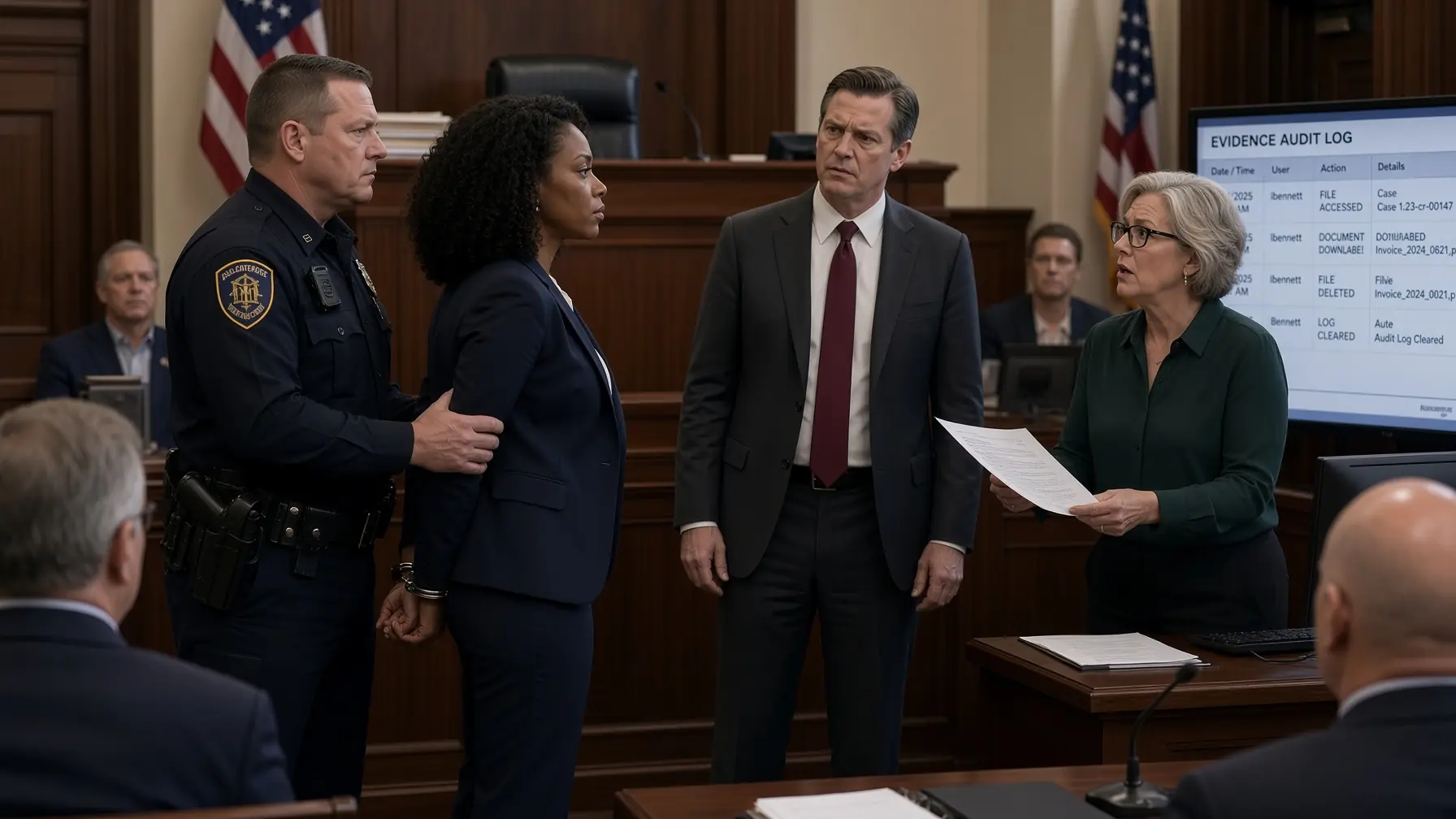
What the spectators could not understand was why she looked so calm. Twenty minutes earlier, Harrow had accused her in open court of manipulating digital evidence in a felony prosecution. Five minutes after that, the judge had ordered Ivory to surrender her forensic laptop for inspection. Ivory refused because the computer contained privileged defense material from six unrelated cases and offered instead to provide a forensic image of the relevant case folder under a protective protocol. Harrow called the refusal proof that she had something to hide. Judge Sloan, already frustrated by a hearing that had spiraled far beyond its scheduled purpose, ordered Ivory to hand over the entire machine. When Ivory refused again and continued insisting that the court’s own evidence system showed a replacement file, Sloan held her in direct contempt. Now a Black woman in a gray suit was being marched from the courtroom in handcuffs while several reporters typed furiously into their phones.
As the side door closed behind her, Harrow exhaled and turned toward the bench. “Your Honor, I think we can now return to the actual issue before the court.” He was forty-three, white, polished, and regarded around the courthouse as one of the district attorney’s strongest trial lawyers. He had prosecuted gang cases, armed robberies, and several high-profile public corruption matters. His voice rarely rose. He did not need it to. That morning he had framed the dispute neatly: the prosecution had produced a body-camera file, defense consultant Ivory Bennett claimed her copy was different, and because the court’s exhibit matched the prosecution’s version, the obvious problem was whatever Bennett had done to the file after receiving it. Harrow called her claim of a second court timestamp “a distraction designed to contaminate the record before the jury ever sees the video.”
Judge Sloan looked toward defense attorney Martin Ellis. “Mr. Ellis, your consultant is in custody because she refused a direct order, not because of her opinion about the evidence.” Ellis stood slowly. He was sixty-one, silver-haired, and had practiced criminal defense long enough to know that arguing with an angry judge usually made an angry judge more certain. “I understand the basis of the contempt order, Your Honor. I am asking for ten minutes.” Sloan looked at the clock. “For what?” Ellis glanced toward the clerk’s station. “To determine whether Ms. Bennett’s factual assertion can be checked without opening her laptop at all.” Harrow objected immediately. “There is no reason to delay the hearing because a paid defense expert generated a hash on her own machine and then refused neutral inspection.” Ellis turned toward him. “She did not say her computer generated the timestamp. She said the court did.”
At the clerk’s station, Tessa Nguyen stopped typing.
Tessa was thirty-four, deputy courtroom clerk, and the kind of person who noticed when page numbers skipped even if nobody else in the room cared. She had heard Ivory’s words more carefully than most because they contained terminology she recognized from a court technology training course six months earlier. Ingestion receipt. Audit ledger. Both hashes. Those were not phrases someone usually invented during an argument. Fulton County’s fictionalized evidence-management platform, CourtVault, generated a SHA-256 hash every time a digital exhibit entered the system. More importantly, the platform wrapped that hash in a digitally signed receipt showing when the file entered, which authorized account submitted it, and whether it was an original or a later revision. Ordinary users saw only the current exhibit unless they opened version history. Court clerks with administrative permissions could see every transaction.
Judge Sloan granted eight minutes.
Harrow sat down.
Ellis immediately walked toward Tessa. “Can you see the version history for Exhibit Forty-Two?” he asked. Harrow rose again. “Your Honor, I object to defense counsel directing the clerk to conduct an unsupervised forensic search.” Sloan held up a hand. “He is not directing anything. I am.” She looked at Tessa. “Ms. Nguyen, can you determine whether Exhibit Forty-Two has more than one court-generated receipt?” Tessa nodded. “Yes, Your Honor.” Sloan said, “Do that. Nothing else.” Tessa turned to her terminal.
The exhibit belonged to State of Georgia v. Terrence Hale, a prosecution that had begun as an ordinary armed-robbery case and become far more complicated after Hale’s arrest. Terrence was twenty-six, Black, and accused of robbing a convenience store with another man before fleeing in a stolen vehicle. He admitted being in the vehicle but insisted he had not entered the store and did not know a gun was inside. The most damaging evidence was body-camera video from Officer Nathan Kessler, who chased Terrence through an alley and later recovered a pistol beside a dumpster. Prosecutors argued the video showed Terrence reaching toward the area where the gun was found. The defense claimed the sequence was less clear and that another unidentified man had crossed the alley during the chase. Ivory Bennett had been hired specifically to analyze the digital evidence because the timing of the pursuit mattered.
Three days before the hearing, Ivory downloaded Exhibit Forty-Two through the court portal. The file was twenty-three minutes and eleven seconds long. CourtVault displayed a receipt identifying it as the original prosecution upload from February 3 at 4:12 p.m., with a SHA-256 hash beginning 8F3A-71C2. Ivory preserved that receipt automatically with her working copy. When the prosecution played Exhibit Forty-Two in court Tuesday morning, the video lasted twenty-two minutes and fifty-three seconds. Eighteen seconds were gone. The missing segment came from the first minute of the alley pursuit, including audio in which Kessler told another officer, “I lost him behind the dumpster—I don’t know which one came out.” It did not prove Terrence innocent, but it weakened the prosecution’s presentation that Kessler had visually tracked him continuously to the location of the recovered firearm.
Ivory noticed the missing segment before anyone else because she had mapped every frame. She also noticed something stranger when Harrow asked the courtroom technician to maximize the video. In the corner of the CourtVault display, beneath the exhibit number, appeared a small revision icon and a signed timestamp: REVISION RECEIPT — 12:43:18 A.M. Ivory asked the judge to stop playback. Harrow objected. Sloan asked why. Ivory said, “Because the file being shown to the court is not the file I downloaded Friday. The original court hash begins 8F3A. The file on that screen begins B0D9, and the system says a revision was accepted after midnight.”
Harrow had smiled.
“Your Honor, this is exactly what we warned about.”
Ivory looked toward him. “What did you warn about?”
“That the defense expert modified her own copy and would use the discrepancy to suggest evidence tampering.”
Ivory’s expression barely changed. “I’m not comparing my file metadata to yours. I’m reading your court’s signed receipt.”
Harrow turned toward the judge. “She is making an accusation she cannot support.”
“I can support it.”
“With a laptop you refuse to surrender.”
“With CourtVault.”
That was when the hearing began sliding toward contempt.
Now, eight minutes later, Tessa Nguyen clicked the small triangle beside Version History.
Her hands stopped moving.
There were two entries.
The first showed the original upload exactly as Ivory had described: February 3, 4:12:09 p.m., source account FULTON-DA-EVIDENCE-INTEGRATION, 1.87 gigabytes, twenty-three minutes eleven seconds, SHA-256 beginning 8F3A71C2. Status: ORIGINAL — SEALED ON INGESTION.
Beneath it was a second entry.
REPLACEMENT REVISION.
Monday.
12:43:18 a.m.
1.82 gigabytes.
Twenty-two minutes fifty-three seconds.
SHA-256 beginning B0D91E44.
Tessa leaned closer.
The submitting account was not a generic technician account.
It read:
For several seconds she said nothing.
Judge Sloan noticed.
“Ms. Nguyen?”
Tessa looked toward the bench.
“Your Honor, there are two receipts.”
Nobody in the courtroom moved.
Harrow stood.
“What?”
Tessa looked back at the screen. “The original was uploaded February third. A replacement was accepted by the system last night at twelve forty-three and eighteen seconds.”
Ellis did not smile.
He simply asked, “Does the replacement have a different hash?”
“Yes.”
“Different file size?”
“Yes.”
“Different duration?”
Tessa swallowed.
“Yes.”
Harrow walked toward the clerk’s station. “Who uploaded it?”
Judge Sloan’s voice stopped him. “Do not approach the clerk.”
He froze.
Sloan looked at Tessa.
“Read the submitting account.”
Tessa hesitated only because she understood what the next five seconds were about to do to the courtroom.
“JHarrow at FultonDA dot gov.”
Everyone looked at Julian Harrow.
His face changed, but only slightly.
“That is my litigation account,” he said. “It does not mean I altered the underlying evidence.”
Judge Sloan stared at him.
“Did you replace Exhibit Forty-Two after midnight?”
“I uploaded a corrected playback copy.”
Ellis rose slowly.
“A corrected playback copy?”
“The original had synchronization issues.”
“You told this court fifteen minutes ago that Ms. Bennett created the discrepancy.”
Harrow turned toward him. “I said her local copy could not establish what happened to the court file.”
“No. You accused her of altering evidence.”
“I accused her of presenting an altered version.”
“You asked the court to seize her computer.”
“Because she refused verification.”