“GET YOUR HANDS WHERE I CAN SEE THEM!”
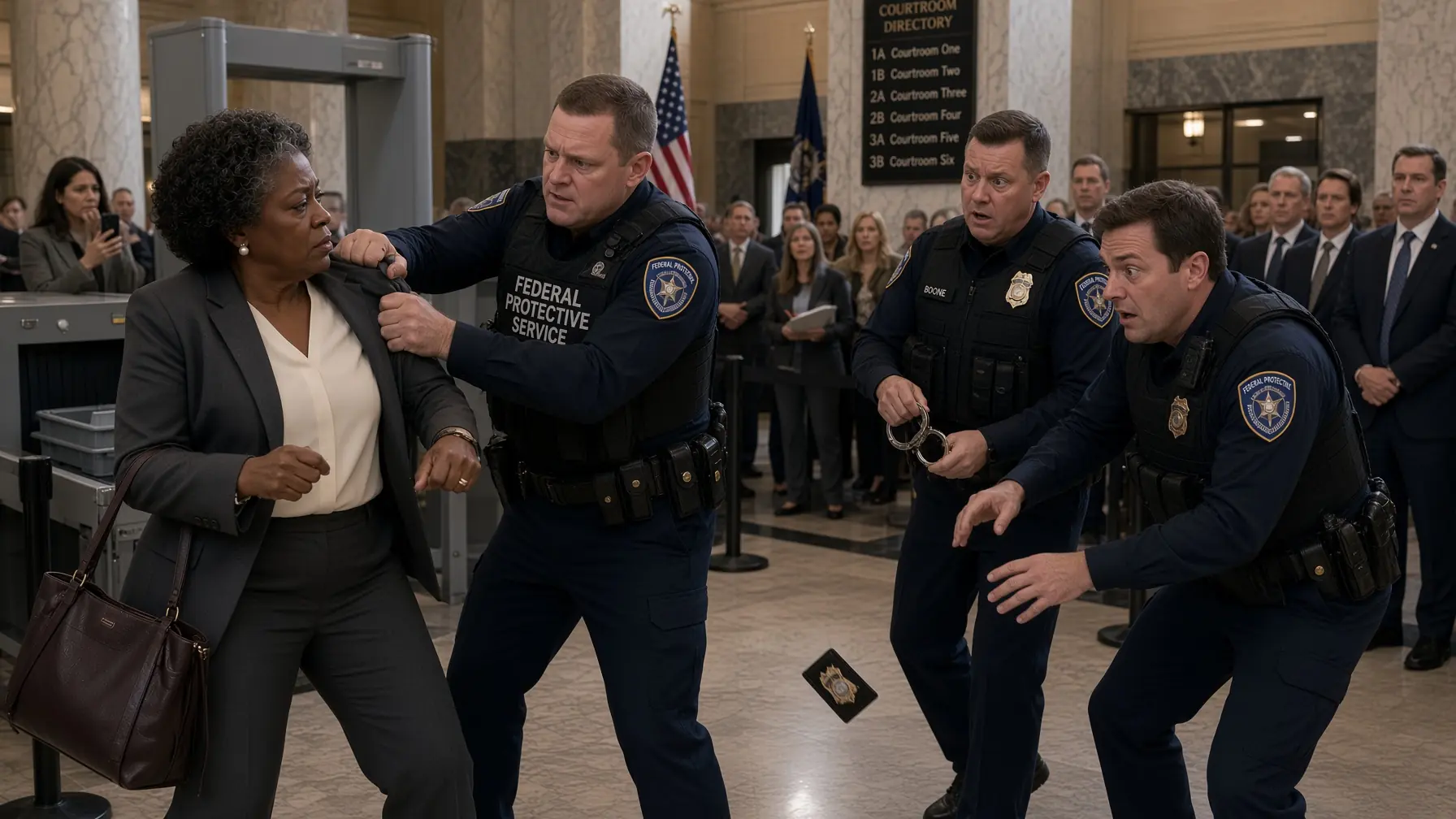
The command cracked across the federal courthouse lobby so sharply that three conversations stopped in the middle of sentences. Judge Eleanor Whitman had barely moved. One moment she was standing beside the public screening station with her purse in a gray plastic tray, calmly explaining that her judicial identification was inside the front pocket. The next, Court Security Officer Mark Harlan had seized her right wrist while another officer, Douglas Quinn, came from the opposite side and twisted her left arm behind her. Eleanor felt the world tilt, saw the polished marble rushing upward, and turned her face just enough that her cheek rather than her nose struck the floor. A gasp moved through the security line. Harlan pressed a knee beside her shoulder and barked, “Stop resisting,” although Eleanor’s hands were already trapped behind her back.
“I am not resisting,” she said, forcing each word through the pain spreading along her cheekbone. “My name is Eleanor Whitman. I am a United States district judge assigned to courtroom 5B. My identification is on the floor beside my purse.” Quinn tightened his grip anyway, telling her to remain still while people backed away from the checkpoint barriers. Somewhere behind Eleanor, a phone began recording. She could hear the frightened whisper of a young woman asking whether anyone had called a supervisor, followed by the rapid footsteps of another security officer approaching from the magnetometer. The officer bent, picked up the credential Eleanor had been trying to retrieve, and stared at it long enough for the silence around them to become uncomfortable.
“Mark,” he said quietly. “This says United States District Judge.”
For the first time, Harlan stopped talking.
His hand loosened.
Not enough to release Eleanor.
Quinn looked at the identification, then toward Harlan, and Eleanor felt something pass between them that she would remember far longer than the impact with the floor. It was not surprise in the ordinary sense. Neither man said, We made a mistake. Neither rushed to help her stand. Harlan’s first reaction was to glance toward the security cameras mounted above the lobby, then toward the glass doors facing the street. Only after that did he say, “We still have an unresolved alarm. Keep her controlled until a supervisor clears it.”
“Controlled?” Eleanor repeated.
Nobody answered.
They pulled her upright.
Then Quinn fastened handcuffs around her wrists.
That was the moment Eleanor stopped believing she was watching a simple error unfold.
She had served on the federal bench for thirteen years. Before that, she had spent eight years as an appellate lawyer and another six trying complex civil cases. She had seen good officers make mistakes. She had seen frightened witnesses misremember details, lawyers overstate facts, and judges—including herself—reach conclusions that later had to be corrected. Procedure existed because human judgment was imperfect. If the security officers had released her immediately after verification, documented the alarm, apologized, and summoned courthouse medical staff, the morning might have remained an ugly but understandable failure of judgment.
Instead, they marched her through the courthouse in cuffs after they knew exactly who she was.
Eleanor said nothing while they led her past the clerk’s office.
Employees stared.
A young assistant United States attorney stopped in the corridor with a case file against his chest, his expression shifting from confusion to disbelief. A deputy clerk who had worked with Eleanor for nine years covered her mouth. Harlan kept one hand around Eleanor’s upper arm and repeatedly told people to move aside, creating the appearance that the woman in restraints was dangerous enough to justify the spectacle. Eleanor walked without resistance, memorizing doors, faces, times, and words because that was what her mind did when everything else became unstable.
At 7:48 a.m., she entered the courthouse security office.
At 7:51, supervisory CSO Gerald Price arrived.
At 7:53, he reviewed her identification.
At 7:54, he asked why she was still handcuffed.
Nobody gave him a clear answer.
Price removed the restraints himself.
“Judge Whitman, I’m extremely sorry.”
Eleanor rubbed the red marks around her wrists and looked at Harlan.
“What was the alarm?”
Harlan answered, “Magnetometer activation during heightened threat conditions.”
“What caused the activation?”
“We haven't determined that.”
“What threat conditions?”
“There’s a sensitive hearing today.”
“I know. I’m presiding over it.”
Harlan looked away.
Eleanor noticed.
She also noticed something else.
He already knew which hearing.
That should not have meant much. The courthouse had been surrounded by reporters since dawn, and the civil-rights case scheduled for 9:30 had dominated local news for weeks. Protesters supporting both sides stood outside behind temporary barriers. Every security officer assigned to the building had been briefed on increased screening and expected crowds.
Still, Eleanor asked, “Did someone identify me as a security concern before I arrived?”
Price answered immediately. “Not that I’m aware of.”
Harlan did not answer.
The hearing involved a lawsuit brought by five residents of Bellhaven County against the county police department and several former officers. The plaintiffs alleged that a specialized street-crimes unit had used unlawful detentions, excessive force, fabricated probable-cause narratives, and selective body-camera activation over several years. Most allegations remained disputed. Some had already collapsed under discovery. Others had become more troubling after internal messages and old disciplinary records surfaced.
That morning’s hearing concerned whether several previously sealed documents should become public and whether plaintiffs could expand discovery into off-duty security work performed by former county officers.
Two names in those sealed documents were Mark Harlan and Douglas Quinn.
Eleanor did not remember that immediately.
Not consciously.
She felt familiarity first.
Harlan.
Quinn.
Something about the pairing bothered her while she sat inside the security office with an ice pack against her cheek. She had read thousands of pages during the preceding month, including deposition transcripts, personnel histories, payroll records, contractor rosters, and protected exhibits that could not lawfully be discussed outside the litigation. Names passed through judges’ minds constantly. Recognition did not equal evidence.
So Eleanor did not confront them.
She did something more important.
She asked that everything be preserved.
“Lobby video, magnetometer logs, handheld scanner data if available, incident reports, body cameras if your contract officers wear them, radio traffic, staffing assignments, access-control records, and any threat advisory governing today’s screening.”
Price nodded.
“I’ll notify the Marshals Service.”
“Good.”
Harlan shifted.
Eleanor saw it.
Then she asked, “Who authorized the decision to keep me restrained after my identity was confirmed?”
Harlan answered, “I did.”
“On what basis?”
“Security protocol.”
“Which protocol?”
He hesitated.
“I’ll have to provide the exact provision in my report.”
Eleanor nodded.
“Please do.”
She did not tell him the answer sounded wrong.
She did not have to.
At 8:11, Eleanor entered her chambers through the judges’ corridor. Her law clerk, Simone Adler, nearly cried when she saw the bruise forming along Eleanor’s face. Eleanor told her to call the chief judge and the courthouse medical officer, then to do nothing else. No social media. No calls to reporters. No attempt to obtain the security officers’ personnel files. Simone understood immediately why.
“You think this intersects with Whitman v. Bellhaven?”
The case was not actually named after Eleanor; Simone was too shaken and corrected herself. “Sorry. Harris v. Bellhaven.”
“I don't know,” Eleanor said. “That is precisely why I cannot start looking for the answer as though I’m still just the presiding judge.”
She sat at her desk.
The hearing binder was already open where she had left it Friday evening.
A yellow tab marked SEALED EXHIBIT 47-C protruded near the back.
Eleanor stared at it.
There was the feeling again.
Harlan.
Quinn.
She did not touch the binder.
Instead, she called Chief Judge Malcolm Avery.
He listened without interrupting while Eleanor described the screening incident chronologically. When she finished, he asked the same question she had expected.
“Do you recognize the officers from the Bellhaven case?”
“I think I do.”
“You haven't checked?”
“No.”
“Good.”
Eleanor leaned back painfully.
“I need to be recused before I look at anything else.”
Avery was silent for a moment.
“You’re certain?”
“I am now a potential witness and possibly a victim in an incident involving people whose names may appear in evidence before me. I cannot evaluate their credibility in the underlying case.”
“The hearing will have to be reassigned.”
“Yes.”
“And postponed.”
“Probably.”
Eleanor closed her eyes.
That part hurt almost as much as the floor.
The hearing involved people who had already waited years.
Some had medical bills.
One plaintiff had lost his job after an arrest later dismissed.
Another officer defendant claimed the litigation had destroyed his reputation despite evidence supporting his actions. Everyone deserved a judge who was not personally entangled.
“Do it,” Eleanor said.
At 8:26, Chief Judge Avery entered an administrative order recusing Eleanor from the case and reassigned it temporarily to Judge Nathaniel Ross. At 8:31, the parties were notified that the morning hearing would be postponed pending review of a newly identified conflict. Reporters assumed Eleanor’s injury caused the delay. That explanation was incomplete, but the court said nothing more because the potentially relevant evidence remained under seal.
Only after the recusal became effective did Avery and Ross review the sealed exhibit.
Eleanor was not in the room.
That mattered later.
Exhibit 47-C contained material obtained from the phone of Lieutenant Patrick Rourke, a former Bellhaven County police supervisor who now managed off-duty security contracts for several private companies. The plaintiffs had acquired portions through civil discovery after a forensic vendor recovered archived message backups. Defendants disputed context and authenticity of some material, which was one reason the exhibit remained sealed.
Two years earlier, Rourke had supervised both Harlan and Quinn when they were Bellhaven officers.
Both men later left county policing and became contract Court Security Officers assigned to the federal courthouse under a private company working through the United States Marshals Service.
Their names appeared in several messages discussing off-duty assignments.
That alone was not suspicious.
Then Judge Ross reached the final page.
A message chain dated eleven days earlier.
Rourke to Harlan:
Big 5B hearing Monday. You working north lobby?
Harlan: