"Ah, you won't get away with this. Oh, stop, please."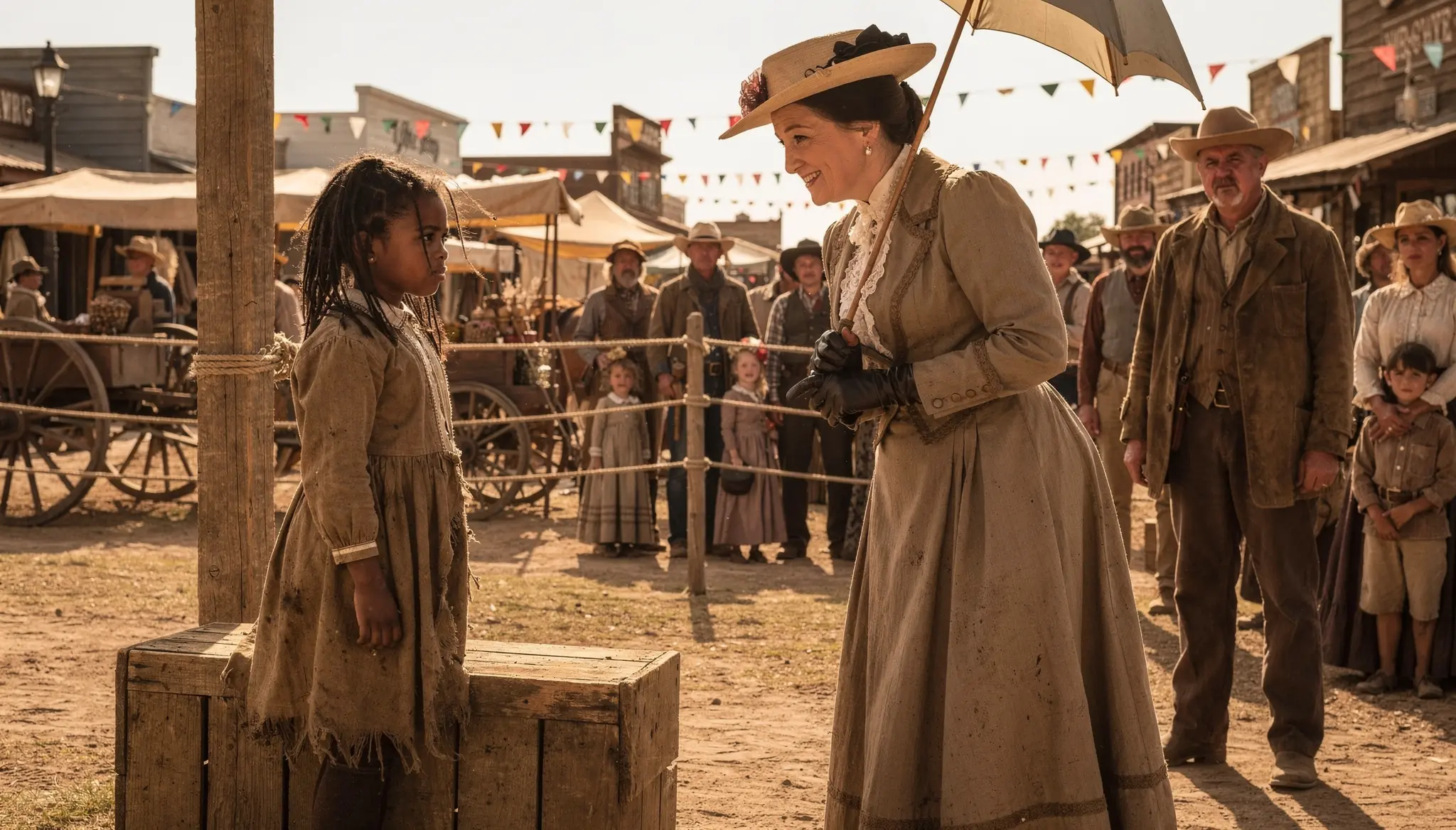
A nine-year-old Black girl was grabbed by the hair. Her owner forced her face into a barrel of horse manure. The crowd laughed. Not one person moved, and every bit of it was seen by an unnamed cowboy. What he did after night fell left the whole town stunned.
Clear Fork sat in a dry fold of the territory where the grass turned gold too early and the wind never quite stopped. Frontier Days came once a year in late September, and for three days the town swelled with ranch hands, homesteaders, and traveling peddlers who set up canvas stalls along Main Street selling everything from patent medicine to peppermint sticks. There were horse races on the flat north of the church, a shooting contest behind the livery, and this year, new to the program, chalked onto a board outside the mercantile: a frontier fun exhibition that promised, in Harriet Vale's own careful handwriting, charitable entertainment for a worthy cause.
The worthy cause was Dela Freeman. Dela Freeman was ten years old, her parents gone these eight months passed. The county had handed her over, along with whatever debts her family was supposed to owe, into the keeping of Harriet Vale—a widow of considerable means, considerable charm, and a smile the town had not yet learned to read correctly.
Harriet Vale had buried two husbands and inherited both their fortunes. Clear Fork saw her as a woman to be admired: generous to the church, kind enough to take in children no one else wanted, never once raising her voice in public. What the town didn't know was how carefully that reputation had been built, debt by debt, and how much of it was simply a performance.
Dela Freeman stood on an overturned crate at the center of a roped-off square, her wrists bound loosely to a post behind her—not so tight that she could not stand, but tight enough that she could not run. Her dress was too big, cut down from something that had belonged to a Vale cousin years before, the hem stiff with dirt no amount of washing had ever fully lifted. Her hair, dark and unbraided, hung in her face, and she kept her chin down the way she had learned to do. Not because it helped, but because it meant she did not have to watch their eyes.
"Three darts for a penny!" called Ellis Cobb, Harriet's foreman, a broad man with a mustache stained yellow from tobacco. He held up a fistful of little cork-tipped darts, the kind children threw at paper targets in city arcades, though nothing about what was happening here belonged to a city or to any decent place at all. "Hit the sash and win a cigar! All proceeds go toward the care and keeping of this poor motherless child, courtesy of Widow Vale's Christian charity!"
The crowd laughed. Someone whistled. A man in a checked coat paid his penny and threw badly, the dart skittering off into the dust. Another man, younger, threw harder, and the dart struck Dela's shoulder hard enough that she flinched and bit down on the inside of her cheek to keep from crying out.
A hundred people stood there. Not one of them stepped in.
Harriet stepped closer to the post, tilting her parasol back so the whole crowd could see her face, see the performance she was about to give them. She crouched slightly, the way a person crouches to speak to something small and stupid.
"Now then," her voice carried, pitched for the audience rather than the child, "show these good people what you are, Dela. Bark for us like the little dog you are."
A murmur of anticipation moved through the crowd, half amusement, half hunger for the next humiliation.
Dela's jaw tightened. She said nothing. She did not move.
"I said bark," Harriet repeated, sweeter now, more dangerous for the sweetness. "It isn't so very hard a thing to ask."
Still, Dela said nothing. Her eyes stayed fixed on that far point, past the bunting, past the wagons, past all of it. And something in her small, straight back refused to bend—refused even now, with a hundred strangers watching and waiting to laugh.
The silence stretched a beat too long, and the crowd's amusement began to curdle into something else: a restlessness, a hunger for the show to continue one way or another. Harriet's smile did not move, but her eyes went flat and hard as river stone.
"Won't bark," she said, straightening, raising her voice for the benefit of the crowd, as though announcing the next act at a county fair. "Well, we'll see if a wash sets her manners right. Bring the barrel!" Harriet called out, and two of her men, grinning, already half-drunk on the carnival's cider and the crowd's attention, went for the manure pail that had been set near the pigpens for exactly this kind of sport.
They dragged it forward, sloshing, and seized Dela under both arms.
"Say it now," Harriet said, leaning close enough that only Dela could hear the next part. "One little bark and we stop."
Dela did not bark. She looked Harriet Vale directly in the eye instead—ten years old, filthy, bound at the wrists, and entirely unbroken—and said nothing at all.
Harriet's hand closed hard in Dela's hair.
"Down!" she snapped, and her men bent the girl forward, tipping her toward the rim of the pail.
And the crowd, God help them, began to laugh in earnest now: a cruel, delighted carnival-day laughter. Someone clapping in time as though it were music. Someone else calling out, "Give her a proper dunking, Harriet! Teach the pup to heel!" It was, to every soul gathered there, simply the day's next amusement.
At the edge of the crowd, two men stood apart from the merriment, and neither of them was laughing. Josiah Langdon had already taken one step forward, his whole body gone tight as a drawn rope, when Harriet, an inch from tipping the girl's head under the surface, seemed to catch herself—some cold, practical instinct overriding the pleasure of the moment. She straightened, hauled Dela back up by the collar instead, and let her drop, gasping and unbowed, into the mud at her feet.
"Waste of good soap to clean her twice in one day," Harriet said lightly to a ripple of appreciative laughter, as though she had simply changed her mind about a hat. "She'll keep her manners a while yet, I expect, without the full treatment."