There are moments a whole town remembers for a generation, retold at church socials and Sunday dinners until the details soften into legend. And the autumn contest at Larkspur Fair in 1885 became exactly that kind of moment. The instant Josie Hartwell stepped up to the shooting line wearing her dead brother's coat and put six shots through a playing card at 80 paces without once lowering the rifle to catch her breath. Men who had ridden 50 mi to compete for the season's largest purse, stood in stunned silence, as she reloaded with the same unhurried economy she brought to every hard thing in her life, and by the time the last shot cracked across the fairground, every soul present, understood they had watched something considerably rarer than a contest winner crowned that day. Wade Sutter had come to Larkspur that autumn on business that had nothing to do with fairground contests, riding foreman for the Ashkam Cattle Company on an errand to survey grazing land the company intended to buy cheap from a struggling rancher named Wendell Hartwell, Josie's own father.
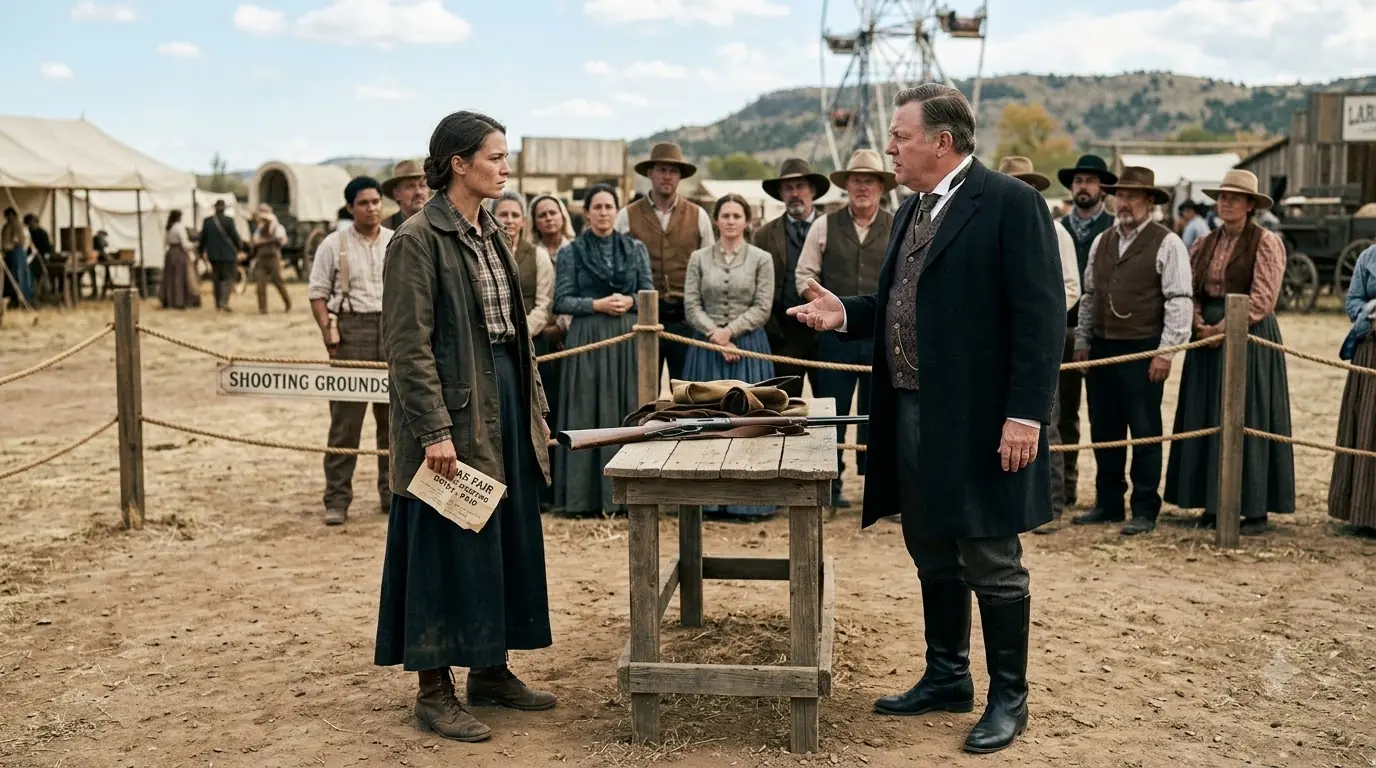
Though Wade did not yet know that connection when he first saw her raise the rifle, what he felt, watching her hold that line with a steadiness that put every man beside her to shame, was not the calculation of a company man assessing a business obstacle, but something considerably more immediate and considerably harder to explain, a recognition that struck him somewhere beneath the ribs, and refused to leave for the rest of the day, or as it would turn out, for the rest of his life. Josie had not set out that morning to fall in love with a stranger any more than Wade had set out to fall in love with the obstacle standing between his company and a cheap parcel of land. And both of them would later admit in quieter moments once the whole affair had settled, that neither had believed themselves the kind of person who could be undone so thoroughly by a single afternoon. But there is a particular alchemy that occurs when courage meets recognition. When one person's refusal to be diminished collides with another person's sudden unwelcome understanding of exactly what he has been sent to help destroy.
And Larkspur's fall contest of 1885 produced exactly that alchemy in front of the whole gathered county. This is the story of a woman who shot her way into a fall contest to save her family's land and a cowboy who arrived to help take that land away, and everything neither of them expected to find. Standing at opposite ends of a shooting range in the golden Texas autumn, Josie Hartwell was 23 years old and had run her father's cattle operation nearly single-handedly for the two years since a riding accident left Wendell Hartwell with a shattered hip that kept him confined to a chair, managing what he could from the porch, while his daughter did the physical work of a rancher twice her size. The debt that had accumulated during those two hard years, medical bills, a drought that thinned the herd, a bank note that grew heavier with every missed quarter, had brought the Hartwell spread to the brink of foreclosure, and the Lark Fair's shooting contest, with its considerable cash purse for the finest marksman in three counties, represented the only realistic chance Josie could see to clear enough of that debt to buy her family another season. She had learned to shoot from her late brother Daniel, killed two years back in a stampede that had also crippled her father, and she wore his coat to the contest that morning, not for sentiment alone, but because some stubborn part of her believed his steadiness might still be riding along in the fabric, guiding her hand the way he'd guided it during a hundred practice sessions along the creek behind their barn.
She had registered under her full name rather than any disguised initials, fully aware that several of the contest officials would object to a woman competing at all, and had decided, with the same flat determination she brought to every hard decision since her brother's death, that their objections mattered considerably less to her than the mortgage payment due in 6 weeks. Her father had begged her not to enter, worried for her reputation in a town that still whispered about unmarried women who behaved too boldly, and Josie had kissed his forehead, and told him plainly that reputation did not keep a roof over anyone's head, and that she intended to win that purse, whether Larkspur approved of the method or not. It was a promise she carried with her the entire ride into town, past fields that should have been thick with cattle and were instead thin and struggling, a visible reminder of exactly what she stood to lose if her nerve failed her at the shooting line. She had practiced every evening for two months leading up to the contest, riding out to the same creek bend where Daniel had first taught her to hold a rifle steady, working through the particular grief of hearing his voice in her memory, correcting her stance, and her breath long after his own voice had gone silent forever. Those evenings alone at the creek had become, without her quite intending it, as much a ritual of mourning as a ritual of practice, and by the morning of the contest, she carried both purposes into Larkspur with her.
The practical need to save her family's land, and the quieter, harder-to-name need to prove that her brother's steadiness still lived on in her own two hands. Wade Sutter had ridden for the Ashkam Cattle Company for six years, rising from a common hand to foreman through a combination of genuine skill and a reputation for getting difficult jobs done without excessive fuss. And the job that brought him to Larkspur that autumn was on paper a simple one. Survey the Hartwell spread's water rights and grazing quality ahead of an offer the company intended to make once the bank foreclosed. an offer calculated deliberately low because a foreclosed property in desperate circumstances rarely commanded its full worth.