$360 cash right now. That was the price Sergeant Nolan Briggs put on a stranger's freedom that night on Cedar Row.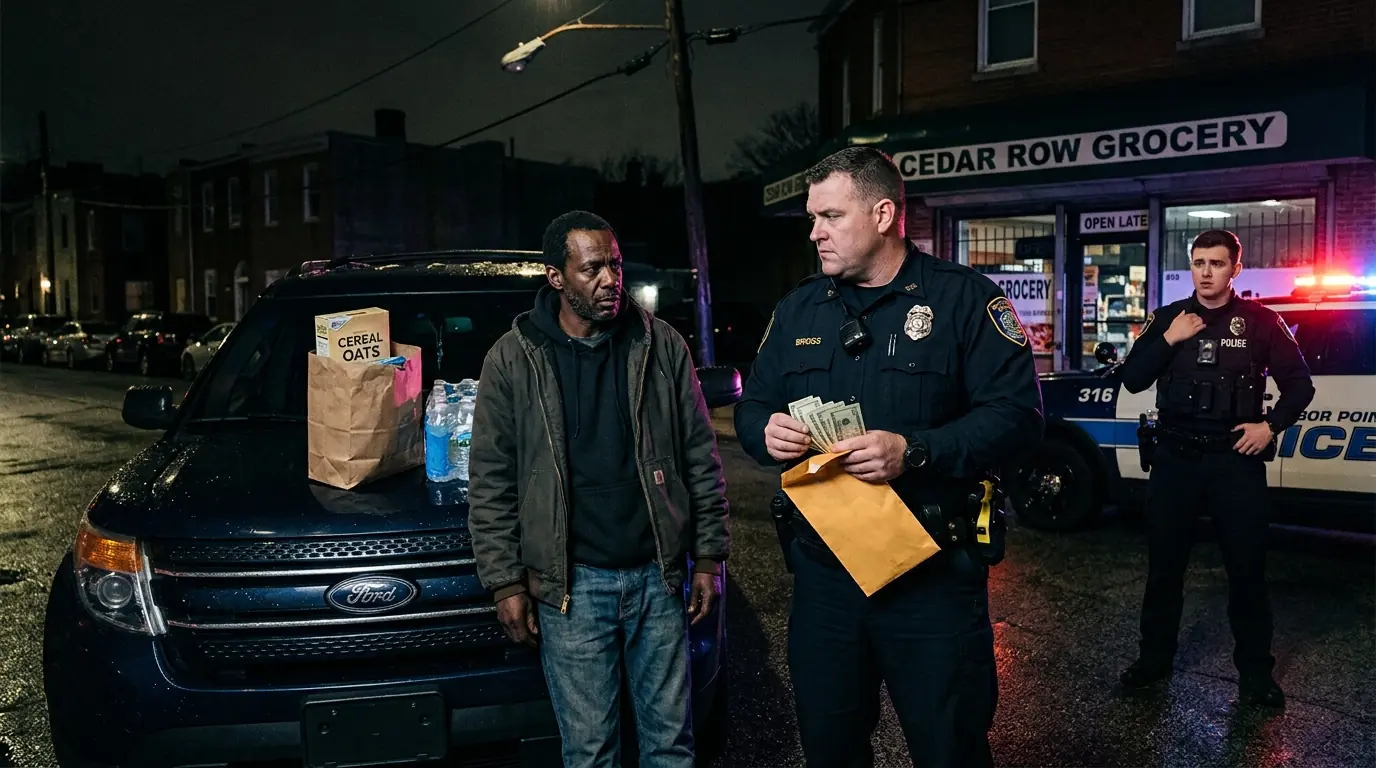
He saw an out-of-state plate, a quiet man, and a fat envelope of cash. Easy money, he thought. What he did not see was the dashcam recording every word. He did not know the man's name. He did not know that in 4 days that same man would walk into Harbor Point's precinct wearing the chief's badge.
Desmond Avery was 44 years old, and he had spent 19 years learning how a city breathes before it breaks. He had walked precincts that smelled of old paper and bad coffee. He had sat across from officers who believed accountability was a word meant for someone else. He had rebuilt trust between communities and departments that had stopped speaking to one another entirely. He had not done it for recognition; he had done it because someone had to, and he was good at it.
Now he was three days away from becoming the new police chief of Harbor Point, Maryland. The city council had voted unanimously. The appointment letter sat quietly in his email. The ceremony was set for Thursday morning, 10:00 sharp, dress uniform required. But to most officers in Harbor Point, Desmond Avery was still just a name on a memo, unread and unremarkable.
He preferred it that way, at least for a few more days.
So instead of arriving Thursday with an escort, he drove into town on Sunday. His 12-year-old son, Marcus, sat beside him, headphones around his neck, watching the unfamiliar streets with the quiet, careful curiosity he had inherited from his late mother. They found a rental on Clement Street, a two-bedroom with clean floors and a window facing a row of quiet houses.
Desmond wanted to see Harbor Point before Harbor Point started performing for him. He wanted to walk its sidewalks, eat in its diners, and understand the city from the ground up before he ever sat behind a desk. It was not a test. It was simply a father and son arriving 4 days early in a city that had no idea who had just moved in.
By 7:00 that evening, the refrigerator in the Clement Street rental was empty, and the kitchen had no cereal, which Marcus considered a crisis of considerable magnitude. Desmond told him they would make a quick run. The woman at the rental office had mentioned Cedar Row, a short strip of small businesses nearby: a gas station, a diner, a convenience store that stayed open late.
They drove over in the SUV. Desmond told Marcus to wait inside while he went in alone, just for a few minutes—a box of cereal, a bottle of water. He was back outside in under 10 minutes, a paper bag in his left hand, keys in his right, walking toward the vehicle parked at the curb.
He did not make it to the driver's door.
"Hey," the voice came from behind him, flat and certain. "Hold up."
Sergeant Nolan Briggs was already out of his cruiser, walking the way certain men in uniform walk when they have decided the outcome before it begins: shoulders back, pace unhurried. Behind him, Officer Trevor Sykes climbed out and hung back near the rear of the patrol car.
Briggs pointed at the SUV's front tire. "Your wheel's over the line." He said it the way a man says something he does not actually care about. The infraction was an excuse, not a reason. "License and registration."
Desmond set the paper bag on the hood and handed both over without argument.
Briggs studied the documents the way a man studies a problem he intends to use, not solve. His eyes moved to the out-of-state plates, then to Desmond's face, then back to the plates. "You're a long way from home."
"Just moved," Desmond said.
Briggs handed the papers back, but did not step away. He stood a foot closer than any routine stop required.
"Here's what I'm going to do for you," he said. "$360. You hand it over right now, and I don't write this up. You drive away. We both move on with our night."
Desmond looked at him without expression. "I'd like a receipt for that."
What happened next took less than 4 seconds.
Briggs moved around behind him, grabbed his shoulder, and turned him hard against the hood. Desmond's chest hit the metal. The paper bag crumpled to the side. Briggs patted down his jacket, methodical, slow enough to look deliberate, and fast enough to look practiced. He found the envelope in the inner breast pocket—$400 Desmond had withdrawn that morning for Marcus's school registration.
Briggs pulled it free, stepped back, and counted the bills right there under a broken streetlamp with the patience of a man who had done this many times before.
"360," Briggs said, folding the envelope. "The rest is yours."
"There's no law that allows a cash fee on a traffic stop," Desmond said. His voice stayed level. "That's not procedure."