"Don't marry him, Mom."
"You little liar, you ruined everything!"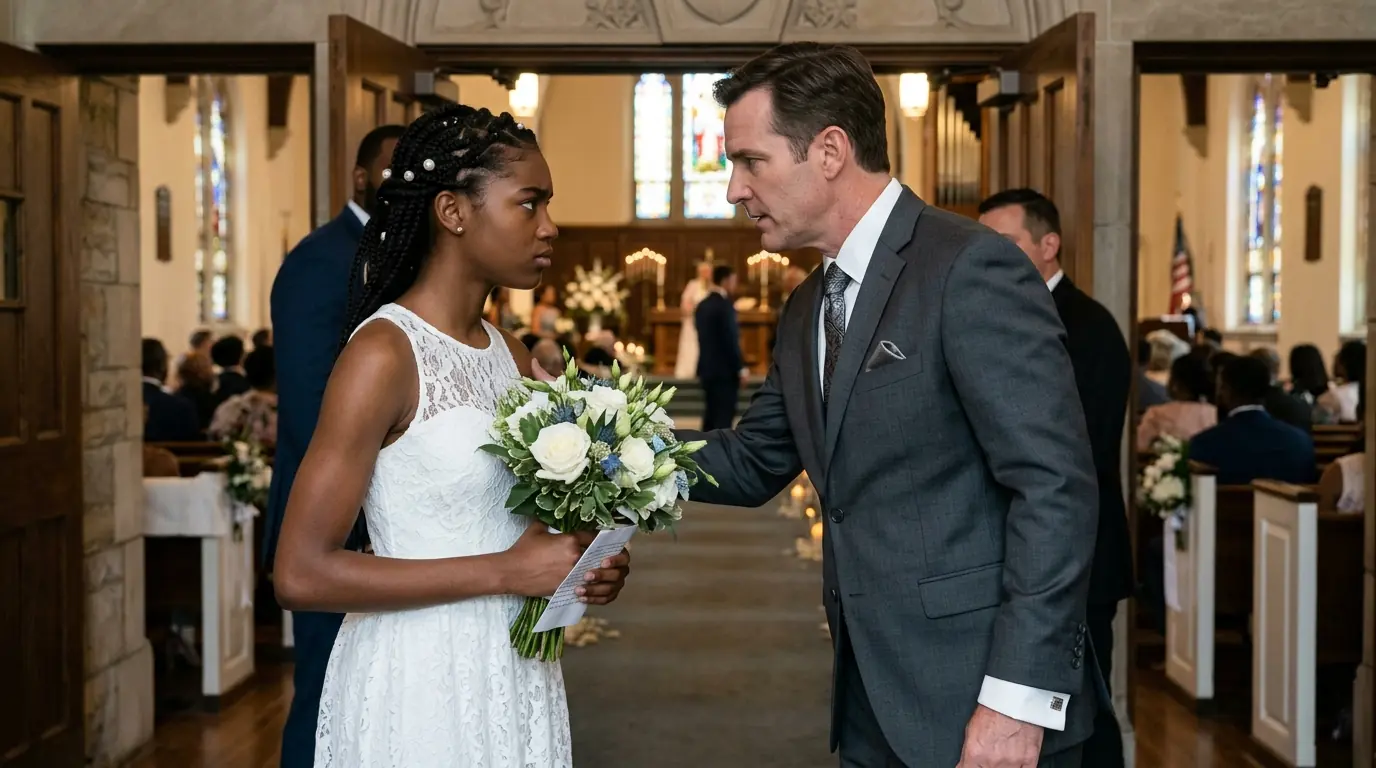
"Maya, what is this?"
"He already has a wife."
Brendan did not say it loudly. That was the thing about him—he never needed to. He reached out and plucked the bouquet straight from Maya's hands. Just like that. No warning. Like it was his to take.
Then he held it up, tilted his head, and looked her over—the way someone looks at a stain they can't quite get out of a white shirt.
"You know," he said, his voice smooth and quiet, "your mother's worked so hard to build something beautiful here. And then she puts a Black girl in a white dress at the front of the church."
He let out a short breath, almost a laugh.
"Let's just hope you don't make a scene and embarrass her. Like you people tend to do."
He dropped the bouquet back into her arms. Then he straightened his gold cufflinks, glanced at her one more time, and added, almost as an afterthought: "Your father left her alone in this world. I'm the best thing that ever happened to your family. The least you could do is smile and stay quiet."
Maya's jaw tightened. She said nothing.
Brendan leaned in one final time, close enough that she could smell his cologne—expensive, suffocating—and whispered directly into her ear: "Nobody in that church is going to believe a word you say, sweetheart. You're 16, you're Black, and I'm the man your mother chose."
He walked away without looking back.
Maya stood completely still while the organ music swelled behind the chapel doors. She had exactly 11 minutes before the ceremony began. And in her other hand, pressed flat against her palm, was a folded piece of paper that was about to destroy everything Brendan had built.
Memphis, Tennessee sits on the edge of the Mississippi River like a city that has always known both beauty and heartbreak in equal measure. The summer heat there is not just warm; it is thick, pressing down on your shoulders like a hand that refuses to let go.
It was in this city, on a Tuesday afternoon in early September, that Diana Lawson finished a 12-hour shift at Regional One Health, peeled off her scrubs in the hospital locker room, and sat down on a bench with her eyes closed for exactly four minutes before she had enough strength to drive home. She did this every night. She had been doing it for three years.
Diana was 43 years old, a registered nurse in the emergency department, and a widow. Her husband, Calvin Lawson, had died in a two-car collision on I-40 on a rainy November evening three years prior. He had been coming home from a parent-teacher conference at Maya's school. He had been 39 years old. He had been the kind of man who remembered to buy flowers not on anniversaries, but on random Wednesdays, just because he thought Diana looked tired and deserved something beautiful to look at.
When he died, Diana did not fall apart. She could not afford to. Maya was 13. The mortgage was real. The hospital bills were real. The grief was real. But Diana Lawson had learned long ago that real things do not wait for you to be ready.
She kept working. She kept driving Maya to school. She kept the lights on, the refrigerator full, and the front porch swept clean. And she kept going.
Maya watched all of this. She was 16 now, tall and lean from years of basketball, with her father's eyes and her mother's stubborn jaw. She and Diana had developed a closeness that only comes from shared loss—the kind where two people stop needing to explain things to each other because they have already survived the unsurvivable together.
They ate dinner at the kitchen table every night Diana was not on shift. They watched old movies on Sunday mornings. They talked about Calvin not with tears, but with laughter, pulling out old stories like treasured photographs kept in a shoebox. Their life was not easy, but it was theirs.
Then, seven months ago, Brendan Calloway walked into it.
Diana had been in the hospital waiting area during a break, drinking bad vending machine coffee and scrolling through her phone, when a man sat down two seats away and said without looking up from his own phone, "That coffee is terrible. I don't know why we keep buying it."
Diana looked up. He was white, broad-shouldered, with silver at his temples, and the kind of easy smile that suggested he had never had a reason to be nervous in his life. He was well-dressed without being flashy. He said his name was Brendan Calloway. He said he was a civil engineering contractor. He said his firm was doing renovation work on the hospital's east wing. He said all of this warmly, naturally, as if they were already old friends simply catching up.
Diana laughed at something he said. It was the first time she had laughed at something a man said in three years. She noticed that later, driving home. She sat with it carefully, the way you sit with something fragile.
Over the following weeks, Brendan was consistent. Not overwhelming—consistent. He texted at reasonable hours. He brought coffee to the hospital reception desk with a note that just said, "Better than the vending machine." He asked questions about Maya and remembered the answers the next time. He did not rush. He did not push.
Diana introduced him to Maya on a Saturday afternoon at their home on Prescott Avenue. Brendan arrived with a small potted plant for the porch and a handshake for Maya—not the performative kind that adults give teenagers to seem cool, but a genuine, direct handshake that said, "I am taking you seriously."
Maya shook his hand and smiled politely. But she watched him.
That was the thing people underestimated about Maya. She had her father's eyes, yes, but she had developed in the years since his death a particular kind of stillness, a patience, the ability to sit back and observe without being observed. She had learned it the hard way. When you lose a parent young, you start paying very close attention to what the adults around you are actually doing versus what they are saying.
And from the very first afternoon, Maya noticed things. Small things. The kind that are easy to dismiss individually, but accumulate over time like water filling a glass.
Brendan never took a phone call in front of them. Not once. If his phone buzzed, he would glance at it, and if he needed to answer, he would excuse himself—always stepping outside, always pulling the door shut behind him, always returning with the same easy smile and a seamless transition back into conversation, as if the call had simply been a work matter too dull to mention.
He had no social media presence. None. In 2024, a 47-year-old successful contractor with a thriving business had no LinkedIn profile, no Facebook, no company website that featured his name or photograph. Maya spent 45 minutes one evening searching and found absolutely nothing.
He always paid in cash. Restaurants, coffee, groceries—cash. Every time.
And there was one more thing, the most unsettling thing, the one that Maya could not shake no matter how hard she tried: Brendan was never fully present in a room. He looked present. He smiled, he laughed, he asked questions, he touched Diana's arm at the right moments. But his eyes, when he thought no one was watching, were always moving—cataloging exits, measuring distances, calculating. Maya knew that look. She had seen it once before on a man her Uncle Marcus had warned her about years ago. It was the look of someone who always had one foot pointed toward the door.