Sign it or I promise you, by tonight you'll be sleeping in a cell with boys who don't care about your GPA. The pen hit the table and rolled toward the 17-year-old's hand. Behind the desk, the deputy's fingers were still pressed flat against the paper. A single page typed with a signature line at the bottom.
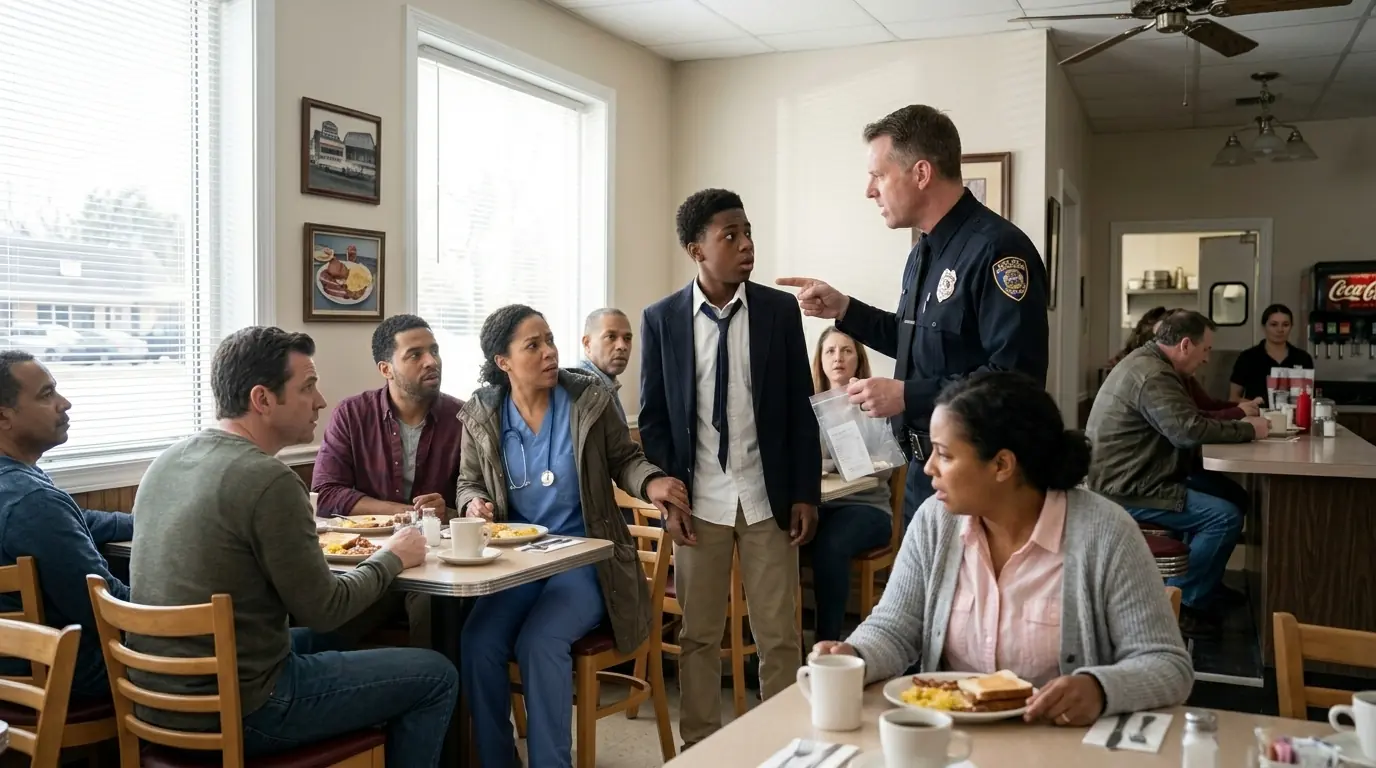
The fluorescent light above them buzzed. The door was closed. No parents, no lawyer, no witness. The boy sitting in that chair had never been inside this office under these circumstances.
Not once in 4 years. Not a single disciplinary note, not a single infraction, not even a tardy slip. Deputy Frank Mercer had pulled him out of a packed auditorium 60 seconds before his name was called for the only full-ride scholarship in the county. He picked the wrong kid.
The morning had started the way Elijah Carter's mother had been imagining for the past 6 months. With a pressed shirt, a borrowed tie, and a kitchen that smelled like coffee brewed too early because neither of them could sleep. Diane Carter stood by the counter in scrubs she hadn't changed out of yet. Her shift at Mercy General had ended at 6:00 a.m. She had driven straight home, reheated the coffee from yesterday, and laid out the one suit jacket she owned on the back of the couch for Elijah.
“You eat?” she asked without turning around. “Not hungry.” “That wasn't the question.” Elijah pulled the tie through the collar and fumbled the knot.
His hands were steady when he debated in front of 300 people, steady when he took the SAT, steady when he delivered the student body address at last year's junior assembly. But this morning, his fingers wouldn't cooperate. Diane crossed the kitchen, took the tie from him, and knotted it in three clean moves. “Your father used to do the same thing,” she said.
“Perfect in front of a crowd, useless with a Windsor knot.” Elijah didn't respond. His father had been gone since he was nine. Not dead, just gone.
The kind of gone that doesn't leave a forwarding address. “Mom, what if they change their mind?” What? Diane smoothed the tie flat against his chest and held it there.
“They didn't.” “You don't know that.” “Elijah Darnell Carter.” She looked up at him.
She was 5 feet 4 inches. He was 6 feet 1 inch. She still made him feel like he was 8 years old. “You earned that scholarship.
Every late night, every debate tournament at 5:00 a.m., every time you chose the library over everything else. They didn't change their mind, and neither did you.” The Whitfield full-ride scholarship was worth $120,000. One recipient per year.
Named after Dr. Lorraine Whitfield, the superintendent of the county school district, who had funded it personally from a trust she'd built over three decades. It wasn't just a scholarship, it was a statement. A declaration that academic excellence in this district would be recognized, celebrated, and rewarded, regardless of what neighborhood you came from. Elijah had been notified 2 weeks ago that he was the recipient.
The ceremony today was the public presentation. The handshake, the oversized check, the photo for the district website. It was supposed to be the best day of his life.
By 8:15 a.m., the auditorium at Westbrook High School was full. 832 seats, and every one of them was taken. Students packed the rows in school colors. Parents lined the back wall.
A local news crew from Channel 4 had set up a camera near the side exit, lens aimed at the stage where a podium stood under a banner that read Annual Whitfield Scholarship Ceremony. Elijah sat in the front row, second seat from the aisle. His blazer was buttoned. His hands were in his lap.
To his left sat Marcus Webb, the student body president, who leaned over and whispered, “You ready?” “Been ready.” “Speech prepared?” “Kept it short, 90 seconds.”
Marcus grinned. “Smart. Nobody remembers long speeches.” Behind them seven rows back, Diane Carter sat between two other parents she didn't know.
She was still in her scrubs. She hadn't had time to change. She'd driven from the hospital to the house, from the house to the school, and she was running on 4 hours of sleep and 17 years of making sure this moment would happen. She held her phone in her lap, camera open, waiting.
On the stage, Vice Principal Sandra Lou adjusted the microphone and glanced at the program. She nodded to someone off stage, cleared her throat, and tapped the mic twice. “Good morning, Westbrook. Welcome to the 14th Annual Whitfield Scholarship Ceremony.
We are honored today to have members of the district board, the Whitfield Foundation Committee, local press, and of course, our incredible students and families.” Applause rolled through the auditorium. Diane clapped harder than anyone in her row. Vice Principal Lou continued.
“Before we begin, I want to acknowledge the significance of this moment. The Whitfield Scholarship is not just a financial award. It is a recognition of character, perseverance, and excellence. And this year's recipient represents all three of those qualities in extraordinary measure.
Elijah felt his pulse in his throat. He pressed his palms flat against his thighs. This year's Whitfield Scholar has maintained a 3. 9 GPA across all four years, captained the varsity debate team to two consecutive state finals, volunteered over 300 hours with the district literacy program and the auditorium doors opened.
Not the side doors, the main double doors at the back of the room, the ones that had been closed and latched for the ceremony. They opened hard and the sound cut Vice Principal Lou off mid-sentence. Two Blackford County Sheriff's deputies walked in. The first was tall, broad-shouldered with a jaw that looked like it had been set in concrete.
Deputy Frank Mercer, badge clipped to his belt, hand resting on the radio mounted on his chest. Behind him, Deputy Tina Voss, shorter, younger, clipboard in hand, eyes scanning the rows like she was looking for a seat number on a plane. 832 people turned around. Mercer didn't slow down.
He walked straight down the center aisle, boots hitting the tile in even, deliberate beats. He didn't look at the stage. He didn't look at the parents. He didn't look at the camera crew who had already pivoted the lens toward him.