The Harley-Davidson's engine growled, a low, throaty hymn that vibrated through John Harper's bones as he leaned into the curve of Highway 340. The morning sun, sharp and golden, sliced across the Colorado plains, glinting off the motorcycles rusted chrome. At 82, Harper rode with the precision of a man half his age, his hands steady on the handlebars, his gray eyes scanning the horizon. The 1970s shovel head was no showpiece. Its paint chipped, its frame scarred, but it ran.
It always ran. For Harper, that was enough. 10 miles from his farm, the town of Carsonville emerged. A cluster of low buildings framed by the distant Rockies. Harper's routine was unchanging.
Fill the tank at Klein's gas station, buy a hydraulic valve for his broken John Deere, return home. 40 years of discipline, forged in jungles and deserts, kept his life ordered. He slowed as the traffic light ahead turned red, the Harley's rumble softening to a steady purr. The gas station's neon sign flickered to his right, and across the street, a diner's windows glowed with early patrons. Normal, quiet, until the flash of red and blue pierced his rear view mirror.
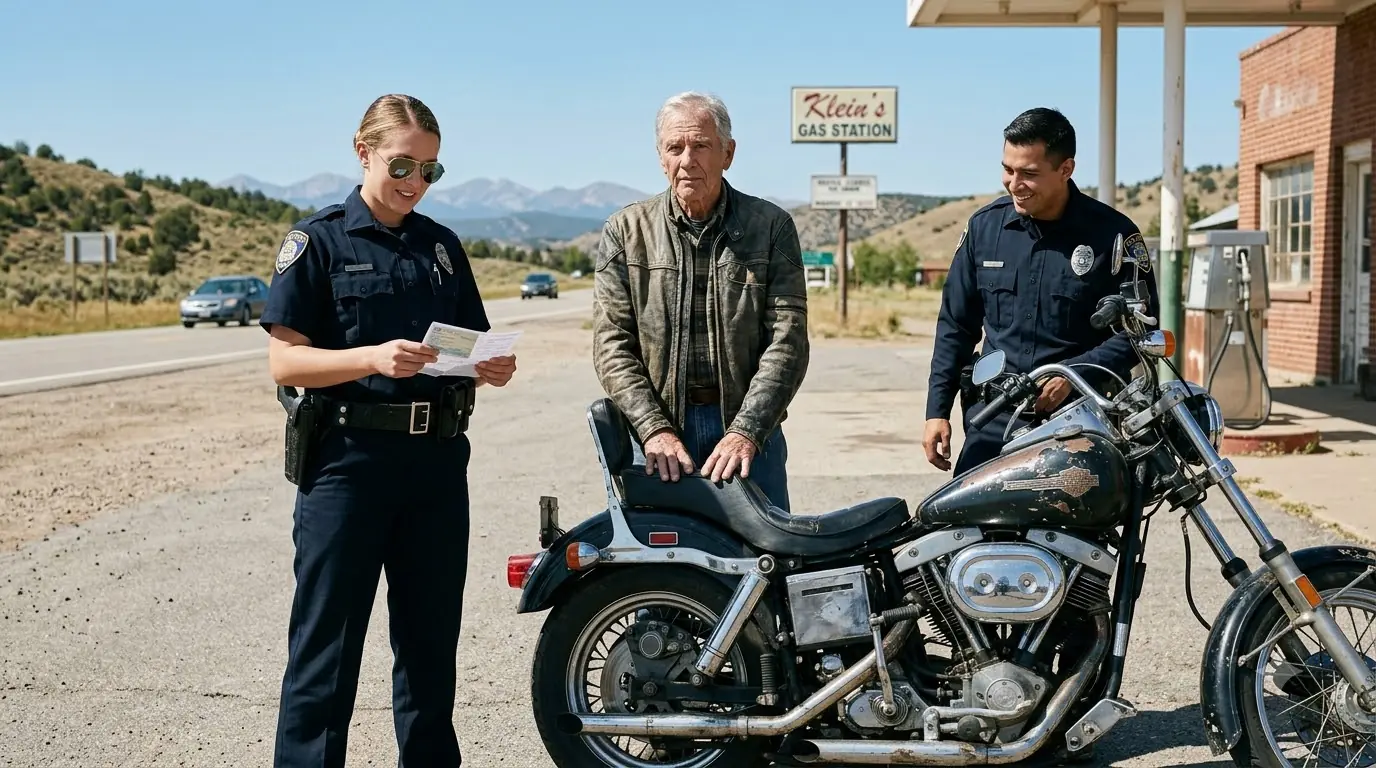
Harper's pulse quickened, not from fear, but from instinct. Situational awareness honed over decades noted the patrol car's angle, the officer stepping out with long deliberate strides. He killed the engine, the silence heavy, and waited. The officer, a woman in her late 20s, approached, her mirrored sunglasses reflecting Harper's weathered face, her name plate read Carter, her hand rested on her holster, a subtle assertion of control. Is this some kind of joke?
Officer Emily Carter's voice carried a mocking edge, her lips curling as she stopped beside the bike. Sir, shut off that relic and step off now. Harper did not move. His hands remained on the handlebars, his gaze fixed on the horizon where the plains met the mountains. He had faced worse than this.
Ambushes in Vietnam, interrogations in Carbell, but the sting of dismissal, of being reduced to an old man on an old bike, cut deeper than he expected. He exhaled slow and measured, and reached for his wallet, pulling out his license and registration with deliberate calm. Carter snatched the documents, her eyes narrowing as she read, "John Harper, 82 years old. " She tilted her head, her tone sharp. Do you not think you are too old to be riding a motorcycle like this? Harper's silence was not defiance, but patience, the kind he had shown young recruits who thought they knew the world.
Another officer, Michael Torres, joined her, his grin wide as he inspected the Harley. Man, this thing's older than my father. Look at that rust. Hands on the bike, sir. Feet apart," Carter ordered, her voice clipped.
The search was unnecessary, a power play, and they both knew it. Harper complied, his movement slow, his dignity intact. His boots scuffed the asphalt, the morning air cool against his callous hands. A small crowd gathered, diners, shopkeepers, a teenager with a phone, murmurss rippling like wind through grass. Mr.
Harper, where do you live? Carter asked, her pen poised over a notepad. Farm off Highway 340, he said, his voice low. Steady. Alone.
Alone. Carter exchanged a glance with Torres, a look that said, confused old man. Do you have family? Anyone who takes care of you? I have been taking care of myself for 82 years.
Carter's jaw tightened. Yes, but do you not think it is dangerous to ride that bike at your age? You could cause an accident, hurt someone. Harper's eyes flicked to her, then back to the horizon. He could have told her about his annual medical exams, his daily workouts, his reflexes sharper than most men in their 30s.
But he owed her no explanation. The crowd grew their whispers louder. "Poor old guy," one said. "Cops got nothing better to do," said another. Harper closed his eyes for a moment, the weight of their pity heavier than Carter's scorn.
"Across the street, Robert Klene, 58, paused, wiping down a fuel pump. A Gulf War veteran, he knew Harper's face, his quiet courtesy, the way he always paid cash, and asked about Klein's son. 15 years of small talk had built a bond, unspoken, but strong. Klene watched Carter's hand hover near her weapon, saw Harper's rigid posture, and felt a fire ignite in his chest. This was wrong.
He grabbed the phone behind the counter and dialed Fort Carson. "This is Robert Klene," he said, his voice urg urgent. "I need an officer on duty now. " Back on the road, Carter's tone sharpened. "Mr. Harper, can you hear me?
Do you understand what I am saying? " Her voice rose, drawing more eyes. Torres leaned in, whispering. I think he might be deaf. Look at him just standing there. Harper opened his eyes, his gaze steady.
I am listening. Then answer me, Carter snapped. Do you not think it is irresponsible to ride that bike? Klein's call connected. His words rushed.
We have a veteran being disrespected by local police. John Harper, 82. He is a good man and they are humiliating him. The officer on the line paused. Did you say John Harper?
A beat. Mr. Klene, keep your eyes on him. We are sending a unit. Do not let them do anything to Mr.
Harper until we arrive. Klene stepped closer to the street, his heart pounding. Something big was coming. He could feel it. The morning sun climbed higher, its light harsh now, casting long shadows across the asphalt where John Harper stood, hands clasped behind his back.
The Harley-Davidson rested on its kickstand, its rusted frame glinting like a relic of forgotten wars. Officer Emily Carter's voice cut through the murmurss of the growing crowd, her words sharp as she circled Harper. Mr. Harper, I am speaking to you. Do you understand the risk you pose on that motorcycle?
Her mirrored sunglasses hid her eyes, but the tightness in her jaw betrayed her irritation. Harper's face remained impassive, his gray eyes fixed on the distant Rockies. He had stood in worse places, muddy trenches, burning villages, facing men with guns, not words. But this, the public stripping of his dignity, stung in a way bullets never had. His silence was not surrender, but a shield forged in decades of discipline.
He felt the crowd's gaze, their whispers weaving a net of pity and judgment. He looks confused," one said. "Somebody should call his family," another muttered. Harper's fingers twitched, a flicker of the anger he rarely allowed himself to feel. Officer Michael Torres, leaning against the patrol car, tried a softer approach.
"Mr. Harper, we are just concerned. You know, a man your age riding something like that. It could be dangerous for you, for others. His grin was gone, replaced by a forced sincerity that did not reach his eyes.
Harper's gaze shifted to him, brief but piercing, and Torres looked away, scratching his neck. Carter stepped closer, her boots clicking on the pavement. Hands on the bike again, sir. We need to check you one more time. The order was unnecessary.
A flex of authority and the crowd sensed it. A woman in a diner apron shook her head, muttering to a man beside her. A teenager's phone stayed raised, capturing every moment. Harper complied, his movement slow, deliberate, his palms pressing against the Harley's warm metal. The bike was more than transport.
It was a piece of him, a survivor like he was. Carter's hands patted his jacket, her touch brisk, impersonal. She found nothing, as she knew she would. Across the street, Robert Klene gripped the phone tighter, his knuckles pale. The Fort Carson officer's words echoed in his mind.