The slap echoed louder than the judge’s gavel.
For half a second, nobody inside Courtroom 4B moved.
Not the court reporter. Not the attorneys. Not the spectators packed into the wooden benches. Not even Judge William Carson, who had spent thirty-one years watching people lie, collapse, scream, confess, and occasionally discover that arrogance became much less impressive when spoken beneath a federal seal.
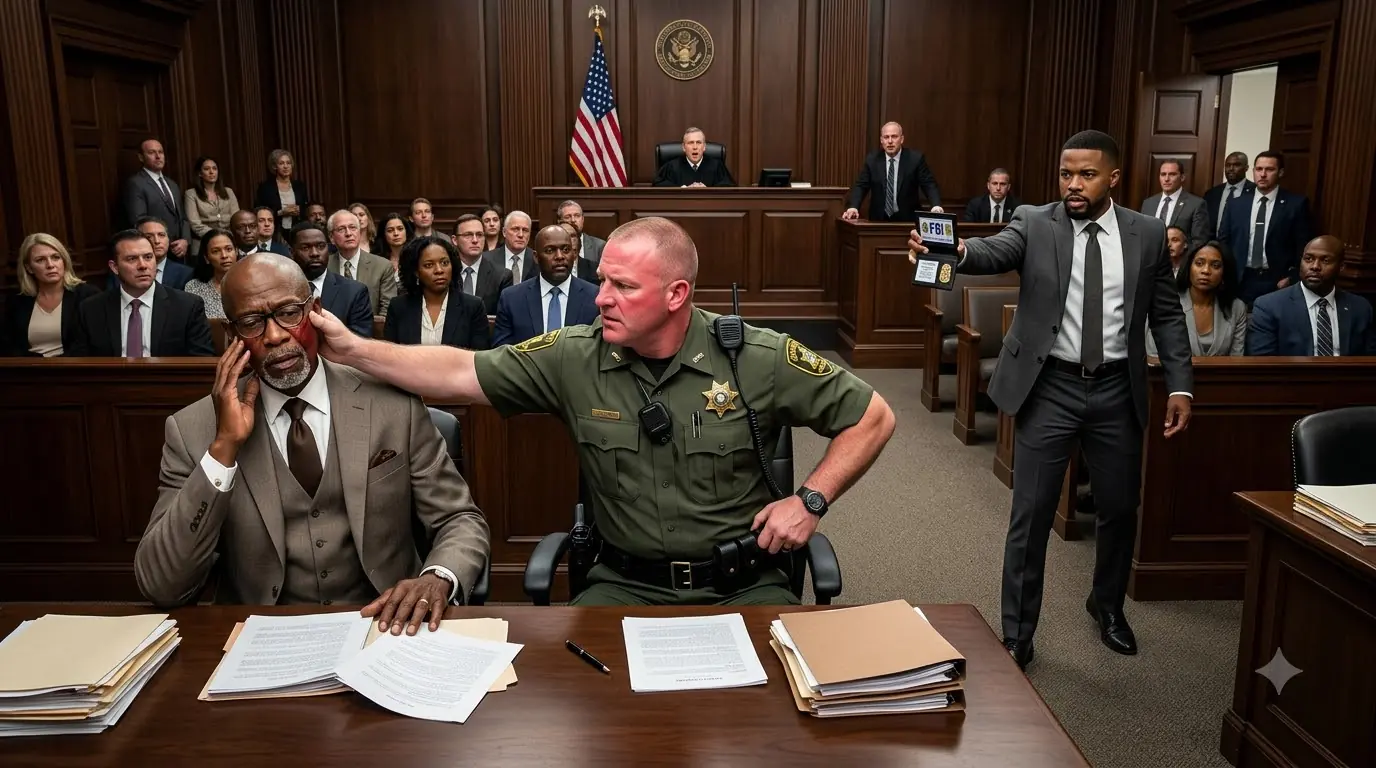
Malcolm Reed remained seated.
His glasses had been knocked crooked.
One lens hung lower than the other.
A thin red mark appeared across his left cheek.
Deputy Travis Cole stood beside him breathing hard.
Cole’s right hand remained raised.
The same hand that had struck him.
Then that hand began dropping toward his belt.
Everything changed.
The rear courtroom doors slammed open.
“DROP IT!”
The voice cracked through the room.
Cole froze.
Everyone turned.
A tall Black man in a charcoal suit stood in the center aisle with an open federal credential wallet held high enough for the closest bailiff to see.
Ethan Reed.
Thirty-five.
FBI Special Agent.
And Malcolm Reed’s son.
“HAND OFF THE WEAPON,” Ethan shouted. “NOW.”
Cole’s fingers stopped inches above his holster.
Two federal agents appeared behind Ethan.
Neither drew a weapon.
They did not need to.
The courtroom had already become still enough to hear the ventilation system.
Judge Carson shot to his feet.
“Deputy Cole, remove your hand from your belt.”
Cole looked toward the judge.
Then Ethan.
Then Malcolm.
“Your Honor, he came at me.”
Malcolm slowly adjusted his glasses.
Nobody had seen him stand.
Because he had not.
Judge Carson’s face hardened.
“He is seated.”
Cole’s breathing quickened.
“He grabbed evidence.”
Malcolm looked down.
A complaint folder lay scattered across the table.
Several pages had fallen to the floor.
One rested beside Cole’s boot.
Malcolm spoke quietly.
“That is my exhibit.”
Cole pointed at him.
“He was provoking me.”
The judge slammed the gavel once.
“Enough.”
One of the courtroom bailiffs approached carefully.
“Deputy, I need you to step away from the table.”
Cole did not move.
Ethan remained in the aisle.
He wanted to move toward his father.
Every part of him did.
But he stayed exactly where he was.
Because he knew something instinctive emotion did not.
If he rushed forward now, Cole could later claim intimidation.
Chaos.
Confusion.
Threat.
One badly chosen movement could blur what had just happened.
So Ethan kept his hands visible.
His voice lowered.
“Deputy Cole, step away.”
Cole looked at him.
“You think that badge makes you important?”
Ethan said nothing.
Cole laughed bitterly.
“You people always show up after somebody pushes back.”
Judge Carson leaned forward.
“Bailiff.”
The bailiff took one more step.
“Deputy, remove your sidearm and place it on the table.”
Cole stared.
“You’re disarming me?”
“You reached toward it immediately after striking an officer of this court.”
“He threatened me.”
Judge Carson’s voice became almost quiet.
“Then I am sure the recording will demonstrate that.”
Cole’s eyes moved downward.
To the red light blinking on his chest.
His body camera.
For the first time, real fear appeared on his face.
Malcolm saw it.
So did Ethan.
Judge Carson pointed.
“Nobody turns that camera off.”
Cole’s jaw tightened.
The bailiff removed his sidearm.
Then another bailiff stepped beside him.
The courtroom spectators began whispering.
Phones were prohibited inside the courtroom, which meant no crowd had recorded what happened.
But three official systems had.
The deputy’s body camera.
The courtroom security camera.
And the federal court’s audio recording.
Cole had assaulted Malcolm Reed in one of the most documented rooms in Virginia.
Yet Malcolm knew documentation did not automatically produce truth.
That was why he had been sitting at the table in the first place.
For twenty-eight years, Malcolm Reed had represented people who possessed evidence everyone claimed did not mean what it appeared to mean.
A camera showed a traffic stop.
The report described resistance.
A jail log showed delayed medical care.
The internal review called it routine processing.
A complaint contained three witnesses.
The disciplinary summary mentioned none.
Evidence did not speak.
People interpreted it.
And the people with the most institutional power often spoke first.
Judge Carson ordered Cole removed from the courtroom.
Cole resisted only verbally.
“You’re making this political.”
Nobody answered.
“This is exactly what he wanted.”
Malcolm looked at him.
Cole continued.
“He came in here trying to destroy careers.”
Malcolm’s voice remained calm.
“I came here with timestamps.”
The line stopped Cole for half a second.
Then the bailiffs walked him toward the side door.
As he passed Malcolm, Cole leaned slightly closer.
Not enough to touch.
Enough to whisper.
“You should have stopped with Mason.”
Malcolm’s eyes sharpened.
“What?”
Cole smiled.
Then he was gone.
Ethan saw the exchange.
“What did he say?”
Malcolm looked toward the closed door.
“Later.”
Judge Carson called a recess.
People stood.
The room erupted into whispered conversation.
Ethan finally moved.
He crossed the aisle quickly.
Malcolm turned toward him.
“You’re bleeding?”
“No.”
“Let me see.”
“I am not five.”
“You’re sixty-three.”
“Unfortunately.”
Ethan crouched slightly to examine the cheek.
Malcolm sighed.
“I’m fine.”
“You were assaulted in federal court.”
“Yes.”
“By a deputy.”
“I noticed.”
Ethan looked toward the side door.
His anger remained visible.
Malcolm touched his arm.
“Do not make this personal.”
Ethan stared.
“He hit you.”
“Yes.”
“He reached for his weapon.”
“Yes.”
“And you’re telling me not to make this personal?”
Malcolm nodded.
“That is exactly what I’m telling you.”
Ethan stood.
“How?”
“Because if you turn this into a son defending his father, everyone gets to forget why we were here.”
Ethan knew that.
He hated that he knew it.
Malcolm collected the scattered exhibits.
One page at a time.
The document Cole had grabbed concerned Terrence Mason.
That name now mattered differently.
Terrence Mason was a forty-seven-year-old Black contractor from Cedar County who had been arrested eighteen months earlier after questioning a deputy during a roadside stop.
Official report:
Mason became physically aggressive and attempted to push past officers.
Body-camera video:
Mason stood beside his truck with both hands visible and repeatedly asked why officers were searching his toolbox without a warrant.
The arrest charge was obstruction.
Dismissed eleven days later.
Terrence filed a complaint.
Three months after that, he withdrew it.
Then left Virginia.
Malcolm had always found the withdrawal strange.
Terrence had been angry when he hired him.
Focused.
Precise.
Not impulsive.
Then one afternoon he called Malcolm and said:
“Drop it.”
No explanation.
No settlement.
No apology.
Just stop.
Malcolm did.
Clients owned their cases.
Attorneys did not.
Then Terrence disappeared from public life.
Now Cole had whispered:
You should have stopped with Mason.
Ethan sat beside Malcolm.
“You’re thinking.”
“Always dangerous.”
“What did Cole say?”
Malcolm handed him the Mason file.
“He mentioned this man.”
Ethan scanned the first page.
“Why?”
“I don’t know.”
“Who is he?”
“Former client.”
“You think Cole knows him?”
“Cole arrested him.”
Ethan looked up.
“That case is connected to today?”
“Possibly.”
Malcolm lowered his voice.
“Terrence withdrew suddenly.”
“When?”
“Fifteen months ago.”
“After what?”
“That’s what I need to know.”
Ethan shook his head.
“No.”
Malcolm looked at him.
“No?”
“You are not investigating anything today.”
“I have a hearing.”
“You have swelling on your face.”
“Minor.”
“You are a terrible patient.”
“I am not a patient.”
“You are about to become one.”
Malcolm almost smiled.
Then his expression hardened.
“Ethan.”
“What?”
“Cole knew Mason’s name.”
“He arrested him.”
“He knew I was still thinking about Mason.”
Ethan stopped.
That was different.
The Mason matter was not part of the public filing.
Malcolm had included related timestamp comparisons in a sealed exhibit.