"What is that smell? Oh, just two dirty street rats crawling in from the gutter."
Gerald Whitmore didn't even look up from his steak.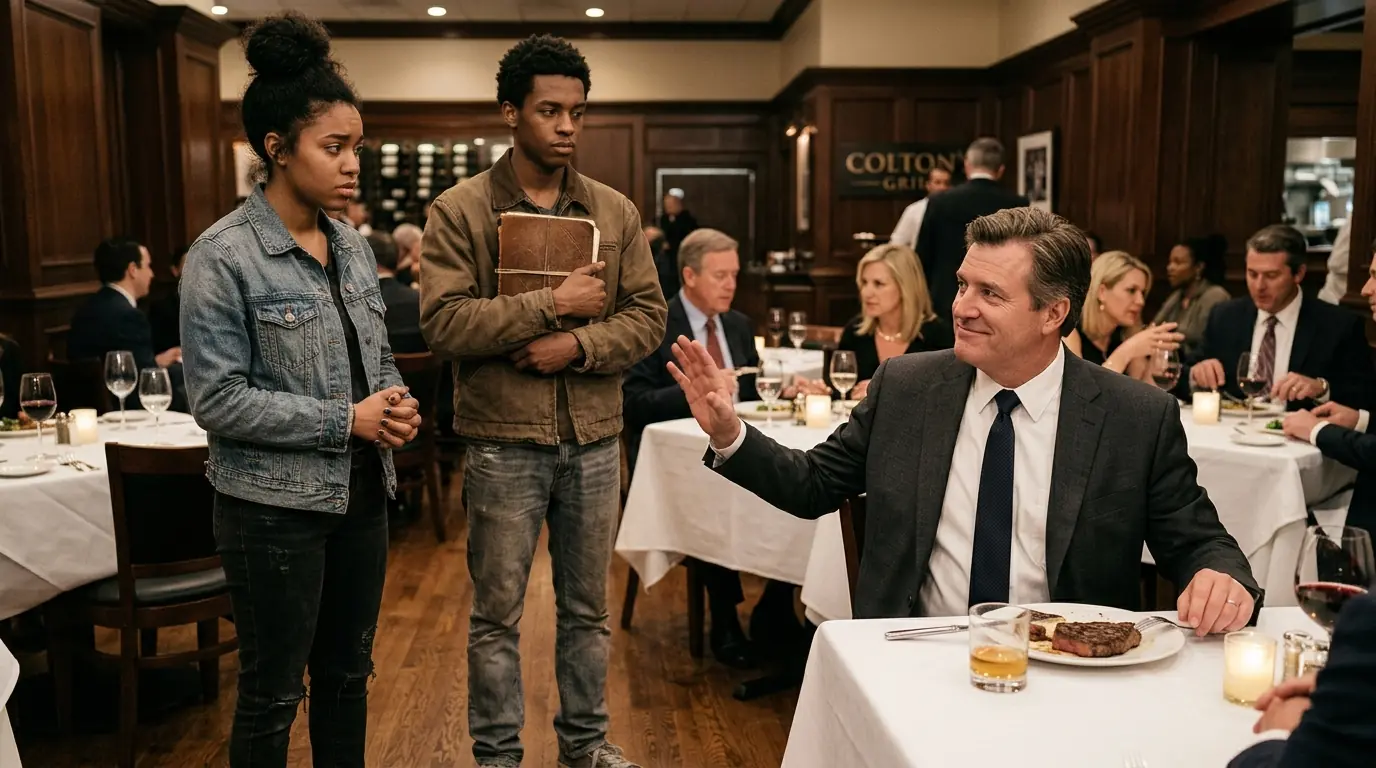
Talia Fletcher, 19 years old, swallowed hard. "Sir, we haven't eaten since yesterday. If you'd let us sing one song for a plate of food."
Gerald's fork hit the plate. "Sing for food?"
The tables laughed. Talia's eyes burned, but she didn't blink.
Gerald leaned forward. "People like you don't belong here. Take that crusty notebook and go howl on a sidewalk."
Tobias, her twin, stood behind her, 19, skinny, silent, clutching that notebook like a shield. 40 people watched. Not one spoke. What Gerald did not know was that in less than 4 minutes he'd be sitting in dead silence while the entire room stood for the two kids he just called street rats.
Colton's Grill sat on the corner of Cary Street in Richmond, Virginia. White tablecloths, dim lighting, jazz on the speakers most Friday nights. Average entree $35. The kind of place where people came to feel important. Tonight the place was packed, every table full, the bar three deep. And at table four, the same table he'd claimed every Friday for 6 years, Gerald Whitmore held court like a man who owned the room. He didn't own it, but he owned the building it sat in. And in Gerald's world, that was close enough.
Gerald was the kind of man who tipped big and talked loud. 56 years old. Real estate money. Three commercial properties on this block alone. Staff smiled when he walked in. Not because they liked him, because Brenda Sullivan, the general manager, made it very clear. Gerald Whitmore gets whatever Gerald Whitmore wants. No exceptions. Brenda ran Colton's Grill the way Gerald liked it. Clean, quiet, comfortable. And comfortable had a meaning in this restaurant that nobody said out loud, but everybody understood. If you didn't look like you belonged, Brenda made sure you didn't stay.
Tonight was supposed to be a normal Friday. Steaks, wine, Gerald telling stories about his latest property deal while diners at the neighboring tables pretended to be impressed. Then Talia and Tobias Fletcher walked through the front door.
They hadn't planned on Colton's Grill. They'd tried two other restaurants first, a barbecue spot on Main Street. The owner told them to leave before Talia could finish her sentence. A diner on Broad. The hostess wouldn't even make eye contact. Colton's was the third stop. The last try before giving up for the night and walking back to Pastor Edwin Brooks's shelter with nothing in their stomachs.
Pastor Brooks had taken them in 9 months ago. Small shelter off Hull Street, 14 beds, a roof that leaked when it rained hard. But it was warm. And Brooks never once made them feel like charity cases. He was the first adult in a long time who looked at them and didn't see a problem. He saw something else. Every morning before the other residents woke up, Talia and Tobias would sit in the shelter's back hallway and sing. Quietly at first, hymns their mother taught them, then louder harmonies that echoed off the cinder block walls and made people stop in the corridor just to listen.
Brooks told them once, "Your mama gave you those voices for a reason. Don't you dare let the world take that from you."
Their mama, Denise Fletcher, backup singer, gospel circuits across the South, small churches, smaller paychecks. She never got a record deal, never got her name on an album. But she could sing in a way that made strangers cry in the third row of a Wednesday night service. She raised the twins alone in Norfolk. No father in the picture, no family with money, just Denise and two kids and a leather notebook she carried everywhere filled with songs she wrote on bus rides between gigs. Melodies she hummed to Talia and Tobias every single night before bed.
14 months ago, Denise caught pneumonia, no health insurance. By the time she got to a hospital, her lungs were already shutting down. She died on a Tuesday afternoon. Talia was holding her left hand. Tobias was holding her right. She was 41 years old.
After that, everything collapsed. Eviction within 60 days. No relatives willing to take in two black teenagers with nothing to offer. The foster system at 18 was a dead end. Nobody even pretended to care about. Within 3 months, Talia and Tobias were sleeping in a bus station. The only thing they kept was the notebook, every song their mother ever wrote, every melody, every lyric. Denise Fletcher's entire life as a musician, sealed in cracked leather and held together with a rubber band.
Tobias carried it everywhere. He never let it out of his sight, not once. Talia asked him once why he held it so tight. He looked at her and said, "Because it's the only part of her that still has a voice."
Now they stood in the entrance of Colton's Grill, hungry, embarrassed, and surrounded by people who had just laughed at them. Brenda Sullivan was already walking toward them. Behind her, Gerald was still grinning, soaking in the applause of his own cruelty.
But there was one person in the room who wasn't laughing. Corner booth alone. A black man in his mid-40s dressed simply, jeans, dark blazer, no flash. He had been reading the menu when the twins walked in. Now the menu was flat on the table, and his eyes hadn't left the two kids standing in the doorway.
His name was Dominic Callaway, Grammy-nominated music producer, three platinum records, two nominations in the last four years, based in Atlanta. But once a year, every year, he drove to Richmond and ate alone at Colton's Grill. Always the same booth. Always a Friday in October. 6 years ago, his daughter used to sit across from him in that booth. She was 17. She loved to sing. She died in a car accident 3 days after her senior prom. This restaurant was their spot.
Dominic watched Gerald humiliate the twins. He watched Brenda march toward them. He watched the room laugh. He didn't say a word, not yet. But he put down his menu and he leaned forward.
Brenda Sullivan stopped 3 feet from the twins and crossed her arms. She didn't raise her voice. She didn't have to. Her tone did all the work. "I'm going to say this once. You have 10 seconds to walk out that door or I'm calling the police."
Talia opened her mouth, but Gerald's voice cut across the room first. "What part of 'get out' is confusing for them, Brenda? Must be a comprehension issue. Probably never finished school either."
More laughter, softer this time. A few people looked away, but nobody spoke up. Then Tobias did something nobody expected. He stepped forward, past his sister, past the hostess stand, and spoke directly to Brenda. Quiet, steady, no anger, no begging.