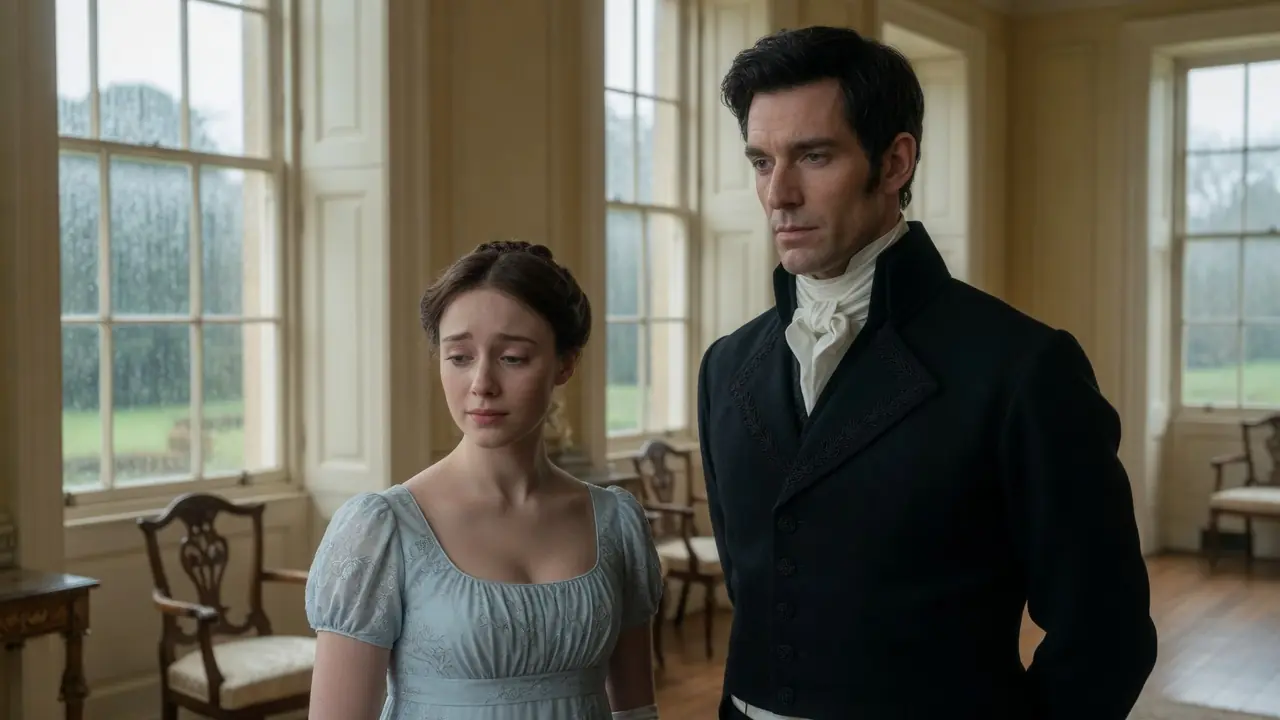
The February rain fell upon London with relentless persistence, as though the heavens themselves mourned what was about to take place within the grand drawing room of Northwick House. Marianne Ellsworth stood perfectly still beside the towering windows, her pale blue gown a stark contrast against the gray sky beyond. She was 20 years old, the daughter of the Earl of Denham. And today, this cold, merciless day, she would meet the man who would become her husband.
She had not chosen him. She had not been asked. Her father's voice drifted from the corridor, mingling with another, deeper, colder, edged with authority that seemed to cut through stone itself. Marianne's fingers tightened around the lace of her gloves.
She had heard whispers about Tristan Northwick, Duke of Northwick, 34 years of age, widowed young, though no one spoke of his first wife with any warmth, a man of immense wealth and greater coldness. A man whose mother had been Irish, a fact that had in certain circles raised eyebrows and fueled whispers about the purity of his lineage. The door opened. Marianne turned, her heart a wild thing trapped within the cage of her ribs.
He entered first, tall, imposing, dressed in black, save for the white of his cravat. His hair was dark, almost black, worn shorter than fashion demanded. His face was all sharp angles, a strong jaw, high cheekbones, a mouth that looked as though it had forgotten how to smile, but it was his eyes that arrested her, gray as the storm outside, and just as unforgiving. Tristan Northwick did not bow.
He did not offer pleasantries. He simply looked at her, a long assessing gaze that traveled from the crown of her carefully arranged hair to the hem of her gown as though she were a horse he was considering for purchase. "Lady Marianne," he said at last, his voice low and devoid of warmth. "Your Grace," Marianne curtsied, her training, holding her upright, even as her knees threatened to buckle, her father, the Earl of Denham, stepped forward, his ruddy face beaming with satisfaction.
"A fine match, is it not? My daughter is accomplished in all the feminine arts, music, embroidery, French. I am aware of her accomplishments. The Duke's words were clipped, dismissive.
The contract has been signed. The wedding will take place in three weeks' time at St. George's Hanover Square. Lady Marianne will have her trousseau prepared.
I expect punctuality. Marianne's breath caught. She had known this was an arrangement, a business transaction dressed in silk and orange blossoms. But the stark coldness of his words struck her like a physical blow.
"Of course Your Grace," her father said quickly, his eagerness embarrassing. "Everything will be as you wish." "It will be." The Duke's gaze returned to Marianne, and for a moment just a heartbeat, she thought she saw something flicker in those gray eyes, but it was gone before she could name it. Lady Marianne, you will find that I am a man of order and discipline. I expect the same from my household.
My late mother taught me the value of duty above all else, and I have lived by that principle. I trust you understand what is required of you. It was not a question. Marianne lifted her chin.
Something stubborn and wild stirring within her chest. I understand that I am to be your wife, Your Grace. I will fulfill my duties as Duchess of Northwick. A muscle twitched in his jaw.
See that you do. And with that, he turned and left the room, his footsteps echoing down the marble corridor like the closing of a crypt. Her father let out a relieved breath. Well done, my dear.
Well done indeed. You will be a duchess. Think of it. A duchess.
But Marianne could not think of it. All she could think of was the cold gray of his eyes, and the terrible certainty that she was walking toward a life of ice and loneliness, bound to a man who saw her as nothing more than a necessary inconvenience. The wedding took place on a gray March morning. St.
George's was filled with flowers, white roses, lilies, hothouse blooms that must have cost a fortune, but they did nothing to warm the ceremony. Marianne walked down the aisle on her father's arm, her white silk gown whispering against the stone floor, and felt as though she were walking to her own entombment. Tristan stood at the altar, resplendent in dark blue velvet, his expression as impassive as marble. When the vicar asked if he took this woman to be his lawfully wedded wife, he answered with a single word.
I do. No emotion, no warmth. When it was her turn, Marianne's voice trembled only slightly. I do.
The vicar pronounced them man and wife. Tristan turned to her, lifted her veil with hands that did not shake, and pressed a brief cold kiss to her lips. It was over in an instant, a kiss that held no promise, no tenderness, only duty fulfilled. The breakfast that followed was a lavish affair at Northwick House, but Marianne barely tasted the food.
She sat beside her new husband at the head of the table, accepting congratulations from guests whose faces blurred together in a haze of silk and champagne. Tristan spoke when required, his manners impeccable, but he did not look at her, did not touch her except when propriety demanded. When the guests finally departed, and the house fell silent, Marianne found herself standing in the grand entrance hall, still wearing her wedding gown, feeling more alone than she had ever felt in her life. Your Grace.
Mrs. Dawson, the housekeeper, appeared at her elbow, a stout woman with kind eyes and graying hair tucked beneath a starched cap. Shall I show you to your chambers? Yes, thank you.
Mrs. Dawson led her up the sweeping staircase, down a corridor lined with portraits of stern-faced Northwicks, and finally to a suite of rooms that took Marianne's breath away. The bedroom was enormous, decorated in shades of cream and gold, with a massive four-poster bed draped in silk. A dressing room adjoined it, and beyond that, a private sitting room with windows overlooking the gardens.
"These are the Duchess's chambers," Mrs. Dawson said softly. "They have not been occupied since the Duke's mother passed eight years ago. His grace ordered them refurbished for your arrival," Marianne's throat tightened.
"They are beautiful. His Grace's chambers are through that door. Mrs. Dawson nodded toward a connecting door.
"He will, that is, when he wishes to visit." I understand. Marianne's cheeks burned. Mrs. Dawson squeezed her hand.
You'll be all right, my dear. Give it time. But as the housekeeper left, and Marianne's ladies maid helped her out of the heavy wedding gown, she wondered how much time would be enough. How many years would it take for a man of ice to thaw?
He came to her that night. Marianne was sitting at her dressing table in her night gown, her hair loose around her shoulders, when she heard the connecting door open. She turned, her heart hammering, and saw him standing in the doorway. He had changed into a burgundy dressing gown, his hair slightly disheveled, the first sign of disorder she had seen in him.
Duty always duty. Marianne rose on unsteady legs. I understand. He guided her to the bed with hands that were neither gentle nor rough, simply efficient.
What followed was exactly as she had been told to expect by her married cousins, quick, impersonal, slightly uncomfortable. Tristan performed his duty with the same cold precision he brought to everything else. He did not kiss her, did not whisper endearments. When it was done, he rose immediately, refastened his dressing gown, and moved toward the connecting door.
"Your Grace," Marianne heard herself say, her voice small in the darkness. He paused, his hand on the door handle. "Will you, that is, do you wish to to what?" His tone was sharp. To stay to talk, perhaps there is nothing to discuss.
You have done your duty. That is sufficient. And he was gone. the door closing behind him with a soft final click.
Marianne lay in the darkness, her hands pressed to her stomach and felt tears slide hot down her temples into her hair. This was her life now, this cold, empty bed, this husband who treated her like a broodmare. She would grow old in this house, unloved and unseen, a ghost in silk gowns, performing her duties while her heart shriveled and died, unless she found a way to survive it. The weeks that followed established a pattern.
Tristan rose early, breakfasted alone in his study, and spent his days managing his vast estates or attending sessions in the House of Lords. Marianne took her meals in the smaller dining room, walked in the gardens when weather permitted, and tried to make sense of her new role. She was the Duchess of Northwick now, one of the highest ranking women in England, but she felt like an impostor playing dressup. Mrs.
Dawson became her guide through the labyrinth of household management. There were 32 servants in the London house alone, each with specific duties that had to be coordinated with military precision. Marianne threw herself into learning their names, their responsibilities, the intricate dance of running a ducal household. You're a natural, Your Grace, Mrs.
Dawson said one afternoon as they reviewed the week's menus. The staff have taken to you wonderfully, have they? Marianne felt a small flutter of pleasure. Indeed, young Thomas, the footman who dropped the soup tureen last week.
He was certain his grace would dismiss him. But you spoke up for him, said it was an accident and could happen to anyone. The boy is devoted to you now. Marianne remembered the incident.
Tristan had been furious, his voice cold as he'd ordered the trembling footman to leave his sight. But Marianne had found Thomas later in the servants hall, assured him that everyone made mistakes, and quietly told Mrs. Dawson to make certain the boy kept his position. It was the right thing to do, Marianne said simply.
Not everyone sees it that way, Your Grace, but kindness is its own reward. Tristan continued to come to her chambers two or three times a week, always late at night, always with the same cold efficiency. He never stayed, never spoke beyond the bare necessities. And Marianne learned to endure it, to close her eyes and think of other things, the garden she planned to redesign, the book of poetry she was reading, anything but the man above her, who treated her body as territory to be claimed rather than a person to be cherished.
But in the morning she would catch his scent on her pillows, sandalwood and something darker, more complex, and feel an ache she could not name. It was not desire exactly. It was loneliness, a longing for connection that seemed as futile as wishing for the moon. One afternoon in late April, Marianne was arranging flowers in the drawing room when she heard raised voices from Tristan's study across the hall.
The door was slightly ajar. You must marry again, Northwick. produce an heir. The title cannot I am aware of my responsibilities.
Tristan's voice was like ice over steel. Then why delay? It has been eight years since. Do not speak of it.
But surely you see the necessity. I said, do not speak of it. The fury in his voice made Marianne flinch. I have married.
I have done what was required. The matter is closed. There was a long pause. Then another voice, older, conciliatory.
Of course, Your Grace forgive me. Footsteps approached the door. Marianne quickly moved away, her heart pounding, but not before she glimpsed the visitor, an elderly gentleman with white hair and a worried expression. He departed swiftly, and the study door slammed shut.
Marianne stood frozen, the flowers forgotten in her hands. Something in that exchange had shaken her. The raw anger in Tristan's voice when his first wife was mentioned. The mention of an heir, a child she was supposed to give him, though he could barely stand to touch her.
That evening at dinner, one of the rare occasions when they dined together, she watched him covertly across the length of the table. He ate in silence, his movements precise, his expression revealing nothing. But she noticed for the first time the faint shadows beneath his eyes, the tension in his jaw, the way his hand tightened around his wine glass when a footman moved too quickly behind him. "What had made him this way?
What had happened to forge a man into something so cold, so controlled?" she wanted to ask. She wanted to reach across the chasm between them and touch something real. But his earlier words echoed in her memory, "Do not question me." So she remained silent, and the distance between them stretched wider still. May brought warmth to London, and with it the beginning of the social season.
Marianne found herself thrust into a whirlwind of balls, soirees, and afternoon teas. As the new Duchess of Northwick, she was a figure of intense curiosity and scrutiny. Every gown she wore, every word she spoke, every gesture she made was observed, analyzed, and discussed by the ton. To her surprise, she was succeeding.
"You were absolutely radiant at Lady Peyton's ball," Lady Catherine Ashford gushed during an afternoon visit. "She was the wife of a Vic count, a woman with three daughters and a generous heart." "That ivory silk with the gold embroidery. Where did you find it?" Madame Bellon on Bond Street, Marianne replied, pouring tea with the grace her mother had drilled into her since childhood. She's French, terribly talented.
I must visit her at once, and your comportment so elegant, so assured. You put the rest of us to shame. Hardly that. Marianne felt her cheeks warm.
But it was true. Somehow, despite her inner turmoil, Marianne had discovered a talent for navigating society. Her genuine kindness toward others, her willingness to listen rather than gossip, her impeccable manners, all of it combined to make her popular in a way she had never expected. Within weeks, ladies were copying her hairstyles.
Her choice of colors became fashionable. Hostesses competed for her attendance at their events. The Duchess of Northwick had become the standard by which other ladies measured themselves. Yet none of it brought her joy.
Because at home in the grand house on Grosvenor Square, her husband remained as distant as ever, they attended social events together, his hand cold on her arm, his expression bored, and left separately, she in her carriage, he on horseback. They maintained the appearance of a proper ducal marriage, but behind closed doors there was nothing but ice, and it was breaking her heart. One evening in late May, Marianne returned home from a musical to find the house unusually quiet. Most of the servants had retired for the night.
She climbed the stairs slowly, exhausted from hours of maintaining her social mask, and was almost to her chambers when she heard it. Music, a violin, playing something haunting and beautiful. The melody seemed to drift from the far end of the corridor, from a room she had never entered. Marianne followed the sound, drawn like a moth to flame.
The door was slightly open, warm candle light spilling into the darkened hallway. She peered inside and felt her breath catch. It was a music room she hadn't known existed, smaller than the grand one downstairs, more intimate. And there, silhouetted against the windows, stood Tristan, a violin tucked beneath his chin, his bow moving across the strings with surprising grace.
He was playing from memory, his eyes closed, his usually rigid posture relaxed, and the music. It was Irish, she realized. A lament, filled with longing and loss, and a grief so profound it made her throat ache. She must have made some sound because his eyes snapped open.
The music stopped abruptly. "What are you doing here?" His voice was sharp, but beneath it, she heard something else. Embarrassment. Vulnerability.
I heard the music, Marianne said softly, stepping into the room. I'm sorry. I didn't mean to intrude. He lowered the violin, his jaw tight.
You should not be here. Why not? She moved closer, emboldened by the glimpse of humanity she had just witnessed. It was beautiful.
I didn't know you played. There is a great deal you do not know about me." He set the violin carefully in its case, his movements precise once more, the walls rebuilding. And a great deal that is none of your concern. I am your wife, Marianne said, and was shocked by the steadiness of her own voice.
Surely some things are my concern. He turned to face her fully, and in the candlelight his features were sharper, more forbidding. Marriage does not grant you the right to pry into my private affairs. I am not prying.
I am simply trying to understand. There is nothing to understand. He moved toward the door clearly expecting her to leave. Go to bed, madam.
It is late. Do not question me, Marianne said quietly. Is that what you were going to say? He stopped, turned slowly.
What? That first day we met, you made it clear that I was not to question you, that you would dictate the terms of our marriage, but Tristan. She used his Christian name for the first time and saw something flicker in his eyes. "How can there be any marriage at all if we are strangers?" The silence stretched between them, taught as a bowstring.
"You know nothing of what you speak," he said finally, his voice low and dangerous. "This marriage serves a purpose. It is not meant to be some romantic fairy tale." "I know that." Her voice broke slightly. Believe me, I know that.
But must it be so cold? Must you treat me as though I am nothing?" Something shifted in his expression. Surprise, perhaps, or pain, she couldn't tell. "I treat you as a duchess should be treated, with respect, with propriety.
With ice," the words burst from her before she could stop them. "You come to my bed and leave as though I am a task to be completed. You barely speak to me. You do not see me, and I, her voice dropped to a whisper.
I am so terribly lonely. The admission hung in the air between them, raw and honest. Tristan stood perfectly still, his hands clenched at his sides. When he finally spoke, his voice was.
Loneliness is the burden of duty. You will grow accustomed to it. Is that what happened to you? You grew accustomed to being alone.
Do not presume to understand me. But there was less bite in his words now, more weariness. Marianne took a breath, gathering her courage. Your mother was Irish.
His head snapped up. How did you? People talk. They say she was from County Cork.
That she was beautiful and kind, and that she taught you to play Irish music. She taught me many things. His voice was tight. Duty, honor, the cost of weakness.
Weakness? Marianne frowned. What do you mean? For a moment she thought he might answer.
His lips parted, his eyes distant, as though he were looking at something only he could see. But then the shutters came down again, and his face became a mask. "Go to bed, Marianne," he said her name for the first time, and it sounded strange in his mouth, almost tender. "This conversation is finished." He walked past her, his shoulder brushing hers for the briefest instant, and she felt the heat of him, the solid reality beneath the armor he wore.
Then he was gone, his footsteps echoing down the corridor, and she was left alone in the music room with only the fading scent of sandalwood and the ghost of that Irish lament. But something had shifted, something small but significant. He had called her by her name. The next morning, Marianne found a letter on her breakfast tray.
It was sealed with the Northwick crest written in a bold precise hand. "Madam, you expressed interest in the gardens. The head gardener, Mr. Hewitt, has been instructed to consult with you regarding any changes you wish to make.
The gardens are yours to manage as you see fit. Northwick." It was hardly a love letter, but it was an acknowledgement, a small concession. Marianne pressed the letter to her chest and felt for the first time since her wedding day a spark of hope. She threw herself into the garden project with enthusiasm.
Mr. Hewitt was a gruff man in his sixties with soil stained hands and an encyclopedic knowledge of plants. He was skeptical at first. Ladies generally knew nothing about real gardening, but Marianne proved him wrong.
She had spent years working in her mother's gardens at home, learning the names of flowers, understanding the needs of different plants, the way light and soil and water combined to create life. She had ideas. A rose garden in shades of cream and blush, a herb garden near the kitchen, a secluded bower with a bench where one could sit and read in peace. "You know your business, Your Grace," Mr.
Hewitt admitted after their third consultation. "Not many ladies do. I find comfort in growing things, Marianne said simply, in watching something beautiful come from the earth. Over the following weeks, she spent hours in the gardens, often with dirt on her gloves and the sun warm on her face.
The servants grew accustomed to seeing the Duchess kneeling among the roses, pruning with her own hands, or conferring with Mr. Hewitt about drainage and soil composition. She did not know that Tristan watched her sometimes from his study window. He told himself it was mere curiosity, an overseer checking on his property.
But the truth, the truth he barely acknowledged even to himself, was that he could not look away. She was so different from what he had expected. When he had agreed to this marriage, he had anticipated a meek, biddable girl who would fulfill her duties and otherwise remain invisible. Instead, he had gotten this.
A woman with a spine of steel beneath her silk gowns. A woman who looked at him with hurt in her eyes, but did not crumble. A woman who laughed with the servants and charmed society, and turned his carefully ordered household into something warmer, more alive. It unsettled him.
And then there was her presence in his home, her scent in the corridors, rose water, and something uniquely her. the sound of her voice drifting up from the drawing room when she entertained guests, the way she moved through his house as though she belonged there, which of course she did. But it still felt like an invasion, an invasion that was slowly breaching his defenses. He came to her chambers less frequently now, making excuses to himself about being busy, about having estate matters to attend to.
The truth was that it had become harder to maintain his coldness, harder to treat her as merely a duty when she looked at him with those expressive eyes that seemed to see straight through his armor. One night in early June, he found himself standing before the connecting door between their chambers, his hand on the handle, unable to make himself turn it. On the other side, he knew she would be waiting, or not waiting, perhaps reading or already asleep. and if he went to her now, performed his duty as he had so many times before, he couldn't do it.
Not tonight, not when his control felt so dangerously thin. He turned away, poured himself a brandy, and stood at the window, looking out at the garden she had transformed. Even in the moonlight, he could see the changes, new roses, new pathways, new life growing where before there had been only rigid formality. She was changing his house, and he feared she was changing him.
The confrontation came in mid June at a ball hosted by the Marquess of Wrexham. Marianne was in the lady's retiring room repairing a torn flounce on her gown when she overheard two women talking in the adjacent al cove. She recognized their voices, Lady Hartley and Mrs. Pemberton, two of society's most notorious gossip.
She has certainly risen to her position admirably. Lady Hartley was saying one would almost forget she's merely an Earl's daughter. Indeed, Mrs. Pemberton's tone was sly, though one wonders how long it will last.
What do you mean, my dear? Everyone knows Northwick is cold as ice. His first wife, poor Creature, died of loneliness, they say, and this new duchess, for all her charm, will fare no better. Mark my words, within a year he'll have a mistress, and she'll be left to manage his household and bear his children, while he seeks warmth elsewhere.
Marianne's hands stilled on her gown, her face burned. You don't think he cares for her at all? Lady Hartley sounded almost disappointed. Care?
Northwick? The man doesn't have a heart to care with. He's all duty and discipline. No, the new duchess may win over all of London, but she'll never win him.
Poor girl doesn't stand a chance. They moved away, their laughter fading. Marianne remained frozen, her reflection staring back at her from the mirror, pale, shocked, her eyes too bright. Was that what everyone thought?
that she was doomed to a loveless marriage destined to be betrayed and abandoned while she played the perfect duchess. The worst part was that they might be right. She repaired her gown with shaking hands, composed her expression, and returned to the ballroom. Tristan was exactly where she had left him, standing near the windows with a group of gentlemen, his posture rigid, his face bored.
He looked so remote, so unreachable, as though he felt her gaze. He turned. Their eyes met across the crowded ballroom. And in that moment, something inside Marianne broke.
She could not do this. Could not spend her life yearning for something he would never give. Could not continue to pour her heart into a vessel that would never hold it. She turned away and walked toward the terrace, needing air, needing space, needing Your Grace.
His voice stopped her at the threshold. She turned to find him standing close, closer than he had been in weeks, his gray eyes searching her face. Is something wrong? No.
Her voice sounded brittle even to her own ears. Nothing is wrong. You are upset. I am perfectly well.
You are lying. The bluntness of it shocked her into honesty. And if I am, does it matter? His jaw tightened.
Of course it matters. You are my wife. Am I? The words escaped before she could stop them.
Because most of the time I feel more like a piece of furniture, useful, decorative, but not not real. He stared at her, something like shock flickering across his features around them. The ballroom continued its glittering dance, but they might have been alone. That is not He stopped visibly struggling.
I do not mean to make you feel unloved. She supplied the word he could not say. invisible, like I matter to everyone except the one person whose regard I She stopped, appalled at what she had almost confessed. Except me, he finished quietly.
She could not look at him, could not bear to see confirmation in his eyes that she meant nothing to him, that she would always mean nothing. "Forgive me, Your Grace, I should not have spoken so." She turned to leave. His hand caught her wrist. The first time he had touched her in public.
The first time he had touched her at all outside the cold confines of duty. Wait, she waited, her heart thundering. I He seemed to struggle with the words, his grip on her wrist tightening. You are not furniture.
You are not invisible. I see you, Marianne. I His voice dropped rough and low. I see you.
She turned back slowly, searching his face for meaning. His eyes were dark, turbulent, filled with something she had never seen there before. Something that looked almost like anguish. "Then why," she whispered.
"Why do you keep me at such distance?" He released her wrist as though it burned him. "Because distance is safer." "Safer for whom?" "For everyone," he stepped back, and she saw him rebuilding his walls brick by brick. "Forgive me, I should not have. We should return to the ball.
Tristan, Your Grace. His voice was cold again, remote. We have been missed. And just like that, the moment shattered.
After the ball, something changed between them. A shift so subtle that Marianne almost didn't notice it at first. Tristan began appearing at breakfast. Not every morning, but three or four times a week.
He would enter the breakfast room while she was taking her tea and toast. He would nod curtly, serve himself from the sideboard, and sit at the opposite end of the table with his newspaper. They rarely spoke, but he was there. Then came the afternoon he walked into the drawing room while she was entertaining Lady Catherine and two other ladies for tea.
Marianne had frozen mid-sentence, her teacup suspended in the air, because Tristan never interrupted her social calls. "Forgive the intrusion," he had said, bowing to the assembled ladies with perfect courtesy. I merely wish to inform you, madam, that the new roses you ordered have arrived. Mr.
Hewitt awaits your instruction. Oh. Marianne set down her teacup carefully. Thank you, Your Grace.
He had nodded and departed, but not before she caught something in his expression, a fleeting softness that made her heart skip. Lady Catherine had leaned forward the moment the door closed. My dear, was that actually concern in the Duke's voice? Don't be absurd, Mrs.
Hartley said, but she looked thoughtful. That evening, Marianne had gone to the gardens to inspect the new roses, three dozen bushes of a rare apricot variety she had requested. She was kneeling among them, examining their roots, when she felt eyes upon her. She looked up to find Tristan standing at the edge of the garden, watching, their gazes held for a long moment.
Then he had turned and walked away, but not before she saw something in his face that looked almost like longing. The visits to her bed chamber stopped entirely. At first Marianne told herself it was relief she felt. Those cold, dutiful encounters had been painful in their own way.
But as days stretched into weeks without any summons, without any knock on the connecting door, she found herself lying awake at night, listening for footsteps that never came. Had she driven him away entirely with her emotional outburst at the ball? Had she revealed too much, asked for too much? or and this thought was somehow worse.
Had he simply lost interest? One night in late June, unable to sleep, Marianne rose and walked to the connecting door. She pressed her hand against the wood, knowing he was on the other side, perhaps also awake. She could knock.
She could go to him. She was his wife. She had that right. But pride held her back.
She would not beg for scraps of affection. She would not The door opened. Marianne stumbled back, her heart in her throat. Tristan stood in the doorway in his shirt sleeves, his cravat gone, his hair disheveled.
He looked as shocked as she felt. "I both began simultaneously, then stopped. I heard you," he said finally. "I thought perhaps you were unwell." "No, I couldn't sleep." She clutched her dressing gown tighter.
"I was just I didn't mean to disturb you." "You didn't?" He hesitated, then stepped back. "Would you?" that is, would you care to come in? It was unprecedented, shocking. She had never been inside his private chambers.
Yes, she heard herself say, "Yes, I would." His room was darker than hers, furnished in deep burgundies and forest greens. Books lined one wall, more books than she had expected. A desk sat before the window, covered in papers and correspondence. It was the room of a man who spent long hours working, thinking, alone.
I owe you an apology, Tristan said abruptly, not looking at her. For my absence of late, I have been avoiding my responsibilities. You mean avoiding me? He flinched slightly.
Yes. Why? He moved to the window, his back to her, his shoulders rigid. Because I am a coward.
The admission shocked her. You are the least cowardly man I have ever met. You do not know me. His voice was hollow.
You do not know what I am capable of, what I have done. Marianne crossed the room slowly, drawn by the raw pain in his voice. Then tell me, I cannot. Why not?
Because, he spun to face her, and in the candle light his eyes were wild, desperate. Because if I tell you, you will understand why I must keep my distance. Why I can never, he stopped, his jaw working. Never what, she whispered.
Never love you. The words fell between them like stones into still water, sending ripples of shock through her entire being. Is that what you think? Her voice was barely audible.
That you are incapable of love. I know I am. He turned away again, his hands gripping the windowsill. My father taught me that emotions are weakness.
Sentiment is dangerous. Control is everything. And my mother, his voice broke. My mother loved deeply, felt deeply, and it destroyed her.
What happened to her? She died when I was 18. The words came slowly, painfully, as though each one cost him dearly. She had been ill for years, a wasting sickness that the doctors could not cure.
But it was not the sickness that killed her. It was heartbreak. Heartbreak. My father was a cruel man.
Tristan's voice was flat now, emotionless in the way of someone who has learned to bury their pain deep. He despised my mother for her Irish blood, for her warmth, for everything that made her different from proper English society. He mocked her accent, her music, her faith. He took lovers openly, flaunted them before her, and when she dared to protest, when she dared to show emotion, he punished her for it.
Marianne's hand went to her throat. How? He sent her away for months at a time to our estate in the north, alone, except for servants. He forbade her to see me, told her that if she wished to behave like a peasant, she would be treated as one.
His hands were white knuckled on the windowsill, and she endured it all because she loved me, because leaving him would mean losing me entirely. Tristan, when she finally died, I was at Eton. They sent word, but I arrived too late. She was already gone.
And my father, his voice turned to acid. My father said it was a mercy, that she had been too emotional, too weak, and weakness had killed her. He was wrong, Marianne said fiercely. It was not weakness.
It was cruelty, his cruelty, that killed her. Perhaps Tristan's shoulders were shaking now, though his voice remained steady. But I learned the lesson he intended. Emotion is dangerous.
Love is a weapon that can be used against you. Better to feel nothing. Better to control everything. and your first wife?" he went completely still.
"What do you know of her?" "Nothing, only that she existed. That she died young." She did. He turned finally, and his face was a mask of anguish. Her name was Eleanor.
"We married when I was 22, an arrangement like ours. She was 15, terrified, completely unprepared for marriage. And I," he laughed bitterly. I treated her exactly as my father had taught me, with coldness, with distance.
I told myself it was kinder that way, that I was sparing her the pain of false expectations. But truly, I was simply afraid of what? Of becoming my father, of letting myself love her and then destroying her as he destroyed my mother. He met Marianne's eyes, and she saw the depths of his self-loathing.
But I destroyed her anyway. She died in childbed 3 years after our marriage, giving birth to a son who did not survive. The doctors said she was too young, too fragile. But I know the truth.
She died because I had made her so desperately unhappy that she had no will to fight for life. You cannot know that, Marianne said, though her heart was breaking for him. For the girl bride he had failed to protect. I know that her last words were my name, and that she said it like a question, as though even at the end she was still trying to understand why I could not love her.
He sank down onto the edge of his bed, his head in his hands. So you see, Marianne, I am not a man capable of love. I am a monument to duty and discipline, built on the bones of two women who deserved better. And you, he looked up at her, his eyes bright with unshed tears.
You deserve so much more than I can ever give you." Marianne stood frozen, her mind reeling from everything he had revealed. Part of her wanted to run, to flee this room and this man and the terrible weight of his past. But another part, the part that had fallen in love with him despite everything, though she had barely admitted it to herself, that part moved forward. She knelt before him, taking his hands in hers.
They were cold, trembling slightly. Listen to me," she said firmly. "What happened to your mother was not your fault. What happened to Eleanor was not your fault.
You were a boy when your mother died, and you were barely more than a boy yourself when you married Eleanor. You did what you had been taught to do. That is no excuse. It is not an excuse.
It is an explanation." She squeezed his hands. But Tristan, you are not your father. You have never been cruel to me. Cold?
Yes. distant, but never cruel. And whatever you believe about yourself, I have seen glimpses of the man beneath that armor, the man who plays Irish music when he thinks no one is listening, the man who made certain his clumsy footmen kept his position, the man who gave me the gardens because he knew they would make me happy. Small gestures, his voice was rough.
They mean nothing. They mean everything. She reached up, cupping his face in her hands. The first time she had ever touched him with such tenderness.
Tristan Northwick, you stubborn, wounded, impossible man. You think you cannot love? You think you have no heart? Then why are you weeping?
He blinked, and tears, real tears, spilled down his cheeks. She caught them with her thumbs, holding his face gently, letting him break apart in her hands. "I am so afraid," he whispered. "Afraid of hurting you?" afraid of failing you, afraid that I am incapable of being what you need.
What I need, Marianne said softly, is for you to stop punishing yourself for your father's sins. What I need is for you to let yourself feel, to let yourself be human, to trust that love is not always destruction. I don't know how. Then learn.
She leaned forward, pressing her forehead to his. We will learn together. They stayed like that for a long moment, breathing together, their hearts beginning to beat in synchrony. Then Tristan's arms came around her, hesitant at first, then stronger, pulling her close.
He buried his face in her hair and shook with silent sobs, years of grief and guilt and loneliness pouring out of him. And Marianne held him, this proud, broken man, and felt something shift in her chest. Not just love, though it was definitely love now, fierce and undeniable, but hope. hoped that they might actually find a way through this darkness together.
When the storm finally passed, Tristan pulled back slightly, his face flushed with embarrassment. "Forgive me, I should not have Don't." Marianne pressed a finger to his lips. "Don't apologize for being human." He caught her hand, pressing a kiss to her palm, the first truly tender gesture he had ever made toward her. "You are extraordinary.
Do you know that? I am ordinary, but I am also stubborn," she smiled slightly. "And I refuse to give up on you, even though I am a lost cause, especially because you think you are." He laughed, a real laugh, and the sound was like sunshine breaking through clouds. Then his expression grew serious again.
"I cannot promise to change overnight. These walls I have built. They are strong. It will take time to dismantle them.
Then we have time." Marianne settled onto the bed beside him, tucking her feet beneath her dressing gown. We have all the time in the world. They talked through the night, really talked for the first time since their marriage. He told her about his mother, her love of music, her stories of Ireland, the way she had tried to teach him compassion despite his father's cruelty.
He told her about his years at Eton and Cambridge, where he had learned to hide his emotions so thoroughly that they had almost disappeared entirely. He told her about the years after Eleanor's death when he had thrown himself into managing his estates, using work as a shield against feeling anything at all, and Marianne told him about her own childhood, the pressure of being an Earl's daughter, the weight of expectations, her love of growing things and quiet spaces. She told him about her fears on their wedding day, her loneliness in the weeks that followed, her growing realization that beneath his ice there might be a man worth knowing. As dawn light began to seep through the curtains, Tristan reached out and took her hand, threading his fingers through hers.
"Thank you," he said simply. "For what? For not giving up. For seeing something in me that I could not see in myself." He brought her hand to his lips, kissing her knuckles gently.
"For being patient with a fool." "You are many things, Tristan Northwick," Marianne said, leaning her head on his shoulder. "But you are not a fool." They sat together as the sun rose. Two people who had begun as strangers, then opponents, and were now finally beginning to become something more, partners, companions, and perhaps in time something even greater than that. In the days following their nighttime confession, Tristan began the slow, painful work of dismantling the walls he had built around his heart.
It was not dramatic. There were no grand gestures or passionate declarations. Instead, it was a series of small moments, tiny cracks in the armor that let light seep through. He began joining Marianne for breakfast every morning, and occasionally he would ask about her plans for the day.
He started appearing in the drawing room when she had guests, staying for a few minutes to engage in polite conversation before excusing himself. Once he even smiled at something, Lady Catherine said, "A real smile that transformed his entire face and left the assembled ladies staring in shock." "Was that actually the Duke of Northwick?" Lady Catherine whispered to Marianne after he left. "Or has someone replaced him with a more agreeable duplicate?" Marianne had laughed, but her heart was full. "He was trying for her.
He was trying." One afternoon in mid July, Marianne was in the gardens with Mr. Hewitt examining the progress of the roses. When Tristan appeared on the pathway, he was dressed for riding, his boots polished, his coat the color of midnight. "Your Grace," Mr.
Hewitt said, bowing. "We were just discussing the placement of the new arbor." "Indeed!" Tristan's gaze was on Marianne, warm in a way it had never been before. "Might I borrow the Duchess for a moment." "Of course, Your Grace." Mr. Hewitt tactfully disappeared behind a hedge.
Tristan approached slowly, his hands clasped behind his back. "I have been thinking a dangerous occupation," Marianne teased gently, his lips twitched. "Indeed, but nevertheless, I have been thinking that perhaps, that is, if you would care to, I wondered if you might like to visit Ashford Hall." Marianne blinked in surprise. Ashford Hall was the principal Northwick seat, a vast estate in Derbyshire.
She had never been there. They had remained in London throughout their marriage. I would like that very much, she said carefully. But why now?
Because he paused and she saw him struggle with the words. Because I want you to see where I grew up. I want you to understand everything. And because he met her eyes and there was something vulnerable in his expression.
Because I am tired of living in the past. I want to build something new with you. Marianne's breath caught. Tristan, say yes.
It was almost a plea. Please. Yes, she said, her voice thick with emotion. Yes, of course, yes.
He smiled. Truly, smiled, and it was like watching winter give way to spring. They left London a week later, traveling north in the ducal coach. The journey took three days, and Marianne watched the landscape change from crowded city streets to rolling countryside to the wilder, more dramatic terrain of Derbyshire.
Tristan was different away from London. He still maintained his dignity, his careful control, but there was less rigidity in his bearing. He pointed out landmarks along the way, told her stories about his childhood, mostly tales involving trouble he and his school friends had gotten into, which made her laugh. You were a hellion," she accused, delighted.
"I was young," he said, but there was a glimmer of amusement in his eyes, and determined to prove myself worthy of the title I would inherit. By stealing apples from the vicar's garden, the vicar was insufferably pompous. It was a public service. She laughed until her sides hurt, and he watched her with an expression of wonder, as though he couldn't quite believe this woman was his wife.
Ashford Hall was magnificent. The house rose from the landscape like a golden crown built of honey-colored stone with countless windows that caught the afternoon sun. Gardens stretched in every direction, more extensive and elaborate than anything Marianne had imagined. The entrance drive alone was nearly a mile long, lined with ancient oaks.
"It's beautiful," she breathed as the coach pulled to a stop before the grand entrance. "It's a responsibility," Tristan said quietly. "One I have carried alone for too long. The servants were lined up to greet them, dozens of people who had known Tristan since childhood.
He introduced Marianne formally, and she saw the surprise and pleasure on their faces as he added, "The Duchess will be taking an active role in the management of Ashford Hall. Please offer her the same loyalty and service you have always given me." Mrs. Roberts, the housekeeper, a formidable woman with steel gray hair and sharp eyes, stepped forward. Welcome, Your Grace.
We are honored to have a duchess in residence once more. Over the following days, Marianne threw herself into learning the workings of Ashford Hall. It was vastly more complex than the London house, a small village unto itself, with farms and tenants and traditions stretching back centuries. She met with Mrs.
Roberts daily, learning the household routines. She visited the tenants with Tristan, listening to their concerns, seeing firsthand the weight of responsibility he carried, and she began to understand him better. This was not just a house or an estate. It was a legacy, a burden, a duty that had been hammered into him from childhood.
No wonder he had learned to suppress his emotions. No wonder he had built such formidable walls. One evening, after a long day of estate business, Tristan took her to the portrait gallery. They walked slowly past generations of Northwicks, stern-faced men and elegant women, frozen in paint and time.
There, he said, stopping before a portrait near the end. My mother. Marianne studied the painting with interest. The woman depicted was perhaps 30, with dark hair and striking gray eyes, eyes like Tristan's.
She wore a green gown and held a violin, and there was a smile on her lips that spoke of warmth and mischief. She was beautiful. Marianne said softly. She was the best of us.
Tristan's voice was rough, the only one who brought real life to this place. Tell me about her. So he did. As they stood before the portrait, he told her about his mother's laughter, her music, the way she would sneak him sweets when his father wasn't looking.
He told her about the Irish songs she taught him, the stories of her homeland, the way she had tried to shield him from his father's harshness. She used to say that love was the only thing worth fighting for. he said quietly. That duty without love was just slavery and pretty clothes.
I thought she was foolish, naive. But now he turned to Marianne and his eyes were bright. Now I think perhaps she was the only one who understood what really matters. Marianne reached for his hand, threading her fingers through his.
She would be proud of you. Would she? His voice was uncertain. I have spent so long being what my father wanted me to be, and now you can be who you want to be.
He pulled her closer, his arms sliding around her waist, the most openly affectionate gesture he had made in public. And who is that? A man who allows himself to feel, to love, to be happy. She looked up at him, her heart in her eyes.
My husband, not just in name, but in truth, Marianne. He cupped her face in his hands, his thumb tracing the line of her cheekbone. I do not know how to say what I feel. The words are difficult.
Then show me, she whispered. He kissed her. Not the cold, perfunctory kiss from their wedding, not the beautiful encounters in her darkened bed chamber. This was different, tender and searching, filled with emotion he could not yet put into words.
His hands were gentle on her face, her waist, her back. He kissed her as though she were precious, as though she were the answer to every question he had ever asked. When they finally broke apart, both breathless, he rested his forehead against hers. "I am trying," he said hoarsely, "to be the man you deserve, to learn how to how to love you properly." "You already are," she said, tears streaming down her face.
"You already are." That night, he came to her chambers, but this time was different. He knocked first. actually knocked and waited for her invitation. He entered slowly, almost hesitantly, as though she might turn him away.
Marianne was sitting at her dressing table in her night gown, her hair loose around her shoulders. She met his eyes in the mirror. Tristan, I do not wish to presume, he said, and there was something achingly vulnerable in his voice. If you would prefer that I leave, stay.
She rose and crossed to him, taking his hands. Please stay. He let her lead him to the bed, and what followed was a revelation. He took his time, his touch gentle and exploratory, learning what made her sigh, what made her gasp.
He kissed her slowly, deeply, as though he had all the time in the world. He whispered her name like a prayer, like an apology, like a promise. And Marianne, who had endured so many cold, dutiful encounters, finally understood what it meant to truly be joined with another person, not as obligation, but as desire, not as duty, but as love. Afterwards, he did not leave.
Instead, he gathered her into his arms, her head on his chest, her body curved against his. His hand stroked her hair with a tenderness that made her throat ache. "Thank you," he murmured into the darkness. "For what?
for not giving up on me, for seeing something worth saving beneath all the ice, his arms tightened around her, for loving me when I could not love myself. I will always love you, Marianne said, the words coming easily now naturally. Even when you are stubborn, even when you are afraid, I will love you, she felt him shudder, felt the dampness of tears against her hair. I love you, he whispered, the words raw and new and clearly difficult for him.
Marianne, I love you. I have loved you for weeks, perhaps months, and been too afraid to admit it, even to myself. But I love you, she turned in his arms, cupping his face so she could see his eyes, those gray eyes that were no longer cold, but warm and bright with emotion. Say it again, she demanded, smiling through her own tears.
I love you, he kissed her forehead. I love you, her cheeks. I love you, her lips. I will spend the rest of my life showing you how much I love you." And he did.
The next morning, Marianne woke to find him already gone from the bed. And for a moment, old fear clutched at her heart. But then she saw it. A single perfect rose lying on his pillow, apricot colored, the same rare variety she had planted in the London gardens.
A note was tucked beneath it, written in his bold, precise hand. For the woman who taught me that walls can be dismantled, that ice can melt, and that love is not weakness, but the greatest strength of all. I will love you until my last breath. Yours eternally, Tristan.
Marianne pressed the rose to her lips, breathing in its sweet fragrance, and felt joy bubble up inside her like champagne. They remained at Ashford Hall through the summer and autumn, and Marianne watched as Tristan continued to change. He smiled more readily. He laughed at her jokes.
He sought out her company, not because duty demanded it, but because he wanted to be near her. He began playing his violin again, Irish music that filled the house with beauty and longing. Sometimes Marianne would find him in the music room at twilight, lost in melody, and she would simply sit and listen, her heart full to overflowing. He took her riding across the estate, showing her his favorite places, a lake where he had learned to swim as a boy, a hilltop where one could see for miles, a secluded grove where his mother used to take him when his father's temper grew too fierce.
I want to share everything with you, he told her one afternoon as they sat by the lake, her head on his shoulder. Every memory, every fear, every hope. I want there to be no more walls between us. There aren't, Marianne said, kissing his jaw.
Not anymore, he turned to her, his gray eyes serious. There is something I want to do. Something important. What?
I want to visit Ireland to find my mother's family if any still live to see the places she told me about to understand where she came from. He took Marianne's hands. And I want you with me. Will you come?
Of course, Marianne said without hesitation. Wherever you go, I go. We are partners now. Remember partners?
He smiled. That beautiful smile that still caught her by surprise every time. I rather like the sound of that. They made plans to travel to Ireland the following spring.
But as autumn deepened into winter, Marianne began to suspect that their plans might need to be adjusted. She waited until she was certain until the physician confirmed what her body had already told her. Then one evening in late November, she found Tristan in his study, pouring over estate documents by candle light. "Working late," she said from the doorway.
He looked up, his face softening immediately. Come in, please. You know you never need permission to enter. She crossed the room and settled into his lap, something she had taken to doing, delighting in his surprised pleasure every time.
He wrapped his arms around her automatically, pressing a kiss to her temple. "To what do I owe this honor?" he murmured against her hair. "I have news," Marianne said, her heart racing. "Something I need to tell you." He pulled back slightly, studying her face with concern.
Are you well? You look pale. Should I summon the physician? The physician has already been summoned.
She took a breath, then smiled. Tristan, I am with child. He went completely still. His face drained of color, then flushed.
His mouth opened, closed, opened again. You are We are We are going to have a baby, Marianne confirmed, laughing at his stunned expression. In late spring, the physician believes a baby, he said it as though he had never heard the word before. Then suddenly fear flooded his face.
But what if? What if I Eleanor? I am not Eleanor, Marianne said firmly, taking his face in her hands. I am strong, healthy, and I have you.
A you who is not the frightened, damaged boy you were when you married her. A you who has learned to love, to trust, to hope. She kissed him gently. We will face this together, my love, just as we face everything together now.
His arms came around her, crushing her against his chest. She felt him shaking, felt the dampness of tears against her hair. "I am terrified," he admitted horsely. "So am I," she confessed.
"But I am also joyful. We are creating a life, Tristan. A life born of love, not duty. A child who will be raised with warmth and affection, not coldness and discipline.
Isn't that extraordinary? He pulled back, cupping her face in his hands, and she saw wonder dawning in his eyes. A child, he repeated. And this time there was joy beneath the fear.
Our child. Our child, she confirmed. He kissed her then deeply and thoroughly. And when he finally released her, there were tears streaming down his face.
Tears of joy this time, not grief. I love you, he said fiercely. Both of you. I will spend every day proving that I can be a good father, a good husband.
I will not fail you. I swear it. You could never fail me, Marianne said, her own tears flowing freely now. You have already given me more than I ever dreamed possible.
You have given me yourself. Epilogue, spring 1803. The baby came on a warm May afternoon, when the roses in the Ashford Hall gardens were in full bloom. Tristan paced the corridor outside Marianne's chambers like a caged wolf, his hair disheveled, his cravat long since discarded.
The physician had assured him that everything was progressing normally, that Marianne was strong and the baby healthy, but he could not shake his terror. Lady Catherine had come to stay for the birth, and she sat with him now, her presence a calming anchor. "She will be fine," Lady Catherine said gently. "Women have been doing this since the dawn of time." Eleanor did it too, Tristan said hoarsely.
And she died. Marianne is not Eleanor. Lady Catherine took his hand firmly. And you are not the man you were then.
Have faith Your Grace. Before he could respond, a cry pierced the air, thin, ready, unmistakably the sound of a newborn infant. Tristan's heart stopped. Then, miraculously, he heard something else.
Marianne's voice, exhausted but strong, saying something he couldn't quite make out, followed by a laugh. A laugh. The door opened. Mrs.
Roberts emerged, her stern face transformed by a smile. Your Grace, you have a son, and the duchess wishes to see you immediately. Tristan didn't remember crossing the threshold. didn't remember anything except suddenly being beside the bed, looking down at Marianne, pale, sweaty, utterly exhausted, and radiantly beautiful, holding a tiny bundle wrapped in white linen.
"Tristan," she said softly, her eyes shining. "Meet your son." With trembling hands, he took the baby from her, cradling the impossibly small weight against his chest. The infant's face was red and wrinkled, his eyes squeezed shut, his tiny fist waving in the air. And Tristan felt something break open inside him, the last piece of ice around his heart, melting away entirely.
"He's perfect," he whispered, tears streaming unashamedly down his face. "He's absolutely perfect." "He is," Marianne agreed, reaching up to touch his arm. "And he has your eyes, I think, already so serious." Tristan laughed through his tears, a sound of pure, unbridled joy. What shall we name him?
Marianne smiled. I was thinking perhaps Daniel. It means God is my judge. Or if you prefer something Irish in honor of your mother.
Daniel, Tristan said immediately, looking down at his son with wonder. Daniel Northwick. It's perfect. He bent carefully, placing the baby back in Marianne's arms, then sat on the edge of the bed, his arm around his wife, his hand resting on his son's tiny chest.
"Thank you," he said hoarsely, "for this, for him, for everything. We are a family now," Marianne said, leaning her head against his shoulder. "The three of us, a family built on love." "On love," Tristan agreed. He kissed her temple, then his son's forehead, breathing in the sweet milky scent of new life.
I never thought I could have this. Never thought I deserved it. You deserve every happiness, Marianne said firmly. And I intend to spend the rest of our lives proving it to you.
Just six months later, the Duke and Duchess of Northwick stood in the gardens of Ashford Hall on a crisp November morning, watching their son take his first uncertain attempts at crawling across a blanket spread beneath an ancient oak. Daniel was a healthy, happy baby, with his father's gray eyes and his mother's ready smile. He gurgled with delight as Tristan dangled a wooden horse just out of reach, encouraging him forward. You are shameless, Marianne accused, laughing.
Bribing our son with toys. I prefer to think of it as early education in goal setting, Tristan replied, grinning. When Daniel finally grabbed the horse, Tristan scooped him up and tossed him gently in the air, making the baby shriek with laughter. Well done, my boy.
You're going to be running before we know it. Marianne watched them together, her heart so full it felt as though it might burst. This man, her husband, her love was so different from the cold, distant duke she had married. Fatherhood had brought out a tenderness in him that he had kept buried for decades.
He was patient with Daniel, playful even, and unashamed of showing affection. I have been thinking, Tristan said, settling Daniel back on the blanket and coming to stand beside Marianne, his arms sliding around her waist. About our trip to Ireland. Yes, I would like to go next spring when Daniel is a bit older.
I want to take you both to show you where my mother came from to find her family if we can to let Daniel know that part of his heritage. I think that's a wonderful idea, Marianne said, turning in his arms to face him. He should know all of himself. English and Irish duty and music strength and gentleness like his mother, Tristan said, kissing her softly.
who taught his father that a man can be all of those things at once. And like his father, Marianne counted, who learned that the greatest strength is allowing yourself to be vulnerable, to love without armor, they stood together in the autumn sunlight, their son playing at their feet, the future stretching before them bright with promise. The man who had once warned, "Do not question me," had learned that true authority came not from control, but from trust, not from ice, but from warmth. He had faced the one thing he could never control, his own heart.
And in surrendering to it, he had found everything he never knew he needed. Love, family, home. And in the end, that was the greatest victory of all. The end.