The deed was folded three times and smelled like cedar, and the lawyer kept his eyes on it the whole time he slid it across the desk, like he couldn't stand to look at me while he told me what it meant. "Cass Elmo Whitfield," he said, "you are now the owner of the Arroyo Largo." He paused, cleared his throat the way men do when there's something they haven't finished saying. "Along with its obligations." I asked him what that meant, obligations, and he said it slow and careful, the way a man says a thing he's practiced saying.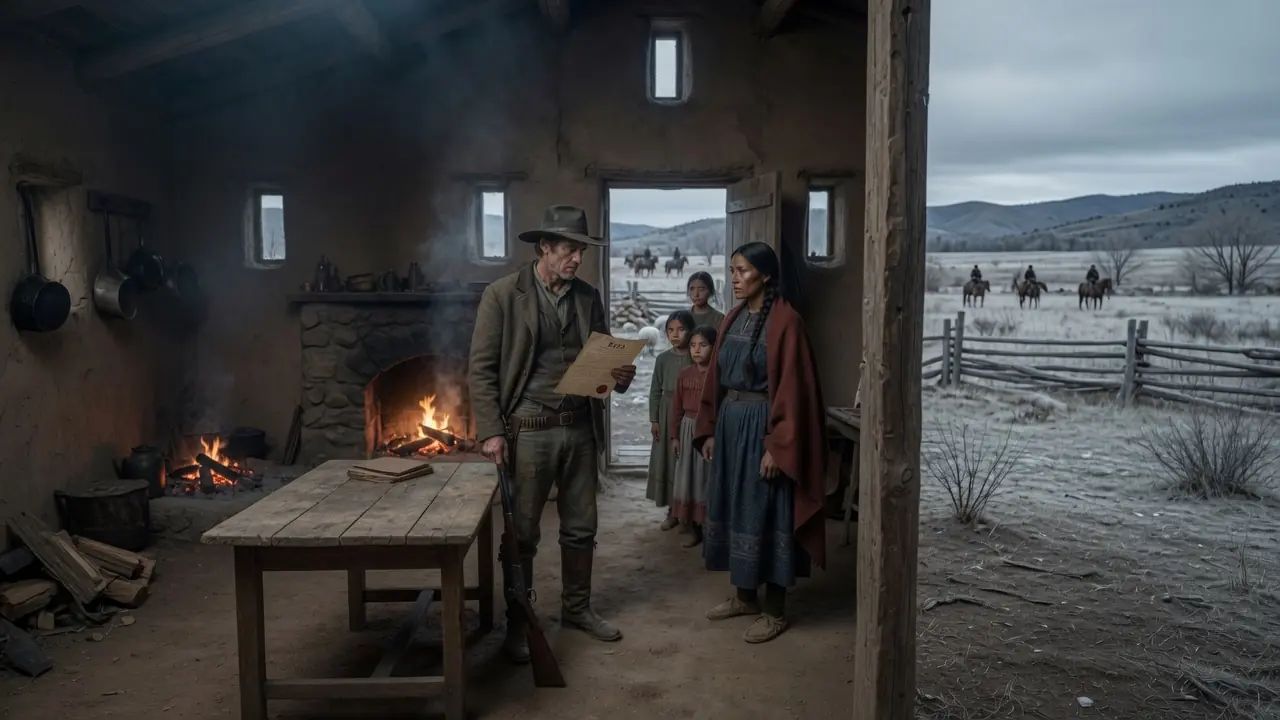
He said my uncle, Dearborn Whitfield, had made an arrangement with a man named Taza, who was Apache and who had died the prior winter, same month as Dearborn. The arrangement was that Taza's four daughters would work the Arroyo Largo, and in exchange they could live on it, the northeast corner, in the house Dearborn had built them. The arrangement didn't have an end date. It just said as long as it's needed. I said, "And if I don't want the ranch?"
The lawyer looked at me then. He said, "You're forty-nine years old, Mr. Whitfield, and you've got sixteen dollars and a horse." The deed was in my coat pocket by the time I walked out into the November street. I need to back up some. I need to say who I was before any of this.
For more than twenty years, I had been a surveyor's hand. I ran chain and drove stakes and read the ground for other men who were too busy acquiring land to stand in it. I was good at it. I knew water by the depression of soil, knew rock line from the way the grass grew thin and yellow in late July, knew the difference between a corner that would hold and one that was already arguing with the earth under it. I had worked the Texas Panhandle, the eastern New Mexico territory, parts of Colorado and Kansas that were still being named.
I had set corners on land that became towns, land that became ranches, land that became cemeteries. I had watched other men take what I helped them measure and build lives from it. I never did that part myself. I had a wife once. This is not a story about her, but she needs to be said.
Her name was Calla and she died of fever eleven years before the lawyer slid me that deed. We had no children. We had a good house in Amarillo for 3 years, the longest I'd stayed anywhere, and it had a kitchen garden she was particular about, and a front porch we used every evening the weather allowed. After she went, I tried to stay in that house and couldn't. The shape of her was in every room of it.
A person's weight after they are gone is somehow heavier than it was when they were there. I sold the house to a man named Prudhoe for less than it was worth because I needed to be gone and he was there with cash money. Then I went back to running chain and I kept moving because moving was easier than stopping somewhere that had her shape in it. I had not planned to inherit anything. Dearborn and I had met once when I was 12 and he was a thick man in good boots who shook my hand and handed my father a bottle of rye and then left and didn't come back.
My father had spoken of him occasionally as men speak of relatives who are doing better than expected with a kind of arm's-length pride. I knew he'd gone west. I knew he'd made something out of it. That was the extent of what I knew about Dearborn Whitfield. The letter from the lawyer had found me in a surveying camp outside Tascosa and had taken three weeks getting there and I had read it three times sitting in the dust beside my tent before I believed it was addressed to me.
So when I rode the Arroyo Largo for the first time under a sky that was more gray than blue and with a wind that smelled of dead grass and cold stone, I was not a man arriving home. I was a man arriving at a problem that had been given to him. The house was better than I expected. Dearborn had built sound adobe and timber low to the ground with a porch that faced east and a barn that faced south and a well that ran clear. The land was dry but not dead.
The main pasture had a creek cutting through it, winter slow, maybe ankle deep but there. To the northeast on a slight rise, there was a smaller house, a long low structure, good roof, smoke coming from the chimney. I sat my horse at the edge of the yard and thought about what the lawyer had said. Four sisters. I didn't know their ages.
I didn't know their names. I didn't know what Dearborn had actually meant when he wrote as long as it's needed. I tied the horse to the porch rail and went inside and built a fire and that's all I did that first night. I sat by the fire and looked at the deed until I knew every word of it. In the morning, they came to me.
I heard boots on the porch before I was fully awake and I had my hand near the rifle before the knock came. Just one knock, not two, not three. One. I said, "Come in," and pulled my hand back. The eldest one stepped through the door first.
She had a small scar at the corner of her left eye. The kind a person gets from a fall, not a fight. Behind her came the other three. The second eldest was thinner and quicker in the eye. The third had a child's seriousness, that particular set of the mouth a young person gets when they've decided to be taken as grown.
The youngest was maybe 16. She stayed in the doorway. The eldest said, in English that was better than some men's I'd worked with, "You are the new owner." Not a question. I said, "Yes."
She said, "My name is Nache. My sisters are Da, Hura, and Ama. "She said them without pointing, just in order, oldest to youngest, and each one looked at me when her name was said. Nache said, "We wanted to see if you had come to put us off." I said, "Not today."
Something moved in her face, just a small thing. She said, "Then we will get back to work." And they went, all four of them, back out through the door, and the youngest pulled it closed behind her without a sound. I want to be honest about the early weeks. They were not easy, not for any of us.
I didn't know the ranch. Dearborn had run cattle, but the herd had been sold off after his death. The lawyer had done that, applied the proceeds against debts. And what I inherited was land and infrastructure and a small flock of sheep that the sisters had been managing on their own for six months. There was a kitchen garden on the south side of their house, put to bed for winter, but you could see it had been serious work.
There was a smokehouse. There was a lean-to full of split wood that was neatly stacked and covered. I walked the property that first full day the way I had walked hundreds of sections of land over twenty years, looking for the story the ground was telling. The east fence was good, recent posts set deep. The south fence was older, probably Dearborn's original work, some wire sagging.
The creek ran shallow but clear over limestone, with cottonwoods along the bank that had good color for November, which meant the water table wasn't far down. The north pasture had winter grass that hadn't been overgrazed. Someone had been rotating the sheep with care, letting sections recover. That was the thing I kept coming back to. The ranch had been taken care of, not just held, but cared for.
In the six months since Dearborn died, with no income and no credit and no man on the property, those four women had done the daily work of it with a seriousness that showed in everything I looked at. In other words, the ranch that the lawyer had handed me was not a failing thing. It was a going thing. They had kept it going. I understood that before I understood much else about the place.
Nache came to the main house on the third morning with a list written on paper. Her handwriting was careful, each letter placed. It said, "Fence posts, fourth pasture, 12 needed." It said, "Wagon wheel, left rear, cracked rim." It said, "Ewes, two not eating."
I looked at the list, and then I looked at her, and I said, "How long has the rim been cracked?""Since August," she said. "That's five months you've been using a cracked rim." She looked at me without expression and said, "We didn't have credit at the smithy." I folded the list and put it in my pocket. I went to the smithy in Dorado that afternoon.
The town was a small one, four streets wide and maybe six deep, the kind of town that runs on knowing everyone's business and gets uncomfortable when new business arrives. Men looked at me on the street with that particular look that means they've already heard something about you, and have already decided whether to wait and see, or have already decided against you. I didn't know which way these men had decided. It didn't change what I needed to do. The smithy was at the south end of town.
The man there was named Gantry, and he looked at me over his tongs and asked which spread I was from, and when I told him, he made a sound in his nose that I didn't like. I asked what the credit situation was, and he said Dearborn had died owing him forty dollars. I paid the forty dollars. I didn't have a lot to spare, but I paid it. Then I ordered the new rim and the fence posts and made arrangements to pick them up in a week.
When I got back, I told Nache. She was mending harness in the barn. She had a waxed thread pulled tight between her teeth, and she took it out and said, "You paid his debt." I said it was my debt by then. She went back to the harness, and I went to look at the ewes, and I thought about Calla, the way she used to mend things, and then I stopped thinking about it.
That's a habit I had, stopping it before it got deep. Christmas came without any ceremony. I killed a deer two days before and hung it in the cold, and on Christmas Eve I took a haunch over to their house and knocked, and Nache opened the door, and I held it out, and she looked at it and then at me and said, "Will you come in?" I did. The inside of their house smelled like piñon smoke and dried chilies and something sweet I didn't recognize until later.
Ama, the youngest, had made a kind of flat cake with piloncillo and pecans. They ate different from me, but not different from what I'd eaten on twenty years of camp cooking meat and cornmeal, dried fruit, things preserved against winter. Hura, the third sister, didn't say much but watched everything. Da, the second sister, asked me questions with a precision that made me think she'd been thinking them up for weeks. What did I do before this?
Had I ever run cattle? Did I know anything about sheep? What was Tascosa like? I answered straight. I told her I didn't know much about sheep, but I was willing to learn.
She nodded like that was the acceptable answer, the honest one. Nache sat at the head of the table because it was her table, and she refilled my cup twice without asking, and once our eyes caught over the lamp and she didn't look away immediately. I did. I looked at the table. Walking back to the main house in the dark in the cold that had come down with the night, I thought, "There are worse things than this, worse places to be, worse obligations."
The trouble started in February. A man named Harker rode in. He had two men with him in a manner that said he'd been practicing it, that easy authority that is really just expectation. He expected to be agreed with, and he was used to being right about that expectation. He said he'd been buying up land along the Arroyo drainage.
He said Dearborn had talked to him about selling before he died. He had a paper he wanted me to look at. I looked at the paper. It was an intent to sell written in Dearborn's hand, but it wasn't signed, just written. I said, "This is an intent, not a sale."
Harker said, "Your uncle was a man of his word." I said I didn't know my uncle and I'm not bound by his intentions. He looked at the house and then at the northeast where the sisters' roof was just visible over the rise. He said, "You understand that property comes with a complication. You'd be better off selling and being free of it.
"I said, "The property isn't for sale. "The men behind him shifted in their saddles. One of them was younger, maybe 25, and he had a way of looking at the northeast rise that I didn't like. Harker tipped his hat. He said he'd be back when I'd had time to think.
He said it like he was doing me a favor. That evening I walked over to Nache's house. She came to the door before I could knock. She'd seen me coming. I told her about Harker.
I told her straight, all of it. She stood in the doorway with her arms folded and listened without interrupting, which is something I've always respected in a person, that they will actually listen before they decide what they think. When I was done she said, "Harker's men have come through the south pasture twice this month, at night." I said, "Why didn't you tell me?" She looked at me steady.
She said, "We didn't know yet who you were." I understood that. Took me a while to fully understand it, but I understood it. They had managed five months on this land alone after two deaths, with no credit and no standing in Dorado and no man they could rely on. They'd been watching to see what I was.
Can't blame a person for that. From then on I moved my bunk to the side of the house that faced north and I left the shutters cracked. The first time one of Harker's men came through close in the first week of March, I was awake. I went out in the cold without a lamp. I didn't fire, just walked up to the fence line and stood there.
The horse stopped about thirty yards out. I could see the man on it against the stars. We looked at each other for a while and then he pulled around and rode out. In the morning I rode to Dorado and spoke to the marshal. His name was Pruitt, and he was not a man I would have trusted with anything important, but he was the law that existed, so I used him.
I told him about the property line intrusions. I was specific about dates and compass bearings because that's what twenty years of surveying gives you. You learn how to say exactly where a thing happened. Pruitt wrote things down and said he'd speak to Harker. Harker didn't come himself for three more weeks.
When he did come, he had the same two men and a new third man, bigger, who wore his gun low and bored. Harker said Pruitt had given him my regards. He said the offer stood. He named a price. I said, "You have three minutes to get off my property."
The big man smiled down at his saddle horn. Nache was somewhere behind me. I hadn't heard her come out, but I felt her there, maybe ten feet back to my right. I didn't turn around. I kept my eyes on Harker, and I said, "two minutes."
Harker looked past me. He looked for a while, and then something went out of his expression, some of that practiced authority, and he pulled his horse around. The three men followed, the big one last, and he looked back twice. When they were out of the gate, Nache stepped up beside me. She had the old Spencer carbine that lived over their door, and she was holding it in a way that said she knew how to use it, not pointed, just held easy.
She said, "You didn't count down from two." I said, "No." She said, "Smart." I almost laughed. It came up and then went back down.
I said, "You could have stayed inside." She said, "So could you have." Spring came slow and cold that year, and then all at once it was warm, the way it happens out there, the hills going green in a week. I worked the fence line all through April, putting in those posts from Gantry's, and Da worked beside me for two weeks when the others had the sheep up on the north pasture. She was strong, and she drove a post without needing to be shown how, and she talked while she worked, which I didn't mind.
She told me about their father, Taza. He had been a man who understood what was coming, she said, and he'd made arrangements against it. He had sent her and Nache to the mission school, which they had hated but endured. He had learned English himself and had traded in it and had built up a reputation for his horses, which were very good. When he made the arrangement with Dearborn, it was because he trusted Dearborn's word, and also because he knew that a piece of paper was better than no piece of paper when the paper said a piece of land was yours to use.
I said, "He sounds like he was a practical man." Da said, "He was. So was Dearborn. "She drove another post with three clean strikes. She said, "My father said that the best men he ever dealt with were the ones who kept their word even when the word had cost them more than they expected.
Dearborn was like that. When he said the arrangement would hold, he meant it down to the last detail. He sent word when he was sick, sent word again when he knew he was dying to say that the paper was in his desk and that it meant what it said. "I said, "Did you know him well? "She said, "Better than most.
He ate at our table sometimes. Nache liked him. "She said that last thing without any weight to it, just a fact. She drove another post. She said, "Nache was the one who talked to Dearborn most.
She was the one who understood the arrangement. When he died, she was the one who decided we would stay. "I said, "She could have gone. "Da said she thought about it. I didn't say anything to that.
The lambing was in May. I had never lambed before in my life, but I had watched horses foal, and I had common sense. And Nache told me what to do in the same tone she would use to tell anyone. No fuss about whether I knew or didn't know, just the information I needed. We were three nights in the barn, all four sisters and me, taking turns sleeping in the hay.
And it was hard and cold and then warm when the first lamb came and stood up shaking on its new legs. Ama, the youngest, made a sound I'd only heard children make when something wonderful happened. She pressed both hands over her mouth, and her eyes went bright, and Hura, the quiet one, put an arm around her shoulders, and they stood together watching the ewe clean her lamb. Nache knelt beside the ewe and ran her hand over the lamb's back, checking it, and looked up at me. She said, "Good."
One word, but her face was different in the lamplight, softer in a way she didn't usually permit. I said, "How many more tonight you think?" She said, "Two, maybe three. Selu is very round. "She was right.
Two more by three in the morning. We lost one stillborn; it came wrong, and I carried it out to bury it, and when I came back, Nache was already on to the next ewe, and there was nothing to say about it. So, I washed my hands and helped. That was the nature of the work. You did what was needed.
In June, a rider came from Colorado with a letter addressed to the property. It was from a law office in Santa Fe. It said that a creditor of Dearborn Whitfield's estate had filed a claim against the property, and that there would be a hearing, and that I should appear. I read the letter twice, and then I went and found Nache, who was in the kitchen garden tying up bean poles. I handed her the letter without saying anything.
She read it, her face didn't change. She handed it back and said, "Harker has a friend in Santa Fe." I said, "Probably." She went back to the bean poles. She said with her back to me, "What will you do?"
I said, "I'll go to Santa Fe and deal with it." She pulled a knot tight. She said, "And if you can't?" I said, "Then I'll find another way." She turned and looked at me, direct, the way she always looked at things, straight at the center of them.
She said, "When do you go?" I said, "Week's end." She nodded and turned back to the garden, and I walked back to the main house and sat down and tried to figure out how much money I had and what kind of lawyer it would buy. I want to say something about the ride to Santa Fe because it mattered in a way I didn't know it would. I rode alone.
Two days each way camping on the road, and those nights under the stars alone after six months on the arroyo were the first time I really thought about what had happened to me. Not the ranch, that was just land and work, and I understood land and work. What I thought about was the particular shape of those six months. I had woken up each morning with a reason to get up. That sounds like a small thing.
After Calla for years, I had woken up because camp life demanded it, because the surveying crew needed their chain carried, purpose through obligation. This was different. The ranch needed me, yes, but more than that, the sisters needed me—not in a helpless way, in the way that four capable people with no outside support need a man who will stand at the gate and say two minutes. I thought about Nache tying bean poles, the way she'd taken the letter and read it and handed it back and asked her questions without any of the panic that most people put in their voice when legal trouble comes. Just, "What will you do?
And if you can't? "She asked what she needed to ask and trusted me with the answer. When was the last time someone had trusted me that plainly? I tried to remember and I couldn't. Even Calla, we had trusted each other, but it was the trust of two people in the same boat, the same fears, the same lean against the same wind.
This was different. Nache had made a calculation. She'd watched me for six months and made a calculation, and she'd handed me the letter. That was a different kind of thing. I lay in my bedroll on the second night looking at Scorpius rising over the rim of the mesa, and I thought about the word obligation the way the lawyer had used it and the way I had been using it.
As if it were a weight, as if what Dearborn had handed me was a problem to be managed. It wasn't—or it wasn't anymore. Somewhere between the cracked wagon rim and the lambing and the two minutes at the gate it had become a home. I hadn't meant for that to happen, but there it was. In Santa Fe, the law office was on a narrow street near the plaza.
The lawyer on my side was a thin man named Beckwith who wore a better coat than his office warranted and who looked at my papers for a long time before he said anything. He said, "This claim is manufactured." I said, "I know." He said, "The good news is that manufactured claims leave traces. What's the creditor's name?
"It was a man named Folger listed as a business associate of Dearborn's. I had never heard Dearborn's name associated with a Folger. I said so. Beckwith said, "Let me look into it. Come back tomorrow.
"I found a room at a boarding house and lay on a strange bed and stared at a strange ceiling and felt the distance from the Arroyo Largo as a physical thing, a thinness in the chest. In the morning Beckwith had done his work. He had found that Folger was real, a freighter legitimate, but that the claim he'd filed was for a debt that had in fact been paid and there was a receipt somewhere that said so. Harker had apparently hoped the receipt was lost with Dearborn. It wasn't.
The executor of Dearborn's estate had it. The hearing lasted 40 minutes. The judge was a compact gray man who read documents with great attention and then looked up over his spectacles and said the claim was dismissed. Folger's lawyer said something about further appeal. The judge said something back that I didn't fully catch but that made Beckwith exhale beside me.
Walking out into the plaza, I shook Beckwith's hand and he said, "Whoever Harker is, he'll try another angle." I said, "Let him." Beckwith looked at me. He said, "You're not what I expected coming in here over a ranch in the territory." I asked him what he'd expected.
He said, "Most men who end up in a legal fight over land are frightened by it. You're not. "I thought about that. I said, "I have things worth fighting for." He nodded satisfied.
Lawyers like a clean sentence. I was home in four days. On the evening of the fourth day, coming down off the high desert into the arroyo drainage, I could see the lights of both houses from the ridge. Lamplight, both of them, warm and small in the dark. I sat the horse on the ridge for a moment.
Then I rode down. Nache must have heard the horse because she was on the porch of their house when I came through the yard. She had a shawl around her shoulders and a lamp in her hand, and she held the lamp up to see me better. And when she saw it was me, she lowered it. I said, "Dismissed.
The claim was dismissed. "She was quiet for a moment, then she said, "Come in. "The others were at the table, Da, Hura, Ama, a lamp between them, some kind of game with smooth stones that Ama was winning. They looked up, and Ama said, "Well." I said, "It's over.
We won. "Ama made that sound again, the one from the lambing, both hands pressed over her mouth, eyes bright. Da said something in Apache to Hura, and Hura, the quiet one, actually smiled. It changed her whole face. Nache set the lamp on the table and went to pour coffee, and I sat down in the chair that had started to be understood as mine over the winter.
Da moved the stone game aside to make room, and Ama leaned against my arm for a moment. She had grown comfortable with me by then, the youngest one, the way young people do when they decide you're safe. And I looked at the lamp and thought, "This is what it looks like, a house with people in it." July. Harker made one more move, not legal, not this time.
He had men cut the south fence line three nights in a row and push cattle through. They were not his cattle; his purpose was to cause trouble, not to graze. The animals were simply strays he had rounded up. The point was to make trouble between me and my neighbors to the south, the Aldridge family, who weren't bad people, but who had short patience for their cattle wandering. Aldridge came over angry the first morning.
He was a big red man with a handlebar mustache and a grievance, and I listened to the whole grievance, and then I rode out to the south fence with him, and I showed him the cut wire and the boot tracks. I said, "Someone's cutting it deliberately. I don't know who yet, but it isn't me, and it wasn't the cattle's idea. "Aldridge looked at the wire for a long time. He said, "You're new here."
I said, "Yes." He said, "Dearborn wouldn't have let this go three nights." I said, "Neither will I." We fixed the fence together that day. The next night I was at the south fence before midnight in the dark, and I waited. They came at two in the morning, two of Harker's men with wire cutters, and I let them get close enough that stopping them was certain before I fired twice into the ground.
They ran. One of them dropped the cutters. In the morning, I rode to Pruitt with the cutters and a description. Pruitt said he'd look into it. I said the matter was going to Beckwith's office in Santa Fe if Pruitt's looking into it didn't produce results.
The fence wasn't cut again. Aldridge came over in August. He brought his wife, and they stayed for supper, and we ate at the big table in the main house, all of us, the Aldridges, me, the four sisters, and it was the first time anyone from Dorado had sat down with the sisters as if it were natural. Aldridge's wife, Clara, was a formidable woman who had a long conversation with Nache about winter feed stocks, and asked Ama about the stone game, and told Da that her English was better than her husband's. Aldridge drank coffee after supper and looked around the table and said to me quietly, "You've done all right here."
I said, "The ranch does most of it." He said, "I don't mean the ranch." I knew what he meant. After they rode out, Nache and I sat on the porch of the main house while the others washed up inside. The night was warm and the stars were the summer kind, thick and low.
The creek made its sound. She said, "Clara Aldridge is a decent woman." I said, "She is." She said, "People will talk less now." I knew she meant the sisters, the fact of them on the ranch.
I said, "People talk about what they're used to and they stop when they get used to it." She said, "Is that what you believe?" I said, "It's what I've seen." She was quiet for a moment. Then Nache said, "Da says you've decided to stay."
I said, "Did Da have an opinion about it?" She said, "She said good." I looked at the stars. I said, "What do you say?" She didn't answer immediately.
She had a way of not answering immediately when a thing mattered. She sat with the question the way you sit with the weight of something before you pick it up. She said, "I say you have made this a different place than it was." I said, "You did that. You kept it going for five months before I ever arrived.
"She said, "We kept it alive. You made it something worth fighting for. "I didn't know what to say to that. I sat with it. She said, "When I gave you that letter in June, the one from Santa Fe."
I said, "Yes." She said, "I knew you would come back." I looked at her. The lamplight from the window laid a strip of gold across the porch boards between us. I said, "How?"
She said, "Because it was yours. You just hadn't understood it yet. "She wasn't looking at the stars anymore. She was looking at me steady, the way she looked at things she'd already decided about. I felt it like a hand placed on the center of the chest, deliberate and warm.
I said her name, just her name, Nache, and she didn't look away. I reached across the small distance of the porch boards and put my hand over hers where it rested on the rail, and she turned her hand over and held mine. Not a small thing. The most real thing that had happened to me in eleven years. We sat that way for a long time, not talking.
The creek below and the stars above and the sound of her sisters in the house behind us. I want to say one more thing about what I am now versus what I was. I was a man who moved because stopping hurt. That's the plain truth of it. After Calla, I kept ahead of the stillness because the stillness had her in it.
Twenty years of being useful to other men on other men's land. I was not unhappy, exactly. I was not the kind of man who sits with his unhappiness and names it and turns it over to look at it from different angles. I just worked and moved and the work was good work and the movement kept the stillness at a distance and that was enough. Then a lawyer in a town I'd never been to slid a deed across a desk and said, "Here is your obligation."
And what he was really saying, without knowing it, was here is your reason to stop. I didn't know a thing about sheep when I arrived. I knew nothing about Apache custom or Apache women or how to read the land the way the sisters read it as a living thing with needs and a temper and a long memory. I knew how to work and how to be straight with people and how to stand at a gate when something worth standing for was behind it. I knew how to look at a fence and understand what it was telling me.
I knew how to read a man's posture at a distance and decide what he was about before he opened his mouth. Turned out that was enough to start. The Arroyo Largo is a going concern now. Not cattle, I don't know that we'll go back to cattle. There's good money in the wool and the sisters know the sheep.
Aldridge has become something close to a friend, the kind of friend made by work and adjacency and a mutual willingness to be straight about disagreements. His wife Clara and Nache have a kind of arrangement of their own. Seeds traded in spring, preserves compared in fall. Dorado is still Dorado and there are still men in it who do their looking sideways when I come in with the sisters. But there are fewer of them than there were, and they keep their looking to themselves.
Last September, we were mending the east fence after a storm had pushed a section down. There were three of us: Nache, Da, and me. Da was telling a story about a horse their father had sold once. The mare had been so smart that she had learned to undo the gate latch herself. Nache was laughing, a full sound I didn't hear often and never got tired of hearing.
I was holding a post and waiting for Da to drive it. Da drove the post and stopped and looked at me and said, in that precise way she had, "You're happy." It wasn't a question. I didn't treat it like one. I said, "Yes."
She looked satisfied. She had the hammer hanging from one hand and she nodded once and moved to the next post, and we got back to work. Nache glanced at me sidelong and there was something in her face, not the laugh anymore, something quieter, older than the laugh. And she reached out for a moment and put her hand against my back between the shoulder blades, just rested it there while I set the post. The hills to the east were going gold with the September grass.
The creek was running higher than it had in July. The sheep were somewhere on the north pasture, a white drift visible over the rise. I drove the post. She took her hand back and picked up the wire and we kept going.
That is the whole of it. That is the thing I wanted to say. An obligation that turned into a home, and a woman who watched long enough to know what she was choosing and then chose it, straight and clear and sure, the way she did everything. A man could do a lot worse than being known that well.