"Don't get on that train." William Carter had one foot on the metal step when he heard the voice, and it said it again, more urgently this time. "Don't get on that train." William turned. A little girl was standing there, her small hand gripping the sleeve of his coat like she was afraid he would disappear if she let go. He frowned slightly, confused, then crouched down so he was closer to her height.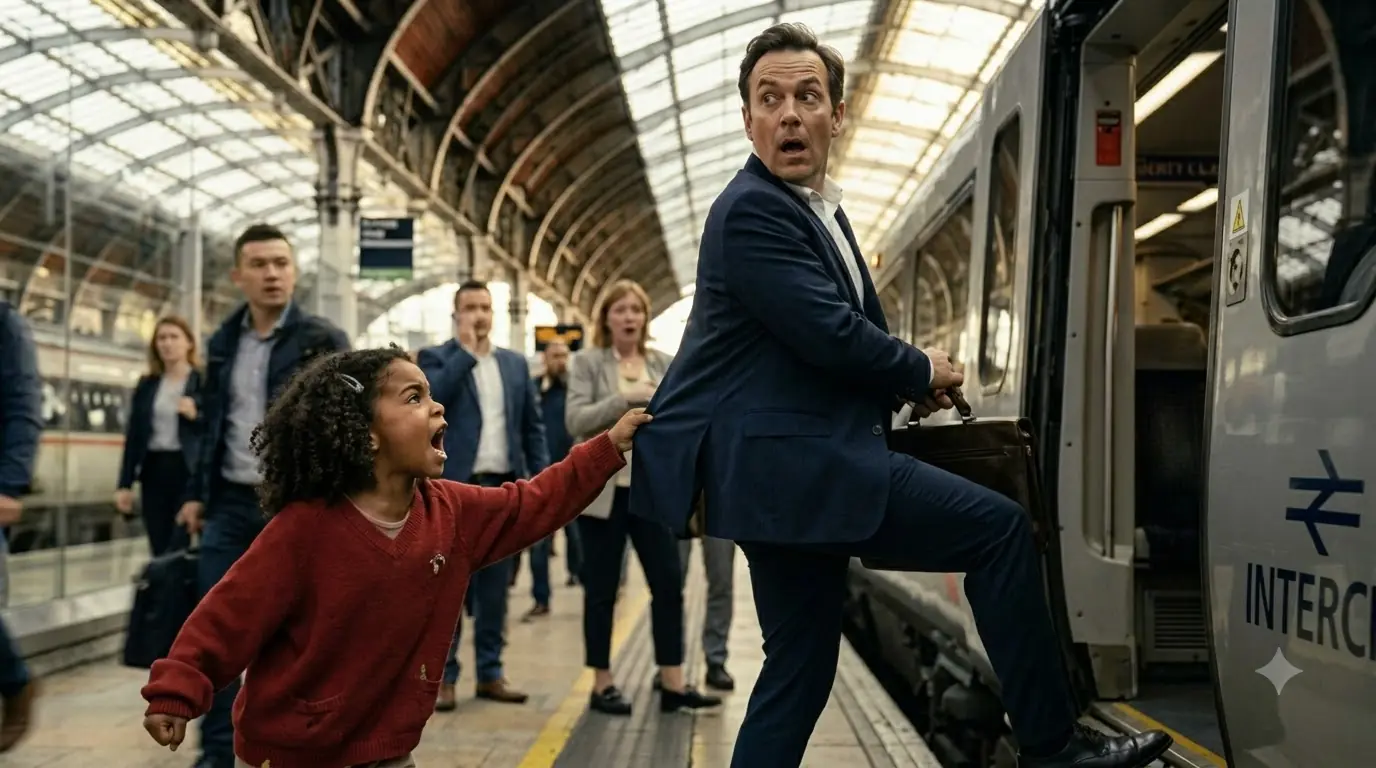
"Hey," he said gently, "why? What's wrong? Is something wrong?" Before she could answer, the loudspeaker above them cracked to life. "Attention, please.
Final boarding will begin shortly for train 175 to Washington, D.C. Passengers are requested to prepare for boarding. Departure in 20 minutes." The announcement echoed across the station. Around them, people shifted, picked up bags, folded newspapers, and began moving slowly toward the platform lines. Behind William, two men were already walking toward him.
"William," said the first man, David Carter, his younger brother, his tone casual but firm. "Boarding is starting soon." Mark Sullivan, William's assistant, stepped closer and checked his watch. "We should get in line now, sir. We don't want to be rushed at the door." William didn't answer them right away.
His attention was still on the little girl holding his sleeve. She shook her head slightly, her fingers tightening on his coat, then she gently tugged his arm, not toward the train but away from it. "Wait," she whispered. "Please.
Just wait a little." William hesitated. David gave a small, impatient smile. "What is this? William, come on.
We can't miss this train." Mark looked at the girl, then back at William. "Sir, we still have time, but we should stay near the platform." The girl tugged William's sleeve again, more urgently, and began leading him a few steps away toward a wide concrete pillar, far enough that they wouldn't be heard easily. William noticed that she kept glancing back at the two men, like she didn't want them to see her talking. That alone made him follow.
He walked with her a few steps to the side, stopping near the pillar. The noise of the station swallowed their voices there. He crouched down again. "Okay," he said quietly.
"We're here. What is it? Why shouldn't I get on that train?" The girl stepped closer and whispered. "I heard them talking." "Two men?" "They were talking about you." William's expression barely changed.
"Talking about me?" "That's not unusual," he said calmly. "A lot of people talk about me." She shook her head quickly. "No." "Not like that." "They were hiding behind the big boxes near the loading door." "They didn't see me." "One of them had your picture." He looked at it and smiled. William felt a faint chill, but logic still held the wheel.
"Sweetheart," he said gently. "Do you know who I am?" She nodded. "Then you also need to understand," he continued, calm, reasonable, adult. "People say a lot of strange things.
Sometimes kids misunderstand what they hear." "They said when you get on the train, they're going to bring you food," she said quickly. "They said they're going to put something in your drink so you fall asleep. Then they're going to put you in a big suitcase and take you somewhere else so you disappear." William stared at her, silent now. "Which two men?" he asked quietly.
Annie didn't answer with words. She lifted her small hand and pointed past the pillar. William slowly turned his head. Across the platform, Mark and David were standing near the boarding area, watching him now.
"That's them." Annie whispered. "They're waiting for you to get on." William Carter slowly straightened to his full height. The loudspeaker echoed again above them. "Attention, please.
Passengers for train 175 to Washington, D.C. Boarding will begin shortly. Departure in 20 minutes. William exhaled slowly and looked down at Annie again. "I'm going to be honest with you," he said quietly.
"This is a very serious accusation. You're telling me my own brother and my assistant are planning to kidnap me. Do you understand how unbelievable that sounds?" Annie nodded. "Yes," she said, "but you can check." William frowned slightly.
"Check what?" "The cameras," Annie said quickly. "Near the loading door. Where the big boxes are. You can see them talking.
You can tell them you dropped something and need to check the security camera. Tell them to wait. If I'm wrong, you can still get on the train." William looked at her carefully now, really looking for the first time. "You really believe what you heard?" he said.
Annie nodded again. "I don't think they know I saw them." William glanced over toward Mark and David again. They were still watching. Mark checked his watch again and said something to David.
David's jaw looked tight. "When you're small," Annie said quietly, "you learn to watch because nobody listens." William looked at the train. Looked at the doors. Looked at the two men who had managed his life for years.
Then he looked back at Annie. "All right," he said finally, his voice low and controlled. "We're going to check the cameras." Annie let out a small breath of relief. William placed a gentle hand on her shoulder.
"Stay with me," he said. Then he turned and began walking back toward Mark and David, Annie beside him. Mark smiled immediately. "Sir, boarding starts in a few minutes." William nodded calmly, as if nothing in the world had changed.
"I dropped something earlier near the loading area," William said. "I want to check the security camera before we board. It'll only take a few minutes. Wait here.
I'll be right back. And then we'll get on the train. For a fraction of a second so small most people would miss it, Mark and David looked at each other. And in that fraction of a second, William Carter knew one thing for certain.
The little girl was not lying.
William Carter did not rush as he walked with Annie toward the security office. But inside, his mind was moving faster than it had in years. Annie walked beside him, very close. Her small steps quick to keep up with his long stride.
Every few seconds she looked back over her shoulder toward the platform, making sure the two men weren't following yet. "Is the camera room far?" she asked quietly. "No," William said. "You did the right thing.
But when we get in there, I need you to show me exactly where you saw them. Can you do that?" She nodded. "Yes, sir." They reached the security office. And William spoke to the officer the same way he spoke to executives and lawyers, calm, direct, in a tone that assumed cooperation.
Within minutes, they were standing in front of a wall of monitors. "Track 9 loading area," William said, "about 20 minutes ago." The officer pulled up the footage and rewound. Grainy black and white video filled the main screen. Stacks of cargo boxes, a service door, a luggage cart, people walking in and out of frame.
"Right there," Annie said, pointing, "behind those boxes. That's where I was sitting." The officer zoomed slightly and continued playing. At 10:17 a.m., two men stepped into frame. David Carter, Mark Sullivan.
William felt Annie's fingers tighten around his sleeve again. "That's them," she whispered. On the screen, David looked around once, then reached into his coat and pulled out a photograph. He held it up.
Even on the security monitor, William could recognize the photo. It was his corporate portrait. The officer adjusted something on the console. "This camera records audio, too," he said.
"Let me increase the volume." Mark's voice came first. Low, but clear enough. "Timing has to be exact. Once he's on the train, we have maybe ten minutes," Mark said.
David chuckled softly. "Ten minutes is more than enough. He trusts you. He won't even question the drink." William felt something inside his chest turn cold and heavy.
On the screen, Mark made a small motion like handing someone a cup. "I'll bring it myself," Mark said in the recording. "I'll tell him it's from the service car. Coffee.
He always drinks coffee on the train." David tapped the large black suitcase beside him. "And when he's out?" David asked. Mark shrugged. "We move him through the service corridor.
There are no cameras in the blind spot near the maintenance door. Then we put him in the car." By the time anyone realizes he's missing, we're already gone. David laughed again, quieter this time. "After today," David said, holding up William's photo and looking at it, "big brother finally stops being the hero." William did not move.
Did not speak. Beside him, Annie looked up at his face, trying to read whether he was angry, scared, or something else. On the recording, Mark spoke again. "You'll need to sign the emergency transfer papers tonight.
Once he's declared missing, the board will panic. You step in as acting CEO." David folded the photo and put it back in his pocket. "I've waited my whole life to stop being the second Carter." The video continued for a few more seconds, then the two men walked out of frame. The room was very quiet.
"I know them." Before anyone could say anything else, the security office door suddenly opened. Footsteps, fast. "William, there you are," David said from behind them. "We've been looking everywhere." Annie froze.
William did not turn around immediately. He kept his eyes on the screen for one more second where the frozen image showed David's hand resting on the suitcase. Then he turned. David and Mark were standing in the doorway.
Mark's eyes moved quickly from William to Annie to the security monitors behind them. He saw the paused footage. He saw the image of himself and David on the screen. For a split second, the polite, professional mask he always wore disappeared.
Sir, Mark said slowly, what is this? David stepped into the room, his voice tight now. Why are we watching security footage? William looked at them both for a long moment before answering.
I told you, William said evenly. I thought I dropped something near the loading area. David forced a small smile. And you needed to bring a child with you to check.
Annie moved slightly closer to William without realizing it. Mark took a step forward, his tone careful now. Sir, boarding is in a few minutes. We really should go.
William looked at him, really looked at him, like a man seeing a stranger wearing a familiar face. I'm not getting on that train, William said. David's smile disappeared. "What?" David asked.
"I said I'm not getting on that train," William repeated, his voice still calm but harder now. Mark's eyes flicked once more to the screen, to the frozen image of the suitcase, to David holding the photograph. Then Mark looked back at William, and this time there was no politeness left in his face. "You saw it," Mark said quietly.
It wasn't a question. David exhaled slowly and closed the door behind him. The soft click of the lock sounded much louder than it should have. For the first time since Annie grabbed his sleeve on the platform, William Carter realized something very important.
This was no longer a misunderstanding. This was a confrontation. and the only reason he was standing here, breathing, instead of lying unconscious inside a suitcase somewhere on that train.
William Carter did not raise his voice. He did not step back. He did not look surprised. If anything, he looked calmer than he had on the platform.
Calmer than he had in years. But inside, something old and hard was waking up the part of him that had built Carter Logistics from two trucks into a national empire. The part that had negotiated with men who smiled while trying to destroy him. Only this time, the men were his own blood, and the man who had stood outside his office for 12 years saying, "I'll handle it, sir.
You saw it." Mark had said. It wasn't a question. William looked at him, then at David, then back at the paused image on the monitor. David's hand resting on the suitcase.
Mark leaning in, explaining how to make a man disappear. "Yes," William said simply. "I saw it." Annie's hand tightened on his coat. She didn't understand everything, but she understood enough.
The room felt smaller now, the air heavier. David took a slow breath and walked further into the room, like a man who had just decided there was no point pretending anymore. "Well," David said quietly, "I guess we should talk then." Mark didn't move closer, but he shifted slightly so he was standing between William and the door. The security officer, who had been silent until now, finally spoke.
"Sir, I've already called station police. They're on their way." Mark glanced at the officer, then back at William. "You shouldn't have done that." William ignored him. His eyes were on David.
"Why?" William asked. Just one word, but it carried 30 years of history inside it. David laughed once, but there was no humor in it. "You really don't know?
I want to hear you say it." William replied. David looked at the screen, at the frozen image of himself holding the photograph. Then he looked back at his brother. "You were always the hero," David said.
"Always the smart one, the responsible one, Dad's favorite, the one who took over the company, the one whose name is on the buildings, the magazines, the interviews," William said nothing. "I was always William's brother." David continued. "Even in my own company, even in rooms I built, with contracts I negotiated, with clients I brought in, I was still just the brother. You had shares," William said quietly.
"You had power. You had a seat on the board." "I had leftovers." David snapped. "You had control." Mark spoke calmly, like he was discussing a business plan. "This isn't personal, Mr. Carter.
This is structural. The company needs new leadership." "The board would never vote you out." "But if you disappeared." He shrugged slightly. "That creates a different conversation." Annie looked up at William, confused. "They were really going to put you in the suitcase?" she whispered.
No one answered her, but the silence was answer enough. William looked at Mark now. "12 years," William said. "You worked for me for 12 years." Mark nodded once.
"And I learned everything. How you think, how you schedule your day, when you drink coffee, when you don't read documents because you trust the person handing them to you. You were going to drug me," William said. "Yes." Mark replied.
No hesitation. No shame. Just a fact. The security officer slowly moved his hand closer to the phone on the desk, ready to call again if he had to.
David looked at Annie now, really seeing her for the first time. "All of this." he said quietly. "Because of a child." Annie instinctively moved closer to William. Half hiding behind his coat.
She heard you, William said. David shook his head slowly, almost in disbelief. Do you know what you cost me? He asked Annie, his voice low.
William stepped slightly in front of her. Don't, he said quietly. For the first time, there was steel in his voice. David looked at his brother and saw something he hadn't seen in a long time.
Not the busy CEO. Not the tired executive. Not the older brother who kept fixing his mistakes. He saw the man who had built an empire.
You always thought you were smarter than me, David said. No, William replied. I thought you were my family. That landed harder than shouting would have.
For a moment no one spoke. Then Mark glanced at the monitor again. Then at the door calculating distances time options. When he spoke again his voice was lower.
If the police are already coming, Mark said, then this conversation doesn't really matter anymore. William watched him carefully. You're right, he said. It doesn't.
In the distance, faint but unmistakable, they could hear it the sound of footsteps running in the corridor, voices, a radio crackling. Station police. David heard it too. His jaw tightened.
For a brief second, his eyes moved toward the back hallway, like a trapped animal looking for another exit. It didn't have to be like this. David said quietly. William looked at him.
No, he said. It didn't. The door opened and two transit police officers stepped in, followed by a plainclothes detective. William Carter?
The detective asked. Yes, William said. We received a call about a possible kidnapping plot, the detective said, looking from William to Mark to David to the frozen image on the screen. William gestured toward the monitor.
You're just in time. The detective looked at the screen. Looked at the suitcase. Listened as the security officer quickly explained about the audio recording.
Mark closed his eyes briefly, like a man acknowledging the end of a long game. David didn't say anything anymore. One of the officers stepped forward. "Sir, I'm going to need both of you to come with us." Mark put his hands slowly behind his back without being told again.
David looked at William one last time. There was anger there. And something else. Something like regret.
Buried too deep and too late. "You chose a stranger over your own brother," David said quietly. William shook his head once. "No." He replied.
"I chose the truth." They put handcuffs on Mark first, then on David. Annie watched silently. Her small hand still gripping the edge of William's coat as the officers led the two men out of the room. David turned his head slightly and looked back at Annie.
All he said was, "You should have stayed quiet." Annie didn't answer. She just held on to William's coat a little tighter. When the door closed and the footsteps faded down the corridor, the room felt very quiet again. The monitor still showed the frozen image of the suitcase.
The plan. The betrayal. The almost. William slowly sat down in the chair in front of the screens, like a man whose legs suddenly remembered how close they had come to collapsing.
After a long moment, he looked down at Annie. "You saved my life," he said. Annie shook her head slightly. "I just told you what I heard." William looked at her for a long time.
Then said quietly, almost like he was saying it to himself as much as to her. "Sometimes the people who save your life are the ones the world never sees." Annie didn't fully understand that either, but she understood the way he looked at her now. Not like a stranger. Not like a nuisance.
But like she mattered. And in a place as big and indifferent as Union Station, that alone was enough to change a person's life. William Carter did not leave the security office right away.
After the police took David and Mark away, the room felt strangely quiet, like the air itself was trying to understand what had just happened. On the monitor, the frozen image of the loading area still glowed. Two men, one suitcase, one plan that had almost worked. William sat for a long moment without speaking.
Annie stood beside him, close but silent, as if she understood that this was the kind of quiet adults needed when something inside them broke and rearranged at the same time. Finally, William stood. "We need to find your mother," he said gently. Annie nodded immediately.
"She's at the hot dog cart. She's going to be worried." They walked back through the corridor toward the main hall. The noise of Union Station slowly returned. Announcements, footsteps, rolling luggage, voices echoing under the high ceiling.
Life had continued as if nothing had happened. People still hurried for trains, coffee still poured, newspapers still folded. No one knew that a man had almost disappeared that morning.
When they reached the food cart, Lisa was already looking around anxiously, standing on her toes, scanning the crowd. "Annie!" she called the moment she saw her. "Where did you go? I told you not to leave this area." Annie ran to her.
"Mama, I had to tell him." Lisa looked up then and realized who was standing a few feet away from her cart, William Carter. For a second, she froze, wiping her hands quickly on her apron, suddenly very aware of the grease stains, the cheap cart, the fact that she was talking to one of the richest men in the country. "Sir, I'm so sorry if she bothered you," Lisa said quickly. "She's a good girl.
She just She talks a lot sometimes and she saved my life," William said. Lisa stopped talking. The noise of the station seemed to fade for a moment, like someone had turned the volume down on the world. "I'm sorry," she said.
William stepped a little closer, but not too close. He didn't want to scare her. He had spent most of his life around boardrooms and private offices. He knew he looked out of place standing in front of a hot dog cart.
"Your daughter heard two men planning to drug me and kidnap me on the train this morning," he said calmly. "She warned me." "Because of her, the police just arrested them." Lisa stared at him, then at Annie, then back at him again, trying to understand whether this was some kind of misunderstanding or a conversation she would remember for the rest of her life. "Annie," she said slowly, "what did you do?" "I heard them behind the boxes," Annie said. "I told you, Mama.
I told you they were talking about hurting someone." Lisa's face changed. She remembered now. Annie had tried to tell her earlier, but she had been busy, tired, worried about making enough money for the day. She looked back at William.
And this time there was no embarrassment in her eyes, only fear and confusion, and the protective instinct of a mother trying to understand how her child had ended up in something dangerous. "Sir, are you saying those men, they were really going to hurt you?" Lisa asked. "Yes," William said. "And when they realized I knew, they also realized Annie had heard them." Lisa's hand immediately went to Annie's shoulder, pulling her closer.
"Is she in danger?" William didn't lie. "She might have been, but the police have them now. Still, I would like to make sure you and Annie are safe for a while." Lisa looked at him carefully now, measuring him the way people who had struggled all their lives measured offers that sounded too good or too strange. "Why would you do that for us?" she asked quietly.
William looked down at Annie, who was holding her drawing pad against her chest. "Because," he said, "when everyone else in that station was minding their own business, your daughter decided a stranger's life was worth the trouble." Lisa swallowed hard and looked at Annie in a way she never had before, not just as her child, but as a person who had made a decision, a brave one. "I just didn't want him to get on the train," Annie said softly. William gave a small, tired smile.
"I'm very glad you didn't." Just then, the detective from the security office approached them with two uniformed officers. "Mr. Carter," the detective said, "we're taking David Carter and Mark Sullivan downtown. We'll need a formal statement from you today." "I understand," William said. The detective glanced at Annie and Lisa.
"This the young lady who reported it?" William nodded. "Yes." "This is Annie, and this is her mother, Lisa." The detective bent slightly so he was at Annie's eye level. "You did a very brave thing today," he said. "Most adults wouldn't have spoken up." Annie looked at William, then back at the detective.
"I just told the truth." The detective smiled a little. "That's usually the bravest thing there is." He straightened and looked at William. "We may also need to talk to her later, with her mother present, just to confirm what she heard." Lisa nodded. "We'll help however we can." After the officers left, William stood there for a moment, looking at the hot dog cart, the small coffee machine, the jar of tips with a few crumpled dollar bills inside.
"This is where you work every day?" he asked Lisa. "Yes, sir," she said, "six days a week." He nodded slowly. "My father started with one truck," he said. "Just one." "He used to say there's no honest work that's small." Lisa gave a faint smile.
"Your father was right." William looked around the station, the rushing people, the tired workers, the travelers, the noise, the ordinary life that had almost swallowed him without noticing. Then he looked back at Annie. "What are you drawing?" he asked her. Annie opened her pad and showed him.
It was the drawing from earlier, a tall man standing at the door of a train, and a small girl reaching out, holding his hand, stopping him from stepping inside. William stared at the drawing for a long time. "That's you," Annie said, pointing at the tall figure. "And that's me." William nodded slowly.
"Yes," he said. "It is." He looked at the drawing again, then at the train tracks in the distance, then back at Annie. "You know," he said quietly, "I've spent my whole life thinking big decisions were made in boardrooms." He paused, then added, "Turns out the biggest one I ever made was deciding to listen to a six-year-old girl in a train station." Lisa felt her eyes sting, but she blinked the tears away quickly. Life had not given her many moments where powerful people spoke kindly to her or her child.
She didn't quite know what to do with this one. "Sir," she said carefully, "whatever happens next, thank you for believing her." William looked at Annie again. "No," he said softly, "thank her for speaking." By the afternoon, the story had already begun to spread through places William Carter did not control. Not the news yet, not the official reports, but the quiet networks, the ones that moved through police radios, station staff, legal offices, and the private phones of people who understood that when a man like William Carter was almost kidnapped in a public train station, it was not just a crime.
It was a message. William sat in the back of a black sedan parked across the street from Union Station, watching the front entrance through the tinted window. Annie and her mother sat across from him. Lisa held her purse tightly in both hands, like someone afraid that at any moment someone might tell her this was all a mistake, and she needed to go back to her cart and pretend none of this had happened.
Annie sat beside her holding her drawing pad again, but she wasn't drawing now. She was watching William the way children watched adults when they knew something serious was happening, but no one had explained the rules yet. A man in his 60s sat beside William. Gray hair, glasses, navy suit that had seen long days and longer cases.
His name was Howard Bennett, William's lawyer for nearly 15 years. Howard looked across the car at Lisa and Annie, then back at William. "I just came from the precinct," Howard said quietly. "They're charging your brother and your assistant with conspiracy to commit kidnapping, attempted kidnapping, and fraud-related charges.
There may be more once they start digging into company documents." Lisa inhaled sharply. The word brother seemed to hit her harder than the word kidnapping. "I'm sorry," she said softly before she even realized she was speaking. William looked at her.
"You didn't do this." "I know," Lisa said. "But I have a brother and I can't imagine." William nodded slowly. "Neither could I," he said. Howard adjusted his glasses and looked at Annie.
"You're the young lady who stopped him from getting on the train?" Annie nodded. Howard studied her for a moment, then said something in a calm, thoughtful voice. "I've been a lawyer for 40 years. Do you know what I've learned?" Annie shook her head.
"The truth usually shows up in very small voices," Howard said. "Most people just don't listen long enough to hear it." Annie thought about that seriously, like she was storing it somewhere in her mind for later. William looked back out the window at the station entrance. Reporters were starting to gather now.
Not many yet, but enough. A camera, a microphone, a man talking on a phone with the intense expression of someone who knew a big story was forming. "They'll find out by tonight," Howard said, following William's gaze. "You can't keep something like this quiet." "I'm not trying to," William said, "but I want the facts clear before the headlines start writing their own version." Howard nodded.
"There's something else." he said, "Your brother has been moving money quietly for almost a year. If you had disappeared today, control of Carter Logistics would have shifted temporarily to him as acting CEO, long enough to make some very permanent decisions." William didn't look surprised. "Mark handled most of the internal paperwork." he said, "I trusted him." Howard gave a small, sad smile. "Trust is not a legal strategy." he said, "but it is a human one." "And it's the one that gets used against good men the most." In the backseat, Annie spoke quietly, "Are they going to go to jail?" All three adults looked at her.
"Yes," William said, "they are, because they were going to hurt you." she asked. "Yes." Annie looked down at her hands. "They told me I should have stayed quiet." she said. William leaned forward slightly.
"David said that to you?" She nodded. William was quiet for a long moment. Then he said something very carefully, like he wanted her to remember it for the rest of her life. "Annie, listen to me.
There are going to be people in your life who tell you to stay quiet because the truth makes their lives harder. You must be very careful about those people. They are usually the ones doing something wrong." Lisa looked at him, listening just as closely as Annie. "My father used to tell me something." William continued.
He said, "If a man tells you not to look at something, that's exactly where you should look." Annie nodded slowly. Outside, more reporters were arriving now. A police car pulled up near the entrance. Two officers stepped out and began speaking to station staff.
Howard checked his watch. You'll need to make a statement soon. He said, "And there's something else we need to discuss. Your brother will claim this was a misunderstanding, that it was a joke, that you're overreacting, that the company stress has made you paranoid.
I've seen it before." William nodded. "That's why we have the video and the audio." Howard nodded back. Yes. And that little girl's testimony.
Lisa shifted slightly in her seat. Sir, I don't want my daughter in the middle of some big court fight. She said carefully. She's just a child.
William looked at her and his voice softened. I understand. And I won't let anything happen to her. To either of you.
Lisa studied his face trying to decide whether this was something rich people said to make themselves feel better or a promise. William seemed to understand what she was thinking. "When I was 10," he said, "my father's business partner tried to cheat him out of the company. My father didn't have money for lawyers, but one of the drivers, just a driver, no college, no big title, came forward and told the truth in court.
He risked his job, maybe his career. My father never forgot that. Neither did I." He looked at Annie. "Today," William said quietly, "you were that person for me." Annie didn't know what to say to that, so she did what she always did when she didn't understand big adult feelings.
She opened her drawing pad and started drawing. Howard watched her for a moment. "What is she drawing now?" he asked. William leaned slightly to see.
On the paper, Annie was drawing a very large train, dark and heavy, with smoke above it. In front of the train stood a small stick figure with one arm stretched out, stopping it. William leaned back slowly in his seat. "Howard," he said quietly, still looking at the drawing, "I almost got on that train.
Howard nodded. Yes, he said. You did. William watched Annie's small hand move across the paper, steady, focused, completely unaware that she had just changed the direction of a very powerful man's life.
From now on, William said quietly, we do things differently. Howard looked at him. What do you mean? William's eyes were still on the drawing.
I mean, he said, I built a company that listens to executives, managers, investors, and consultants. Maybe it's time I build something that also listens to people like her. He nodded toward Annie, because this morning, William Carter said, the only person who told me the truth was the one with the least power in the entire station.
When the car finally pulled away from Union Station, Annie turned around in her seat and watched the building grow smaller through the rear window. For years, that station had been her whole world. The place where her mother worked, where she did homework on slow afternoons, where she drew pictures of trains and people, and imagined where they were all going. It was loud, crowded, sometimes cold, sometimes boring, but now it felt different.
Now it felt like the place where something important had happened, even if most of the people walking through it would never know. "Where are we going?" Annie asked. "To my office," William said. Just for a little while.
Then we'll take you and your mother home. Lisa shifted slightly. "Sir, I don't want to be any trouble. I still need to work.
If I don't open the cart tomorrow, I don't get paid for the day." William looked at her. "Lisa, today two men tried to make me disappear. Your daughter stopped them. Right now, work is not your biggest problem." Lisa looked down at her hands.
People like her didn't stop working. Not for sickness, not for bad weather, not for heartbreak. If you didn't work, you didn't eat. It was that simple.
William seemed to understand that without her saying it, "You won't lose money because of this," he said. "I'll make sure of it." Lisa looked up quickly. "Sir, I'm not asking for money." "I know," William said. "That's why I'm offering help." She didn't answer right away.
Pride and exhaustion argued quietly inside her chest. In the front seat, Howard Bennett watched this exchange through the reflection in the window. He had seen this before. People who had very little often protected their dignity more fiercely than people who had everything.
"Lisa," Howard said gently. "Sometimes accepting help is not weakness. Sometimes it's how people say thank you." Lisa looked at him, then at Annie, then back at William. "I don't want my daughter to think we owe anyone our lives," she said quietly.
William nodded once. "You don't owe me anything," he said. "If anyone owes someone here, it's me." Annie listened to all of this very carefully, even though she didn't understand every word. She understood tone.
She understood who was kind and who was pretending. And she understood that the man sitting across from her now looked at her like she mattered. The car drove for another 20 minutes before turning into a part of the city Annie had never seen before. Tall buildings, glass, steel, clean sidewalks.
Quiet in a different way than the station, this was the quiet of expensive places where people didn't shout because they expected to be heard anyway. The car pulled into an underground garage and parked. A private elevator took them directly up to the top floor. When the doors opened, Annie stepped out and stopped.
The office was bigger than her entire apartment. Floor-to-ceiling windows showed the city stretching in every direction. There were bookshelves, dark wood, leather chairs, a long conference table, and a large photograph on the wall of trucks lined up in neat rows under a wide American sky. This is where you work?
Annie asked quietly. Yes. William said. She walked slowly to the window and looked out.
It's so high, she said. William watched her for a moment then said something half to himself, half to Howard. Strange, isn't it? What is?
Howard asked. I've been up here for years, William said. And the person who saved my life today has probably never been above the second floor of any building. Annie turned from the window.
Mama says high places make people forget what the ground looks like. Howard let out a quiet breath. Your mother is a wise woman, he said. Lisa looked embarrassed.
I just meant people change when they get too far away from real life. William nodded slowly. Yes, he said. They do.
He walked to his desk but didn't sit down. Instead, he turned and looked at Annie. Can you tell me exactly what you heard this morning? He asked gently.
From the beginning. Every word you remember. Annie climbed into one of the big chairs, her legs not even reaching the edge, and thought for a moment. They said, "Once he's on the train, we have 10 minutes." She began.
Then the other one said, "He won't suspect anything. He trusts me." Then they talked about the drink and the suitcase and the place with no cameras. William closed his eyes briefly. Hearing it again out loud made it more real, not less.
And then, Annie continued, the one who had your picture said, "After today, I finally stop being the second Carter." Howard looked at William slowly. That line alone will destroy him in court, he said quietly. William didn't respond. He was looking at Annie.
Why didn't you just tell your mom and go home? He asked. Annie thought about that for a long moment before answering, because they were going to do it today, she said. If I went home, you would still get on the train.
William sat down slowly in his chair. There it was again, that simple, direct way she saw the world. No strategy, no calculation, just right and wrong, danger and safety, truth and lies. Most people William said quietly, would have told themselves it wasn't their problem.
Annie shrugged a little. But it was, she said, because I heard it. No one in the room spoke for several seconds after that. Finally, Howard broke the silence.
William, he said, there's going to be a board meeting tomorrow. Emergency session. News like this doesn't stay contained. You need to decide how you're going to handle this publicly.
William nodded slowly. We tell the truth, he said. Howard smiled faintly. That's always the hardest strategy, but it's usually the one that lets you sleep at night.
William looked at Annie again, sitting in a chair too big for her, holding a drawing pad on her knees in an office built for billion-dollar decisions. You know what the strangest part of today is? William said. Annie looked up.
What? William leaned back in his chair and looked out at the city. I've had days where I made deals worth hundreds of millions of dollars, he said. I've had days where I bought companies, sold companies, hired hundreds of people, fired dozens.
I thought those were the days that changed my life. He looked back at her, but the day that really changed my life, he said quietly, was the day a six-year-old girl told me not to get on a train. And I listened.
The next morning, William Carter woke up earlier than usual. For years, his mornings had followed the same pattern. Wake up, check emails, scan financial reports, call Asia, review schedules prepared by Mark, drink coffee, move, decide, sign, approve, repeat. His life had been a machine built on efficiency and trust, especially trust.
Trust in systems. Trust in people he paid to be competent. Trust in routines that made a man feel in control. That morning, he did not check his email first.
He stood by the large window in his apartment, looking down at the city while the sky slowly shifted from gray to pale blue. Somewhere down there, people were opening coffee shops, driving delivery trucks, unlocking office doors, setting up food carts in train stations. Somewhere down there, a woman named Lisa would normally be setting up a hot dog stand while her 6-year-old daughter sat on a milk crate and drew pictures of trains. But today, things were different.
William picked up his phone and called Howard. "Board meeting is at 9:00," Howard said as soon as he answered. "Half the board already knows something happened." "Not details." "But enough to start worrying about stock prices." "They would," William said. "You ready for this?" Howard asked.
William watched the city for another moment before answering. "My brother tried to erase me," he said calmly. "I think I can handle a board meeting." He ended the call and got dressed slowly, deliberately. Dark suit, white shirt, no tie.
He looked at himself in the mirror for a long moment. Like a man trying to see if he could recognize the person looking back. "You almost disappeared yesterday," he said quietly to his reflection. Then he picked up his keys and left.
The Carter Logistics headquarters was a glass tower that reflected the sky so perfectly it sometimes looked like the building wasn't really there at all. Inside, everything was quiet, controlled, expensive in a way that tried not to look expensive. When William walked into the boardroom, every conversation stopped. Seven people sat around the long table, men and women in their 50s and 60s mostly.
People who had built companies, managed funds, survived recessions, buried friends, raised children, and learned how the world really worked. At the far end sat Margaret Collins, 70 years old, former CEO of a manufacturing giant, and the only person on the board who had known William's father personally. "William," she said, her voice calm but direct. "We heard your brother was arrested yesterday.
I assume that's not a rumor." "It's not," William said. He remained standing at the head of the table instead of sitting. "David and my assistant Mark Sullivan were arrested for conspiracy to kidnap me yesterday morning." No one spoke for several seconds. Then one of the board members, a heavy-set man named Richard Hale, leaned forward.
"Kidnap you?" "That's not a word people just throw around in a board meeting, William." William nodded once. "There's video and audio. They planned to drug me on the train to Washington, put me in a suitcase, and move me through a service exit before anyone noticed I was missing." Someone quietly said, "Jesus Christ," under their breath. Margaret Collins did not look surprised.
She just looked tired, like someone who had lived long enough to know that money and family were a dangerous combination. "How did you find out?" she asked. William was quiet for a moment before answering. "A 6-year-old girl heard them talking behind a stack of shipping crates," he said.
"She ran across the platform and told me not to get on the train." Richard frowned. "A child?" "Yes," William said. "A child. She heard what every adult in that station didn't hear because they were too busy with their own lives." Margaret studied him carefully.
"And you believed her?" William thought about that question for a long moment. "I didn't," he said, "not at first, but she told me to check the security cameras, so I did, and that's why I'm here today. Silence settled over the room again, heavier this time. Finally, Margaret nodded slowly.
"Your father used to say something," she said. "He said the biggest mistakes in business usually happen when powerful people stop listening to powerless people." William gave a small, sad smile. "He was right." Richard leaned back in his chair. "So, what happens now?" "The company, I mean." "This kind of scandal can destroy stock value if we don't control the narrative." William looked around the table at all of them, one by one.
"For the last 10 years," he said, "we've built a company that tracks shipments to the minute, monitors fuel to the gallon, predicts delays before they happen, and audits every department except the people at the top. No one interrupted him. That stops now." William continued. "Starting today, we implement a new internal reporting system.
Anonymous, protected, reviewed directly by the executive board. Anyone in this company, from a driver to a janitor, can report something suspicious, unethical, or dangerous without going through their manager." Richard frowned. "You're changing company structure because of this?" "I'm changing company structure," William said, "because yesterday the only person who told me the truth was a child who doesn't even work for this company." Margaret's eyes softened slightly. "What's her name?" she asked.
"Annie," William said. Margaret nodded slowly. "Then maybe we should all remember that name." William walked to the window at the end of the boardroom and looked down at the city again. "Yesterday," he said quietly, "I learned something I should have learned a long time ago.
Danger doesn't always come from strangers. Sometimes it comes from the people who know your schedule, your habits, your signature." He turned back to the board. "And sometimes," he said, "the person who saves you is the one everyone else walks past without seeing." No one argued with him after that because everyone in that room was old enough to know one thing. The man standing in front of them had almost been erased the day before.
And the only reason he was still standing there was because a little girl in a train station decided that the truth was more important than staying quiet.
The office was quiet except for the low hum of air conditioning and the soft tapping of keyboards. William Carter sat at his desk reviewing the security footage one more time. Annie was perched on a high stool beside him, her small legs swinging lazily. Her drawing pad lay open on the corner of the desk untouched for the first time in hours.
She watched the screens with wide eyes as if trying to memorize every detail of the two men who had plotted against William. Howard Bennett, William's lawyer, and Margaret Collins, senior board member, stood behind them. Howard spoke quietly, careful not to disturb the child. The footage, the audio, it's enough to press charges.
But the way your brother and Mark planned this, they almost covered every trace. Annie leaned forward and pointed to the monitor. See here? They whispered about the suitcase and the drink.
And right here, David said he would take over everything if you disappeared. William nodded. Yes, that's exactly it. They relied on my routine, on my trust, on my predictable schedule.
But they didn't count on you. She smiled faintly. I only told the truth. Truth, William said, letting the word roll slowly in his mouth.
Is the most dangerous weapon when someone has everything to lose and nothing to fear. A sudden movement outside the window drew William's attention. Through the glass, he saw two figures approaching the entrance of the building. His heart skipped a beat before he recognized them.
Mark Sullivan and David Carter. Both had somehow evaded immediate police custody, possibly released temporarily or trying to manipulate the system. Their expressions were cautious, calculating, but their intent was clear. They wanted to reach him.
"Annie," William said quietly, his hand brushing her hair back slightly. "Stay right here. Don't move." She nodded, gripping the edge of the desk. William stood and walked calmly toward the door, deliberately showing no fear.
He opened it slightly and stepped into the hallway just enough to be seen. Mark and David paused, eyes narrowing. They didn't know if William was bluffing, if this was another trap or a confrontation. William's calmness unnerved them more than shouting could have.
"You're making a mistake," David said, his voice low but firm. William's eyes scanned them both, cold and measured. "I'm not the one making mistakes," he said. "You are." Mark's lips tightened.
"We don't have to do this here." William gestured toward the open security office. "This is exactly where we'll do it." The two men hesitated. Behind William, Annie peered from the slightly ajar door, her small head visible just enough to signal presence but not interfere. William gestured subtly, indicating she stay close but unseen.
Mark and David followed his gaze, their suspicion rising but their understanding incomplete. Inside the office, the monitors still displayed the conversation from the previous day. Howard and Margaret stepped in, flanking William, making it clear that he was not alone. William pointed to the screen.
"This footage proves everything. The audio records your entire plan. Every whispered word, every calculated motion." David's eyes flicked to the screen and then back to William, his mouth tightening. "You can't prove intent." William's voice remained calm, steady, but the weight behind it made the air feel heavier.
Intent is obvious. You discussed kidnapping, coercion, and fraud. You even detailed how I would be incapacitated and moved. That's intent.
Mark tried to step closer. We were talking hypothetically. William shook his head. Hypothetical conversations don't involve specific photographs, exact times, and hidden locations.
You calculated this and you were caught. Annie's voice was barely audible. They were going to put him in the suitcase. Howard nodded toward her.
That's correct, William. And that's why we act fast. David's expression darkened. And what if we claim this footage is fabricated?
William leaned toward him, almost casually, but every inch of his posture radiated authority. Then you'll need to fabricate me out of existence to make the lie stick. You see, a 6-year-old girl witnessed everything. She verified everything.
She has courage you'll never understand. Annie looked at him. They're still here? She asked softly.
Yes, William said, his eyes meeting hers. But we're not afraid. Margaret stepped forward. We need to make this public and involve law enforcement before they can manipulate the system further.
The stock market, shareholders, employees, they all need the truth. William nodded. Right, Howard. Prepare the statement.
Security and the station police will confirm the arrest records. Everything else will be backed up with video and audio. David took a cautious step back. You can't ruin us with just this, he said, his voice trembling slightly.
Your family. William's eyes hardened. Family doesn't kidnap. Family doesn't betray.
Family doesn't plan to erase a life because of envy. Mark swallowed, knowing the power dynamic had shifted completely. The calmness in William's voice was more intimidating than any shout. Annie peeked around the desk, her small face serious.
"They can't get away with it." she said. "No," William said. "They can't. And you're going to help make sure they don't." Howard motioned toward the monitors.
"The next step is to secure the footage, make multiple copies, and deliver it to law enforcement. Then, a formal statement. Everything else will follow legally." Margaret added. "And the board must approve all actions immediately.
Delay will only give them leverage." William turned to her. "Do it. Make sure the board understands the severity. And make sure the media report only facts.
No speculation. No embellishment." David's face went pale, his last semblance of control slipping away. He looked at Mark and whispered something that was lost to the room, probably instructions to retreat, negotiate, or manipulate the narrative. But William had already stopped listening.
He had the upper hand. Annie tugged lightly on his sleeve. "Can we go back to the station later? I want to see where I saw them talking." William looked at her and smiled faintly.
"Yes, we'll go back. You're going to show me everything again." The two men, realizing they had lost, exchanged a look. There was no plan left, no angle to manipulate. The proof.
The witness. The authority. All of it was aligned against them. Police radios crackled in the distance.
Moments later, two officers appeared in the doorway. "Mr. Carter." one said. "We've confirmed the locations, the suspects, and the statements. Ready for a formal report?" William nodded, looking down at Annie.
"Yes." he said. "And thank you, Annie. You are braver than most adults will ever be." Annie smiled slightly, a small, proud smile. "I just did what I thought was right." William's eyes softened.
"Exactly. And that makes all the difference." Outside, the city continued moving as it always did, but inside that office, a lesson had been delivered that no amount of wealth, power, or routine could ever teach. Courage often comes in small hands. The truth cannot be silenced, and those who choose to see it truly see it change the course of lives.
William looked at the monitors one last time. David and Mark were in custody soon after the officers arrived. The audio and video would stand as evidence. Shareholders would be reassured.
The company would survive, and he knew one thing for certain. From now on, he would never underestimate a voice, no matter how small, that spoke the truth. Annie had already proven that, and he would honor it for the rest of his life.
The afternoon sunlight slanted through the tall windows of Carter Logistics headquarters, falling in long rectangles across the conference room floor. William Carter sat at the head of the long table, surrounded by board members, Howard Bennett, and Margaret Collins. Annie and Lisa waited just outside the room, Annie clutching her drawing pad tightly. William's hands rested on the polished oak surface, his eyes scanning the faces around him, calculating tone, focus, and allegiance.
"This morning could have destroyed the company," William began, his voice even, carrying authority without raising volume. "But it didn't, and it won't. Not because of contracts or lawyers, but because someone saw the truth and spoke it. And that someone," he said, glancing briefly at the slightly open door where Annie peered in, "was a 6-year-old girl." The room remained silent, the board absorbing the weight of the statement.
People like Margaret Collins understood exactly what that meant. It was a lesson in vigilance, in listening to voices others ignored. Howard stepped forward, opening a folder of documents. We've prepared statements for law enforcement, internal memos for employees, and a press release that confirms the arrests.
There's also the security footage and audio. We've secured all the evidence, so no one can tamper with it. Richard Hale, a long-time board member, leaned forward. This is extraordinary.
Your brother and your assistant plotting against you in detail on tape, and a child stopped it. His voice was incredulous. I've been on this board 20 years, and I've never heard of anything like it. William's eyes narrowed slightly.
Extraordinary. Yes. But not unbelievable. I trusted the wrong people too long.
That's the real problem. And it's one I intend to fix. A younger board member, Jessica Morales, chimed in, her tone sharp but respectful. What about the employees, the shareholders?
If the story leaks before we control it, it could crash stock prices. William nodded. I'm aware. That's why Howard has prepared everything for immediate release.
Transparency. We give the facts, no speculation, and we protect our people. That includes our employees and their families. No one else needs to be drawn into this.
Margaret Collins' gaze softened as she looked at William. You're changing company policy after what a child revealed. That's remarkable. Most adults wouldn't have paused to listen.
William exhaled slowly. Most adults would have boarded that train, ignored a child, believed that routine, trust, and experience guaranteed safety. But this morning, I realized the truth is not always delivered by those we expect, and the person with the least power sometimes has the clearest vision. Howard adjusted his glasses and tapped a page in his folder.
We should also discuss internal reporting. Annie's actions today prove that anyone can see what's happening, even in places executives might not. We need an anonymous, protected channel for employees to report misconduct or safety concerns without fear of retaliation. It has to go directly to the executive board or legal counsel.
Richard frowned slightly. You mean a system where anyone from drivers to clerks can report anything? Won't that create chaos, false reports? William's voice was firm.
Not if we handle it correctly. The channel will be secure. Reports reviewed promptly. False reports will be investigated.
But we will listen, because failure to listen almost got me killed yesterday. Jessica nodded slowly. It's unconventional, but after today, I see your point. William paused, letting the weight of the words settle in the room.
This isn't just about safety. It's about trust. About ensuring that everyone, regardless of status or age, has a voice. That's what keeps a company and its people alive.
That's what keeps it human. Margaret leaned back in her chair. You're willing to overhaul the system because a child spoke the truth? That's extraordinary.
William looked at her. No. I'm willing to overhaul it because the truth matters. Because even adults make mistakes when they ignore it. Annie didn't.
She acted. And she reminded me what matters most. Outside the conference room, Annie whispered to her mother, "He really listens to me." Lisa smiled faintly, squeezing her daughter's hand. Yes, baby.
He does. And that's why he's still safe. Inside, William continued, outlining the steps for immediate action. Notifying law enforcement, securing evidence, preparing employees for the official announcement, and implementing the new internal reporting system.
Howard and Margaret took notes, confirming logistics, timelines, and protocols. The board members asked questions, voiced concerns, but ultimately deferred to William's decisiveness. Once the initial meeting concluded, William walked toward the office where Annie waited. She had been standing quietly, her hands gripping her drawing pad, watching through the slightly open door.
"Come on," he said, kneeling slightly so she could see his face. "Time to go see the platform again." Her eyes lit up. "Really?" "Yes," William said. "I want to see where you saw them talking.
I want to understand everything from your point of view." They walked together to the elevator. On the ride down, William glanced at Annie. "You know, a lot of adults never learn to look at the small details, to notice people who seem invisible. They miss things that matter most." Annie nodded, hugging her pad to her chest.
"I just watched." "That's exactly it," William said. "Watching, noticing, deciding to act. That's courage." When they reached the station, the noise and chaos of the afternoon were in full swing. Commuters rushed to trains, porters moved carts, announcements crackled over the loudspeakers, and the smell of coffee and pretzels mixed with the faint scent of train exhaust.
But Annie's eyes went straight to the corner behind the stacked crates, the place where she had first overheard the conversation. William followed her gaze, observing the space carefully. "That's where it started, wasn't it?" he asked. Annie nodded.
"Right there." "That's where I saw them talking. And that's where I knew something was wrong." William knelt beside her, studying the space, imagining how the two men had positioned themselves, how they had whispered, how they had counted on the chaos of the station to mask their actions. I almost didn't notice it myself, he said quietly. Even after all these years, even after all the experience, I almost stepped onto that train without seeing the truth.
Annie looked at him, small hands pressed together. That's why I ran to you. William smiled faintly, resting a hand on her shoulder. And that's why we're here now.
Making sure nothing like this ever happens again. They stood in silence for a moment, letting the noise of the station wash over them. It was ordinary. It was mundane.
And yet, for William, Annie, and Lisa, it carried the weight of survival, of courage, and of lessons learned in the smallest, most unexpected ways. The city moved around them, oblivious to the danger that had almost occurred. But William Carter knew now that vigilance, truth, and courage, no matter how small, could change everything. And that knowledge, he realized, was more valuable than any contract, any stock, or any deal he had ever signed.
The security team had finished reviewing all footage, and the station police had confirmed the arrests. Yet, William Carter knew the tension of the day wasn't over. He sat in his office, reviewing the final recordings one last time. The grainy images of his brother and Mark Sullivan frozen in the moments before their plan was intercepted.
Annie sat beside him, her small hands clasped together, her drawing pad closed for now, watching the monitors with a quiet intensity. The way they moved, the way they whispered, every second counts. William said, pointing at the monitor, "This isn't just about security. It's about recognizing patterns, predicting moves, and understanding intent before it becomes action." Annie nodded.
Although she didn't fully understand each word, she felt the seriousness in his voice. Howard Bennett, leaning against the wall, spoke next. Everything is documented. Video, audio, timestamps, and the testimony from Annie.
The case is airtight. But, what's your plan for the press release? Shareholders need to hear this soon. William leaned back, eyes still on the screen.
We tell the truth. Nothing more, nothing less. Transparency protects the company. Misrepresentation only encourages chaos.
Outside the office, the city moved on, oblivious to the almost disaster that had unfolded in the station that morning. But, the memory of nearly stepping onto the train still hung in William's mind, a reminder of vulnerability, of trust misplaced, and of courage found in the smallest of people. Annie tugged at his sleeve. Can we see the train again?
Just for a minute? William looked down at her and smiled faintly. Yes. But, we stay close.
It's all right. She nodded, her small face serious. Together, they walked to the station, the noise and energy of the afternoon surrounding them. The platform was busy with travelers, porters moving luggage, conductors calling out arrivals and departures, the hum of trains rolling beneath the station.
William's eyes swept the area quickly, calculating, remembering, comparing it to the memory of the morning. He noticed the spot where the crates had been stacked, the space where the two men had plotted. Annie walked beside him, pointing to precise locations, her memory astonishing in its detail. "That's where I heard them whispering," Annie said, her voice low.
"And that's where I realized something was wrong." William knelt down to her level. And you didn't hesitate. You ran and told me. Annie nodded.
I had to. William studied her seriously. Most adults would have ignored it, assumed it was nothing, or worse, not trusted a child's account. Annie's eyes widened.
"They said I shouldn't have told anyone, and you did anyway," William said, smiling softly. "That's what matters." They moved closer to the spot where the conversation had begun, where the suitcase had sat, and where the plan had almost been executed. William knelt beside the area, placing a hand on the platform's cold metal. "This," he said quietly, "is where the line between routine and disaster was crossed.
You saved my life here." Annie glanced up, unsure how to respond to a man so serious. "I I just told the truth," she said. William nodded slowly. "And that's why it counts.
The truth is often overlooked, ignored, or dismissed. But in your case, it changed everything." Howard, standing nearby, watched the interaction carefully. "We'll need statements for the official investigation. Annie's testimony, combined with the footage, will make it impossible for David or Mark to claim otherwise." William stood and looked around the bustling platform.
"We need to ensure that nothing like this can happen again. Procedures, security, internal reporting, everything must be revisited. Every employee must know that safety and honesty are paramount." Annie tugged at his sleeve again. "Are they really going to go to jail?" "Yes," William said firmly.
"And the law will make sure they cannot harm anyone else. But what you did today, you taught me something more important than any security protocol." Lisa, standing slightly behind them, whispered, "What did she teach you, sir?" William smiled gently at her. "That courage and truth do not depend on size, age, or status. Sometimes the smallest voice can change the largest plan." Annie's chest swelled slightly with pride.
She didn't fully understand the depth of what she had done, but she understood that she had made a difference. That knowledge was empowering, and she held on to it tightly. As the evening sun dipped lower, the station lights flickered on, bathing the platform in warm artificial glow. William looked at the trains, the moving wheels, and the people boarding and disembarking.
He thought about how close he had come to being taken, and how the presence of one determined child had prevented it. Howard cleared his throat. Mr. Carter, we'll need a formal statement for the press. Shareholders, employees, and authorities must receive it today.
And Annie will need her account verified in the report. William nodded. Of course, but first, I want Annie to see the platform she saved me on. Every detail, every corner.
She deserves to know her impact. Annie walked slowly to the center of the platform, her small figure dwarfed by the massive structure around her. William followed, standing slightly behind, observing the flow of people, the timing of trains, the location of crates, imagining every step, every whisper that could have ended differently. "This is where it started," Annie said quietly, "and this is where I ran to find you." William looked down at her, a rare softness in his eyes.
Yes. You ran straight into action, Annie. And you didn't even know how powerful that was. Lisa stepped closer, placing her hand gently on Annie's shoulder.
"You've made a difference, baby. A big one." Annie nodded, feeling the weight of the moment, but also the pride of her bravery. She didn't fully understand the legal proceedings, the company implications, or the board decisions, but she understood that courage and honesty mattered above all. William turned back to the tracks, observing trains coming and going, commuters moving in a blur.
"This platform," he said, "will always remind me of what's important, not just schedules or profits or contracts, not just routine, but truth, vigilance, and courage even from the smallest person." Howard and Margaret watched, both aware that this day would be written into company history, not in financial reports, not in board meeting minutes, but in the story of what it meant to listen, to act, and to value integrity above all. Annie looked up at William. "Will they come back?" she asked softly, referring to David and Mark. William shook his head.
"No, they've been caught. The law will take care of them, but we have to make sure nothing like this ever happens again. Procedures, training, security, everything." Annie nodded. She didn't fully understand procedures, but she understood the sentiment.
Protection, prevention, safety. She had already learned what courage meant, and now she would see how the adults acted on it. As the last train of the evening left the station, William watched it disappear into the distance. He thought about the morning, about the near disaster, and about the child who had stopped it.
Annie squeezed his hand lightly, and he looked down at her. "You did something extraordinary today," he said quietly, "something most adults would never do. You spoke up. You acted.
You saved a life." Annie smiled faintly. "I just told the truth." William nodded. "And that's enough. More than enough." The station buzzed with its usual energy, unaware of the events that had nearly unfolded, of the lives that had been quietly protected, and of the courage displayed by one small girl.
William stood beside her, looking out at the tracks, knowing that the smallest actions often carry the greatest consequences, and that sometimes survival depends on listening to the quietest voice in the room.
By the following morning, the air in William Carter's office felt heavier than usual. The events of the previous day had left a residue that no amount of routine, scheduling, or security checks could erase. Even though David and Mark were in custody and the law would handle the consequences, William understood that trust, once broken, could take years to rebuild. And sometimes, it could never be restored.
Annie sat at the corner of the desk, her legs swinging, her drawing pad open again, but for now untouched. Lisa stood nearby, her hands crossed tightly, her gaze moving between her daughter and the man who had become, in a single morning, both a protector and a figure of awe. Howard Bennett tapped the desk lightly. "We've notified the board and prepared the statement for employees.
Public disclosure will happen later today, once we've secured internal communications. Everything is aligned with law enforcement and legal requirements." William nodded slowly. "Good. But today isn't just about announcements.
It's about reinforcing what we learned yesterday and making sure the company culture changes before anyone else thinks they can exploit trust." Margaret Collins, still standing by the doorway, added, "We need protocols. We need safeguards that are enforced at every level. Otherwise, this becomes a story repeated elsewhere. We can't afford another near disaster." William looked at the monitors on his desk.
Footage from the station played silently. Trains, people, the corner behind the crates. He leaned closer, pointing at small details. "Notice how carefully they moved.
How they timed everything. Every movement calculated. That's what makes betrayal so dangerous. It's invisible until the consequences hit." Annie peered over the edge of the desk.
"It looked like a game." she said softly. "But it wasn't a game." William's lips tightened. "Exactly. And that's why we can't treat internal threats lightly.
Even routine can be weaponized when someone knows the patterns. Howard nodded. We've also recommended a series of anonymous reporting channels for all employees, from drivers to clerical staff. Direct access to security and legal.
Every report verified and acted upon swiftly. William rubbed his chin, deep in thought. And there must be immediate training. Employees need to understand that observing, reporting, and questioning isn't insubordination.
It's survival. Lisa shifted uneasily. Sir, I don't want Annie involved in anything else. She's just a child.
William's gaze softened. I understand. She won't be directly involved. But she already taught us something adults too often forget.
Vigilance and courage can come from the smallest, least expected source. Annie smiled faintly, proud but serious. I just said what I saw. And that, William said quietly, was enough to change the course of a life and a company.
He paused, letting the weight of the words sink in. A soft knock on the door interrupted them. One of the security managers entered, carrying a tablet. Sir, we've conducted a preliminary audit of all transport protocols and employee access logs.
Everything appears secure now, but the officers recommend additional surveillance at loading zones and boarding platforms. William nodded. Do it. Double coverage.
Nothing goes unobserved, no matter how small the detail. The security manager hesitated. There's also the issue of staff morale. After yesterday's events, some employees are nervous.
They want assurance that reporting won't result in retaliation. Howard spoke up. That's why the anonymous channels are essential. And why leadership must be transparent.
William, you need to meet with department heads, explain what happened, and emphasize safety and integrity as non-negotiable priorities. William leaned back in his chair. Then that's the plan. We make the truth the standard, not secrecy or fear.
Annie tilted her head. Does that mean people like David and Mark won't ever trick anyone again? William gave a small, knowing smile. They're behind bars for now, but what we build here, the culture, the vigilance, the courage to speak up, that's how we make sure something like this never happens again.
Lisa exhaled, a mix of relief and disbelief. It's overwhelming. But I can see why it matters. For everyone.
Howard cleared his throat. Sir, there's one more concern. Media outlets have picked up on minor leaks. If the story gets out without proper framing, it could misrepresent events.
William nodded. We frame it ourselves. Honest, factual, emphasizing safety, the law, and the courage of those who intervened. Nothing more.
Nothing sensational. Margaret added quietly. And make sure Annie and her mother are protected. They've already been exposed enough today.
William looked at Annie. You'll remain safe. This is your choice. Your life.
What you did here today matters. But you won't be exploited. Annie nodded. I just want things to be okay.
William reached over and patted her shoulder. They will be because you made them be. He stood and walked toward the window, looking down at the city streets. The trains moved below, like veins carrying life through the city.
People rushed, unaware of the near catastrophe they had narrowly avoided. But William knew the world had changed for him and for Annie forever. Howard and Margaret followed his gaze. So, what's next?" Margaret asked.
William exhaled slowly. "We rebuild trust, step by step. We ensure vigilance. We reinforce honesty, and we make sure everyone understands that courage, no matter how small, is the backbone of safety.
That's the lesson we can't afford to forget." Annie, standing beside him, looked at the tracks below and whispered, "I'm glad I ran." William crouched slightly to her level. "And I'm glad you did. Because if you hadn't, I wouldn't be here today talking about lessons instead of regrets." Lisa touched Annie's hair softly. "You've already changed more than you know, baby." William turned back to the monitors on his desk, watching the tiny flickers of the station video.
Every detail mattered. Every pattern mattered. And from this day forward, vigilance and honesty would no longer be optional. They would be absolute.
He looked at Howard. "Prepare the board meeting for later today. We'll review internal protocols, employee safety, and reporting procedures. Make sure the emphasis is on transparency and empowerment.
Everyone must understand the lesson Annie has taught us." Howard nodded. "Understood, sir. I'll have everything ready." William glanced once more at Annie, who smiled faintly but seriously. "You've made the right choice today," he said, "and because of that, so many other choices will be better from now on." Annie looked up at him, proud but calm.
"I just told the truth." William's lips curved into a small smile, and that was all that mattered. Outside the office, the city continued moving, oblivious to the events that had unfolded, but inside, the people who had witnessed the courage of a 6-year-old knew something profound. The smallest voice could change the largest outcome, and honesty, once acted upon, could save more than a life it could save a legacy.
The morning after the board meeting William Carter arrived at his office earlier than usual. The city outside was awakening slowly commuters threading their way to trains, buses, and offices oblivious to the drama that had nearly unfolded the day before. But inside William's office the atmosphere was dense with strategy, reflection, and quiet determination. Annie and Lisa had arrived shortly before him.
Annie sat quietly on the edge of a high-backed chair her drawing pad open but untouched. While Lisa lingered near the doorway. Her eyes scanning the room as if expecting danger to appear around every corner. The events of the previous day had left both mother and daughter alert.
And William knew that part of his responsibility was not just managing the company. But ensuring their continued sense of safety. Howard Bennett entered next carrying a stack of folders. Morning sir.
We've compiled the security audit, internal reporting plans, and draft statements for law enforcement. All departments have been briefed on protocol changes, but we need your approval before releasing official communications. William nodded taking a seat behind his desk. He tapped a finger against the polished surface.
Thinking through the chain of events that had nearly destroyed everything he had built and nearly ended his life. Good. We proceed carefully. Facts first.
No speculation. No dramatization. Accuracy protects people more than any press release ever could. Margaret Collins already seated nearby added softly.
The board is aligned with your approach. Everyone agrees. Transparency is essential. But we must manage it properly.
Any misstep could erode trust faster than yesterday's near miss. William leaned back in his chair and looked at Annie. You remember exactly where you were yesterday morning, don't you? Annie nodded.
Right behind the crates. I saw them whispering and pointing to the suitcase. She lowered her voice. They thought no one was watching.
Exactly, William said. And because you acted, we're able to prevent a disaster. That's why we're implementing these new procedures. Everyone must know that observation and reporting are not just encouraged, they're essential.
Lisa exhaled slowly, brushing a loose braid from her daughter's face. I just I want to make sure she's safe. I don't want her involved in this more than she already has been. William's gaze softened.
She won't be involved beyond today's observations, but her courage has set the precedent for everyone in this company. That's why it's important she understands what her actions meant. He gestured toward the monitors showing the station from the previous day. Even the smallest details can be the difference between life and catastrophe.
Howard cleared his throat. We need to coordinate with law enforcement. They're preparing the formal reports. But we want internal communication to precede any public disclosure to maintain stability.
William nodded. We handle this in stages. Employees first, then shareholders, then public release. And all communications will emphasize the courage of those who acted, especially the young witness who prevented this.
Margaret leaned forward. You're emphasizing a child's role in corporate communication? William's eyes were steady. Yes, because courage doesn't depend on age.
Annie's example ensures everyone understands that safety and honesty are valued above hierarchy. That message needs to be clear. Annie glanced up at him. You really mean that?
About the message? I do, William said. Everyone from the janitor to the board member must feel empowered to speak the truth. Your actions prove that, Annie, and we're going to honor it.
The office door opened slightly and one of the security managers appeared, tablet in hand. Sir, preliminary surveillance for all high-risk areas has been completed. No breaches since yesterday. We recommend continued monitoring and staff briefings.
William stood and walked to the window, looking down at the city streets below. Good. But we must go further. We can't assume a single incident is enough to prevent future threats.
Training, reporting, vigilance, constant reinforcement. Howard added. We also recommend a special session for senior staff on recognizing patterns of risk. Yesterday's event shows even trusted personnel can betray expectations.
William's gaze returned to Annie. You need to understand what you did is rare. Adults, with all their experience, sometimes fail to act. But you acted without hesitation.
Annie looked at him quietly. I just told what I heard. And that, William said softly, was enough to save lives and expose betrayal. That's more than most adults ever manage.
Lisa moved closer, her voice hushed. I hope she always understands how important that was. William gave a small smile. She does now.
And we'll make sure everyone else understands, too. Courage, observation, speaking the truth. These are the pillars we're building on. Howard opened a folder and began reviewing documents with Margaret, discussing internal policy changes, reporting channels, and staff training schedules.
William watched them for a moment, then returned his attention to the window. Below, trains moved rhythmically. Commuters hurried. Life went on.
But the lesson of yesterday had reshaped everything inside this office. William turned toward Annie. Do you want to see the platform again? One last look for today.
Annie's eyes lit up. Yes, I want to see where I stopped them. They walked through the building and descended to the station. The afternoon bustle had intensified.
The trains, announcements, and people blending into a seamless current. Annie led the way confidently, retracing the steps of the previous morning. She pointed to the corner behind the stacked crates. This is it.
I saw them here, talking. And that's the suitcase. William studied the area carefully, imagining how the plot had unfolded, visualizing the near miss. It's incredible to think a child's observation prevented this, he murmured.
A tiny detail, a small voice, and everything changes. Annie tilted her head. Sometimes adults forget to watch. I just looked.
William placed a hand gently on her shoulder. Exactly. And that's why we listen to those who notice. It's why we act.
Lisa watched, her hands tightening around her purse. I hope she always remembers this. How much courage can change everything. William turned back to the platform, observing the trains and people in motion.
She will. And we'll make sure everyone else remembers, too. Courage isn't about size. Age doesn't define it.
The truth always matters. Annie smiled faintly. I just did what I thought was right. And that, William said, was everything.
He looked out across the platform, the trains moving steadily, people oblivious to the morning's events. But inside, the lesson had been cemented. Vigilance, honesty, and courage, even from the smallest voices, could alter the course of lives and preserve what mattered most. And William Carter, having learned it firsthand, intended to ensure that lesson would never be forgotten.
By late afternoon, the energy in Carter Logistics headquarters had shifted from tension to a quiet determination. The board meeting had concluded, internal protocols were in motion, and the initial statements had been sent to law enforcement and key stakeholders. Yet, William Carter knew the aftermath of yesterday's near catastrophe required more than policy changes. It demanded reflection, understanding, and preparation for the ripple effects that would inevitably follow.
Annie sat at her usual spot beside his desk. Her drawing pad now filled with sketches of the platform, the suitcase, and the two men plotting their betrayal. Lisa remained close, her arms crossed over her chest, both protective and exhausted. William reviewed the footage one final time.
His sharp eyes tracing the movements of David and Mark, noting subtle gestures, their calculated whispers, and the exact spot where Annie had intercepted the chain of events. Howard Bennett and Margaret Collins stood nearby, reviewing the newly drafted internal reporting protocols. We've outlined steps for anonymous reporting, clear procedures for escalating threats, and mandatory awareness training for all employees, Howard explained. The goal is to ensure nothing like yesterday can happen again.
William nodded, leaning back in his chair. Good. But this is more than just procedures. It's about changing the culture.
People must understand that vigilance, honesty, and courage are not optional. They are essential, Margaret added. It's remarkable what your daughter did. A child saw what adults missed, acted without hesitation, and prevented a disaster.
We should consider a company-wide initiative to highlight the importance of observation and reporting at every level. William's gaze shifted to Annie. Do you understand what you accomplished yesterday? Annie tilted her head.
I stopped them. That's all. No, William said softly. It's more than that.
You reminded me and everyone here that even the smallest voice can have the greatest impact. Your actions changed the course of my life, the company, and possibly countless others. That's not all. That's everything.
Lisa's voice trembled slightly. I just want to make sure she's safe from all this attention. William smiled gently. She will be.
The focus is on her courage, not exposure. No one will exploit her, and what she taught us will guide company policy from now on. Just then, a security officer knocked and entered holding a tablet. Sir, preliminary surveillance of all sensitive areas has been completed.
There have been no breaches since yesterday morning, and all internal logs confirm secure access. Officers recommend continued monitoring, especially at loading platforms and entry points. William stood and walked to the window, looking down at the city streets and the trains below. Good, but we can't assume one day of vigilance is enough.
We implement training, reporting, and monitoring as permanent priorities. And employees must understand the value of speaking up. Howard nodded. We've prepared a special session for department heads to reinforce these points.
Using yesterday as a teaching example, without naming the child directly in public communications. William exhaled, his mind processing every angle. We have to ensure the lesson reaches every employee. The actions of a single child demonstrated what adults often forget.
Observing, questioning, and acting are sometimes the only safeguards against betrayal. Annie tugged at his sleeve. Can we go back to the platform again? I want to see where it all started one last time.
William crouched slightly. Yes, we will. You need to see the impact of your actions fully. And I want to see it from your perspective.
When they arrived at Union Station, the platform was bustling with afternoon commuters. Trains rolled in and out rhythmically. Passengers shuffled quickly and station announcements punctuated the air. Annie led William to the precise corner behind the crates where she had first observed David and Mark.
Her small hands pointed to every detail, the location of the suitcase, the hiding spots, and the direction she had run to intercept him. William studied the area carefully. It's astonishing how much you remembered. Every detail matters, Annie.
Annie nodded. I just watched carefully. That's all. William crouched beside her.
No. What you did goes beyond watching. You assessed danger, took action, and saved lives. Adults with decades of experience could have failed where you succeeded. Lisa's hand rested lightly on Annie's shoulder.
You're stronger than you realize, baby. William stood and looked out at the tracks. From now on, we embed this lesson into the company training, reporting channels, vigilance. These will all be built on the principle that courage and honesty, no matter who demonstrates them, protect us all.
Howard adjusted his glasses. Sir, we'll finalize the internal communications today. Employees will receive guidance emphasizing safety, transparency, and the importance of reporting suspicious activity. Law enforcement will coordinate for verification and oversight.
William nodded. Good. And we'll maintain control over the narrative. Facts, not speculation, recognition of courage, not dramatization.
Annie glanced up at him. Do you think anyone else will get hurt? William placed a reassuring hand on her shoulder. Not if we follow the protocols we're establishing.
And because you acted, the system now has a model for preventing future danger. Lisa exhaled slowly, relief evident on her face. I can't believe how much difference one child made. William smiled faintly.
Sometimes the smallest voice is the most powerful. Yesterday proved that beyond doubt. As the afternoon light faded and station announcements continued, William, Annie, and Lisa remained on the platform reflecting quietly. William's mind, usually focused on schedules, meetings, and profits, now lingered on courage, observation, and integrity.
He understood that the events of the day had not just altered his life, they had transformed the culture of his company and in many ways reaffirmed his understanding of leadership. Annie looked up at him. "Will you always remember today?" William smiled and knelt to her level. Every moment.
And I'll make sure everyone in this company does, too. You've shown us all what matters most. Vigilance, courage, and honesty. The trains continued to come and go, carrying commuters oblivious to the morning's near catastrophe.
But for William Carter, Annie, and Lisa, this platform would forever be the place where truth prevailed, courage mattered, and the smallest voice altered the course of lives. William looked at Annie once more. "You did more than stop them, you taught us all how to see, how to act, and how to protect what's important." Annie's smile was small but confident. "I just told the truth." "And that," William said, his eyes softening, "was everything." The three of them stood together, watching the trains roll by, the city moving beneath the evening sky, knowing that the courage of a 6-year-old had left an indelible mark not only on William Carter's life, but on the entire organization he led, and on the way the world might view truth, bravery, and responsibility from that day forward.
The evening settled over the city as William Carter, Annie, and Lisa stepped out of the station for the last time that day. The golden glow of the sunset reflected off the skyscrapers, washing the streets in warm light. For the first time since the morning's chaos, the world seemed ordinary again. But William knew that nothing would ever feel the same, not for him, not for Annie, not for the company.
Annie held her drawing pad tightly, her small fingers tracing the edges as if it contained a map of the entire day's events. Lisa held her daughter close, still processing the courage and foresight her 6-year-old had demonstrated. The streets were busy with people rushing to their destinations, trains rumbling in the distance, commuters chatting, but all of it seemed secondary to the lessons that had been learned. William glanced down at Annie and smiled softly.
"Do you understand what you accomplished today?" he asked quietly. Annie nodded slowly. "I told the truth," she said simply. William shook his head gently.
"It was more than that. You noticed. You acted. And you didn't let fear stop you.
You changed everything with one small choice." Lisa wiped a tear from her cheek. "I just can't believe it. You risked so much, baby. But you didn't hesitate." Annie looked up at her mother.
"I had to. He might have gotten hurt." William crouched to her level. "And because of you, he didn't. That's courage, Annie.
That's why we always need to listen to the smallest voices. They often see the things adults overlook." They walked down the steps toward the street. The city lights flickered on as dusk turned to evening. William's mind was already racing, thinking about the changes he would implement at Carter Logistics, the new protocols, and the culture he wanted to foster, one that encouraged observation, honesty, and courage at every level.
But he also realized that the most important lessons couldn't be written into policies. They had to be remembered, felt, and respected. Howard Bennett had arranged for a car to take them home. As they walked, he spoke quietly, "Mr. Carter, tomorrow we begin rolling out the training sessions and internal reporting protocols.
Employees will see firsthand that vigilance and honesty are valued over hierarchy. This will set a precedent not just for this company, but potentially across the industry." William nodded. "Exactly. And it starts with the story of what happened today.
Not sensationalized, not exaggerated, just the truth and the lessons it carries. We honor courage wherever it comes from." Annie climbed into the backseat with her mother. William followed and sat beside them. The car moved through the city streets, the traffic humming quietly.
Outside, the world seemed unaware of the near catastrophe, but inside the vehicle, there was a quiet sense of victory, a recognition of bravery, foresight, and action. William looked at Annie. "Do you know what you taught me more than anything else?" Annie shook her head. "What?" "That courage doesn't depend on age, experience, or power. Sometimes the smallest person can make the largest difference.
And the truth, when acted upon, has the strength to change outcomes no one thought possible." Annie's eyes widened slightly, taking in the weight of his words. "So, it really mattered?" she asked. William smiled softly. "Yes, more than you can imagine.
You saved lives. You prevented a betrayal that could have changed everything. And you reminded me and the entire company of the importance of vigilance and honesty." Lisa squeezed her daughter's hand. "I hope you never forget this, baby.
What you did today, it's extraordinary." Annie leaned against her mother, a small smile on her face. "I just did what I thought was right." William nodded. "And that was enough, more than enough." The car pulled up to their apartment building. Annie and Lisa stepped out first.
William followed, his thoughts already partially back at the office, planning the next steps, reviewing the new security measures, and considering how to integrate the lessons of the day into corporate culture. As they reached their door, Annie paused and looked up at him. "Will you always remember me?" she asked softly. William crouched slightly to meet her gaze.
"Always. Today, you taught me lessons I'll carry for the rest of my life. Courage, honesty, and action, those are things no amount of money or power can replace. And I will always remember the person who reminded me of that." Annie nodded, her small face serious but proud.
She stepped inside with her mother, the door closing behind them. William stood in the lobby for a moment, taking a deep breath. The city continued moving outside, indifferent and bustling, but he felt a profound sense of clarity. He had learned that courage could come from the smallest and most unexpected sources, and that honesty, when acted upon, could preserve life, trust, and legacy.
Returning to his car, William gazed at the station in the distance. He imagined the trains, the platform, and the corner where a little girl had stood, deciding to speak up. The memory brought a rare smile to his face, one not of triumph, but of gratitude. That night, as William returned to his office to finalize the plans for the internal communication rollout, he knew that Carter Logistics would never be the same.
Employees would be empowered, reporting channels would be strengthened, and a culture of vigilance would replace complacency. And at the center of it all, he carried the lesson that had been gifted by a six-year-old girl, that courage and truth, no matter how small or unexpected, could change the course of everything. He paused, looking at the city skyline one last time, and whispered softly, almost to himself. Sometimes the smallest voice is the loudest, and the bravest act comes from the unlikeliest hero.
And with that thought, William Carter returned to work, determined to honor the courage and truth that had saved him, changed his company, and reminded him that life's most powerful lessons often come from the most unlikely teachers.