"Don't start it, sir." The voice was thin, almost swallowed by the soft hush of the fountain at the center of the circular drive, but it carried the kind of certainty that a man notices even when he is not yet ready to be noticed.
Richard Caldwell heard it the way you hear a door close in another room of a very large house, late at night, when you had thought you were alone.
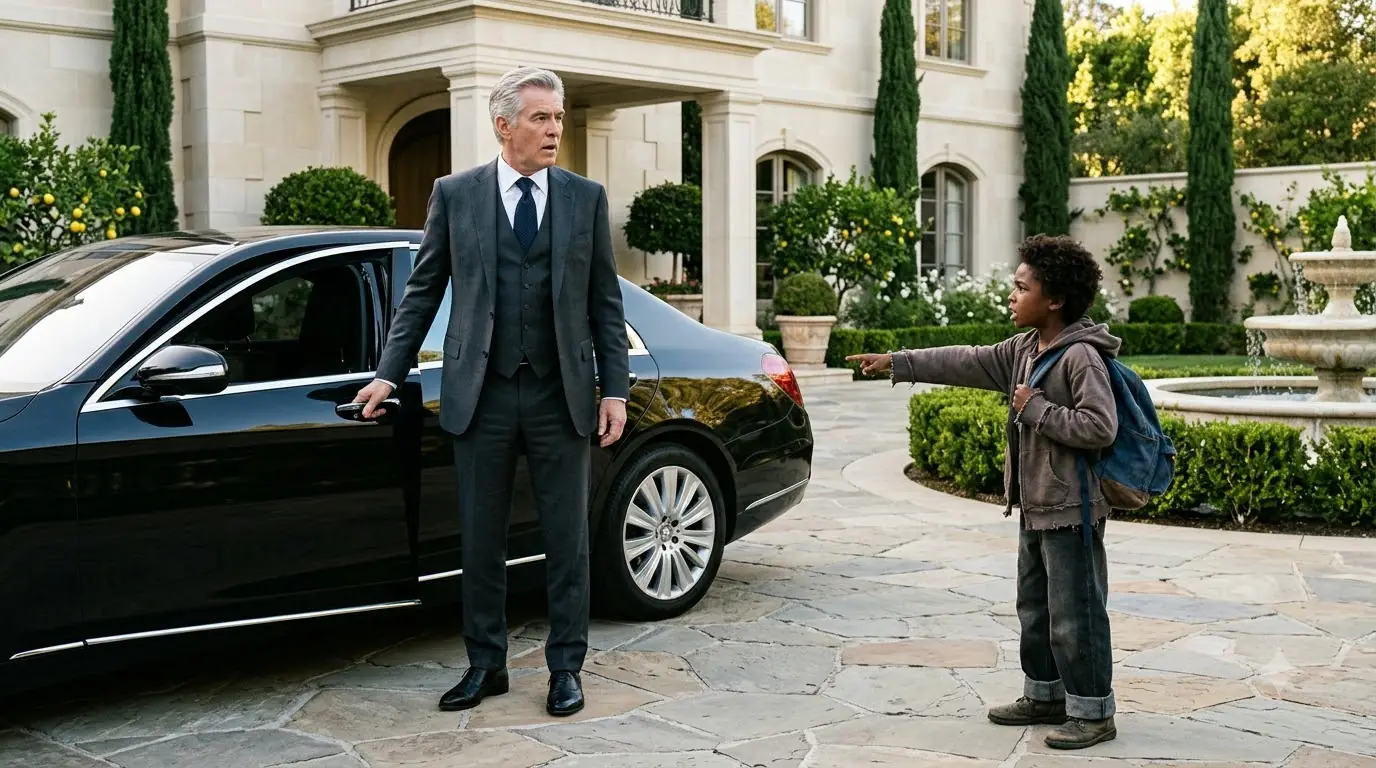
He paused with his hand already on the polished chrome of the door handle.
The black sedan was warm in the late afternoon sun, the kind of car that costs more than most people's homes, and is so quiet when it idles that you sometimes forget it is running. His driver had not yet come out. He had told Marcus he would drive himself this evening. He had told Marcus a lot of things this week. "Don't start it, sir."
"Please." Richard turned his head slowly. He was 63 years old, with a kind of silver hair that television producers ask their stylists to imitate, and a tailored charcoal three-piece suit that had been measured to his shoulders in a small shop in London 19 years earlier, and remeasured every two years since. He was, by any reasonable accounting, one of the wealthiest men in the state.
He had stepped out of his front door perhaps 11 seconds before, and in those 11 seconds the world he understood had been the world of his estate. The clipped boxwoods, the Italian cypresses standing in disciplined rows, the cream stone facade of the house his late wife had loved, and he could no longer quite bring himself to love alone.
The boy did not belong in that world. He stood maybe 15 ft away on the flagstones of the drive, one palm raised flat in front of him, the way a small crossing guard holds up a hand to stop traffic. The other hand white-knuckled on the strap of a backpack that was filthier than the boy was, and the boy was not clean.
He could not have been older than eight, possibly younger. His skin was a deep umber brown, his hair a soft uncombed crown of dark curls that the wind kept lifting and setting back down. He wore a hooded jacket the color of damp cardboard, sleeves frayed at the cuffs.
The jeans were two sizes too long, rolled at the ankle in a way that suggested someone had once tried to make them fit and given up. The boots on his feet had been someone else's boots first and possibly someone else's before that.
But his eyes did not match any of it. His eyes were dark and steady and locked on Richard's face with the unblinking gravity of a child who has been carrying something heavy for a long time and has finally found the one person he was meant to give it to.
A landscaper somewhere at the far edge of the property was running an edge trimmer. The sound seemed very distant, the way ordinary sounds become distant in the seconds before something extraordinary happens. "Son," Richard said, and his voice came out softer than he intended.
"You shouldn't be on the property. The gate is locked. How did you get in?" "I climbed the wall by the lemon trees.
I didn't break anything, sir." The boy's chin came up half an inch. "Please don't start the car. The brakes are cut."
Richard's hand was still on the door handle. He felt the metal beneath his palm with sudden exact clarity, the small grooves where his thumb rested, the slight warmth of sun-heated chrome. He did not move it. He did not lift it away. He simply became very suddenly aware of it.
"What did you say?" "The brakes." The boy swallowed. The motion went through his whole small throat.
"I saw a man do it. Two nights ago when you weren't home. He came in through the side gate where the camera doesn't reach. I was sleeping in the alley behind your wall because the shelter on Pier Street was full and I heard the gate."
"I climbed up to see and I saw him. He had a black bag and a flashlight with a red filter. He was under your car for a long time. He cut something underneath, and then he poured something on the ground from a bottle."
"It looked like oil, but it wasn't oil. It was thinner, and after he finished he made a phone call and said, 'It's done. He won't make the curve.'" Richard did not move. Somewhere inside the house a clock he had bought in Vienna in 1997 was striking the half hour and the small bronze chime came faintly through the open front door and the boy did not flinch, did not look away, did not let his hand drop.
Richard Caldwell had built a fortune of $740 million over 40 years on a single principle that he had once written on a yellow legal pad in a hotel room in Chicago when he was 28 years old. The principle was this, most disasters announce themselves first. They knock politely. The cost of listening is almost nothing. The cost of not listening is everything.
He had forgotten that principle exactly twice in his life. Once in 1996 when he had ignored his auditor's careful suggestion about a partner in Singapore and once in 2011 when his wife Elena had said very quietly over breakfast that her chest sometimes felt tight when she climbed the stairs and he had told her she worked too hard and they should plan a vacation. She had been gone 14 months later. He took his hand off the door handle. He took it off slowly the way you take your hand off a thing that might still be hot and he stepped back from the car one full step and then a second step and the gravel of the drive made the small careful sound that gravel makes under expensive shoes.
"What's your name?" he asked. "Elijah." The boy's hand was still raised, but it was beginning to tremble at the wrist now. "Elijah Brooks."
"Elijah, I want you to put your hand down. You're not in trouble. Nothing is going to happen to you. I want you to come over here, away from the car, and stand by the fountain. Can you do that for me?"
Elijah lowered his hand. He did not run to the fountain. He walked deliberately, the way a child walks when he has decided not to be a child for a few more minutes, and he kept his backpack strap clutched in his other hand the whole way. When he reached the fountain, he stopped beside it and put his small back against the cool marble basin and watched Richard and waited. Richard reached inside his suit jacket for his phone.
His fingers found it without his eyes, the way a man's fingers find a thing he has touched 10,000 times. He drew it out. He looked at the screen. He did not call his head of security. He did not call his estate manager.
He did not call Marcus, his driver, who lived in the small guest cottage at the rear of the property, and who would already be wondering, perhaps, why Mr. Caldwell had told him to take the evening off after 15 years of never being told to take an evening off. He did not call any of them. He called the police. "This is Richard Caldwell. I'm at 4400 Heron Lake Drive.
I have credible information that my vehicle has been tampered with. The brake lines have been cut. I have not started the car. There's also a substance on the driveway under the chassis that I believe to be brake fluid, but I'm not certain. I need a forensic unit, and I would like to request that a detective from the major crimes division come to the property.
No, sir, I am not in immediate danger. There is a child here, an eyewitness. He will need to be handled with care. He's 8 years old. Yes.
Thank you. I'll be at the front fountain." He hung up. Elijah was watching him with an expression Richard could not quite name. It was not relief.
It was something quieter than relief, something more careful. It was the expression of a child who has spent enough years being disbelieved by adults that being believed for the first time feels less like a celebration, and more like standing very still and waiting to see whether the believing will hold. Richard walked to the fountain. He did not crouch the way one is supposed to crouch with children, because something in the boy's posture suggested he had been crouched at too many times by social workers and shelter staff. He simply sat down on the broad marble lip of the fountain beside him at a respectful distance, and rested his forearms on his knees.
"You saved my life," he said. Elijah did not answer. He turned his head and looked at the black car the way a person looks at something that has stopped meaning what it used to mean. "How did you know it was my car?"
Richard asked. "How did you know to come back today?" "I didn't know it was today." Elijah's voice was small.
"I came every day. This is the fourth day. I sat across the road by the big oak tree. I waited for someone to come out of the house. I was scared they would call the police on me before I could tell them.