"Don't touch my piano, beggar. That's a half-million-dollar Steinway. You're not even supposed to breathe near it. Get him out before he steals something."
"I can play, sir. Tiny ton, I really can."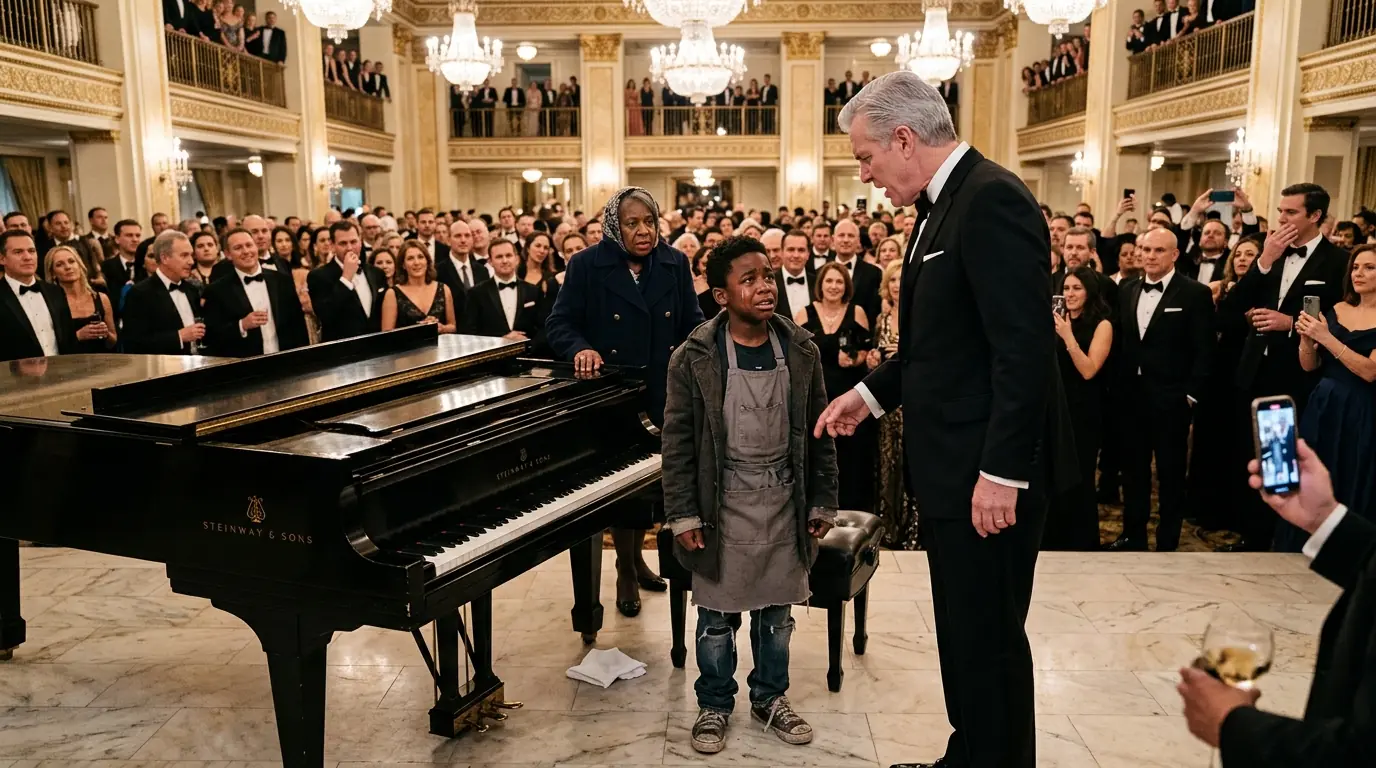
The man froze. Then he laughed—loud, ugly, for the whole room to hear.
"You? You play?"
He wiped the bench where the boy stood and dropped the cloth on the floor.
"Fine. Play. But if you're bad, you and your grandmother are gone. No pay."
400 people watched. A 10-year-old in torn sneakers sat down at that piano. And the first note he played would silence every laugh in the room.
Six hours earlier, the sky over Chicago was the color of wet concrete. Rain fell in thin needles. It pooled in the cracks of the sidewalk on the South Side, where a small apartment building leaned against the cold like an old man too tired to stand straight. On the third floor, behind a window patched with cardboard, a boy was playing piano.
His name was Roland Mercer. He was 10 years old.
The piano wasn't really a piano. It was an upright, decades old, the wood scarred and pale, with a finish that wore away. Three of its keys were dead. They didn't make a sound anymore, just a soft, hollow thunk, like knocking on a closed door. Roland had learned to play around them. His small fingers leaped over the silent keys without thinking, the way you step over a missing stair in the dark.
He closed his eyes. The melody he played was slow and aching—a tune that climbed and climbed, and then stopped. It always stopped in the same place, right before the end.
"You're playing it again," a voice said behind him.
Roland turned. His grandmother stood in the doorway, one hand on the frame to steady herself. Della Mercer was 71 years old. She had been beautiful once, and you could still see it in the way she held her chin. But the years had been heavy, and lately, so had her body. Her hands trembled now—not always, but more than they used to.
"I can't finish it, Grandma," Roland said. "It just stops."
Della crossed the room slowly and sat beside him on the bench. She rested her fingers on the keys, but didn't play. She just looked at the music. Sheet music, so old the edges had gone brown and soft as cloth. It had belonged to Theo.
Theo Mercer was Roland's father. He had been a pianist, too. A real one, people said, the kind that comes along once in a generation. But the world never gave Theo his chance. He played weddings and funerals and empty hotel lounges where nobody listened. He wrote his own music at night after Roland had gone to sleep. And he was working on one piece, one last song, when his heart gave out one winter morning.
Roland was six years old. The song was never finished; the last page was blank.
"He wrote it for you," Della said quietly. "He told me before. He said, 'This one's Roland's. He'll know how it ends.'"
Roland stared at the blank page. "But I don't."
Remember that: the song with no ending. Because by the end of tonight, that blank page is going to matter more than anyone in that ballroom could possibly imagine. Keep it in your mind.
Della stood, slower than before, and went to the window. On the sill sat a row of orange medicine bottles lined up like little soldiers. Some were full. Some were nearly empty. She picked one up, shook it, and frowned at the sound.
Money was the thing that was always missing in that apartment. It was missing the way air is missing in a closed room. You don't see it, but you feel it pressing on everything. Della's pension covered the rent, barely. It did not cover the medicine, and it did not cover the appointment she had next week, the one she kept telling Roland not to worry about.
She had a plan, though. That was Della; she always had a plan.
"There's a party tonight," she said, "downtown, a fancy one. They needed extra hands to clean up after, and they pay cash. Double, because it's last minute." She tried to make her voice light. "One night, it'll cover the doctor with a little left for groceries."
Roland looked at her. "You can barely stand up some days."
"I can stand up fine."
"Then I'm coming with you."
"Roland—"
"You said yourself there's nobody to leave me with, and I'm not staying here alone at night again." He crossed his arms, 10 years old and immovable. "I'll help carry things. I'm strong."
Della looked at her grandson for a long moment. At the holes in his sneakers she couldn't afford to replace. At the second-hand coat two sizes too big. At the hands. Theo's hands: long-fingered and sure. Hands that could do something extraordinary if the world ever gave them room. And the world had never, not once, given them room.
Della knew that hotel was a place for rich people. She knew how they looked at a poor Black woman and her grandson. She could leave him home, keep him safe from all of it. Or she could bring him and risk what might happen. What she chose next set everything in motion.
She chose to bring him.
"All right," she said, "but you stay close to me. You don't touch anything. You don't talk to anybody. You make yourself small. You hear me?" Then her voice softened and she put her hand against his cheek. "Your daddy played for empty rooms his whole life. Don't you ever learn to hide for full ones."