Victoria Mercer had been in the restaurant for 11 minutes before she mocked the waiter's shoes. It was not the first thing she had said about him. The first thing had been to her CFO, Marcus Penn, while Darius Cole was still three tables away. "Do they not have anyone else tonight?" said quietly. Not quietly enough.
The second thing had been when Darius arrived at the table and introduced himself. She had looked at his name tag and then at him and then at the wine list, which she handed back without opening, as though he had offered her something that did not require examination. The third thing had been when he recommended the Barolo, which was a recommendation he made because the table had ordered the lamb, and the Barolo was correct, and because Darius had been doing this work for 3 years and understood what correct meant in this context. Victoria had looked at him and said, "I'm sure you have strong opinions about wine." Darius had poured the Barolo. The shoes comment came when he was refilling the water glasses.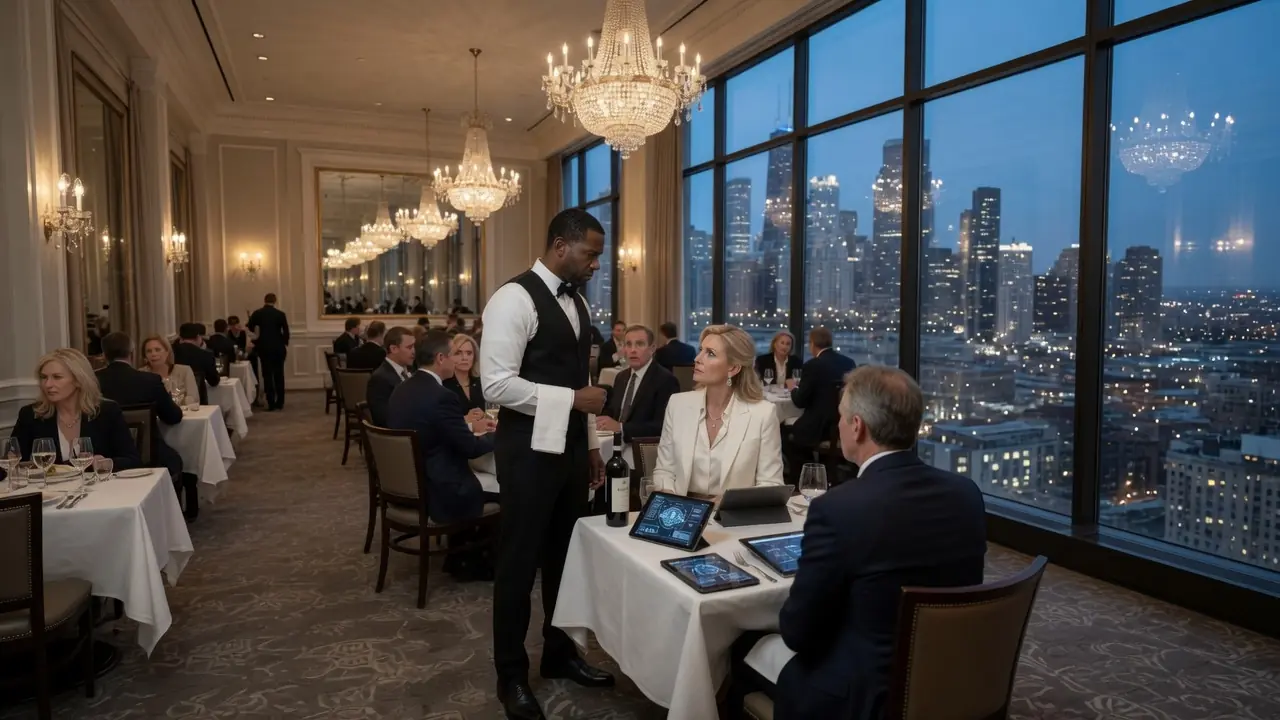
She said it to Penn, the same not quiet enough register. "Does the restaurant not have a uniform standard? Those shoes belong in a maintenance closet." Darius set down the water pitcher. He looked at his shoes. They were clean.
They were not expensive. They were the shoes of a man who stood for 8 hours and had decided a long time ago that the shoes were not the point. He looked at Victoria Mercer. "I'll let the manager know you mentioned it." he said. She looked at him with the specific expression of someone who has been responded to by a person they were not addressing.
"I wasn't speaking to you." she said. "I know." he said. He picked up the pitcher and went to the next table. Darius Cole was 41 years old and had been working at Astor House for 3 years, which was long enough to know the menu completely and the regular guests by preference and the kitchen staff by the specific qualities that kitchen staff revealed over time. Who was reliable under a Friday rush, who covered for whom, who made the stock correctly on Tuesdays when they thought no one was checking.
He had come to the restaurant the same way he had come to most things in the past 6 years. By deciding that what he needed was something stable and present, something that produced a clear result at the end of each day and did not require him to be somewhere other than where Nia needed him to be. Nia was 10. She had her mother's patience and her own version of a quality that Darius had spent his career trying to systematize. The ability to see the structure of a thing before you fully knew what the thing was.
She was interested in everything in the specific way of someone who has not yet decided what to concentrate on. And Darius encouraged this because he had concentrated too early and had learned that concentration was more useful when it was a choice than when it was a default. Her mother Camille had died 4 years ago. A car accident, a Tuesday in March, the kind of morning that did not announce itself as the last one of anything. Nia had been 6.
Darius had been in the middle of a negotiation that he had put down and never returned to and he did not regret putting it down. The negotiation had been the sale of his remaining shares in Crestline Systems. He had co-founded Crestline at 28 with a woman named Helena Cross who had the commercial instincts and the investor relationships and with his own work, which was the forecasting architecture. The structural logic that allowed the platform to model complex system behavior at a scale and accuracy that nobody else had achieved. The architecture was the thing.
He had liquidated, not all of it, but enough, and at the wrong time, and for a price that reflected the wrong time, and Nia had her surgery and recovered, and was now 10 years old with her mother's patience and the ability to see the structure of a thing. He had sold the remaining shares 18 months later after Camille died, because he had decided that what he needed was something stable and present, and a founder's equity position in a platform company was neither. He had moved to Chicago. He had found Astor House. He had taken the job.
He was 3 years into it, and the decision had been correct, and he did not spend time thinking about whether it had been. He was thinking about the table 12 lamb order when Victoria Mercer said the thing about Nia. The table had been difficult in the specific way of tables that have decided that difficulty is a form of communication. Victoria had sent the bread back twice. Once because it was too warm, and once 12 minutes later because it was not warm enough.
She had requested modifications to two dishes that were not available, and accepted the explanation with the manner of someone filing information for future use. Her CFO Penn had been apologetic in the way of someone who has been apologizing for someone else for a long time, and has refined the apology into a practiced efficiency. Darius had served the table with the same quality he brought to every table, complete attention applied without preference, and had not varied this for the bread or the modifications or the shoes. He was refilling Penn's wine glass when Victoria leaned back and looked at the tablet in front of her, one of three on the table, all showing something from the Horizon platform being prepared for its launch in 2 weeks and said in the tone of someone musing rather than speaking, "It must be difficult raising a child alone on a waiter's salary. I imagine the girl has a complicated relationship with ambition." Darius set down the bottle, not quickly, with the same deliberateness with which he set everything down, the deliberateness of a man who had been standing for 6 hours and had a system for how objects were placed on surfaces.
He looked at Victoria Mercer. "Mock me again," he said. "I dare you." The table was very quiet. Penn had stopped moving. The two advisers had the expressions of people applying maximum effort to the skill of being invisible.
Victoria looked at Darius with the specific expression of someone who has received a response they did not account for and is determining what to do with it. "I beg your pardon," she said. "You've made three comments in the past hour designed to communicate that I don't belong in this room," Darius said. He said it at the volume of a conversation, not a confrontation. "The last one was about my daughter.
That one I'm not going to absorb in silence." He paused. "Mock me again. I'll be here." She looked at him. She looked at the table. She looked at the tablet in front of her and in the moment she looked at it, Darius looked at it, too.
2 seconds. Something in his face changed, not dramatically, not in a way that Penn or the advisers could have described clearly, but Victoria saw it because she was looking at him and she saw it. "Is there a problem?" she said. "No," Darius said. He picked up the bottle.
He went to the next table, but he did not stop seeing what he had seen on the tablet. The module name in the upper left corner of the interface was Crest 7. It was not a name that would mean anything to anyone who had not written it. It did not appear in Crestline's public documentation, in the acquisition filings, or in any of the technical literature published about the platform's architecture. It was a name Darius had used internally in the development environment as the identifier for the seventh iteration of the core forecasting module, the module that made everything else work.
He had named it Crest 7 because it was the seventh version, and the first six had not been right, and because he had been 29 years old and had not yet developed the habit of using names other people could make sense of. The Horizon platform was built on Crest 7, not inspired by it, not influenced by it, built on it. The same structural logic, the same module naming convention, the same architecture he had spent 3 years developing and signed over in the acquisition agreement. What acquisition agreements did not require, and what Darius had retained in a separate intellectual property filing that predated the company, was the documentation for three known structural flaws in Crest 7 that he had identified and quarantined in the seventh version, and had not yet resolved when the acquisition happened. The flaws were in the forecasting model's handling of cascading system failures.
Under specific load conditions, conditions that would not appear in standard testing but would appear in real-world deployment at scale, the model would produce confidence intervals that were technically accurate, but operationally misleading. The platform would tell you it was certain about a forecast when it had no basis for that certainty. If Horizon was built on Crest 7, and those flaws had not been resolved, anyone using Horizon for high-stakes forecasting decisions was making those decisions on a foundation that Darius knew was unsound. He went to the kitchen. He confirmed the table 12 lamb.
He went back to the floor. He stopped at table 12. He set down Penn's salad. "The Horizon platform," he said. Victoria looked at him.
"It has a cascading failure problem in the confidence interval generation," he said. "Under high load real world conditions, it will tell you it's certain when it isn't. The flaw is in the seventh iteration of the core module in how it handles correlated inputs under threshold conditions." The table was very quiet in a different way than before. "The second flaw is in the anomaly detection layer," he said. "It flags false positives at a rate that looks acceptable in testing, but becomes unmanageable at scale.
Your engineers have probably adjusted the sensitivity threshold downward to compensate. That masks the symptom without addressing the structure." Penn had stopped eating. "The third flaw is the one that should concern you most. The load balancing architecture assumes homogeneous input streams. Real deployments produce heterogeneous streams, and the model degrades non-linearly when it encounters the heterogeneity.
You won't see it in a controlled environment. You will see it in production at the worst possible time." He looked at Victoria. "I can tell you these things because I wrote the module," he said. "I named it Crest 7. I identified those flaws before I sold the architecture and documented them in an IP filing that exists independently of the acquisition agreement." He paused.
"Your engineers have been trying to hide them. I would like to know why." The silence at the table was the silence of people for whom everything that had happened in the last hour has just been reorganized. Victoria Mercer looked at Darius Cole. "Who are you?" she said. "Your waiter," he said.
"Table 12 is ready." He went to the kitchen. He did not go back to the table. Reuben Hale, the restaurant manager, appeared at Darius's elbow in the kitchen pass. He was 48, had been running Astor House for 11 years, and had been watching table 12 with the attention of a manager who knows when a table is generating the specific kind of energy that requires monitoring. "You okay?" Reuben said.
"Yes." Darius said. "What happened out there?" "I told a table the truth about their product." Darius said. "And before that, one of them made a comment about my daughter." Reuben looked at him. "The comment about your daughter is on camera." Reuben said. "Full coverage of the floor.
The conversation was close enough to the ceiling mic to be recorded. I want you to know that." Darius looked at him. "I want you to know that." Reuben said again. "In case it becomes relevant later." It became relevant four days later. An edited clip appeared on a media platform, 30 seconds extracted from the longer exchange, showing Darius saying, "Mock me again.
I dare you." to a seated woman at a restaurant table, with her response clipped and his face in the foreground, and the frame cut to make the exchange look like aggression without context. The caption described a waiter who had threatened a guest. The post was anonymous, but traceable. Nia came home from school the day the clip circulated and told Darius that three kids had said something to her about her dad being in a video. She said it with the quiet directness she used when something had happened that she wanted him to know about, but did not want to make larger than it was.
He sat down with her at the kitchen table. He told her what had happened. The full version, not simplified, not protective of the uncomfortable parts. She was 10 years old with her mother's patience and the ability to see the structure of a thing. She listened.
When he finished, she was quiet for a moment. "They cut the part where she talked about me," she said. "Yes," he said. "That's the most important part," she said. "Yes," he said.
"It is." She looked at the table. "What are you going to do?" she said. "I'm going to get the full footage," he said, "and I'm going to find the IP filing, and I'm going to talk to someone I used to work with. Her name is Helena. She co-founded the company with me.
She's been inside the organization that acquired it. She knows what they did with the architecture." "Do you trust her?" Nia said. He thought about Helena Cross, who had called him twice in the past year with a quality in her voice that he recognized as the quality of someone looking for permission to say something they had not yet said. "Yes," he said. "I think so." "Okay," Nia said.
She picked up her pencil. She went back to the notebook. "Tell me what she says." Helena Cross met him at a coffee shop on a Tuesday morning. She was 43, a senior executive at Meridian Technologies, the company that had acquired Crestline that had built Horizon on the architecture Darius designed. She had been wanting to talk for 8 months.
"They knew about the flaws," she said. "The engineering team flagged all three of them in the first 6 months of development. The decision was made at the VP level. I was in the meeting to suppress the flagging in the public documentation and adjust the testing parameters so the flaws wouldn't appear in the standard benchmarks." "Why?" Darius said. "The launch timeline was fixed by investor agreements.
Delaying to resolve structural flaws would have triggered penalty clauses. The calculation was that the flaws were unlikely to produce visible failures in the first 12 to 18 months of deployment, the period that mattered for the market valuation. And after 12 to 18 months, someone else's problem, she said. By then, the valuation is locked and the liability is reframed as a maintenance issue. He looked at his coffee.
The clip, she said. I know where it came from. Victoria's communications team pulled it from the restaurant footage after she filed a formal complaint, which required the restaurant to produce the recording. She paused. I have the commit logs from the Crestline repository.
The actual development history, including the flaw documentation that was removed from the public record. I've been keeping them for 8 months because I knew this moment was coming. She put a drive on the table. I want it all to come out, she said. What they built it on.
What they knew and didn't disclose. What they did to your reputation when you recognized your own work. She paused. And what it means that you gave up that architecture to save your daughter's life, and they've been selling it for 4 years without your name on it. Darius looked at the drive.
The Horizon launch is in 11 days, he said. I know, she said. He called Reuben from the parking lot. The full footage, he said. The unedited recording from that evening.
I need it. I pulled it the day the clip went up, Reuben said. It's been sitting in a secure file waiting for you to ask. He paused. Darius, I watched the whole thing.
What she said about Nia. Another pause. I want to be a witness. I want my name on the record. Thank you, Darius said.
Don't thank me, Reuben said. Just make sure the right people see the whole tape. The Horizon launch was held at the Meridian Technologies campus on a Thursday evening in November. A space curated to communicate the company's understanding of itself, lit to flatter rather than illuminate, with an audience assembled for their capacity to amplify rather than to question. Victoria Mercer took the stage at 7:00.
She had been told 20 minutes before that a man named Darius Cole was in the building and had requested 5 minutes at the microphone under the event's stated open forum protocol, a provision included in the event's legal registration as a formality and which her legal team had discovered in the 20 minutes they had to work with could not be revoked without creating a problem worse than the disclosure. She had been told what he would likely say. She took the stage anyway because she had a response framework and because she had been in rooms like this for 20 years and understood that control was a function of narrative. Darius walked to the microphone at 7:42. He looked at the room.
He said, "My name is Darius Cole. 11 years ago, I co-designed a forecasting architecture called Crest 7. I designed it to help organizations make better decisions under uncertainty. I sold it as part of a company acquisition because I needed to pay for my daughter's heart surgery and she needed the surgery because her mother was dying and someone had to make a decision and I made it." The room was very quiet. "The platform being launched tonight is built on that architecture," he said.
"Not inspired by it, built on it. The core forecasting engine is Crest 7. I named it. I know its structure because I designed it. I also know three significant flaws in its current implementation that were documented by the engineering team, suppressed from the public record and not disclosed to the enterprise clients being asked to make high-stakes decisions based on its output." He looked at Victoria Mercer on the stage.
"I am not here for revenge," he said. "I am here because those flaws exist and people should know about them before they stake their operations on a platform that will fail under real-world conditions. And I am here because 11 days ago a woman at a restaurant table mocked my race, my job, and my daughter. And when I told her to stop, a 30-second clip was used to make me look dangerous while the rest of the recording stayed hidden." He produced a drive from his jacket. "The full restaurant footage is available from Reuben Hale, the manager of Astor House, who has been holding it since the edited clip appeared.
The commit logs documenting the suppressed flaw reports are available from Helena Cross, a senior executive at Meridian Technologies, who is also in this room tonight." He looked at the audience. "I designed this platform," he said. I gave it up to save my daughter's life. Someone built their career on it and tried to make me invisible. I am telling you this not because I want the platform to fail.
Correctly implemented, it is genuinely valuable work. I am telling you this because the people who use it deserve to know what it is and what it isn't. And because the man they tried to make invisible was standing right in front of them the whole time." He set the drive on the podium. He walked off the stage. The disclosure took 3 weeks to move through the legal and regulatory channels the commit logs and footage and Helena's testimony required.
Victoria's response framework did not survive contact with the actual documentation. The specific problem with architectural documentation being that it is detailed and timestamped and unambiguous in a way that narrative frameworks cannot address. Meridian Technologies announced a voluntary review of Horizon's technical documentation. The three structural flaws were publicly disclosed 2 weeks after the launch event in a technical advisory that Helena helped write. Meaning it was written by someone who understood the architecture well enough to describe both the flaws and the remediation path, which existed and was not as complicated as the suppression had made it seem.
The full restaurant footage was released by Reuben with a statement that described the events of the evening accurately and without editorializing, which was more devastating than editorializing would have been. Darius's IP attorney filed the documentation establishing his prior authorship of Crest 7. The subsequent negotiation with Meridian Technologies produced a settlement that included a licensing arrangement and an authorship credit in the platform's technical documentation. Darius knew it existed. That was enough.
He used part of the settlement to open a restaurant, smaller than Astor House, on the north side of the neighborhood in a space that had good light and a kitchen exactly the size the menu required. He named it after the month Nia was born. He hired three kitchen staff and two servers and told them in the first staff meeting that the restaurant had one rule that preceded all the others. Nobody who worked here and nobody who ate here would ever be treated as though they did not belong. One of the servers, a woman named Camille who was 24 and paying close attention to everything, asked, "Why make it a rule instead of just a way of doing things?" He thought about Nia at the kitchen table saying, "The part where she talked about me is the most important part." "Because the things that matter most are the things that get unwritten when nobody's paying attention," he said.
"A rule is a way of paying attention." She nodded. "Okay," she said. Nia came to the restaurant on its first Sunday. She sat at the corner table by the window which caught the morning light from the east and she had her notebook with her and she ate a breakfast that was very good and she looked at the room. "Dad," she said when he came to sit across from her.
Yeah, he said. It's good. Thank you, he said. She looked at the room again. She said it would be hard, Nia said.
The woman at the restaurant. She said it like it was a bad thing, raising me alone. I know, he said. Is it hard? She said.
He looked at his daughter, at the notebook and the pencil and the 10 years of her that had accumulated into the person sitting across from him in the corner booth by the window. Yes, he said. And it's also the best thing I've done. She looked at him with the patient attention she brought to things she was confirming rather than discovering. I know, she said.
I just wanted to hear you say it. She picked up her pencil. She went back to the notebook. Outside the Sunday morning was doing what it does, arriving without urgency, laying its light across the street and the storefronts and the corner table where a man and his daughter were having breakfast in a place that belonged to both of them. Darius looked at the room.
He had built things before that were larger than this. He had designed architecture that ran on systems serving millions of users and produced insights that moved real decisions in real directions. He had also stood at a restaurant table with a wine bottle and told the truth when it needed to be said. This was smaller than both of those things. It was also in the specific way of things that are exactly what they are supposed to be, complete.