"You will go to Thornfield Wold," said Aldous Fane, fifth Duke of Ravensby, without looking up from the letter he was sealing, "and you will remain there. I find I prefer the house without you in it." He heard rather than saw his wife receive the sentence, the small stillness of her, the breath she did not quite take. He did not look up because he had decided not to look up, and a duke who has decided a thing does not revisit it.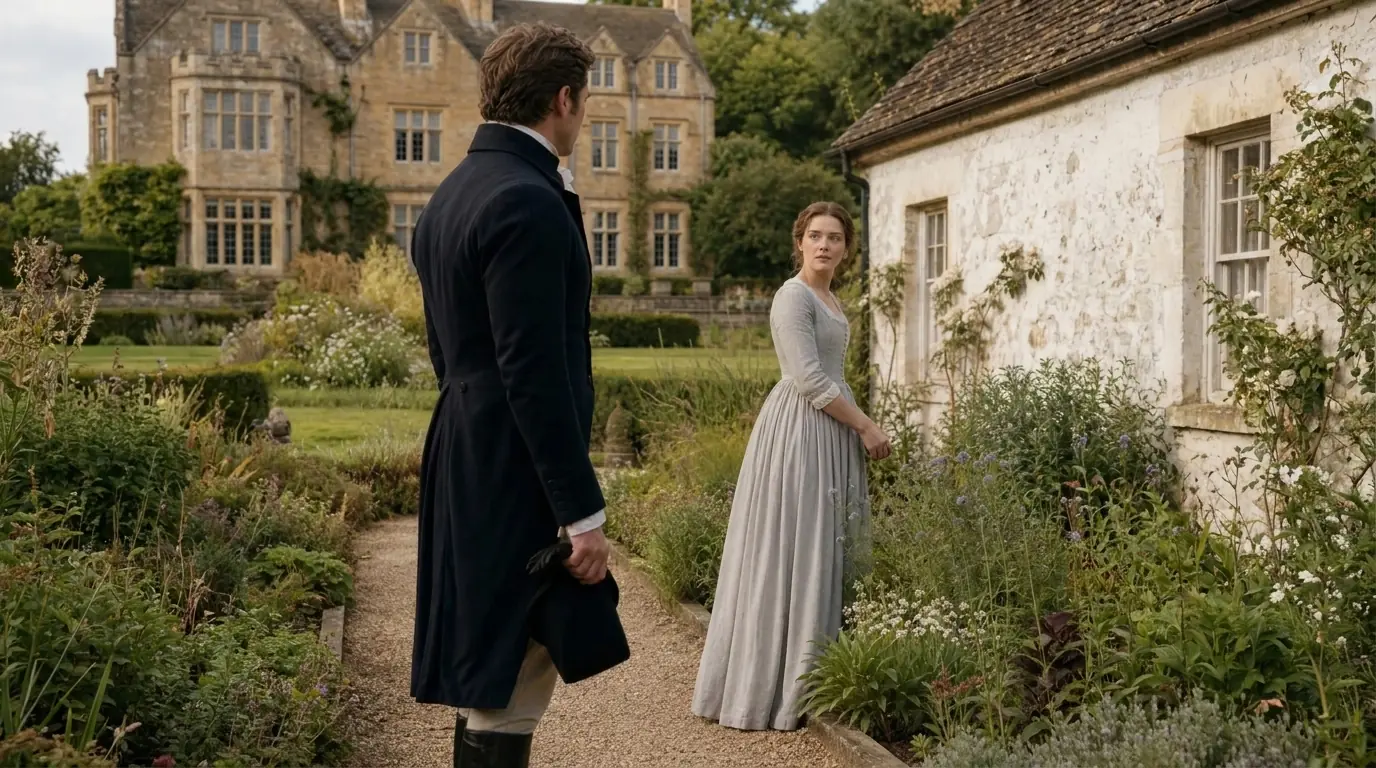
And because if he were entirely honest, which he was not in the habit of being with himself, he did not wish to see her face while he said it. "May I ask why?" Marguerite said. Her voice was very level.
It was always very level. It was one of the things about her that he had come, over three years of marriage, to find faintly insufferable, this refusal ever to weep or rage or give him the satisfaction of a scene he could win. "I should like to understand what I have done, Your Grace, if only so that I might avoid doing it at Thornfield, where I gather there will be no one for me to do it to."
"You have done nothing," Aldous said, and pressed his seal into the wax.
"That is rather the difficulty. You are a very correct wife, Marguerite. You keep my house, and you observe every form, and you have given me no cause for complaint that any man could name aloud. And I find I cannot breathe in the same house with all that correctness one moment longer. I married to secure the succession and to please my father before he died, and I have done neither, and the marriage sits in my life like a stone in a shoe, and I would rather feel it at a distance than at every meal. There. You wish to understand. Now you do."
It was cruel. He knew it was cruel even as he said it, and he said it anyway, because cruelty at least was a kind of honesty, and he was so tired of the correctness, of the silence between them, of the way she looked at him sometimes across the long dinner table with a patience that felt like an accusation of his own failure to feel for this blameless woman, the thing a man was supposed to feel and could not manufacture. He had married her because she was suitable. She had been chosen for him the way a horse is chosen, for her lines and her temper and her breeding, and she had turned out to be exactly what she had been advertised to be, and he despised himself for finding that a grievance and despised her unfairly for being the occasion of it.
She was quiet for a long moment. When he did at last look up, he could not help it. She was standing very straight by the window, the winter light hard on her face, and she was not weeping. She was looking at him with an expression he would spend a long time afterward trying to name, not hurt, not anger, something more like the look of a person taking a very careful measurement of a thing so as to remember its exact dimensions.
"I am sending you to a house that is legally mine and legally yours as its mistress," he said, "and which is far from London and far from me, which are its two chief recommendations. You will have an allowance. What you do with the ruin is your affair. I ask only that you do it there and not here."
"I see." She drew on her gloves slowly, one finger at a time, and he watched her do it and felt something he did not examine. "Then I shall go to Thornfield, and I shall not trouble you, your grace. You need not fear letters. You have been very clear about what you prefer, and I have never in three years failed to give you what you preferred. I do not intend to begin now."
She curtsied to him, correctly of course, faultlessly, the deep grave curtsy a duchess gave a duke, and there was in its very perfection a reproach sharper than any words. "Goodbye, Aldous. I hope the house is quieter without me. I hope it is everything you wished."
She went. She was gone within the week, no scene, no tears, no reproachful letter left on his pillow, nothing but the sudden vast quiet of the London house with no one in it but himself, which was, he told himself firmly, exactly what he had wanted. For a month he was certain of it. The house was quiet.
He dined alone and read what he liked and answered to no one and felt the stone gone from his shoe. He went to his clubs, he saw his friends, he attended to the estate business with his steward, and if now and then his eye fell on her empty chair at the long table, or if the house at three in the morning seemed larger and colder than a house had any right to be, he ascribed it to the season and thought no more of it. The reports began in the second month. They came at first buried in the steward's ordinary correspondence, a line here, a paragraph there.
Her Grace had engaged workmen at Thornfield to see to the west wing roof. Her Grace had drawn on her allowance to purchase timber and slate. Her Grace had put the home farm back into cultivation and taken on hands from the village. Aldous read these without much interest, mildly surprised that his wife had troubled herself, and filed them and forgot them.
But they did not stop. Month by month, through the winter and into the spring, the reports thickened, and something in their tone began to change. The steward, a dry unenthusiastic man, began, almost against his will, to write of Thornfield with a note that Aldous eventually identified, with some astonishment, as admiration. The village school had reopened.
The steward wrote, Her Grace having engaged a master and paid his stipend from her own allowance. The gardens were restored. The walled kitchen garden was feeding the house and half the village besides. Her Grace had re-roofed the west wing, rehired families who had drifted away for want of work, established a physic garden and a small dispensary where she herself, who had apparently some knowledge of such things, attended the sick.
The rents, which had produced nothing in a decade because there had been nothing to rent, were beginning modestly to come in again. Thornfield Wold, the dry steward concluded in a spring letter, was no longer a ruin. It was, he wrote, and Aldous read the sentence twice, becoming the best-loved house in the county, and Her Grace the best-loved woman in it. And if His Grace would forgive the liberty, the steward had never in his professional life seen an estate so transformed, nor so quickly, nor by so unlikely a hand.
Aldous set the letter down and sat for a long time in the quiet of the London house that was exactly as quiet as he had wanted it. And found that the quiet had gone from a relief to a weight without his noticing the change. He told himself he was pleased. It was his estate.
Her industry increased its value. He ought to be gratified that the allowance he had thrown at her to be rid of her had been so profitably spent. He told himself all of this and did not believe any of it. Because underneath the accounting lay a thing he could not account for at all.
Which was that he had lived beside this woman for three years and thought her a stone in his shoe. A correct and empty and insufferable nothing. And now, at a distance of two hundred miles, she was rebuilding a world with her two hands and being loved for it. And he had not known she had it in her because in three years he had never once troubled to look.
He had called her correct. He saw now that he had confused her correctness for emptiness, the way one might mistake a locked room for an empty one, never having tried the door. She had been faultless with him because he had given her nothing to be anything else with no warmth to answer, no question to open her, no reason on earth to show a cold husband the woman who could rebuild Thornfield Wold. And so she had shown him only the duchess.
And he had looked at the duchess and pronounced there was no one home and sent the no one away. And only now, with the house she had made rising in his steward's letters, understood that he had banished a stranger he had been married to for three years. He did not go at once. He was too proud to go at once and besides he did not know what he would say.
A month more passed. He found himself reading the steward's Thornfield paragraphs first before the London business and then rereading them. And once he caught himself at his desk having written her name, Marguerite, on a fresh sheet and nothing after it because he did not know how to begin a letter to a wife he had thrown away. And had torn the sheet across and thrown it in the fire and sat watching it burn.
It was a small thing that finally moved him. Among the spring reports the steward had enclosed without comment a folded paper, a petition of sorts got up by the village and copied out in a child's careful hand, thanking Her Grace of Ravensby for the school and the dispensary and the work she had brought back to Thornfield and signed or marked by forty families. Aldous read the 40 names. He did not recognize a single one.
They were his tenants and he had never known them. And at the foot, in the same childish hand, someone had added a line the villagers had plainly asked to be included. We pray the good duke will come and see what Her Grace has made, for surely he must be as fine as she is to have such a wife. Aldous Fane read that line alone in his quiet house and put his hand over his eyes and sat a long while.
And then he rang for his valet and ordered the carriage for the morning because he found he could not bear another day of being the good duke his tenants imagined, and his wife knew better than to expect. He arrived at Thornfield Wold on a clear day in early June and did not know it. He had last seen the place a dozen years before, a boy sent to a crumbling secondary seat while his father shot. He remembered a dark bramble-choked ruin, the roof half open to the sky, a dead thing.
What his carriage came up the mended drive to now was a house alive, warm, honey-colored stone scrubbed of its ivy, every window glazed and shining. The west wing whole and roofed in new blue slate, and everywhere everywhere the evidence of a hand at work. The walled garden heavy with early growth, an orchard staked and pruned, a knot of village children, he heard them before the carriage stopped. Let out from a schoolroom that had been a stable, and beyond the fields of the home farm green and ordered where he remembered only nettles.
He got down slowly. No one had expected him, he had sent no word. A gardener straightened from a bed of physic herbs and stared. A woman with a basket stopped on the path.
And word went through the place ahead of him the way it does. The good Duke, the good duke has come. So that by the time he reached the door there was a small gathering, hopeful and shy, and he moved through it in a kind of daze, nodding, saying nothing, because every face that turned to him was a face that loved his wife and expected him to be worthy of her. And he had come two hundred miles precisely because he knew he was not.
They told him she was in the dispensary. He went round the side of the house the way they pointed, past the physic garden, to a low clean whitewashed room that had been a scullery. And he stopped in the doorway, unseen for a moment, and looked at Marguerite. She was on a low stool beside a cot, and on the cot lay an old laborer with a bandaged arm.
And she was changing the dressing with sure unhurried hands, talking to the old man low and easy. And the old man was laughing at something she had said. And she was laughing, too, laughing, his correct silent stone of a wife. Her sleeves pushed up, and a smudge of something on her cheek, and her hair coming loose from its pins.
And she looked all this thought. Standing frozen in the doorway with his heart doing something painful and unfamiliar in his chest, more beautiful than she had ever looked in three years of faultless London evenings. Because for the first time since he had known her, she looked entirely, gloriously alive. She glanced up and saw him.
The laughter died. Her hands went still on the bandage, and the old man looked from one to the other of them, sensing something, and the room went quiet. And for a long moment the duke and Duchess of Ravensby only looked at each other across the little clean whitewashed room she had made out of a ruin. "Your grace," Marguerite said at last.
Her voice was level again, instantly, perfectly level, the London voice, the duchess voice. And he heard it slam down over the living woman like a shutter over a window, and understood that he had done that, that his mere presence had made her put the armor back on. "You are a long way from home. I hope nothing is wrong."
"No." His own voice came out rough. "Nothing is wrong. May I, when you are finished, may I speak with you? I have come a great distance to say something and I find I have forgotten most of it, but I should like to try."
She tied off the old man's bandage and helped him sit and saw him out with a kind word, all of it unhurried, none of it hastened for a duke's convenience, and Aldous waited in the doorway and did not once tell her to hurry. And something in that waiting seemed to register with her because when at last she rose and faced him, the shutter had lifted very slightly from her eyes. In the weeks after the child's petition reached him, and before his pride at last gave way, Aldous had done a thing he was not proud of. He had written, in secret, to the vicar of the Thornfield parish, an elderly man he had met once and forgotten, and asked him, under the pretense of a landlord's ordinary interest, to describe how matters truly stood at the Wold and whether the steward's reports were colored by any wish to flatter.
The vicar's reply had come within the fortnight, and Aldous had read it in his study with the door shut, and it had finished what the steward's letters began. The steward, the old vicar wrote, had, if anything, understated the case. When Her Grace had come to Thornfield in the dead of winter, the vicar had expected a fine London lady come to sulk in the country and gone again by spring, as such ladies did. He had been, he confessed, entirely mistaken.
Her Grace had arrived, looked at the ruin without dismay, and set to work the very next morning. She had gone from cottage to cottage in the cold herself, not sending a servant, learning every family's name and trouble. She had found the school shut these eleven years and the children growing up unlettered and had reopened it before the month was out. She had found Old Wynn, the laborer, dying of a wound gone bad because there was no one within a day's ride who knew how to dress it, and had dressed it herself, having somewhere acquired the knowledge.
And Old Wynn was alive and at his work. She had found the village dying by inches for want of a landlord who cared, and she had cared plainly and practically and without any fuss about it. And the village had come back to life around her like a garden watered after long drought. "She never speaks of your grace," the vicar wrote in a passage Aldous read a great many times, "save with perfect respect. And she keeps your portrait in the hall, and the people, taking their cue from her, pray for you by name in church each Sunday as the good duke who sent them so fine a lady."
"I do not know, your grace, what passed between you that brought Her Grace to us. I know only that we counted the great mercy of our lives, and that if there is any justice in heaven, a man who could give the world such a wife must have some greatness in him yet, however he has hidden it. Forgive an old man his plainness. I have buried too many of this parish for want of the care she brought to weigh my words when I speak of her."
Aldous had put the letter down and gone to the window of his study and stood there a long while in the failing light with something breaking very quietly inside him. "She keeps your portrait in the hall. She prays for you by name. She never speaks of you save with perfect respect."
He had thrown this woman away like a stone in his shoe, told her to her face that he preferred his house without her, and she had gone two hundred miles and made a ruined estate into the best-loved house in the county and taught a whole village to pray for the man who had discarded her, and had done it. He understood now, not to shame him, not as a reproach, but simply because it was in her nature to build and to heal and to be faithful. And she could no more help it than a spring could help rising. He had married her for her breeding and her correctness and her suitability, the way a man buys a horse.
And it turned out he had, entirely by accident and wholly without deserving it, married the finest woman in England, and had needed to lose her and read of her at two hundred miles' distance in a dry steward's hand and an old vicar's plain one before he could bring himself to see it. That night he did not sleep, and in the gray hours he faced the thing squarely: the empty correctness he had blamed her for had been his own doing, that a wife shows a husband the self he makes room for and no other, and that he had made room for nothing and got nothing and called the nothing her fault. He had wanted to feel something for her and could not in the cold house he had made cold. And now, absurdly, unforgivably late, two hundred miles away, reading of another man's tenants praying for him, he felt it, a great helpless swell of it, for a woman who had every right never to want to see his face again.
He rang for his valet in the morning and ordered the carriage. He was done being the good duke of a village's imagining. He would go and be measured against the truth of her and take whatever she gave him, and it would be no more than he deserved and very likely a great deal less than he now hopelessly wanted. She walked him out into the garden because the dispensary was hers and she would not have this conversation in it.
And they went slowly along the gravel path between the beds of physic herbs, and the June light lay gold over the honey-colored stone of the house she had raised from ruin, and for a while neither of them spoke. "You have made a miracle here," Aldous said at last. "I did not believe it reading the reports. I came in part because I did not believe it. I stand in the middle of it and I still hardly do."
"It was not a miracle. It was work." She did not look at him; she looked at her garden. "You gave me a ruin and an allowance and a great deal of solitude, and I found I could do something with all three. The village needed a school, so I built one. The sick had no one, so I learned enough to be someone. The land was dying, and I put it back to work. There is no mystery in it, Aldous."
"There is only the fact that here, for the first time in my life, I was needed by someone, and no one had decided in advance that I was a stone in his shoe." She still said it without heat, but the words landed like blows all the same because they were true and she let them be true. "I have been happier at Thornfield in six months than I was in three years as your duchess. You should know that, since you came so far. Your banishment was the kindest thing you ever did me."
Aldous stopped walking. "That," he said, "is the most terrible thing anyone has ever said to me, and I have earned every word of it." She turned then and looked at him, and the level voice cracked just slightly at the edges.
"I did not mean it to wound. I have stopped wanting to wound you. I stopped somewhere around the west wing roof. I mean it as the plain truth, which you always said you valued and which I was never permitted to give you, because a wife who tells a cold husband the truth is not correct, and I was so very determined to be correct. I thought if I were faultless enough, you would come, in the end, to—" She stopped.
"It does not matter what I thought. It was a girl's foolishness. I have grown out of it here. I have Thornfield now, and forty families who need me, and a self I did not know I had until you sent me away to find her. I do not require anything from you anymore, Aldous. That is what has changed. And I think it is why you have come. Because a wife who required nothing was insufferable to you, and a wife who requires nothing and is loved by a whole county besides is something you cannot account for at all."
"You are right," Aldous said. His voice was not steady. "You are entirely right, and I am going to say the thing I came to say now before your rightness talks me out of it, because I deserve to be talked out of it, and I am not going to let you. Marguerite, I called you correct and empty and a stone in my shoe, and I sent you away because I could not feel for you what a man should feel, and I blamed you for it when the whole fault was mine, because I never once tried the door."
"I looked at a locked room and called it empty and never turned the handle. And now I have come two hundred miles and turned it and found this." He gestured at the garden, the house, the whole living, transformed place. "I found you, the woman who was behind the correctness the entire time, whom I was married to for three years and never met. And I am so ashamed of myself that I can hardly stand in front of you. I did not come to bring you home. I have no right to bring you home. You have made a better home here than I ever gave you."
"I came—" He stopped and made himself go on, because he had never in his life said such a thing and did not know if he could. "I came because somewhere in these six months I began to fall in love with my own wife by post, reading a dry man's reports of a woman I had thrown away rebuilding the world. And I could not bear another day of loving her at a distance without at least telling her so to her face, even if it is too late. Even if she quite rightly sends me back to London to be quiet in my empty house forever."
"I have no scene to offer you, Marguerite. I have only this: that I was wrong, wholly and shamefully wrong, and that the correctness I despised was armor I put on you myself, and that the woman underneath it is the only thing I have ever wanted and been too proud and too blind to see. I do not ask you to come back to me. I ask leave to come here to Thornfield, to you, and to court my own wife properly from the beginning, as I should have done three years ago, and to earn, if I can, some small part of what these forty families feel for you, who have known you six months and love you better than I managed in three years."
"That is all. That is everything. It is entirely in your hands, as it should have been from the first."
Marguerite Fane, Duchess of Ravensby, stood in the garden she had made and looked at her husband for a long, long time.
And Aldous watched the war go on behind her level gray eyes. The pride that had a perfect right to send him away against something older and more stubborn that had built a whole world in the shape of a hope she had told herself she had grown out of. "You want to court me?" she said slowly. "Here at Thornfield as though we were strangers."
"We are strangers," Aldous said. "That is precisely the trouble. I should like to stop being one if you will let me." She was quiet.
Somewhere behind them a child laughed in the schoolroom and the June light moved on the honey-colored stone and the physic herbs gave up their scent in the warmth. "You will not take me back to London," she said. "This is my home now. These are my people. I will not give up the dispensary or the school for anyone, not even a duke, not even—" Her voice caught.
"Not even a duke who has said the only true thing to me he has said in his life."
"Then I will come here," Aldous said instantly. "London can rot. I have hated it for years and only now understood why. I will live at Thornfield and learn the names of forty families and carry your baskets and hold the ladder while you rehang the world and I will consider it the honor of my life. Marguerite, will you let me stay?"
And Marguerite, who had grown out of hope and found it grew back the moment it was watered, felt the level voice fail her entirely at last and let it, and did not reach for the armor. "Stay," she said softly. "God help me, then stay. But you will earn it, every day of it. I did not build all this to hand it and myself to a man who might change his mind by Michaelmas."
"I will earn it every day for the rest of my life," he said. "I have a great deal to make up. I intend to enjoy every hour of the making." He did not kiss her then.
It was not the moment, and he had learned, at terrible cost, not to take what he had not earned. He offered her his arm instead, and she looked at it. And then slowly, the way she did everything on her own time and for her own reasons, she took it. And they walked on together through the garden she had made, husband and wife and strangers both, at the beginning of the thing they should have begun three years before.
He stayed. He learned the forty families and held the ladder and carried the baskets and sat at the foot of the schoolroom on wet afternoons while she taught. And in the slow turning of that first summer into autumn, the duke of Ravensby became, without quite noticing when it happened, the good duke his tenants had always imagined. Not because he had been born fine, but because his wife had made a ruin into a home.
And then, with far more patience than he deserved, made a cold man into someone worth living beside. She had transformed the house. She transformed him, too, and it took longer and cost more, and neither of them would have had it any other way. And on the still evenings, when the day's work was done, they walked out to the top of the wall together and watched the light go off the field she had brought back to life.
And Aldous, who had once preferred his house without her in it, could no longer imagine a single hour of his life that was not better for her being in it, and told her so every day because he had wasted three years of days not telling her, and did not mean to waste one more.