The entire room went silent. Every salesman in the dealership stood frozen, their smirks wiped clean. The same elderly man they had laughed at the day before—the one they had mocked for his worn shoes and tattered coat—was standing before them again. This time, however, he was not merely another customer.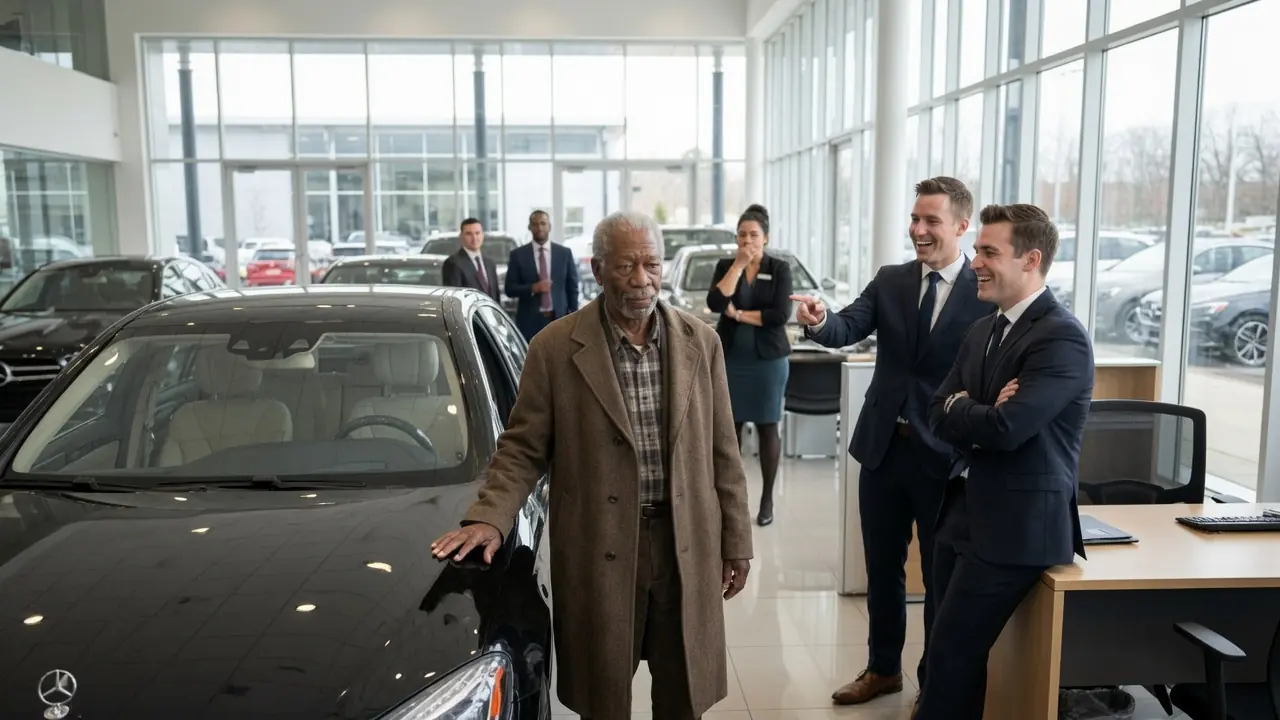
This time, he was their boss.
The general manager's face turned pale as he stared at the documents in the old man's hand. The papers were real. There was no mistake. The dealership—the very place where they had insulted him—now belonged to him.
Gasps filled the showroom. Some of the salesmen took a step backward as if they had seen a ghost. No one spoke. No one dared.
The elderly man finally broke the silence. His voice was calm, but it carried the weight of someone who had lived through storms and survived.
“So,” he said, his sharp eyes scanning the faces of those who had laughed at him, “what were you saying about me yesterday?”
The tension was unbearable.
But to understand how the entire dealership ended up standing speechless before William Turner, it was necessary to return to where it had all begun.
The sun hung lazily in the sky as William shuffled down the sidewalk. At seventy-two years old, he was in no hurry. Life had taught him the value of patience. Good things and bad things arrived in their own time, whether a person was ready for them or not.
William's old brown coat flapped slightly in the breeze. It had seen better days, just like him. His shoes were scuffed, his jeans slightly faded, and nothing about his appearance suggested wealth. He did not look like a man who could buy a luxury car in cash. He did not even look like someone who could comfortably afford coffee at an expensive café.
But appearances could be deceptive.
He reached the dealership, a flashy glass building filled with polished vehicles and bright red banners advertising limited-time deals. Salesmen in crisp suits stood near the entrance, eager to descend on anyone who looked profitable.
The moment William stepped inside, he felt the shift in the air. No one hurried toward him the way they did when a young, well-dressed couple entered behind him. No one welcomed him. Most of the employees barely acknowledged him at all.
William took a slow breath and approached the nearest salesman.
“Good afternoon,” he said politely. “I'm looking to buy a car.”
The salesman, a young man with slicked-back hair, barely glanced up. His name tag read Mark. He looked William over from head to toe, and his lips curled with amusement.
“Are you sure about that, old man?” Mark asked, tapping a pen against the desk.
William's expression remained calm. “Yes, I'm sure.”
Mark exchanged a smirk with another salesman across the room. The second man's name was Ryan, and he chuckled under his breath.
“All right, sir,” Mark said, forcing a false smile. “Why don't you tell me what kind of car you're looking for?”
“I was thinking about the new luxury model,” William replied, pointing toward a sleek black sedan near the center of the showroom.
Ryan burst out laughing. “That one? Are you sure you didn't mean the used section out back?”
Several other salesmen chuckled. Even some of the customers overheard and gave William pitying looks.
William stood quietly for a moment. Then he reached into the inner pocket of his coat and removed a thick stack of one-hundred-dollar bills.
The laughter stopped.
Mark's eyes widened. “Wait. You actually have—”
“I was planning to buy the car in cash,” William said, still perfectly calm. “But I don't think I want to anymore.”
Before Mark or Ryan could recover, William turned and walked out.
The laughter had become stunned silence, but the worst was still to come.
That night, William sat alone in his modest home, staring through the window at the stars. The mocking voices from the dealership still echoed in his mind, but he was not angry in the reckless way younger men often became angry. He had seen this sort of behavior before—people deciding another person's value by clothing, shoes, age, or race before learning anything about them.
Life, however, had a way of surprising people who placed too much confidence in appearances.
The next morning, William opened a drawer and removed a thick file. The folder contained information that would change everything. He smiled faintly to himself.
By the time he walked back into that dealership, no one would ever laugh at him again.
The morning air was crisp when William stepped outside. He adjusted the same brown coat and tucked the folder beneath his arm. With every step, he felt the weight of years of work and experience pressing against his chest.
He did not think of himself as a vengeful man. Revenge was usually loud, wasteful, and temporary. What William believed in were lessons. Life had taught him plenty, and now it was time for several other people to learn one.
When he reached the dealership, he paused outside the glass doors. Inside, the salesmen laughed and chatted as though nothing had changed. They had no idea what was about to happen.
William stepped inside.
Mark noticed him first. His smirk returned immediately.
“Oh, look,” he said, nudging Ryan. “The old man's back.”
Ryan grinned. “What's wrong, sir? Couldn't find a nice used car somewhere else?”
A few of the other salesmen laughed. The receptionist, a young woman named Lisa, watched William with mild amusement.
William said nothing. He walked directly to the front desk and placed the folder on the counter.
“I need to see the general manager,” he said firmly.
Lisa blinked. “Do you have an appointment?”
“No.”
“Then I'm afraid—”
“Tell him it's about ownership,” William interrupted.
Something in his tone erased the amusement from her face. Lisa hesitated, picked up the phone, murmured a few words, then hung up.
“He'll be right out.”
Mark and Ryan were still grinning when a tall man in an expensive suit entered the showroom. Gregory Barnes, the general manager, was in his late fifties and carried himself with the sharp, calculating confidence of someone accustomed to controlling a room.
He looked William over just as his employees had done the day before.
“What can I do for you, sir?” Gregory asked. His voice was polite but distant.
William opened the folder, removed a document, and handed it across the counter.
Gregory skimmed the page lazily until he reached the bold words near the bottom. His face changed immediately. He read the section again, then turned the page and read the signatures.
His fingers tightened around the paper.
“Where did you get this?” he demanded.
William smiled slightly. “I bought it.”
The room went silent.
Gregory's breathing grew heavier as he examined the details. The ink was fresh. The signatures were valid. The transfer had been recorded. There was no mistake.
“This isn't possible,” Gregory muttered.
Mark and Ryan exchanged confused looks.
“What's going on?” Ryan whispered.
Gregory slowly turned toward them. His face had lost all color.
“He owns the dealership,” he said hoarsely.
A stunned hush spread across the showroom. Mark's jaw dropped. Ryan's smirk vanished. The other salesmen stared in disbelief, and Lisa raised a hand to her mouth.
William folded his arms.
“So,” he said quietly, “what were you saying about me yesterday?”
The answer lay in what had happened after William left the dealership the previous afternoon.
He had gone directly to the office of his lawyer, Robert Hayes, an old friend who had worked beside him for decades. Together, they had built businesses, made investments, survived downturns, and watched small opportunities grow into large fortunes.
When William entered Robert's office, the younger man looked up and smiled.
“What brings you here, Bill?”
William placed a newspaper advertisement on the desk. It announced that the dealership's owner was seeking a buyer.
“Remember this place?” William asked.
“I want it.”
Robert leaned back, rubbing his chin. “I see. Any particular reason?”
William's expression darkened. “I went there today. I needed a car. They treated me like garbage.”
“They don't know who you are, do they?”
“No.” William chuckled. “And that's the best part.”
Robert grinned. He recognized the look in William's eyes. It was the same expression William had worn decades earlier when he turned a small investment into a fortune.
“You've got the money,” Robert said, opening the file. “The owner has been trying to sell for months. If we move quickly, we can finalize the transfer by tomorrow.”
William nodded. “Do it.”
Now he stood inside the dealership holding the papers that made him the owner, watching the very people who had mocked him confront their mistake.
Gregory drew a slow breath. “Mr. Turner, I—”
William raised one hand. “Save it. I don't want apologies. I want actions.”
He turned to the employees gathered around the showroom.
“Let me tell you something about business,” he said. “It isn't only about money. It's about people. The way you treated me yesterday—is that how you treat every customer?”
No one answered.
“Because if it is,” William continued, “then you've been running this place wrong. That changes today.”
Gregory swallowed. “What do you mean?”
“I mean that from this moment forward, things will be different. New policies. New expectations. New attitudes.” His eyes shifted toward Mark and Ryan. “And some people may have to prove they deserve to work here.”
Mark's face tightened. “Sir, we—”
“If I had walked in wearing an expensive suit, you would have treated me differently,” William said, cutting him off. “That isn't how business should work, and it isn't how life should work.”
Gregory shifted uneasily. “Mr. Turner, please give us a chance.”
William studied the room. He saw fear, shock, guilt, and calculation. He had the authority to fire every person in the building, but he was not interested in destruction for its own sake.
“You'll get a chance,” he said at last. “But you're going to earn it.”
Everyone held their breath.
Then the front door swung open, and a tall, angry man stormed into the dealership. He was in his late forties, wearing an expensive watch and an even more expensive suit.
“Who the hell just bought my dealership?” he demanded.
The former owner had arrived, and he did not look pleased.
The air turned cold as Richard Callaway scanned the showroom. His gaze landed on William, and his lips curled in disbelief.
“You?” he spat. “This is some kind of joke, right?”
William remained calm. “No joke. I own the dealership now.”
Richard laughed bitterly. “An old man in a thrift-store coat? I've been running this place for fifteen years. There's no way.”
He snatched the documents from Gregory and searched them for an error. As he read line after line, the anger on his face gave way to disbelief. The transfer was valid.
“This isn't possible,” he muttered. “I was selling to an investor. Not—” He turned sharply toward Gregory. “Did you do this?”
Gregory raised both hands. “I swear I didn't know. I had no idea who he was when he came in yesterday.”
“Yesterday?” Richard looked at William. “You were here yesterday?”
William nodded. “I came to buy a car. I got laughed at instead.”
Richard's expression darkened. He turned on Mark and Ryan.
“Was it you two?”
The men suddenly found the floor very interesting.
Richard growled. “You idiots. Do you have any idea what you've done?”
Ryan cleared his throat. “Sir, we didn't know he was—”
“You didn't know?” Richard shouted. “What kind of salesman laughs at a paying customer? What kind of fool turns away a man holding cash?”
Mark tried to speak, but Richard cut him off.
“I don't want excuses.”
He faced William again. “Fine. You bought it. But I built this place. I made it successful. I am this dealership.”
“Not anymore,” William said.
Richard slammed the papers onto the desk. “You think you can run this place better than me? You're an old man with no experience selling cars.”
William gave him a faint smile. “I don't think I can. I know I can.”
Richard crossed his arms. “And what exactly do you plan to do, boss?”
William's smile disappeared.
“First, I'm going to fix this place. Right now, it's rotten. It's full of people who judge customers by their wallets instead of their character. That changes today.”
He turned to the employees.
“From now on, this dealership treats every customer with respect. Whether they're wearing a suit or a secondhand coat. Whether they pay cash or finance. Whether they look wealthy or poor. Everyone gets the same service. Understood?”
A few employees nodded. Others remained frozen.
“Second,” William continued, looking at Richard, “I don't need to know everything about selling cars to know how to run people. I've been doing that my entire life.”
Richard smirked. “And what about me? You think you can walk in and get rid of me?”
To everyone's surprise, William answered, “No.”
Richard blinked. “What?”
“I don't plan to fire you. In fact, I want you to stay.”
Murmurs moved through the room.
Richard narrowed his eyes. “Why?”
“Because you built this place. You know it better than anyone. But you let it decay. You let the wrong people take control.” William glanced toward Mark and Ryan. “Now you have a choice. Help me repair what's broken, or walk away.”
For the first time, Richard fell silent. He looked at William not as a poor old man in a worn coat, but as someone powerful and difficult to intimidate.
Finally, Richard exhaled. “And if I stay?”
“You follow my rules.”
A long pause followed. Then Richard shook his head and laughed quietly.
“You're either crazy or brilliant, Turner.”
“A little of both.”
“All right,” Richard said. “I'll stay. For now.”
William nodded. “Good.”
Then he turned to Mark and Ryan.
“Now, as for you two.”
Both men stiffened.
“You made a serious mistake. You have two choices. Resign and walk out now, or stay and prove you deserve your jobs.”
Mark swallowed. “How do we do that?”
William smiled. “Start by selling me a car properly this time.”
A nervous laugh rippled through the showroom. Even Richard smirked.
Mark and Ryan exchanged glances. They knew they had no better option.
“Of course, sir,” Mark said, straightening his tie. “Right this way.”
They led William through the showroom, their former arrogance replaced by uncertainty. Every employee watched. Richard leaned against a wall with his arms crossed, waiting to see what happened next.
“All right, sir,” Mark began. “Let's look at some of our top models.”
Ryan gestured toward a sleek black luxury sedan. “This is one of our best. Fully loaded, leather interior, heated seats, state-of-the-art technology. I think you'll love it.”
William ran a hand over the polished hood. “What's the price?”
“Seventy-two thousand dollars,” Ryan said.
William raised an eyebrow. “And?”
Ryan blinked. “And?”
“Tell me why this car is right for me.”
Mark cleared his throat. “As I said, it's a luxury model. Very stylish. Very comfortable.”
“I didn't ask whether it was stylish,” William said. “I asked whether it was right for me.”
Neither salesman answered.
William leaned against the car. “Yesterday, you assumed I couldn't afford anything here. Today, you're making a different assumption. You're pushing the most expensive vehicle because now you think I have money.”
He folded his arms. “Do you know what I need? What I like? How I'll use the car?”
Silence.
“That's the problem,” William said. “Sales isn't about the price tag. It isn't about forcing the most expensive car onto the lot's wealthiest-looking customer. It's about the customer. Until you understand that, you'll never be good salesmen.”
Mark and Ryan lowered their heads.
William looked at the rest of the employees.
“This isn't only about them. I know what this dealership has become. I know how you treat people who don't look profitable. That stops today.”
No one argued.
Before William could continue, the front doors opened and a woman entered. She appeared to be in her mid-thirties, wearing a simple blue blouse, jeans, and slightly worn shoes. She held a folder against her chest and approached the reception desk hesitantly.
“Excuse me,” she said. “I need help buying a car.”
Lisa gave her a professional smile that faltered slightly when she noticed the woman's clothing.
“Of course. Do you have a specific model in mind?”
“I don't know much about cars. I just need something reliable. My old one broke down, and I need to get to work.”
“What's your budget?” Lisa asked.
The woman's face reddened. “It isn't very much.”
Mark and Ryan exchanged a glance. Several salesmen looked away.
William noticed immediately.
“I'll help you,” he said.
The woman turned, surprised. “Thank you, sir.”
William invited her to walk with him. “Tell me about your needs. What kind of work do you do?”
“I'm a nurse. I work night shifts at the hospital across town.”
“So you need something reliable, fuel-efficient, safe, and comfortable for long drives.”
Her eyes brightened. “Yes. Exactly.”
“Then let's find the right car.”
For the next fifteen minutes, William walked through the lot with her. He asked about her budget, mileage, work schedule, safety concerns, and maintenance costs. Together, they found a simple, dependable sedan in excellent condition and within her price range.
The woman's eyes filled with tears.
“This is exactly what I was looking for,” she whispered. “And I can afford it.”
“Then let's get the paperwork started.”
She turned to him. “I can't tell you what this means. The last dealership I visited treated me like I didn't belong there. Like I was wasting their time.”
William's expression darkened. “Not here. Not anymore.”
As he led her inside, Mark and Ryan remained frozen.
“We should have done that,” Ryan said quietly.
Mark nodded. “Yeah.”
Richard, who had watched the entire exchange, gave a low whistle. “Turner, I have to admit, you really are shaking things up.”
William smirked. “Like I said, you haven't seen anything yet.”
He had barely taken two steps toward his new office when an angry voice exploded from the entrance.
“Where's my car?”
A furious man in his late forties stormed inside. He wore an expensive suit and watch, but his face was red with frustration. He slammed both hands onto the front desk.
“I bought a car from this place two months ago, and now the engine is ruined. I want my money back.”
The entire dealership froze. Employees exchanged nervous looks. Richard rubbed his temple.
William's jaw tightened. He had only begun repairing the dealership, and already he was about to learn how deep the damage went.
The man's voice echoed through the showroom.
“I spent my hard-earned money here, and you sold me a lemon. I want my money back now.”
Employees stole nervous glances at one another. Gregory stepped forward cautiously.
“Sir, please. Let's discuss this calmly.”
“Calmly?” the man snapped. “The engine died this morning. I had to call a tow truck just to move it out of my driveway, and now you want me to be calm?”
William watched from the side, studying everything—the man's posture, Lisa's discomfort, Gregory's hesitation, and the complete lack of urgency from Mark and Ryan, who had retreated to a corner and begun whispering.
He stepped forward.
“What's your name, sir?”
The man turned his anger toward him. “Jacob. Jacob Reed.”
“All right, Mr. Reed. I understand your frustration. Let's sit down and review the details.”
“I don't want to sit. I want my money back.”
“If you were in my position, wouldn't you want to understand the problem before making a decision?”
Jacob hesitated. William's steady tone drained some of the heat from the confrontation.
“Fine,” he said. “Five minutes. That's all you get.”
William nodded. “Lisa, pull up his file.”
Lisa typed quickly. “Mr. Reed purchased a two-year-old pre-owned sedan. It passed inspection before the sale.”
William looked at Jacob. “You said the engine failed this morning?”
“Yes. I took care of that car. I did everything right, and now it's useless.”
“Did a mechanic inspect it?”
Jacob removed a folded document from his jacket and slapped it onto the desk. “Right here.”
William read it carefully. The diagnosis was clear. The engine failure came from a defect that had almost certainly existed before the sale.
His expression hardened.
“Who handled this transaction?” he asked.
Gregory shifted uneasily. “Mark did.”
William turned. Mark froze.
“I don't remember anything being wrong with that car,” Mark said.
William held up the mechanic's report. “Then explain this.”
“Maybe the problem happened after he bought it.”
Jacob scoffed. “Don't even try that. My mechanic said this didn't appear overnight.”
William's voice remained controlled, but steel entered it. “Mark, did you know there was a problem before the sale?”
Mark opened his mouth, but no sound emerged.
“I don't know,” he finally said.
The silence became suffocating.
Then Richard spoke from the back of the room.
“I knew something was wrong with that vehicle.”
Every head turned toward him.
Richard pushed away from the wall and walked forward. “That sedan sat on the lot for months. It had already been returned once, but we put it back on the market after a basic inspection.”
William frowned. “Who approved that?”
Richard's gaze shifted toward Gregory.
Gregory's face paled. “I didn't think it was a serious issue.”
William drew a slow breath. “You knew the car had problems, and you still allowed it to be sold?”
“We were behind on the sales quota,” Gregory said, wiping his forehead. “I didn't want another return on record.”
Jacob's face reddened again. “So you knew, and you still sold me that piece of junk?”
William raised one hand before the argument could erupt.
“Mr. Reed, I apologize on behalf of this dealership. This never should have happened.”
Jacob crossed his arms. “What happens now?”
“You receive a full refund.”
Murmurs spread through the showroom.
Gregory's eyes widened. “Wait, William. We can't just—”
William gave him a sharp look. “Yes, we can.”
Gregory fell silent.
Jacob blinked. “Seriously?”
“You trusted us, and we failed you. It's our responsibility to make it right.”
Some of the tension left Jacob's shoulders. “I wasn't expecting that.”
William extended his hand. “I hope this dealership can earn your trust again someday.”
Jacob hesitated, then shook it. “I respect that.”
Lisa processed the refund. When Jacob left, William turned immediately to Gregory.
“You and I are going to have a long conversation about how this place will operate from now on.”
Gregory swallowed. “Understood.”
William faced Mark. “You're on probation.”
Mark paled. “Sir, wait—”
“I could fire you today. Instead, I'm giving you a second chance. Prove you deserve it.”
“Yes, sir.”
Ryan shifted beside him, clearly wondering whether he would be next.
William looked over the entire staff.
“Let today be a lesson. We do not cut corners. We do not deceive customers. We do not take advantage of people. That's the old way of doing business. Anyone who cannot accept the new way is free to leave.”
No one moved.
Richard chuckled. “Turner, I have to admit, this is the most fun I've had in years.”
William smirked. “I'm glad you're enjoying yourself.”
Just then, the dealership doors opened again.
A sharply dressed man in a navy suit entered. He had the unmistakable air of someone accustomed to influence. His silver hair was neatly combed, his expression unreadable, and his presence changed the atmosphere instantly.
Lisa drew a sharp breath.
Mark whispered, “Oh, no.”
William frowned. “Who is he?”
Richard gave a low whistle. “Thomas Langley. One of the most powerful automotive executives in the state.”
“And why is he here?”
“Because he controls half of this dealership's supply contracts.”
William felt a small tightening in his stomach. Whatever was coming would not be easy.
The moment Langley crossed the showroom, every employee straightened. Even Gregory, still shaken by the morning's events, looked as though he had swallowed something sour.
Langley walked toward William, polished shoes clicking against the tile.
“You must be William Turner,” he said. His voice was smooth, but an edge ran beneath it.
William extended his hand. “That's right.”
Langley stared at the hand long enough to make the insult deliberate, then shook it briefly.
“I've heard some interesting things this morning,” he said, adjusting his cuffs. “Imagine my surprise when I learned that my business partner, Richard Callaway, is no longer in charge.”
Richard crossed his arms. “Trust me, Langley. I was just as surprised as you.”
Langley's jaw tightened. He returned his attention to William.
“I don't like surprises, Mr. Turner. And I especially dislike sudden leadership changes involving businesses connected to my money.”
“I understand.”
“Do you?”
William nodded. “You're here to decide whether your investments are secure. You're wondering whether this dealership under my ownership will become a liability.”
Langley's lips curled faintly. “At least you're direct. That saves time.”
He walked slowly around the showroom.
“I have a reputation, Mr. Turner. I have spent decades ensuring that the dealerships I work with maintain a certain standard. I don't work with amateurs.”
“Then it's fortunate that I'm not one.”
A few employees exchanged anxious looks. Richard gave an amused whistle.
Langley's face darkened. “How many cars have you sold?”
“None.”
“Then explain how you intend to run a business you know nothing about.”
“By understanding what this place was supposed to be. By repairing what is broken. By making sure we sell vehicles with integrity instead of deception.”
Langley laughed softly. “Integrity. How charming.”
“Is it?”
“Listen, old man. I am—”
“I am an old man,” William interrupted, “but I'm not a fool. I know why you're here. You're worried about your bottom line. You want to know whether I'm going to interfere with the way things used to be done.”
Langley's smile did not move. “Are you?”
“If you're asking whether I will tolerate dishonest sales, predatory contracts, and unreliable vehicles being pushed onto good people for quick money, then yes. I am changing things.”
“And if I don't approve?”
William smiled. “You're free to take your business elsewhere.”
The entire room went silent.
Langley's smirk faltered for a fraction of a second. Then he chuckled.
“Interesting. Very interesting.”
He removed his phone, tapped the screen, and slipped it back into his pocket.
“I have another meeting. But I'll be watching this place closely. Let's see whether you can support those words, Mr. Turner.”
“I look forward to it.”
Langley turned and walked out, leaving tension behind him like smoke.
Richard exhaled. “That was enjoyable.”
Gregory wiped his forehead. “You do realize he can ruin this dealership?”
“Let him try.”
Gregory stared at William. “You want to fight Langley?”
“I don't want to. But if I have to, I will.”
Mark cleared his throat. “Sir, with respect, I don't think you understand how this business works.”
William turned toward him. “Then teach me.”
Mark blinked. “What?”
“Show me how things used to work here. Show me what was wrong, so I can fix it.”
Ryan looked uncertain. “You really mean that?”
“I do.”
For the first time, neither salesman looked smug or defensive. They looked unsure, perhaps even ashamed.
Richard chuckled. “This should be interesting.”
William looked at Gregory. “Gather the team. We're having a meeting.”
Gregory sighed and rubbed his temples. “This is going to be a long day.”
“Get used to it.”
Before William could reach his office, his phone vibrated. The number was unfamiliar.
He answered. “Hello?”
A woman's voice came through the line, urgent and anxious.
“Mr. Turner, you don't know me, but I need your help. Please. It's about the dealership.”
William's stomach tightened. “Who is this?”
There was a pause.
“My name is Emily. I used to work there.”
The line went dead.
William stared at his phone. Something was very wrong.
He tried to return the call, but no one answered. He tried again with the same result.
He slipped the phone into his pocket and entered the meeting room. Employees had gathered along the walls and around the table. Some looked skeptical. Others looked nervous. Lisa sat with a notepad. Gregory leaned against his desk.
William stood before them.
“Let's talk about what's truly wrong with this place.”
Silence followed.
Mark cleared his throat. “Sir, if you don't mind me saying so, this dealership makes money. We're one of the top locations in the area.”
William nodded. “How do we make that money?”
Mark hesitated.
Ryan finally answered. “We push high-interest financing. We sell unnecessary features. We move vehicles that perhaps shouldn't be sold.”
The room shifted uncomfortably.
“So you deceive customers,” William said.
Gregory scoffed. “It's business. Every dealership does it. If we don't, we lose money.”
“Not anymore.”
Murmurs moved through the room.
“You don't understand what you're saying,” Gregory argued. “If we don't push financing, we lose commission. If we don't upsell, we miss targets. If we don't move problem vehicles, they become dead inventory.”
“Then we'll find another way.”
“With all due respect,” Mark said, “that's not how this industry works.”
William's voice hardened. “Then perhaps the industry needs a new way.”
Richard laughed quietly from the back. “This is more entertaining than any board meeting I ever attended.”
William ignored him and looked at the employees.
“I know change is difficult. But understand this clearly: if you do not want to be part of an honest dealership, you may leave. No hard feelings.”
A few salesmen exchanged glances, but no one stood.
“Good,” William said. “Then let's get to work.”
His phone buzzed again.
Unknown number.
“Excuse me.”
He stepped into the hallway and answered. “Emily?”
“Mr. Turner, I need to meet you in person.”
“Who are you, and what is happening?”
“I worked in finance at the dealership. I was fired because I found something I wasn't supposed to find.”
William's pulse quickened. “What did you find?”
“I can't explain over the phone. Meet me at Pine Street Café in one hour. I'll tell you everything.”
The call ended.
William stood in the hallway for a moment, staring at the blank screen. Someone had just warned him that the dealership's problems went far beyond poor customer service.
One hour later, he pulled into the parking lot of Pine Street Café. It was a quiet place near the edge of town, with only a handful of cars outside.
Inside, a woman sat alone in a rear booth, both hands wrapped around a coffee cup. She appeared to be in her late twenties, with dark hair tied in a loose ponytail. Her leg bounced beneath the table, and she looked toward the door every few seconds.
William approached carefully.
“Emily?”
She startled, then nodded. “Mr. Turner.”
He slid into the seat opposite her. “You have my attention.”
Emily drew a deep breath. “I worked in the finance department. My job was to process loans and finalize contracts.”
William nodded for her to continue.
“At first, everything seemed normal. Then I noticed patterns. Customers were receiving financing deals that didn't make sense. Interest rates were being increased after approvals. Some contracts had signatures that didn't look right.”
William's brow furrowed. “Are you saying the dealership committed fraud?”
“I'm saying signatures were forged on financing agreements.”
His stomach tightened. “Who was responsible?”
Emily hesitated before answering in a whisper.
“Gregory.”
“Are you certain?”
“I saw him alter documents more than once. He changed numbers, adjusted terms, and made deals appear better on paper than they truly were. When I began asking questions, I was fired.”
William leaned back slowly. The problem was no longer merely unethical. It was criminal.
Emily leaned across the table. “I didn't call only to tell you. I still have proof.”
William's eyes locked onto hers. “What kind?”
She reached into her bag and removed a small flash drive.
“I copied files before they dismissed me. Customer contracts, interest-rate adjustments, internal notes. Everything I could access.”
She slid it across the table.
William picked it up. It weighed almost nothing, yet he understood the power inside it.
“This is dangerous information,” he said.
“I know. That's why I need you to handle it.”
“I will.”
As William stood, Emily caught his wrist.
“Be careful. If Gregory learns you have this, he won't simply let you expose him.”
William held her gaze. “I'm counting on that.”
Back at the dealership, Gregory sat alone in his office when his phone rang.
“We have a problem,” a low voice said.
“What kind?”
“Turner met with Emily. She gave him something.”
Gregory shot to his feet. His face darkened.
William Turner had become a serious problem, and now Gregory believed he had to be dealt with.
William returned to the dealership and sat alone in his office with the flash drive on the desk. The weight of Emily's warning pressed against him. Forgery. Fraud. Predatory financing. Gregory had been running the business like a factory for deception.
William could have gone directly to the authorities, but instinct told him Gregory would fight. A man bold enough to forge signatures would also be bold enough to destroy evidence, intimidate witnesses, or fabricate an explanation.
When desperate people felt cornered, they became dangerous.
A knock sounded at the door.
William slipped the flash drive into his pocket. “Come in.”
Lisa looked inside. “Gregory wants to see you in his office.”
“Did he say why?”
“No. But he didn't look happy.”
William stood. “Thank you.”
As he crossed the dealership, employees watched him with open curiosity. He entered Gregory's office without knocking.
Gregory sat behind the desk, fingers interlocked, his expression carefully neutral. His eyes, however, were sharp and calculating.
“Mr. Turner,” he said smoothly. “Please sit.”
William remained standing. “If you have something to say, say it.”
A slow smile appeared on Gregory's face.
“All right. Let's not waste time. I know you met with Emily.”
William did not react. “Do you?”
“Come on, old man. You think I don't keep track of things? I know she told you something.”
“Let's assume she did. Why does that concern you?”
Gregory leaned back. “Because she's a liar. A disgruntled former employee trying to create trouble. I would hate for my new boss to become entangled in baseless accusations.”
“What if the accusations aren't baseless?”
For a fraction of a second, Gregory's jaw tightened. Then he laughed.
“William, you've owned this place for two days. Do you truly think you understand how this business works?”
“I understand honesty. I also understand when someone is covering his tracks.”
Gregory's eyes darkened. “You don't want to make an enemy of me.”
William smiled faintly. “Then perhaps you shouldn't have made one of me first.”
The tension in the office became suffocating.
Finally, Gregory stood. “We can resolve this quietly. Whatever she gave you, hand it over. I'll make sure this misunderstanding disappears.”
“No.”
Gregory's fingers curled against the desk. “You don't want to do this.”
“Oh, but I do.”
Gregory's polished mask cracked. “Fine. You want to play hardball? Let's see how long you last.”
William adjusted his coat. “I've lasted a very long time, Gregory. And I'm just getting started.”
He turned and walked out, leaving Gregory behind with clenched fists.
That night, William sat in his study with the flash drive connected to his laptop. Contracts, spreadsheets, altered interest rates, scanned signatures, and internal messages filled the screen.
It was all there.
As he scrolled, one name caught his attention.
Thomas Langley.
William leaned closer. Langley had approved multiple financing programs tied to inflated rates and forged agreements. His authorization appeared again and again. Gregory was not acting alone.
This was not a crooked manager running a private scheme. Langley was involved.
Across town, Thomas Langley sat in a sleek office, drinking whiskey when his phone buzzed.
“Turner has the files,” the caller said.
Langley's jaw tightened. He slowly set down the glass.
“Then we have a problem.”
He drummed his fingers against the desk.
“Handle it.”
The room was dark except for the glow of William's laptop. He continued studying the files until the numbers began to blur. The deeper he looked, the clearer the pattern became. The inflated interest rates, forged signatures, and predatory loans were not isolated incidents. They were part of an organized system designed to extract as much money as possible from customers who trusted the dealership.
A faint sound outside made him sit upright.
A click.
Then the soft crunch of footsteps on the gravel beside his house.
William closed the laptop and listened. His instincts warned him that someone was standing near the driveway.
He moved quietly to the window and lifted the edge of the blind. A dark figure stood near the edge of the property, almost hidden beneath the streetlights.
William's hands tightened. He had survived too much to be easily frightened, but this was no longer an argument over business practices. Someone wanted him to understand that they knew where he lived.
He reached for the old wooden bat he kept beside the door. He did not seek violence, but he had no intention of allowing a stranger to enter his home unchallenged.
By the time he opened the front door, the figure was moving away. William stepped onto the porch, but whoever had been there disappeared between the shadows before he could identify them.
A white envelope lay on the doorstep.
William picked it up and opened it. Inside was a single sheet of paper bearing three words in bold black letters.
STOP DIGGING.
His grip tightened around the page.
They knew about the files. They wanted fear to accomplish what money and intimidation had not.
William carried the note inside, placed it beside his laptop, and stared at it for a long moment. Then he smiled without humor.
The warning had confirmed that he was close to something important.
He arrived at the dealership earlier than usual the next morning. The employees were not gathered in their normal clusters. They whispered in pairs, glancing toward him before quickly looking away.
At the front desk, Lisa leaned closer.
“Sir, someone is waiting in your office.”
“Who?”
“A lawyer.”
William exhaled. “Of course.”
He walked into the office and found a man in an expensive charcoal suit sitting in William's chair, casually reviewing a file.
The man rose and extended his hand. “Mr. Turner. Elliot Crane. I represent Thomas Langley.”
William did not shake it. “I assumed as much.”
Crane smiled as though the slight did not bother him. “I'll be direct. My client has concerns.”
“I imagine he does.”
“Mr. Langley is a businessman. He dislikes disruptions.”
“And by disruption, you mean me.”
“Let's call it an opportunity instead.” Crane placed a document on the desk. “Mr. Langley is offering to purchase the dealership from you for a very generous price.”
William glanced at the number. It was high enough to tempt almost anyone. He barely considered it.
“No.”
Crane raised an eyebrow. “No?”
“I did not buy this dealership to resell it. I bought it to repair it.”
The lawyer sighed. “Mr. Turner, I strongly recommend that you reconsider.”
“And I strongly recommend that you tell Langley I don't frighten easily.”
Crane's pleasant expression faded. “That's unfortunate. My client hoped you would be reasonable.”
“Reason is what brought me here, and it is what will keep me here.”
Crane collected his papers and briefcase.
“Then I suppose you've left us no choice.”
At the door, he looked back.
“A word of advice, Mr. Turner. Some men dislike unfinished business. My client is not a man you want as an enemy.”
When the lawyer left, the office remained heavy with the threat.
Langley wanted William gone. If money failed, he would use another method. William needed decisive proof before Langley had time to destroy it—or him.
He called Emily.
“I need your help.”
“What kind?” she asked warily.
“The files you gave me are strong, but I need something that connects Langley directly to Gregory's actions. Something he cannot explain away.”
Emily remained silent for a moment.
“I may know where to look.”
“Where?”
“There is a storage room in the dealership basement. They keep old records there—documents they don't want anyone finding. I saw Gregory carry files downstairs several times, but I never had access.”
“Do you think the original records are there?”
“I know some of them are.”
William looked through the office window toward Gregory, who was speaking to a salesman across the showroom.
“Meet me here after closing.”
Emily hesitated. “Are you sure?”
“We don't have another choice.”
That evening, long after the last customer and employee had left, William waited near the rear entrance. Emily arrived wearing a dark jacket with the hood raised. Her eyes moved nervously across the empty parking lot.
“This is reckless,” she whispered.
William gave her a small smile. “I've done more reckless things.”
They entered the darkened dealership and moved through the silent corridors. Without the voices of customers and employees, the building felt unfamiliar. Showroom lights reflected faintly from the polished vehicles like watchful eyes.
Emily led him down a narrow staircase to the basement. At the end of the corridor stood a locked metal door.
“This is it.”
William removed a key he had discreetly copied from Gregory's office ring earlier that day. He inserted it into the lock.
The mechanism clicked.
The door opened onto a cramped storage room lined with dusty metal shelves. Boxes were stacked almost to the ceiling. Old contracts, invoices, financing records, and customer files filled every available space.
Emily switched on a flashlight. “Start with anything marked private, executive, or vendor.”
They searched quickly but carefully. William opened boxes and examined folders while Emily moved along the opposite wall.
Minutes passed.
Then Emily stopped.
“I found something.”
She held up a thick envelope labeled PRIVATE—DO NOT REMOVE.
William opened it.
Inside were financial reports, secret account records, original contracts, and direct written instructions from Thomas Langley ordering Gregory to manipulate financing terms. Some messages specified which customers should receive inflated rates. Others directed Gregory to replace original pages after signatures had been collected.
William felt a slow surge of anger.
“This is everything,” Emily whispered.
Before he could answer, footsteps sounded in the hallway.
The basement door slammed shut.
Emily drew a sharp breath. “Someone's here.”
William pulled her behind a row of filing cabinets.
“Stay quiet.”
The footsteps approached slowly. A beam of light swept across the walls.
“Come out, old man,” Gregory called.
Emily clutched the envelope against her chest. William remained perfectly still.
“I know you're here, Turner.”
The flashlight beam passed over the shelves.
“I warned you,” Gregory continued. “You should have accepted the offer. It would have made things easier.”
The light moved closer.
“You think you're some kind of hero, but men like you do not win against people like Langley.”
Gregory stepped deeper into the room. One hand held the flashlight. The other remained inside his jacket.
William saw the outline of a firearm.
Gregory removed his phone and made a call.
“Yes. They're here. Basement.”
He ended the call.
More people were coming.
Emily touched William's sleeve and silently formed the words, What do we do?
William waited until Gregory turned toward the opposite shelves. Then he grabbed a heavy metal file box and threw it across the room.
The box crashed against a shelf, scattering documents. Gregory spun toward the sound.
William lunged from hiding and caught Gregory's wrist before he could draw the weapon. He twisted sharply, forcing the flashlight to the floor.
Gregory grunted. “You old—”
William shoved him backward into the shelving. The metal frame rattled violently.
“Run!” William ordered.
Emily sprinted toward the exit with the envelope. William followed.
They raced up the narrow staircase, but the outer door would not open.
“It's locked,” Emily said, pulling desperately at the handle.
Behind them, Gregory was recovering.
William looked around. A smaller maintenance door stood beside a bank of pipes.
“This way.”
They entered a narrow concrete passage smelling of dust, oil, and damp metal. Pipes ran along the ceiling. William had spent enough time inside factories and commercial buildings to know that service corridors nearly always had an emergency exit.
At the far end, he saw a rusted metal door.
They ran toward it.
Behind them, the basement door burst open. Multiple footsteps thundered into the corridor.
William and Emily pushed against the emergency door. It groaned but did not move.
“Again,” William said.
They drove their shoulders into it together.
The door shifted an inch.
A gunshot cracked through the basement. The bullet struck somewhere above the pipes, sending a shower of dust into the corridor.
Emily gasped.
William turned. Gregory stood at the far end with a handgun, accompanied by two men in dark suits.
Gregory smiled coldly. “End of the line, Turner.”
William moved in front of Emily.
“You truly want to do this?” he asked.
“You still don't understand. Langley doesn't lose. You're only another loose end.”
Emily held the envelope tighter. “You won't get away with this.”
Gregory laughed. “That's charming.”
He raised the weapon.
At that instant, the emergency door behind William burst inward. Bright headlights flooded the passage.
Richard Callaway stepped through, holding a tire iron in one hand.
“I hate to interrupt,” he said, “but I don't like the way this party is going.”
Gregory stared. “What the hell are you doing here?”
“Making things interesting.”
Before Gregory could redirect the gun, Richard swung. The tire iron struck Gregory's wrist. The weapon clattered across the concrete.
Gregory cried out and grabbed his arm.
William seized Emily's hand. “Go!”
Richard backed through the doorway while the two men hesitated, uncertain whether to pursue without the gun.
“Get in the car!” Richard shouted.
They ran into the cold night. Richard's vehicle waited nearby with the engine running. William and Emily climbed inside, and Richard slid behind the wheel.
“Hold on.”
The tires screamed across the pavement as the car accelerated from the lot.
William looked through the rear window. Gregory and the two men emerged from the basement, anger visible even at a distance.
Emily shook beside him, still clutching the envelope.
“We have it,” she whispered. “We have everything.”
“Yes,” William said. “Now we have to use it.”
For several minutes, no one spoke. The car moved through the empty highway darkness while the weight of what had happened settled over them.
Richard finally broke the silence.
“Well,” he said, “that was fun.”
William turned toward him. “You call that fun?”
“At least I finally got to hit Gregory. I've wanted to do that for years.”
Emily exhaled shakily. “They were going to kill us.”
William nodded. “And now they know we won't stop.”
Richard's amusement faded. “What's the plan, Turner? You've officially angered some very powerful people.”
William rubbed his temples. They had the proof: altered contracts, forged documents, secret accounts, and instructions connecting Langley directly to the fraud. But if they simply turned it over quietly, Langley's lawyers might delay the case and bury the story for years. If they approached a single reporter, Langley could pressure the publisher or obtain an injunction before the evidence spread.
They needed a strategy that moved faster than Langley's influence.
“We don't merely expose him,” William said. “We destroy the structure protecting him.”
Emily stared. “How?”
“Langley's empire depends on reputation. Investors trust his name. Manufacturers trust his contracts. Banks trust his financial statements. Once that credibility disappears, everything else follows.”
Richard glanced at him. “What are you proposing?”
“We release the evidence widely and simultaneously. Not to one police department. Not to one reporter. To regulators, news organizations, investors, lenders, manufacturers, and every partner whose money depends on Langley's honesty.”
Emily frowned. “You mean leak it ourselves?”
“We control the timing and the evidence. He won't have time to silence everyone.”
Richard gave a low whistle. “Bold.”
“If we move slowly, he attacks us individually. If we move all at once, he has to defend himself everywhere.”
“What if he comes after us again?” Emily asked.
“He already has.”
She looked down at the envelope, then nodded. “Let's do it.”
William turned to Richard. “Do you still have contacts in the industry?”
Richard smiled. “I was in this business long before you bought my dealership. I know everyone.”
“We need investors, competitors, and former partners—people with enough influence to keep the evidence alive after it becomes public.”
“I know exactly whom to call.”
The next morning, William, Emily, and Richard gathered in the dealership office before opening. William reviewed the flash-drive files while Emily scanned the basement documents. Richard spent hours on the phone.
Emily created a secure distribution list that included major news organizations, the state attorney general's consumer-protection division, federal financial regulators, lending institutions, automotive manufacturers, and several law firms already representing customers in financing disputes.
“Everything is ready,” she said.
“Send it to all of them,” William replied. “At the same time.”
Her fingers moved across the keyboard.
“Done.”
Richard ended another call and leaned back with satisfaction. “You have the attention of several people who have wanted Langley vulnerable for years. They despise him almost as much as he despises losing control.”
“Good.”
The dealership opened at nine. Employees arrived unaware that the most powerful man connected to their business was about to lose control of his empire.
At ten fifteen, Gregory walked through the front doors.
His face was bruised, and his wrist was wrapped, but he did not come alone. Two men in dark suits entered behind him.
The showroom fell silent.
Gregory stopped in front of William.
“You made a mistake, old man.”
William did not move. “Did I?”
“You have no idea who you're fighting.”
“And you have no idea who you've already lost to.”
Gregory's smile faltered. “What are you talking about?”
William removed his phone and turned the screen toward him.
A breaking-news banner filled the display.
AUTOMOTIVE EXECUTIVE THOMAS LANGLEY LINKED TO LARGE-SCALE FINANCING FRAUD.
Below it were scanned documents, excerpts from internal messages, and reports that regulators had opened investigations.
Gregory's face drained of color.
“No.”
Employees reached for their own phones. Gasps spread across the showroom as the same story appeared on national business sites, local television feeds, and industry publications.
Richard gave a low whistle. “That moved quickly.”
Gregory's hands clenched. “Langley will destroy you.”
William's gaze did not waver. “Let him try.”
Gregory's phone rang.
The screen displayed Thomas Langley.
Gregory stared at it without answering.
“You should pick up,” William said.
The phone continued ringing.
At last, Gregory answered.
Langley's furious voice was loud enough for those closest to hear the first words.
“You idiot!”
The rest became a stream of shouted accusations. William did not need to hear every sentence. Gregory's expression told the story. Langley's investors were withdrawing. Banks were freezing accounts. Manufacturers were suspending contracts. Lawyers were calling. Regulators had requested records.
The empire was already cracking.
When Gregory ended the call, his hands trembled. He looked at William with something close to fear.
“What happens now?”
William's expression remained cold.
“You run, like every coward who gets caught.”
Gregory stepped backward. Then again.
For a moment, it seemed he might argue, threaten, or attempt one final act of defiance. Instead, he turned and walked out of the dealership for the last time.
The two men who had accompanied him followed without a word.
Within a week, the scandal spread across every major business network. Langley's partners withdrew. Manufacturers terminated agreements pending review. Customers filed lawsuits. Regulators seized records, and lenders opened audits covering years of transactions.
The image Langley had spent decades constructing collapsed almost overnight. His name, once associated with power and success, became shorthand for predatory financing and corporate corruption.
Gregory disappeared. Some employees claimed he had fled the state. Others believed he was hiding while lawyers negotiated his surrender. William did not waste time speculating. The evidence was now in hands capable of pursuing him.
The dealership, meanwhile, began to change.
The transformation was not immediate or easy. William knew that replacing one corrupt manager did not automatically repair a corrupted culture. He ordered an independent review of every financing agreement completed during Gregory's management. Customers whose contracts had been altered were contacted and offered corrected terms, refunds, or legal assistance.
Vehicles with unresolved mechanical histories were removed from sale until certified inspections were completed. Sales quotas were redesigned so employees no longer earned more for placing vulnerable customers into expensive loans. Add-on products had to be explained clearly and could not be hidden inside monthly-payment calculations.
William introduced a written promise at the front desk: every customer would receive the same greeting, the same access to inventory, and the same honest explanation of price regardless of appearance.
At first, some employees resisted.
“This will destroy our commissions,” one salesman complained during a meeting.
“No,” William replied. “It will destroy dishonest commissions. If you can only earn money by confusing customers, you don't know how to sell.”
Mark and Ryan remained on probation. William assigned them to review old customer complaints and personally call people they had dismissed or mistreated.
The first calls were painful.
Mark spoke to a retired teacher whom he had pressured into a high-interest loan despite her excellent credit. Ryan apologized to a young construction worker he had mocked for asking about a lower-priced vehicle. Some customers hung up. Others shouted. A few accepted the apologies but made it clear they would never return.
William did not protect the salesmen from those reactions.
“You wanted a second chance,” he told them. “A second chance does not erase the first mistake. It gives you the responsibility to face it.”
Over time, both men changed. The arrogance left their voices. They began asking customers questions before recommending cars. Mark discovered that he was better at helping families compare safety features than pushing luxury upgrades. Ryan became skilled at finding reliable vehicles for customers with strict budgets.
Neither transformation happened because William embarrassed them. It happened because he required them to practice a different way of working every day.
Richard stayed as promised. He knew the supply network, service department, and local market better than anyone. Without the pressure to defend his old leadership, he gradually admitted how much he had allowed to deteriorate.
“I thought the numbers meant everything was fine,” he told William one evening as they reviewed the month's results. “Sales were strong. Profits were rising. I ignored how we were getting there.”
“Numbers tell you what happened,” William said. “They don't always tell you what it cost.”
Richard nodded. “I should have known better.”
“Then know better now.”
Emily returned to the dealership, not as a frightened former employee but as director of compliance and customer finance. Her first task was to rebuild the approval system so that no single manager could alter terms after a customer's signature.
Every contract required a digital audit trail. Interest-rate changes triggered an independent review. Customers received plain-language summaries before signing. Employees could report misconduct directly to an outside compliance service without going through their managers.
Emily also created a refund and restitution program for people harmed by the old system. The work was exhausting, but each corrected contract felt like a small recovery of what Gregory and Langley had stolen.
One afternoon, Jacob Reed returned to the dealership. He had used his refund to buy a vehicle elsewhere, but he stopped by to speak with William.
“I heard what happened,” Jacob said. “The fraud, the investigation, all of it.”
William nodded. “You were one of many people this place failed.”
Jacob looked around the showroom. Mark was patiently explaining financing options to an elderly couple. Ryan sat with a young mother comparing maintenance costs. No one appeared rushed or dismissed.
“It feels different,” Jacob said.
“It is different.”
“Maybe the next time I need a car, I'll come back.”
William extended his hand. “We'll be ready to earn your trust.”
The nurse who had purchased the affordable sedan returned several weeks later for routine service. She brought a box of pastries for the staff and asked whether William was available.
“The car has been perfect,” she told him. “I haven't missed a single shift.”
“That is exactly what it was supposed to do.”
She smiled. “You treated me like a person before you treated me like a sale. I won't forget that.”
Word traveled. Customers who had avoided the dealership began visiting. Nurses, teachers, construction workers, retirees, young families, business owners, and wealthy buyers all entered through the same doors and received the same attention.
The business did not collapse under honest policies, as Gregory had predicted. It grew.
Trust brought repeat customers. Clear contracts reduced disputes. Thorough inspections lowered returns. Employees who once chased short-term commissions began building long-term relationships.
Within months, the dealership posted its strongest legitimate sales period in years.
William stood outside one afternoon watching cars enter the lot. People smiled as they walked toward the showroom. No one hurried to judge them by clothing before deciding whether they deserved attention.
Richard joined him, hands in his pockets.
“Well, Turner,” he said, “you actually pulled it off.”
William smiled. “I told you I would.”
Emily approached carrying a stack of clean, newly approved contracts.
“People are lining up to buy from us,” she said. “We've never been this busy.”
“Good. Let's keep it that way.”
Richard laughed. “What's next, boss?”
William looked at the building—the place he had bought almost on impulse, the place where he had been mocked, and the place he had chosen to transform rather than simply punish.
He thought of the day he had entered wearing an old coat and carrying cash. He thought of Mark and Ryan laughing, Gregory hiding defective cars and fraudulent contracts, and Langley believing influence made him untouchable.
Then he looked through the glass. Mark was helping a customer understand a warranty. Ryan was bringing coffee to an elderly man waiting for a test drive. Lisa welcomed a family without first studying their clothes. Emily reviewed a contract beside a new finance employee. Richard stood at William's side, no longer defending what the dealership had been.
William drew a deep breath.
“Now,” he said, “we build something better.”
For the first time in a long while, William Turner knew that he had done more than prove a room full of arrogant salesmen wrong. He had taken a business built on judgment and deception and turned it toward dignity.
The dealership would never be the same again.
Neither would the people inside it.