Eleven experienced cattlemen studied the Hereford bull in Pen Seven and reached almost exactly the same conclusion.
Finished.
Not dead.
Not useless.
Not even necessarily unhealthy.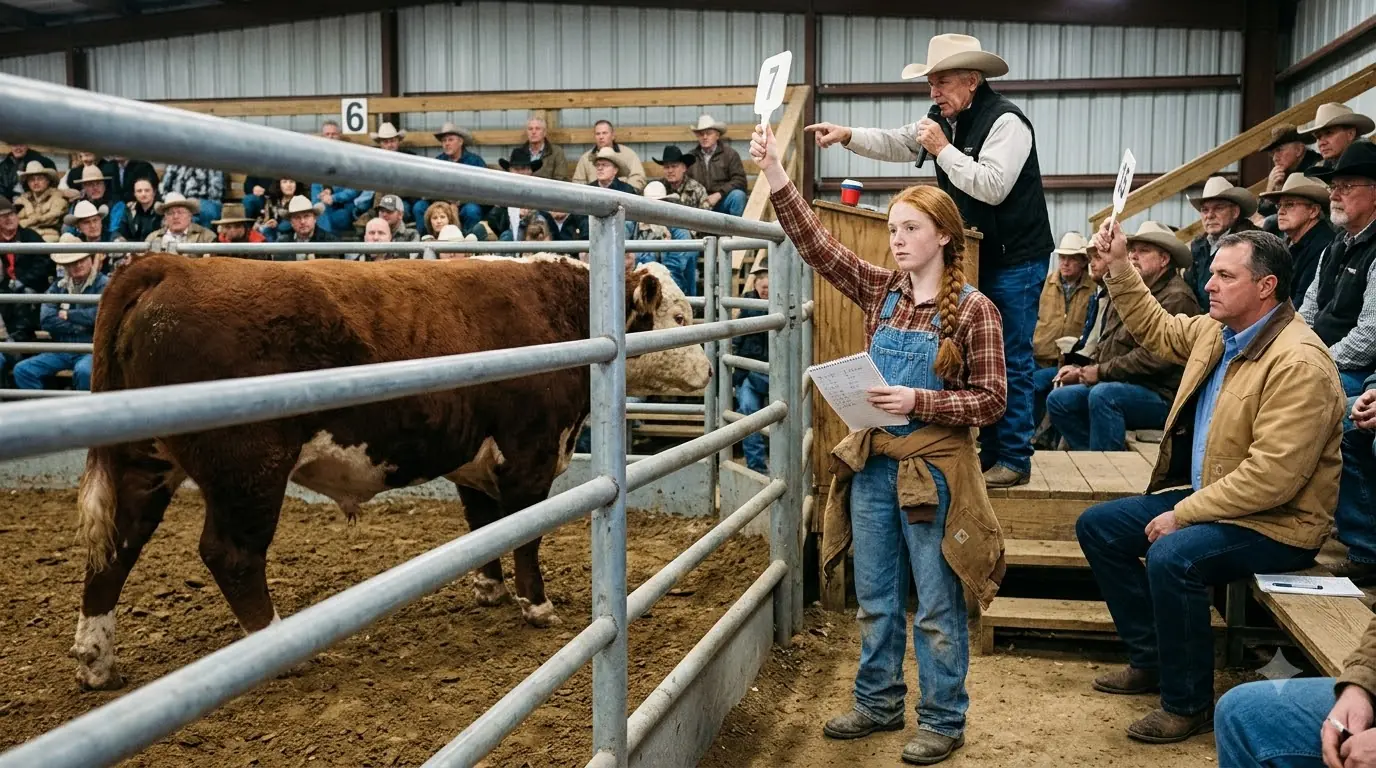
Finished in the only sense that mattered inside the Calhoun County livestock sale barn on the first Saturday of November 2019.
Finished as serious breeding stock.
The bull weighed 1,820 pounds according to the official sale sheet. He was four years old, heavy through the chest, wide over the back, and carried the kind of red body and white face that would have made him impressive from fifty yards away.
Then he walked.
His left rear leg swung perhaps two degrees differently from the right.
Not enough to make him stumble.
Not enough to make him refuse weight.
Just enough.
A livestock dealer named Curtis Harlan watched the bull cross Pen Seven twice, spit into a paper cup, and shook his head.
“That animal’s done.”
Three men beside him nodded.
A fourth asked, “Hip?”
“Hock, maybe.”
“Could be foot.”
Curtis shrugged.
“Doesn’t matter. Four-year-old bull walking wrong in November? I’m not paying breeding money to diagnose him.”
The men moved on.
By nine-thirty that morning, the verdict had spread through the barn without ever becoming official.
Nobody wrote FINISHED on the sale sheet.
Nobody needed to.
Livestock markets had their own weather.
An opinion started at one rail, moved through three conversations, crossed a coffee line, and within twenty minutes became something very close to fact.
At the edge of Pen Seven stood sixteen-year-old Marisol Vega.
Almost nobody noticed her.
She was barely five foot two.
Her fair freckled face made her look younger than sixteen when she wasn’t speaking, and her long copper-red hair had been braided over one shoulder before dawn because loose hair irritated her when she worked.
She wore faded blue denim overalls over a red-and-brown plaid shirt.
Dusty boots.
No makeup.
A cheap spiral notebook in her left hand.
Around her waist she had tied an old brown Carhartt jacket with a frayed cuff and a dark grease stain near the right pocket.
The jacket had belonged to her grandfather.
That was the only reason she wore it despite the heated sale barn.
Ernesto Vega had died eight months earlier.
He had been seventy-three.
He had worked cattle for more than fifty years.
And he had left Marisol three notebooks that almost everybody in the family considered worthless.
They were not diaries.
Ernesto would have laughed at the word.
The first notebook was green.
Cattle.
Tag numbers.
Birth weights.
Weaning weights.
Calving dates.
Sires.
Dams.
Temperament scores.
Feed notes.
Foot angles.
Pasture observations.
The second was blue.
Grass.
Rainfall.
Grazing rotations.
Hay yields.
Soil conditions.
Water levels.
Fence repairs.
The third was black.
Money.
Sale prices.
Vet costs.
Fuel.
Equipment.
Lease rates.
Bank terms.
County appraisal figures.
Occasionally, one-line opinions about people.
Don’t buy hay from Earl after rain. Lies about moisture.
Banker smiles too much when selling insurance.
And beside the name Gary Hendrick:
Never let a man tell you dirt is worthless while he is trying to buy it.
Marisol had read that sentence more than once.
That morning, the man himself was in the barn.
Gary Hendrick stood near the auction office wearing a tan jacket that looked like ranch clothing until somebody noticed it had never been worked in.
Fifty-five.
Tall.
Silver beginning at the temples.
Pressed blue shirt.
Dark jeans.
Expensive boots.
Gary had made his money in commercial construction, then moved into residential development.
During the previous decade, he had purchased thousands of acres across three counties.
Old cattle land went in.
Roads, ornamental ponds, stone entrance signs, and houses with names like Prairie Reserve came out.
Gary did not dislike ranchers.
He simply thought most of them misunderstood what their property was worth once cattle were removed from the calculation.
The Vega farm interested him for several reasons.
Eighty-seven acres.
County road access.
A low ridge ideal for homes.
Electric service already nearby.
And one boundary less than two miles from a highway improvement project the county had begun discussing quietly.
The farm had belonged to Ernesto and his wife, Rosa, for thirty-nine years.
Rosa died first.
Ernesto stayed.
When Ernesto died, ownership passed equally to his son Tomás Vega and daughter Elena Vega, Marisol’s uncle and aunt.
Marisol’s mother had died when she was nine.
Ernesto had raised her for long stretches after that.
Legally, however, the land did not belong to Marisol.
Not yet.
Elena lived in San Antonio.
Tomás had moved to Corpus Christi.
Neither wanted the ranch.
Both had taxes, mortgages, and lives elsewhere.
Six weeks after Ernesto’s funeral, Gary offered $612,000.
Tomás wanted to accept immediately.
Elena wanted $650,000.
Gary moved to $635,000.
They were negotiating.
Marisol had been told repeatedly that emotion was not a business plan.
She agreed.
That was why she brought the notebooks.
At 9:41, Pen Seven walked again.
Marisol crouched beside the rail.
The bull placed his left rear hoof down.
Heel first.
Then outside edge.
Then the toe.
She watched again.
Heel.
Outside.
Toe.
The hock remained stable.
No obvious swelling.
No hesitation when turning left.
No shortening of stride when bearing weight.
Marisol wrote:
LH rotates outward after contact. Hock stays centered. More toe than joint?
She turned three pages backward.
One of Ernesto’s notes from four years earlier was circled.
417. Cedar bull calf. Big hip. LH toe wants outside. Trim before 14 mo. Not structural. Watch heel.
Marisol stopped breathing for a second.
She looked at the sale tag.
Lot 417.
That could be coincidence.
She found another note.
417 sold Clay Mercer, 2016. $2,850 floor if comes back mature. Keep eye. Rosa 31 x Sentinel.
Marisol stared.
Then she looked at the bull.
The sale sheet identified the consignor as Clay Mercer Ranches.
Her heart began beating faster.
She checked the figure again.
$2,850.
Four years earlier Ernesto had written a floor price for a bull he no longer owned.
Why?
Below it was another line.
If feet hold, he proves north pasture program works.
That sentence made less sense.
Marisol had spent months trying to understand it.
North pasture program.
Ernesto had mentioned the north pasture constantly during his last three years.
The grass there was different.
Less improved Bermuda.
More native bluestem and side-oats grama.
He had reduced supplemental feed.
He had rotated cows aggressively.
Neighbors thought he was trying to save money.
Maybe he was.
But Notebook Two showed something else.
Weight gains.
Calf performance.
Rainfall normalized by acre.
Forage recovery.
Ernesto was running an experiment.
Not a scientific trial in the university sense.
A rancher’s trial.
Can smaller acreage produce competitive cattle if the pasture is managed better?
Marisol looked back at Pen Seven.
The bull stood with his head low.
A man slapped the rail.
The bull barely reacted.
Good temperament.
Marisol wrote another number.
1,820 pounds.
She knew current salvage value.
She knew likely breeding value if the leg was a hoof issue rather than a joint defect.
She knew what a bull of similar lineage could sell for privately.
She also knew exactly how much money she had.
Three thousand one hundred forty-eight dollars.
Her entire savings.
Most came from selling two calves Ernesto had gifted her years earlier.
Some came from repairing fence for neighbors.
Some from working weekends at Mendoza Feed & Supply.
The rest came from birthday checks she had never spent.
She could not afford to be sentimental.
Ernesto had hated sentimental purchases.
Once, when Marisol was eleven, she wanted to buy a skinny calf because it “looked sad.”
Ernesto asked, “What are you buying?”
“A calf.”
“No. You’re buying feed bills.”
She had cried.
He bought her ice cream afterward.
He still did not buy the calf.
Now Marisol wrote at the top of her page:
MAX = 2,852.
Not 2,850.
She added two dollars because her grandfather would have complained about round numbers.
At 10:31, retired county judge Paul Brewster noticed her.
Paul was seventy-one and had known Ernesto for forty years.
He approached the rail holding coffee.
“You buying cattle today?”
“Maybe.”
He looked into Pen Seven.
“That one?”
“Maybe.”
Paul studied the bull.
“You see him walk?”
“Yes.”
“You know what people are saying?”
“Yes.”
Paul took another sip.
“You disagree?”
“I’m still deciding.”
He smiled.
That answer sounded exactly like Ernesto.
“What’s the notebook say?”
Marisol closed it.
“Grandpa’s notes.”
“I figured.”
“You remember this bull?”
Paul looked again.
“No.”
“Clay Mercer bought calves from Grandpa?”
“For years.”
“How many?”
Paul shrugged.
“Enough.”
“Did Grandpa ever talk about Sentinel?”
That name changed Paul’s expression.
“Vega Sentinel?”
Marisol nodded.
“Best Hereford Ernesto ever owned.”
“How good?”
Paul laughed.