The black limousine pulled up to the gates of Riverside Music Academy just as the evening sun cast long shadows across the perfectly manicured lawn. Inside the car, Alexander Blackwood adjusted his expensive silk tie and checked his Rolex one more time. At 35, he was already considered one of the world’s most celebrated pianists, with sold-out concerts in Vienna, Paris, and New York. His long, pale fingers drummed impatiently against his leather briefcase as he waited for his driver to open the door.
“Remember to have the car ready by 9 sharp,” Alexander said without looking at the driver. “I don’t intend to stay at this small-town academy any longer than necessary.”
The driver nodded silently, used to his employer’s cold demeanor. Alexander stepped out of the car, his Italian leather shoes clicking against the stone pathway. He looked up at the modest brick building with barely concealed disdain. Riverside Music Academy was nothing compared to the prestigious conservatories he was accustomed to visiting, but his manager had insisted this appearance would be good for his image, showing that he cared about nurturing young talent in smaller communities.
The academy’s main entrance buzzed with activity as students and faculty prepared for the evening’s master class. Alexander strode through the doors, his presence immediately commanding attention. Conversations stopped mid-sentence as people recognized the famous pianist. He was exactly what they had expected—tall, impeccably dressed, with an air of superiority that seemed to follow him like an expensive cologne.
“Mr. Blackwood, welcome to Riverside Academy.” Professor Williams, the academy’s director, hurried over with an eager smile. “We’re so honored to have you here. Your reputation precedes you.”
Alexander offered a brief handshake, already scanning the room with critical eyes. The students looked nervous and underprepared. The faculty seemed competent enough, but this was clearly a far cry from the elite institutions he usually frequented.
“I trust everything is prepared for the demonstration?” he asked, his voice carrying a slight accent that made everything sound more important.
“Of course, of course. We have our best students ready to perform for you. I think you’ll be impressed by the talent we’re developing here.”
Alexander doubted that very much, but he nodded politely. As they walked through the academy’s halls, he noticed the worn carpets and outdated equipment. The pianos, while well-maintained, were clearly not the concert-quality instruments he was used to playing. Still, he reminded himself this was just one evening. He would give his demonstration, offer some patronizing advice to the students, and be back in his hotel suite before 10:00.
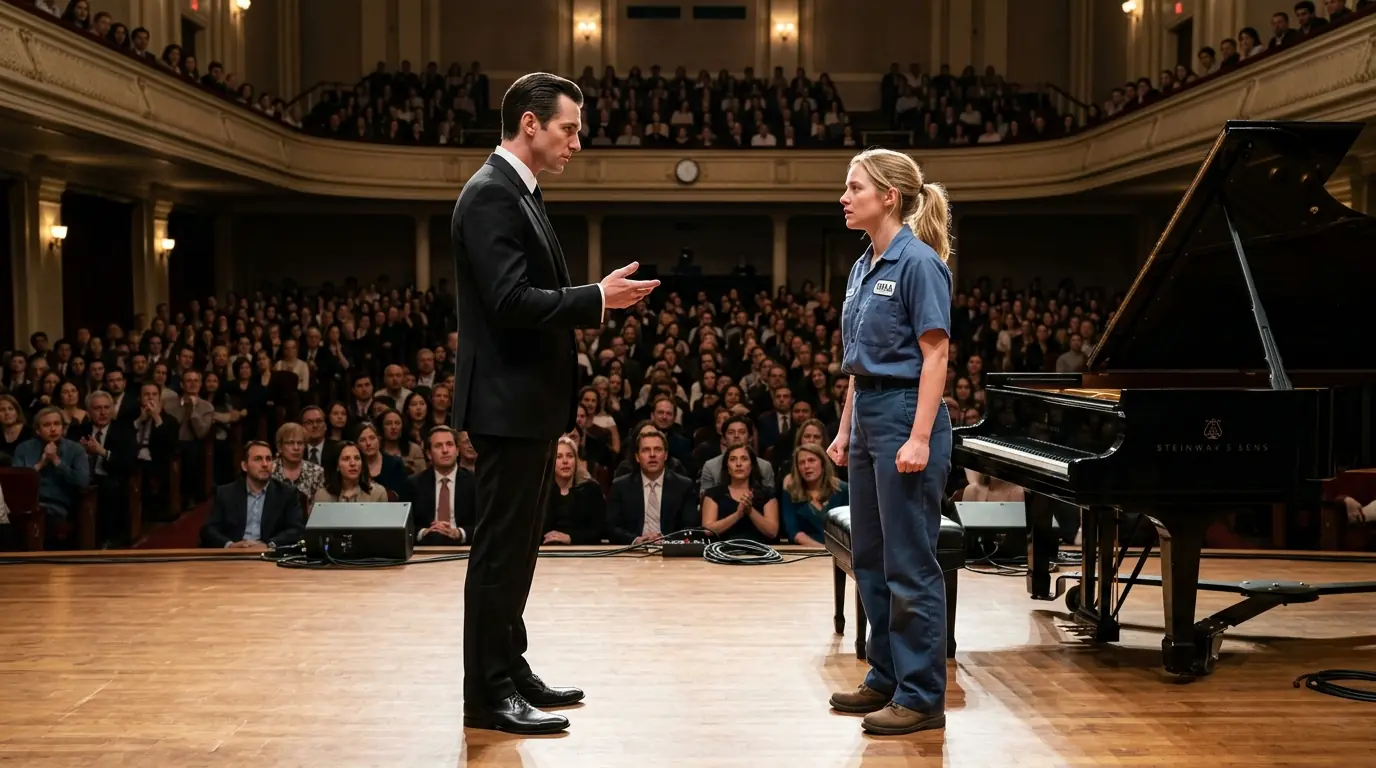
The master class took place in the academy’s main recital hall, a modest space that could seat about 200 people. Tonight it was packed with students, faculty, and local music lovers who had come to see the famous pianist in person. Alexander took his place at the Steinway grand piano, running his fingers over the keys with practiced precision.
For the next hour, he demonstrated various techniques, his fingers dancing across the keys with mechanical perfection. Every note was precisely placed, every phrase technically flawless. The audience watched in respectful silence, clearly impressed by his skill.
But something was missing.
The music, while perfect, felt cold and distant, like watching a beautiful but emotionless performance.
“Technical mastery is everything,” Alexander announced to the students after finishing a particularly complex piece. “Without proper technique, you cannot call yourself a true musician. I’ve spent 20 years perfecting my craft, studying under the world’s greatest masters. There are no shortcuts to excellence.”
Several students raised their hands to ask questions, and Alexander answered each one with the same condescending tone. He corrected their posture, criticized their hand positions, and made it clear that they had years of work ahead of them before they could even begin to approach his level of skill.
As the formal presentation ended, the academy hosted a small reception in the lobby. Local donors, faculty members, and advanced students mingled with refreshments, hoping to catch a moment with the visiting celebrity. Alexander accepted their praise with practiced grace, though he found their amateur enthusiasm somewhat tiresome.
It was during this reception that he first noticed her.
She was standing in the corner of the room, away from the crowd, quietly observing the festivities. Unlike the other attendees, who were dressed in their finest clothes for the occasion, she wore simple jeans and a plain sweater. Her dark hair was pulled back in a practical ponytail, and she seemed to be trying to make herself invisible.
What caught Alexander’s attention wasn’t her appearance, but her posture. She stood with the straight back and relaxed shoulders of someone who had spent years at a piano bench. Her hands, he noticed, bore the subtle calluses that came from regular practice. Yet she clearly didn’t belong with the academy students or faculty.
As he watched, a young student approached her with a question about a piece they were struggling with. The woman listened carefully, then offered a gentle suggestion about phrasing and dynamics. Her voice was soft, but there was something in the way she spoke about the music that made Alexander lean closer to hear.
“Try thinking of that passage as a conversation between two voices,” she was saying. “The left hand is asking a question, and the right hand is responding with emotion, not just notes.”
Alexander felt a spark of irritation. Who was this woman to be giving advice about musical interpretation?
He moved closer to the conversation, his presence causing the small group to fall silent.
“I couldn’t help but overhear,” Alexander said, his voice carrying that subtle tone of superiority that had become his trademark. “Are you a faculty member here?”
The woman looked up at him with calm eyes.
“No, I’m not.”
“A student, then?”
“I take some evening classes when I can afford them,” she replied quietly.
Alexander’s eyebrows rose slightly.
“I see. And you felt qualified to offer advice about phrasing and interpretation?”
A slight flush colored her cheeks, but she maintained her composure.
“I was just sharing what I’ve learned through experience.”
“Experience?” Alexander repeated, as if the word left a bad taste in his mouth. “And what exactly is your experience? Are you a performer? Have you studied at any recognized conservatory?”
The woman shook her head.
“No, nothing like that. I just… I love music. I’ve been playing since I was a child.”
“Playing?” Alexander said with a slight smile that didn’t reach his eyes. “Well, I suppose everyone needs a hobby. But perhaps you should be more careful about offering advice to serious students. Musical interpretation requires years of proper training and study.”
The group around them had grown larger, attracted by the tension in the conversation. Alexander was aware of the audience, and it only fueled his sense of superiority.
“This woman, whoever she was, represented everything he despised about amateur musicians—the belief that passion could somehow replace proper training and technique.”
“I didn’t mean to overstep,” the woman said quietly. “I was just trying to help.”
“Help?” Alexander’s voice carried across the room now, causing more heads to turn. “Tell me, what exactly do you do here at the academy? Are you a teacher? An administrator?”
The woman hesitated, clearly uncomfortable with the attention.
“I work here part-time… maintenance and cleaning, mostly. It helps pay for my classes.”
“This was exactly what he had suspected—a janitor who thought she could offer musical advice to serious students.”
“How fascinating,” he said, his voice dripping with false politeness. “A cleaning lady who fancies herself a music teacher. I suppose next you’ll be telling us you’re a concert pianist in your spare time.”
The woman’s face flushed deeper, but she didn’t back down.
“I never claimed to be anything more than someone who loves music. But I don’t think that love should be limited by what job someone has to do to survive.”
Alexander’s smile became more predatory.
“Love of music is admirable, of course, but there’s a difference between appreciation and expertise. You wouldn’t expect a janitor to perform surgery, would you? Music requires the same level of professional training and dedication.”
The room had gone completely silent now. Everyone could feel the tension building between the world-famous pianist and the quiet academy worker.
“I understand the difference,” the woman said, her voice steady despite the obvious embarrassment. “I never claimed to be an expert. I just believe that music speaks to everyone, regardless of their background or training.”
“How wonderfully democratic of you,” Alexander replied. “But I’m afraid music isn’t quite so accessible. True musical understanding requires years of study, proper technique, and most importantly, natural talent that can’t be taught.”
He paused, looking around the room at the faces watching their exchange.
“In fact,” Alexander continued, his voice taking on a theatrical quality, “I’d be willing to demonstrate exactly what I mean. If you’re so confident in your musical abilities, perhaps you’d be willing to put them to the test.”
The silence in the room stretched on for what felt like forever. Every eye was fixed on the woman in the corner, waiting for her response to Alexander’s cruel challenge.
She stood there, her hands clasped tightly in front of her, clearly feeling the weight of everyone’s stares. Alexander watched her with satisfaction, confident that she would back down.
But then something unexpected happened.
The woman lifted her chin slightly.
“All right,” she said simply. “I accept.”
A collective gasp went through the crowd.
Wonderful,” Alexander said, his voice carrying a note of triumph. “I do admire confidence, even when it’s misplaced.”
He turned to address the crowd, playing to his audience like the seasoned performer he was.
“Ladies and gentlemen, it seems we have ourselves a most interesting evening planned for tomorrow.”
Professor Williams stepped forward, looking uncomfortable with the turn of events.
“Now, Mr. Blackwood, I’m not sure this is entirely appropriate. Perhaps we could arrange something more… educational.”
“Nonsense.” Alexander waved him off. “This will be highly educational. These students need to understand the difference between amateur enthusiasm and professional excellence. What better way to demonstrate that than through direct comparison?”
The woman had remained silent during this exchange, but now she spoke up.
“What are the terms of this demonstration?”
Alexander’s eyes gleamed. This was the moment he had been waiting for.
“Oh, I think we should make it properly official, don’t you? After all, if we’re going to do this, we might as well do it right.”
He began pacing slightly, his performer’s instincts taking over as he addressed the room.
“Here’s what I propose. Tomorrow evening, 7:00, right here in this hall, we’ll each perform one piece of our choosing. The academy’s board of directors can serve as judges, along with any other qualified musicians present.”
“And the stakes?” someone called out from the crowd.
Alexander’s smile became predatory.
“Ah, yes, the stakes. Well, since our friend here seems so eager to prove herself, let’s make it worthwhile. The winner receives a full scholarship to the academy’s graduate program.”
Murmurs of excitement rippled through the room. A full scholarship was worth thousands of dollars and represented the kind of opportunity that could change someone’s life forever.
“And the loser?” the woman asked, though something in her tone suggested she already knew she wouldn’t like the answer.
“The loser,” Alexander said with theatrical flair, “agrees to never again offer musical advice to students of this academy. In fact, to make it truly meaningful, the loser will be banned from the academy premises entirely. After all, we wouldn’t want any confusion about who has the authority to teach music here.”
The room erupted in shocked whispers. This wasn’t just a friendly competition anymore. It was a high-stakes duel with life-changing consequences. Alexander was essentially betting his reputation against this woman’s ability to remain at the academy where she worked and studied.
“That seems rather extreme,” Professor Williams protested. “Surely we can find more reasonable terms.”
“Not at all,” Alexander replied smoothly. “If someone is going to challenge professional expertise, they should be prepared to face professional consequences. Besides, I’m sure our friend here is confident in her abilities, aren’t you?”
All eyes turned back to the woman. She had gone pale, clearly understanding the full weight of what was being proposed. If she lost, and how could she not lose against someone of Alexander’s caliber, she would lose not just her job, but her chance to continue her musical education.
“I…” she began, then stopped.
Alexander could see the doubt creeping into her expression. Good. Maybe now she would come to her senses and withdraw gracefully.
But then a voice spoke up from the crowd.
“She doesn’t have to agree to those terms.”
It was an older woman, someone Alexander hadn’t noticed before. She had silver hair and wore a simple but elegant dress.
“This is supposed to be a demonstration, not a punishment.”
Alexander turned his attention to the newcomer, slightly annoyed at the interruption.
“And you are?”
“Professor Linda Chun,” the woman replied calmly. “I teach music theory here, and I’ve been watching this conversation with great interest.”
Alexander recognized the name. Chun was well respected in academic circles, though she had never achieved the commercial success he had.
“Professor Chun, how lovely to meet you. I’m sure you understand the importance of maintaining professional standards.”
“I understand the importance of treating people with respect,” Chun replied, her voice carrying a quiet authority that made Alexander pause. “What you’re proposing isn’t a musical demonstration. It’s a public humiliation.”
“I disagree,” Alexander said, though he could sense the mood in the room beginning to shift. “I’m simply offering to demonstrate the difference between trained and untrained musicians. If that’s humiliating, perhaps the fault lies with those who overestimate their abilities.”
Professor Chun looked at him with the kind of steady gaze that made Alexander feel like a student being scolded.
“And what exactly do you gain from this demonstration, Mr. Blackwood? What purpose does it serve beyond satisfying your own ego?”
The question hung in the air like an accusation.
Alexander felt the room’s energy changing, people beginning to question his motives. This wasn’t going according to plan. He had expected to be seen as the reasonable professional putting an amateur in her place, not as a bully picking on someone less fortunate.
“I’m simply trying to protect these students from false teaching,” he said, his voice becoming slightly defensive. “Music is a serious art form that requires serious study. Allowing unqualified people to offer advice does more harm than good.”
“And who decides who is qualified?” the woman asked suddenly. Her voice was stronger now, as if Professor Chun’s support had given her courage. “You? Because you have more expensive clothes and play in bigger halls?”
Alexander felt a flash of anger.
“I decide because I’ve dedicated my life to mastering this art. Because I’ve studied under the world’s greatest teachers and performed for presidents and royalty. Because I’ve earned the right to call myself a professional musician.”
“And what have I earned?” the woman asked, stepping forward slightly. “What right do I have to love music? To find joy in playing? To share what little I know with others who are trying to learn?”
The room was completely silent now, everyone hanging on every word of this unexpected confrontation.
Alexander realized he was losing control of the narrative. What had started as a simple put-down was turning into something much more complex.
“You have the right to enjoy music as a hobby,” he said, trying to regain his composure. “But you don’t have the right to present yourself as someone qualified to teach it.”
“I never presented myself as anything,” the woman replied, her voice growing stronger. “I simply tried to help a fellow student who was struggling. I shared what I’ve learned through years of practice and study, even if that study didn’t take place in a famous conservatory.”
“Years of practice,” Alexander scoffed. “Playing piano as a hobby is hardly the same as professional training.”
“How do you know what my training has been?” the woman challenged. “How do you know anything about my background or my abilities? You’ve made assumptions based on my job and my clothes, but you’ve never heard me play.”
Alexander felt the conversation slipping away from him. This was not how things were supposed to go. He was the famous pianist, the one everyone had come to see. She was just a janitor who had overstepped her bounds. But somehow she was making him look like the unreasonable one.
“Fine,” he said, his voice turning cold. “If you want to prove yourself, then let’s settle this tomorrow night. But I won’t water down the terms. If you’re going to challenge my expertise, you need to be prepared for the consequences.”
The woman looked around the room, seeing the faces of students and faculty members who had become invested in this unexpected drama. Some looked sympathetic, others curious, and a few seemed almost eager to see what would happen.
“All right,” she said finally. “I accept your terms. Tomorrow night, 7:00, one piece each. Board of directors as judges. Winner gets the scholarship. Loser leaves the academy.”
Alexander felt a surge of satisfaction. Finally, things were back on track.
“Excellent. I trust you’ll choose something appropriate to your skill level. Perhaps a simple children’s piece.”
The insult was deliberate, designed to remind everyone of the vast difference between them.
But the woman didn’t react with anger or embarrassment. Instead, she simply nodded.
“I’ll choose something that means something to me,” she said quietly. “Something that represents who I am and why I love music.”
“How touching,” Alexander replied with false sweetness. “I’m sure it will be very… heartfelt.”
Professor Chun stepped forward again.
“This has gone quite far enough, Mr. Blackwood. I think you should reconsider.”
“The challenge has been made and accepted,” Alexander interrupted. “Unless, of course, our friend here would like to withdraw. I would certainly understand if she’s having second thoughts.”
The woman looked at him for a long moment, and Alexander saw something in her eyes that he couldn’t quite identify. It wasn’t fear or doubt. It was something else entirely, something that made him slightly uncomfortable.
“No,” she said simply.
The next morning came with a buzz of excitement that spread through Riverside Academy like wildfire. Word of the piano duel had traveled far beyond the academy walls, and by 10:00, the main office was fielding calls from local newspapers, radio stations, and even some music bloggers who had somehow heard about the unusual challenge.
Alexander woke up in his luxury hotel suite, feeling refreshed and confident. He ordered room service, fresh fruit, artisanal coffee, and croissants, and spent the morning answering calls from his publicist, who was both thrilled and concerned about the unexpected media attention.
“This could be fantastic for your image,” his publicist gushed over the phone. “The great Alexander Blackwood, champion of musical excellence, taking time to educate the masses. Very noble, very inspiring.”
“Exactly what I was thinking,” Alexander replied, sipping his coffee while gazing out at the city below. “Sometimes it’s important to remind people what true artistry looks like.”
Meanwhile, at the academy, the atmosphere was electric. Students clustered in small groups, discussing the upcoming performance with the kind of excitement usually reserved for major sporting events. The faculty was divided. Some thought Alexander’s challenge was unnecessarily cruel, while others believed it might serve as a valuable lesson about the importance of proper training.
But it was the woman at the center of it all who remained the biggest mystery.
She had arrived for her morning shift at 6:00, just as she always did, carrying her cleaning supplies and wearing the same simple clothes. She worked quietly through the halls, emptying trash cans and mopping floors, seemingly unbothered by the whispers and stares that followed her wherever she went.
“Did you hear what happened last night?” one student whispered to another as she passed by. “She actually accepted his challenge. Can you believe it?”
“I heard she’s been taking classes here for years,” another replied. “Maybe she’s better than we think.”
The woman continued her work without acknowledging the conversations, but those who looked closely might have noticed the slight tension in her shoulders, the way her hands gripped the mop handle just a little tighter than usual.
Professor Chun found her during lunch break, cleaning the windows in the main hallway.
“We need to talk,” she said gently.
The woman looked up, her face showing the first signs of the stress she had been hiding.
“If you’re going to try to talk me out of this, please don’t. I’ve already made my decision.”
“I’m not here to talk you out of anything,” Chun replied. “I’m here to make sure you understand what you’re walking into.”
They found a quiet corner in the faculty lounge, away from the curious eyes and ears of students. Chun poured two cups of coffee and sat down across from the woman, studying her face carefully.
“Tell me about your background,” Chun said simply. “The real story.”
The woman was quiet for a long moment, staring into her coffee cup.
“Why does it matter? Everyone’s already decided who I am based on what they can see.”
“Because,” Chun replied, “I’ve been teaching music for 30 years, and I can tell the difference between someone who plays piano as a hobby and someone who has real training. The way you talked about phrasing last night, the way you carry yourself, there’s more to your story than you’re letting on.”
A small smile played at the corners of the woman’s mouth.
“You’re very observant, Professor.”
“So tell me.”
The woman took a deep breath.
“My name is Grace. Grace Williams. I started playing piano when I was four years old. My grandmother was a concert pianist back in China before she moved to America in the 1960s. She gave up her career to raise a family, but she never stopped playing.”
Chun nodded, encouraging her to continue.
“I was… good. Very good. I won competitions, got scholarships, was accepted to Juilliard when I was sixteen.”
Grace’s voice grew softer.
“Everyone said I was a prodigy. That I had a gift.”
“What happened?”
“Life happened,” Grace said simply. “My grandmother got sick just before I was supposed to start at Juilliard. Alzheimer’s. My parents both worked two jobs just to pay the bills, and someone needed to take care of her, so I stayed.”
Chun felt her heart sink. She had seen this story before. Talented young musicians whose dreams were derailed by family circumstances, by the harsh realities of life that conservatory brochures never mentioned.
“For twelve years, I took care of her,” Grace continued. “I worked whatever jobs I could find during the day, and I took care of her at night. I kept playing, practicing on an old upright piano we had in the apartment, but my dreams of being a concert pianist… those had to wait.”
“And your grandmother?”
“She passed away two years ago.” Grace’s voice was steady, but Chun could see the pain in her eyes. “That’s when I moved here and started taking classes. I’m twenty-eight now, Professor. Too old to be a prodigy. Too old for most of the programs I once dreamed of attending.”
The pieces were falling into place for Chun. This wasn’t just some amateur who had been inspired by a few piano lessons. This was a trained musician who had sacrificed her career for family, who had spent years keeping her skills sharp while the world moved on without her.
“Does Alexander know any of this?” Chun asked.
Grace shook her head. “He never asked. He saw the uniform, the job, and decided he knew everything about me.”
“You could tell him. You could tell everyone. It would change how they see this whole situation.”
“Would it?” Grace asked. “Would it really matter? I’m still the woman who cleans these halls. I still work three jobs to pay for part-time classes. Those are the facts of my life now.”
Chun studied her carefully.
“So why did you accept his challenge? You must know how risky this is.”
Grace was quiet for a long moment.
“Because he’s wrong,” she said finally. “He’s wrong about music. About what makes someone qualified to love it and share it. He thinks music belongs only to people like him. People with the right background, the right training, the right connections.”
“And you’re going to prove him wrong?”
“I’m going to try.” Grace looked directly at Chun. “I may not win tomorrow night. He’s technically perfect, and I’ve been away from serious playing for years. But I’m going to show him that music isn’t about superiority or exclusion. It’s about connection, about touching people’s hearts.”
Chun felt a chill run down her spine. She had seen that look before, in the eyes of students who were about to attempt something extraordinary.
“What piece are you going to play?”
“Chopin’s Ballade No. 1 in G minor.” Grace’s voice was soft but determined. “It was my grandmother’s favorite. She used to say it told the story of every immigrant who gave up their dreams so their children could have better ones.”
Chun knew the piece well. It was technically demanding, emotionally complex, and absolutely beautiful when played with the right touch. It was also exactly the kind of piece that could either showcase a pianist’s abilities or expose their weaknesses without mercy.
“That’s a dangerous choice,” Chun said carefully. “It’s not just technically difficult. It requires a level of emotional maturity that comes from real-life experience.”
“I know.” Grace stood up, smoothing down her work clothes. “But it’s the right choice for me and for my grandmother’s memory.”
As Grace left the faculty lounge, Chun sat alone with her coffee, thinking about the events that had been set in motion. Across town, Alexander was probably practicing his chosen piece, confident in his ability to demonstrate his superior training and technique. He had no idea that he was about to face someone whose musical education had been shaped not just by conservatory training, but by years of sacrifice, loss, and the kind of life experiences that couldn’t be taught in any classroom.
The rest of the day passed in a blur of anticipation. Students and faculty found excuses to walk past the recital hall where maintenance staff were setting up extra seating to accommodate the larger-than-expected crowd. The academy’s board of directors held an emergency meeting to discuss the unusual situation, ultimately deciding that they would honor their commitment to serve as judges, though several members expressed concern about the proceeding.
Alexander spent the afternoon in his hotel room running through his chosen piece, Rachmaninoff’s Piano Concerto No. 2, the same piece he had performed hundreds of times in concert halls around the world. He played it flawlessly, as always, each note precise and technically perfect. To him, this was simply another opportunity to demonstrate his superiority, another chance to remind the world why he was considered one of the greatest pianists of his generation.
But as evening approached, something strange began to happen. Word of the challenge had spread beyond the local community, and people began arriving from neighboring towns and even from the state capital. Music teachers, conservatory students, retired musicians, and music lovers of all kinds came to witness what was being described as a David-versus-Goliath battle in the world of classical music.
The local news station sent a crew to cover the story, and several music bloggers set up livestreams to share the event with their followers. What had started as a simple demonstration of musical hierarchy was turning into something much larger, a public examination of what it meant to be a musician, and who had the right to claim that title.
As the sun set over Riverside Academy, the stage was set for a confrontation that would challenge everything both Alexander and Grace believed about music, talent, and the true meaning of artistry. Neither of them knew it yet, but this evening would change both of their lives forever.
The only question was who would be changed the most.
Seven o’clock was still hours away, but the academy was already buzzing with an energy that felt electric. Grace finished her regular work shift at 3:00 in the afternoon, hung up her cleaning apron for the last time that day, and quietly made her way to the small practice room in the basement that she had been using for months.
The room was barely larger than a closet, with an old upright piano that was slightly out of tune and a single window that looked out onto the parking lot. But for Grace, it had become a sanctuary. This was where she came every evening after work, where she slowly rebuilt the skills that years of caring for her grandmother had forced her to set aside.
As she sat down at the bench, her hands trembling slightly, she thought about all the nights she had spent in this room, playing softly so as not to disturb classes upstairs, working through pieces that had once been second nature to her, slowly finding her way back to the music that had always been her first love.
Meanwhile, Alexander was having quite a different afternoon. After a leisurely lunch at the city’s finest restaurant, he had returned to his hotel suite, where a small crowd of reporters was waiting to interview him. He held court in the elegant lobby, answering questions with the practiced ease of someone who had been dealing with media attention for decades.
“Mr. Blackwood, what made you decide to issue this challenge?” asked a young reporter from the local newspaper.
Alexander smiled his most charming smile.
“I believe in maintaining standards in classical music. When someone without proper training attempts to teach others, it does a disservice to the art form. Sometimes it takes a direct demonstration to illustrate the difference between professional excellence and amateur enthusiasm.”
“But don’t you think the terms are a bit harsh?” pressed another reporter. “If this woman loses, she’d be banned from the academy entirely.”
“Music is not a democracy,” Alexander replied smoothly. “Excellence requires dedication, proper training, and natural talent. If someone isn’t willing to acknowledge those requirements, perhaps they shouldn’t be involved in musical education at all.”
A blogger who had driven down from the state capital raised her hand.
“Have you heard this woman play? Do you know anything about her musical background?”
Alexander waved dismissively.
“I know everything I need to know. She works as a janitor and takes part-time classes. That tells me she’s an amateur who has overestimated her abilities. Tonight’s demonstration will make that clear to everyone.”
But even as he spoke those confident words, something nagged at the back of Alexander’s mind. There had been something about the way Grace carried herself, something about her posture and the way she spoke about music, that didn’t quite fit his image of an untrained amateur. He pushed the thought aside. He was being ridiculous. He had met thousands of musicians in his career, and he could spot real talent from across a room.
Back at the academy, word was spreading through the halls like wildfire. Students were cancelling dinner plans, faculty members were rearranging their schedules, and even people who had never shown much interest in classical music were talking about the upcoming performance.
“I heard she used to be really good,” whispered one student to another as they passed Grace’s practice room. “Like competition-level good.”
“No way,” replied her friend. “If she was that good, why would she be working as a janitor?”
In the practice room, Grace could hear the muffled conversations through the thin walls, but she tried to block them out. She had work to do.
Her fingers moved across the keys, working through the opening measures of Chopin’s Ballade No. 1. The piece was like an old friend, familiar and comforting, but also demanding in a way that required her complete attention. She had chosen this piece not just because it was her grandmother’s favorite, but because it told a story that felt deeply personal to her.
The Ballade moved through different emotions, hope, struggle, triumph, loss, like chapters in a book about the immigrant experience. It was a piece that required not just technical skill, but emotional honesty.
As she played, memories flooded back. Her grandmother’s hands guiding hers on the keyboard when she was small. The pride in her grandmother’s eyes when Grace won her first competition at age eight. The difficult conversation when Grace had to tell her acceptance letter to Juilliard that she wouldn’t be coming.
“Music is not about showing off,” her grandmother had always said in her accented English. “Music is about telling truth. If you can tell truth with piano, people will listen. If you just show technique, they will forget you tomorrow.”
Grace’s fingers stumbled slightly over a difficult passage, and she stopped, taking a deep breath. She was nervous, more nervous than she had been in years. This wasn’t just about proving Alexander wrong. This was about proving something to herself. Could she still be the musician she had once been? Could years of sacrifice and hard work be overcome in one evening?
Professor Chun appeared in the doorway carrying two cups of tea.
“Mind if I listen for a while?”
Grace nodded gratefully, accepting the warm cup.
“I’m not sure I’m ready for this.”
“Tell me about the piece,” Chun said, settling into the room’s only chair. “Why did you choose it?”
Grace’s fingers found the opening notes again, playing them softly.
“My grandmother used to say that every immigrant family has a story like this Ballade. It starts with hope, the dream of a better life in a new country. Then comes the struggle, the realization that dreams don’t come easy. There are moments of triumph, but also moments of loss.”
She played through the piece’s famous opening theme, the melody floating through the small room like a conversation between past and present.
“She gave up her career as a pianist to come to America,” Grace continued. “She never regretted it, but I know she missed performing. Sometimes I would catch her playing this piece late at night when she thought everyone was asleep. She would play it with tears in her eyes.”
Chun listened as Grace moved into the more turbulent sections of the piece, her technique showing the careful training of her youth combined with an emotional maturity that came from life experience.
“You know,” Chun said quietly, “Alexander has no idea what he’s getting into.”
Grace stopped playing and looked at her teacher.
“He’s technically perfect. I’ve heard recordings of his performances. I can’t compete with that level of precision.”
“Precision isn’t everything,” Chun replied. “I’ve been to many of his concerts over the years. He plays every note perfectly, follows every marking in the score, never makes a mistake. But he also never surprises you. His performances are technically flawless and emotionally empty.”
“That’s not necessarily a bad thing,” Grace said. “Technical perfection is what most people expect from a professional pianist.”
“Is it?” Chun asked. “Think about the performances that have moved you the most in your life. Were they perfect, or were they honest?”
Grace thought about her grandmother’s late-night playing, about the way those imperfect performances in their small apartment had carried more emotional weight than many professional concerts she had attended.
“The academy’s recital hall is filling up,” Chun said, changing the subject. “Word has gotten out about your background. People are coming from all over the state to hear this.”
Grace felt her stomach clench with anxiety.
“That makes it worse.”
“No,” Chun said firmly. “That makes it important. Do you know how many young musicians have given up their dreams because they think they don’t fit the traditional mold? How many people believe that music belongs only to those with expensive educations and perfect backgrounds?”
She leaned forward, her voice becoming more intense.
“Tonight you have a chance to show them something different. You have a chance to prove that music belongs to anyone willing to pour their heart into it.”
Grace looked down at her hands, at the calluses from cleaning work that sat alongside the fingertip calluses from years of piano practice. They told the story of her life, someone who had learned to balance dreams with responsibility, who had found ways to keep music alive even when circumstances tried to kill it.
“What if I forget the notes?” she asked quietly. “What if my technique isn’t good enough anymore?”
“Then you’ll be human,” Chun replied. “And sometimes being human is more powerful than being perfect.”
As the afternoon wore on, Grace continued practicing, working through the difficult passages that had given her trouble, trying to find the right balance between technical accuracy and emotional expression. With each repetition, she felt herself growing more confident, not in her ability to match Alexander’s perfection, but in her ability to tell her story through the music.
Outside, the sun was beginning to set, casting long shadows across the academy grounds. Cars were already arriving in the parking lot, even though the performance wasn’t scheduled to begin for another two hours. Food trucks had appeared, drawn by the unexpected crowd. Local news vans were setting up in the courtyard. What had started as a simple challenge between two musicians was turning into something much larger, a public examination of what it meant to be an artist, and whether excellence could be measured purely in technical terms.
In his hotel room, Alexander was putting on his concert attire, an expensive black suit, perfectly pressed shirt, and Italian leather shoes that cost more than most people made in a month. He looked at himself in the mirror, practicing his confident smile, preparing for what he assumed would be another easy victory.
By 6:30, the academy’s main recital hall was packed beyond capacity. Every seat was filled, and people stood along the walls, crowded in the aisles, and even sat on the floor near the stage. What had started as a simple demonstration had turned into the musical event of the year for the entire region.
The audience was unlike anything the academy had ever seen. There were conservatory students who had driven hours to witness what they thought would be a masterclass in humiliation. Local music teachers sat next to retired musicians, curious teenagers next to elderly couples who remembered when classical music was more popular. Food service workers from nearby restaurants had come on their breaks, drawn by word-of-mouth stories about one of their own taking on a world-famous pianist.
Alexander arrived at exactly 7:00 in a black limousine that drew stares and whispers from the crowd gathered outside. He stepped out wearing his perfectly tailored concert attire, his hair styled to perfection, looking every inch the international star he had worked so hard to become. Camera phones flashed as he made his way to the entrance, and he paused to sign a few autographs and pose for pictures.
“Feeling confident tonight, Mr. Blackwood?” a reporter asked.
Alexander flashed his practiced smile.
“Always. Excellence speaks for itself.”
Inside the hall, the atmosphere was electric with anticipation. People whispered excitedly, sharing rumors and speculation about what they were about to witness. Some had come expecting to see a master musician demonstrate his superiority. Others had come hoping to see an underdog story unfold.
Grace had been waiting in a small room behind the stage for the past hour, trying to calm her nerves. She wore the same simple black dress she had bought years ago for her grandmother’s funeral, the only formal outfit she owned. Her hands were shaking slightly, and she kept running through the opening measures of her chosen piece in her mind.
Professor Chun knocked softly and entered the room.
“How are you holding up?”
“Terrified,” Grace admitted honestly. “I keep thinking about all the people out there, all the cameras. What if I make a fool of myself?”
“You won’t,” Chun said firmly. “But even if you did, would that be worse than never trying at all?”
Through the thin walls, they could hear the murmur of the crowd, the scraping of chairs as people settled in, the occasional laugh or excited exclamation. The sound made Grace’s stomach twist with anxiety.
“I used to dream about playing for audiences like this,” she said quietly. “When I was young, I would imagine myself on stage at Carnegie Hall or Lincoln Center. I never imagined my first real performance in years would be like this.”
“Maybe that’s what makes it perfect,” Chun replied. “You’re not playing for critics or judges or people who expect perfection. You’re playing for real people who just love music.”
At 7:15, Professor Williams, the academy director, took the stage to address the crowd. The hall fell silent as he adjusted the microphone.
“Good evening, everyone. I want to thank you all for joining us for what has turned into quite an extraordinary event. As you know, we have two pianists who will each perform one piece this evening. Our panel of judges consists of the academy’s board of directors along with several visiting musicians and music educators.”
He gestured toward a group seated in the front row, including Chun and several other faculty members, as well as some local music professionals who had volunteered to help judge the unusual competition.
“Mr. Alexander Blackwood, our visiting artist, will perform first, followed by Grace Williams, one of our part-time students. Each performer will have the stage for approximately 15 minutes.”
The crowd applauded politely, though Grace could hear the underlying tension in the sound. People were on edge, waiting to see what would happen when two very different worlds of music collided.
Alexander made his entrance to enthusiastic applause. He walked to the beautiful Steinway grand piano with the confident stride of someone who had performed on the world’s greatest stages. He adjusted the bench precisely, tested the pedals, and ran his fingers over the keys with practiced ease.
“Ladies and gentlemen,” he announced, his voice carrying easily through the hall without amplification, “I will be performing the first movement of Rachmaninoff’s Piano Concerto No. 2 in C minor.”
A murmur of appreciation went through the crowd. It was a beloved piece, technically demanding and emotionally powerful when played well. Alexander had chosen it specifically because it would showcase his technical abilities while remaining accessible to a general audience.
He positioned his hands over the keyboard and began.
From the very first notes, it was clear that Alexander was a master of his craft. His technique was flawless, every note precisely placed, every dynamic carefully controlled. His fingers flew over the keys with mechanical precision, never hesitating, never faltering. The famous melody soared through the hall with crystalline clarity.
The audience listened in respectful silence, clearly impressed by the display of technical skill. Alexander’s years of training were evident in every phrase, every carefully calculated gesture. He played with the confidence of someone who had performed this piece hundreds of times, who knew exactly how each passage should sound.
But as the performance continued, something strange began to happen. Despite the undeniable skill on display, the music felt somehow distant, cold. Alexander played every note perfectly, but the performance lacked something essential, a sense of genuine emotion, of personal connection to the music.
It was like watching a beautiful machine in operation, impressive certainly, but lacking the warmth and unpredictability that made music truly moving.
The audience appreciated the technical mastery, but they weren’t emotionally engaged in the way that great performances demanded.
When Alexander finished with a flourish of perfectly executed scales and chords, the applause was enthusiastic but polite. People clapped because they recognized that they had witnessed extraordinary technical skill, but there wasn’t the kind of overwhelming emotional response that truly great performances inspired.
Alexander stood and bowed gracefully, his confidence unshaken. He had delivered exactly the kind of performance he had intended, technically perfect, professionally polished, and clearly superior to anything an amateur could produce.
As he walked off stage, he was already composing his victory speech.
Then it was Grace’s turn.
She appeared at the side of the stage, and a hush fell over the crowd. In her simple black dress, with her hair pulled back in a plain ponytail, she looked like exactly what she was, a working-class woman who had never expected to find herself on a stage like this.
Some people in the audience felt a wave of sympathy for her. After Alexander’s flawless performance, what could she possibly do to compete? Others leaned forward with curiosity, wondering what had given her the courage to accept such an impossible challenge.
Grace walked to the piano with quiet dignity, her head held high despite the hundreds of eyes watching her every move. She sat down at the bench and adjusted it slightly, her movements careful and deliberate.
Unlike Alexander, she didn’t announce her piece or address the audience directly. She simply placed her hands on the keys and closed her eyes for a moment, as if gathering herself for what was to come.
When she opened her eyes and began to play, something magical happened.
The opening notes of Chopin’s Ballade No. 1 floated through the hall like a whispered secret. Grace’s touch was completely different from Alexander’s, softer, more nuanced, full of subtle shadings that spoke to years of deep emotional connection with the music.
From the very beginning, it was clear that this wasn’t going to be just a performance.
It was going to be a conversation between Grace and everyone in the room.
Her playing had an intimacy that drew people in, making them feel as if they were eavesdropping on something deeply personal. The famous opening theme, simple but profound, seemed to tell the story of every dream deferred, every sacrifice made for love, every quiet moment of beauty found in the midst of struggle.
Grace’s fingers moved across the keys with a kind of gentle authority that spoke not just of technical training, but of a lifetime spent understanding what music could mean to the human heart.
As she moved into the more complex sections of the piece, it became clear that her technique, while perhaps not as flashy as Alexander’s, was more than adequate for the demands of the music. But more importantly, every note seemed to carry emotional weight. Every phrase seemed to mean something.
The audience found themselves holding their breath, leaning forward in their seats, completely absorbed in the story Grace was telling through Chopin’s notes. This wasn’t just a display of skill. It was a window into a soul that had been shaped by loss, sacrifice, love, and an unshakable belief in the power of music to heal and inspire.
Alexander, watching from the wings, felt something he had never experienced before. His confidence began to crack as he realized that he was witnessing something he had never learned how to create, music that spoke directly to the heart, performance that transcended technical excellence to become something approaching art.
For the first time in his career, Alexander Blackwood began to understand the difference between playing notes perfectly and making music that mattered.
As Grace continued playing Chopin’s Ballade, something extraordinary began happening in the concert hall. The audience, which had listened politely to Alexander’s technical display, was now completely captivated. People who had come expecting to witness a one-sided demonstration found themselves drawn into a musical experience unlike anything they had ever heard.
The piece moved through its different sections like chapters in a deeply personal story. Grace’s hands danced across the keys with a combination of precision and emotion that spoke to something beyond mere training. When she reached the lyrical second theme, her playing became so tender and expressive that several people in the audience felt tears forming in their eyes.
In the front row, an elderly woman who had taught piano for 50 years leaned forward, her mouth slightly open in amazement. She had heard this piece performed by world-class pianists, but never with this level of emotional honesty. Grace wasn’t just playing the notes. She was living them, breathing them, making them part of her own story.
Alexander stood frozen in the wings, watching Grace’s performance with growing disbelief. He had expected her to struggle with the technical demands of the piece, to make the kind of amateur mistakes that would clearly demonstrate the gap between professional and amateur musicians.
Instead, he was witnessing something that challenged everything he thought he knew about musical excellence.
Grace’s technique wasn’t as polished as his own. Her left hand occasionally rushed slightly in the more complex passages, and her pedaling wasn’t always perfectly clean. But somehow these small imperfections only made her performance more human, more real.
She played like someone who understood that music wasn’t about showing off, but about communicating something essential about the human experience.
As the piece moved into its stormy middle section, Grace’s playing became more passionate, her whole body moving with the music. She leaned into the dramatic passages with an intensity that came from somewhere deep inside her, somewhere that years of caring for her grandmother and working multiple jobs had taught her about struggle and perseverance.
The audience was completely silent now, hanging on every note. A teenage girl in the third row, who had come skeptically expecting to see a cleaning lady embarrass herself, found herself completely absorbed in the music. She had never understood what her piano teacher meant when she talked about musical expression. But now she was hearing it, feeling it in her chest like a physical force.
Behind the girl, a construction worker who had wandered in out of curiosity discovered that his eyes were wet. He didn’t understand classical music, had never been to a concert before. But Grace’s playing spoke to something universal, the story of ordinary people who carried extraordinary dreams, who found beauty in the midst of difficult lives.
Alexander felt something cracking inside his chest as he watched Grace navigate the piece’s most challenging passages. She approached each difficult section not with the mechanical precision he was known for, but with a kind of musical intelligence that seemed to understand exactly what each phrase needed to say. When she reached the famous virtuosic passages that typically served as showcases for technical brilliance, she played them not to impress, but to serve the emotional narrative of the piece.
Professor Chun, sitting with the other judges, found herself fighting back tears. She had heard Grace practice this piece in the small basement room, but here on stage, with the pressure of the moment and the energy of the audience, Grace was reaching heights that even Chun hadn’t expected.
This wasn’t just good playing.
This was the kind of musical communication that reminded people why they had fallen in love with music in the first place.
The piece built toward its climactic return of the opening theme, now transformed by everything that had come before. Grace’s playing had taken the audience on a complete emotional journey, from the gentle hope of the opening through struggle and turbulence to this moment of hard-won wisdom and acceptance.
As she played those familiar notes again, now deepened by context and experience, the transformation was complete. What had begun as a simple melody had become something profound, a musical representation of how life changes us, how we return to our starting points forever changed by our experiences.
Alexander realized he was holding his breath.
In all his years of performing, he had never seen an audience respond to music the way they were responding to Grace. People weren’t just listening. They were experiencing something together, sharing in a moment of pure musical communication that transcended the usual boundaries between performer and audience.
When Grace finally reached the piece’s quiet, contemplative ending, she played those final notes with such tenderness that the silence that followed felt sacred. Her hands lifted from the keys gently, and she sat perfectly still for a moment, as if she too was absorbing what had just happened.
The silence stretched on for what felt like an eternity. Five hundred people sat motionless, processing what they had just experienced. It was the kind of silence that follows only the most extraordinary performances, when an audience needs a moment to return from the emotional journey they’ve been taken on.
Then, slowly, one person began to clap.
Then another.
Then the entire hall erupted in the kind of thunderous applause that shakes buildings and changes lives. People leaped to their feet, their hands already sore from clapping, but unable to stop.
The teenage girl was crying openly now, not from sadness, but from the overwhelming beauty of what she had just heard. The construction worker was applauding so hard his hands hurt, but he couldn’t make himself stop. The elderly piano teacher was on her feet, tears streaming down her face, clapping not just for Grace, but for everything the performance had represented.
Grace sat at the piano bench, overwhelmed by the response. She had poured everything she had into that performance, years of suppressed dreams, the memory of her grandmother’s sacrifices, her own struggles to keep music alive in her life despite everything that had tried to kill it. The audience’s reaction told her that her message had been received, that her story had been heard and understood.
Alexander stumbled backward from his position in the wings, his face pale with shock. The sound of that applause was like nothing he had ever heard at one of his own concerts. His performances received respectful appreciation, professional acknowledgement of his technical skills.
But this was something else entirely.
This was the sound of hearts being moved, of lives being touched by music in its purest form.
The applause continued for what felt like forever. Grace finally stood and bowed, her simple black dress and humble demeanor making the ovation even more powerful. She wasn’t a glamorous star acknowledging her due. She was an ordinary person who had just shared something extraordinary, and the audience recognized the gift they had been given.
Professor Williams had to wait several minutes before he could restore enough quiet to address the crowd. When he finally managed to get people to sit down, the energy in the room was still electric.
“Ladies and gentlemen,” he said, his own voice shaky with emotion, “I think we can all agree that we have witnessed something very special tonight.”
The judges didn’t need to deliberate.
The choice was obvious to everyone in the room, including Alexander himself.
Grace hadn’t just won the competition. She had redefined what it meant to be a musician.
But as the reality of what had just happened began to sink in, Alexander felt something he had never experienced before in his professional life. For the first time, he understood that all his technical perfection, all his professional training, all his international success meant nothing if it couldn’t create the kind of connection he had just witnessed.
Standing in the wings, watching Grace accept the continued applause of an audience that had been genuinely moved by her performance, Alexander Blackwood began to realize that he had spent his entire career missing the point of music entirely.
And that realization was about to change everything.
The applause finally began to die down, but the energy in the room remained charged with emotion. Grace walked slowly off the stage, her legs shaking from the adrenaline and the overwhelming response. She had never experienced anything like that, that moment when five hundred people rose to their feet as one, united by the music she had shared with them.
Professor Williams returned to the microphone, his face still showing the impact of what everyone had just witnessed.
“The judges will now briefly confer to make their decision,” he announced, though his voice suggested that the outcome was already clear to everyone present.
In the wings, Alexander stood motionless, staring at the stage where Grace had just delivered what was arguably the most moving performance the academy had ever hosted. His hands were trembling, and for the first time in decades, he felt completely lost.
Everything he had built his identity around, technical perfection, professional superiority, critical acclaim, suddenly felt hollow and meaningless.
The teenage girl from the third row found Grace near the side exit, her eyes still red from crying.
“That was the most beautiful thing I’ve ever heard,” she said, her voice barely above a whisper. “I’ve been taking piano lessons for six years, but I never understood what music could really do until tonight.”
Grace smiled gently, still overwhelmed by everything that had happened.
“Music has always been there waiting for you,” she said softly. “Sometimes it just takes the right moment to really hear it.”
More people were approaching now. The construction worker who had been moved to tears, elderly couples who wanted to thank her, music students who looked at her with new understanding of what it meant to truly communicate through an instrument. Each person seemed to have been touched by something different in her performance, but they all shared the same sense of having experienced something profound.
Meanwhile, the judges were having the shortest deliberation in the academy’s history.
Professor Chun looked around the table at her colleagues, all of whom wore expressions of amazement and certainty.
“I think we’re all in agreement,” she said simply.
“Absolutely,” replied Dr. Martinez, the board president. “I’ve been coming to concerts for forty years, and I’ve never seen an audience respond like that. The choice is obvious.”
“It’s not even close,” added Professor Thompson from the music theory department. “Technical skill is important, but what we just witnessed was music in its purest form.”
Back on stage, Professor Williams was preparing to announce the decision when Alexander suddenly appeared beside him. The famous pianist looked pale and shaken, his usual confidence completely gone.
“May I say something?” Alexander asked, his voice barely audible through the microphone.
The audience fell silent, surprised by his unexpected return to the stage. Alexander stood at the podium for a moment, struggling to find words for feelings he had never experienced.
“Before I…” he began, then stopped, overwhelmed by the magnitude of what he needed to say. “I need to apologize. To Grace, to all of you, and to music itself.”
The hall was so quiet that people could hear their own heartbeats. Alexander’s admission was completely unexpected, and everyone leaned forward to hear what the world-famous pianist would say next.
“I came here tonight thinking I was going to teach a lesson about musical excellence,” Alexander continued, his voice growing stronger, but filled with emotion. “I thought I understood what it meant to be a musician. I thought technical perfection was the highest goal, that proper training and professional recognition were what separated real musicians from amateurs.”
He paused, looking out at the audience that had been so moved by Grace’s performance.
“I was wrong. Completely, utterly wrong.”
A murmur went through the crowd. This was not what anyone had expected from the arrogant pianist who had issued such a cruel challenge just twenty-four hours earlier.
“What I heard tonight,” Alexander said, his voice beginning to crack with emotion, “was not just superior to my own performance. It was everything I thought I was, but never actually achieved. Grace didn’t just play music. She became music. She showed me what I’ve been missing my entire career.”
In the audience, people exchanged amazed glances. The transformation they were witnessing was as dramatic as the performance that had caused it.
“I have spent twenty years perfecting my technique,” Alexander continued. “I can play any piece flawlessly. I have performed in the world’s greatest concert halls, received standing ovations from critics and celebrities, but tonight I realized that I have never once moved an audience the way Grace just moved all of you.”
His voice broke completely then, and he had to pause to collect himself. When he continued, tears were visible on his cheeks.
“I challenged Grace because I thought she was presumptuous. Because I believed that music belonged only to people like me. People with the right education, the right background, the right connections. But music doesn’t belong to people like me. Music belongs to people like Grace, people who understand that it’s not about showing off or proving superiority. It’s about touching hearts, sharing truth, connecting with other human beings.”
The audience was completely silent, witnessing what felt like a public transformation.
Alexander wiped his eyes and looked directly toward where Grace was standing at the side of the hall.
“Grace, you don’t need to accept my apology, and you certainly don’t need my validation, but I want everyone here to know that what you did tonight was not just better than anything I could do. It was better than anything I’ve ever heard any professional musician do. You reminded us all why music exists in the first place.”
He turned back to the audience, his composure finally returning somewhat.
“I withdraw from this competition. Grace has already won, not just this challenge, but the respect and admiration of everyone who heard her play. She has earned something I’ve been chasing my whole career without ever really understanding what it was.”
Alexander stepped away from the microphone and walked directly to Grace, who was still standing near the side exit surrounded by admirers. The crowd parted as he approached, everyone watching this unprecedented moment.
“Grace,” he said when he reached her, his voice quiet but clear enough for nearby people to hear. “I am deeply sorry for the way I treated you. You are a far better musician than I am, and a far better person than I’ve been. If you’ll let me, I would be honored to learn from you.”
Grace looked at him for a long moment, seeing not the arrogant performer who had humiliated her the night before, but a fellow musician who had just experienced a profound awakening. Her response was simple and gracious.
“Music is big enough for all of us,” she said gently. “There’s no need for apologies between people who love it.”
The audience erupted in another round of applause, this time for both pianists, for Grace’s grace and humility, and for Alexander’s courage in admitting his mistakes and changing his perspective so completely.
Professor Williams returned to the microphone to make the official announcement, though by now it was purely ceremonial.
“The judges are unanimous in their decision. Grace Williams is awarded the full scholarship to our graduate program.”
The applause that followed was warm and sustained, but it felt like a celebration rather than a victory. People weren’t just celebrating Grace’s win. They were celebrating the transformation they had all witnessed, the reminder of what music could be when it came from the heart rather than the ego.
As the evening wound down and people began to leave, many lingered to talk about what they had experienced. Music students discussed how the performance had changed their understanding of what they were trying to achieve. Local residents who had never paid much attention to classical music found themselves curious about learning more.
Alexander stayed until the very end, watching as Grace graciously accepted congratulations and answered questions from aspiring musicians. He was learning something new just by observing her interact with people, seeing how she made everyone feel that their musical journey was valid and important, regardless of their skill level or background.
When the hall was finally empty, except for a few faculty members cleaning up, Alexander approached Grace one more time.
“I have a favor to ask,” he said quietly. “I have concerts scheduled for the next six months, but after that… would you consider teaching me? Not technique. I think I have enough of that. But what you have, what you showed us tonight. I need to learn how to make music matter.”
Grace smiled, understanding exactly what he was asking for.
“I think we could learn from each other,” she said. “That’s what music is really about, sharing what we know and growing together.”
As they walked out of the academy together, both musicians understood that this evening had changed not just their own lives, but their understanding of what it meant to be an artist. The night that had begun as a cruel challenge had become something beautiful, a reminder that music’s greatest power lay not in technical perfection, but in its ability to connect human hearts across any divide.
Six months later, the same concert hall at Riverside Academy was buzzing with excitement once again, but this time the atmosphere was completely different. Instead of the tense anticipation that had filled the room during the famous piano duel, there was a warm sense of celebration and community.
Grace had settled into her graduate studies with remarkable success. Her unique perspective and life experience had enriched every class she attended, and her fellow students had quickly learned to value her insights about music and performance. She approached her studies with the same humble dedication she had shown in everything else, never letting her newfound recognition change her fundamental character.
The teenage girl who had cried during Grace’s performance had become one of her most devoted students. Under Grace’s guidance, she was learning that technical exercises weren’t just about building finger strength, but about developing the tools needed to express genuine emotions through music.
“Remember,” Grace would tell her students, “the piano doesn’t care if you’re rich or poor, young or old, trained at a fancy school or self-taught in your grandmother’s living room. It only cares if you’re willing to be honest with it.”
Meanwhile, Alexander had undergone the most dramatic transformation of his life. After completing his scheduled concert tour, he had returned to Riverside Academy not as a visiting celebrity, but as a humble student seeking to rediscover what music really meant.
The change in him was remarkable. Gone was the arrogant performer who had dismissed anyone without proper credentials. In his place was a man who listened more than he spoke, who asked questions instead of giving lectures, and who approached music with a curiosity and openness he hadn’t felt since childhood.
“I spent so many years trying to prove I was better than everyone else,” he confided to Grace during one of their practice sessions. “I forgot that music is supposed to bring us together, not divide us.”
Alexander had begun volunteering at the local community center, teaching piano to children whose families couldn’t afford private lessons. The experience had been humbling and transformative. These kids didn’t care about his famous career or his perfect technique. They just wanted to learn how to make beautiful sounds, and their pure enthusiasm reminded him why he had fallen in love with music in the first place.
One of his students was a seven-year-old boy whose family had recently immigrated from El Salvador. The child couldn’t afford a piano at home, so Alexander had arranged for him to practice at the academy after hours. Watching this little boy’s face light up when he successfully played a simple melody had taught Alexander more about the joy of music than all his years of professional training.
Professor Chun observed both Grace and Alexander with deep satisfaction. As an educator, she had always believed that the best learning happened when people from different backgrounds came together to share their knowledge and experiences. Seeing Grace and Alexander support each other’s growth had confirmed everything she believed about the power of music to transform lives.
The academy itself had been transformed by the events of six months ago. The story of the piano duel had spread far beyond the local community, inspiring musicians and music lovers around the world. The academy had received donations that allowed them to expand their scholarship program, and applications from potential students had tripled.
More importantly, the culture of the academy had changed. Students and faculty approached music with a new understanding of what it meant to be an artist. Technical excellence was still valued, but it was no longer seen as the ultimate goal. Instead, people focused on developing their ability to communicate, to connect, to touch hearts through their performances.
Tonight’s concert was the culmination of all these changes. Grace and Alexander had spent weeks preparing a joint performance that would showcase not just their individual growth, but the musical partnership that had developed between them.
As the audience filed into the hall, the energy was completely different from that tense evening six months ago. Families came together, music students sat next to retirees, and there was a sense of community that made everyone feel welcome. The construction worker, who had been moved to tears by Grace’s original performance, was there with his whole family, eager to share the experience that had changed his appreciation for music.
The teenage girl who had become Grace’s student was in the front row with her parents, who had been amazed by their daughter’s transformation. She no longer approached piano lessons as a chore to be endured, but as an opportunity to explore her own emotional expression through music.
Alexander’s young student from El Salvador was there too, sitting proudly with his family and wearing his best clothes for the special occasion. He had been practicing diligently, and Alexander had promised him a chance to perform at the next student recital.
When Grace and Alexander took the stage together, the audience applauded warmly, but there was no tension this time, no sense of competition or conflict. Instead, there was anticipation for something beautiful and collaborative.
“Six months ago,” Grace said, addressing the audience directly, “this stage was the site of what we thought was a competition. Tonight, we want to share with you what we’ve learned since then. That music is not about winning or losing, but about growing and sharing and connecting with each other.”
Alexander nodded, his demeanor completely different from the arrogant performer who had challenged Grace so cruelly.
“We’ve prepared a piece that represents our journey together,” he said. “It’s an arrangement we created collaboratively, combining elements that showcase both our strengths while serving the music itself.”
They had chosen to perform a four-hand arrangement of Schubert’s Ave Maria, a piece that required both technical skill and deep emotional sensitivity. But more than that, it demanded the kind of musical communication and trust that could only develop between performers who truly respected each other.
As they began to play, it became immediately clear that something magical was happening.
Grace’s gift for emotional expression had influenced Alexander’s playing, making it warmer and more human than his previous mechanical perfection. Meanwhile, Alexander’s technical expertise had helped Grace refine her skills, giving her the tools to express her musical ideas with even greater clarity.
But the most remarkable thing about their performance was how they listened to each other. Each phrase was a conversation, each musical gesture a response to what the other had just played. They had learned to subordinate their individual egos to serve the greater good of the music itself.
The audience was transfixed. This wasn’t just a piano duet. It was a demonstration of what could happen when people put aside their differences and work together toward a common goal. The music flowed between the two pianists like a living thing, growing and developing in ways that neither could have achieved alone.
When they reached the piece’s climactic moment, Grace and Alexander played with such perfect unity that it was impossible to tell where one musician ended and the other began. They had become a single musical voice, expressing something greater than either could have achieved individually.
The final notes faded into silence, and for a moment the hall was completely still.
Then slowly the audience rose to their feet in another thunderous ovation.
But this time the applause wasn’t just for the performers. It was for the journey they had all witnessed, the transformation that had brought them to this moment.
As Grace and Alexander bowed together, they represented something powerful about the human capacity for growth and change. Six months ago they had been adversaries, divided by pride and misunderstanding.
Tonight they stood as partners, united by their shared love of music and their commitment to using that love to bring people together.
Professor Chun wiped tears from her eyes as she watched her students accept the audience’s appreciation. This was why she had dedicated her life to music education, not just to teach technical skills, but to help people discover the transformative power of artistic expression.
After the concert, as people lingered to talk and celebrate, the sense of community was stronger than ever. Students discussed what they had learned from watching Grace and Alexander’s collaboration. Parents talked about signing their children up for music lessons. Local residents who had never considered themselves part of the academy’s community found themselves feeling welcomed and included.
Alexander spent time with his young student from El Salvador, translating some of the evening’s conversations and encouraging the boy’s dreams of becoming a musician. The child’s enthusiasm reminded Alexander daily of why music mattered and why it was so important to make it accessible to everyone.
Grace found herself surrounded by aspiring musicians who wanted to know how they could develop the kind of emotional honesty she brought to her performances. Her answer was always the same.
“Practice not just with your fingers, but with your heart. Let your music tell your story.”
As the evening wound down and people began to leave, Grace and Alexander stood together on the stage where their journey had begun. The transformation they had both undergone seemed almost impossible to believe, but it was real and lasting.
“Thank you,” Alexander said quietly, “for showing me what I had been missing and for giving me the chance to find it.”
Grace smiled, looking out at the empty hall that had witnessed so much change.