The restaurant shimmered under soft golden lighting, a place designed to make people feel important the moment they stepped inside, with polished floors reflecting every movement and quiet conversations floating through the air like something carefully rehearsed, and that night, as guests in tailored suits and elegant dresses leaned over perfectly plated meals, an old man walked in, slow but steady, his presence immediately breaking the invisible pattern of who was expected to belong there, his coat worn thin, his shoes marked by years of walking, his posture slightly bent but dignified, his skin dark like many in the city, yet his life clearly written in the lines of his face, around seventy years old, carrying the quiet weight of time and survival, and though he didn’t speak loudly, the room noticed him all the same, not with curiosity, but with judgment that came far too quickly.
“Waiter, I’d like to order the ribeye steak.”
His voice was calm, polite, as if nothing about the room around him suggested he shouldn’t be there, but the waiter barely hid his reaction, his lips curling slightly as he looked the man up and down.
“Sir, we don’t serve people like you here.”
The words landed with a quiet sharpness, and the old man blinked once, not offended, not surprised, just steady.
“People like me?”
The waiter leaned closer, his tone lowering but not softening.
“Yeah. People who can’t afford the menu. Go grab a frozen dinner at Walmart instead.”
“Security!” he shouted. “Get this clown out of here before he scares off real customers.”
The laughter spread now, more open, more confident, phones lifting, whispers moving quickly from table to table, people leaning just enough to get a better view without being directly involved, and in the middle of it all, the old man—Mr. Collins—stood still, his face calm, his eyes tired but clear, as if he had seen this before, as if he had lived through enough moments like this to know how they ended.
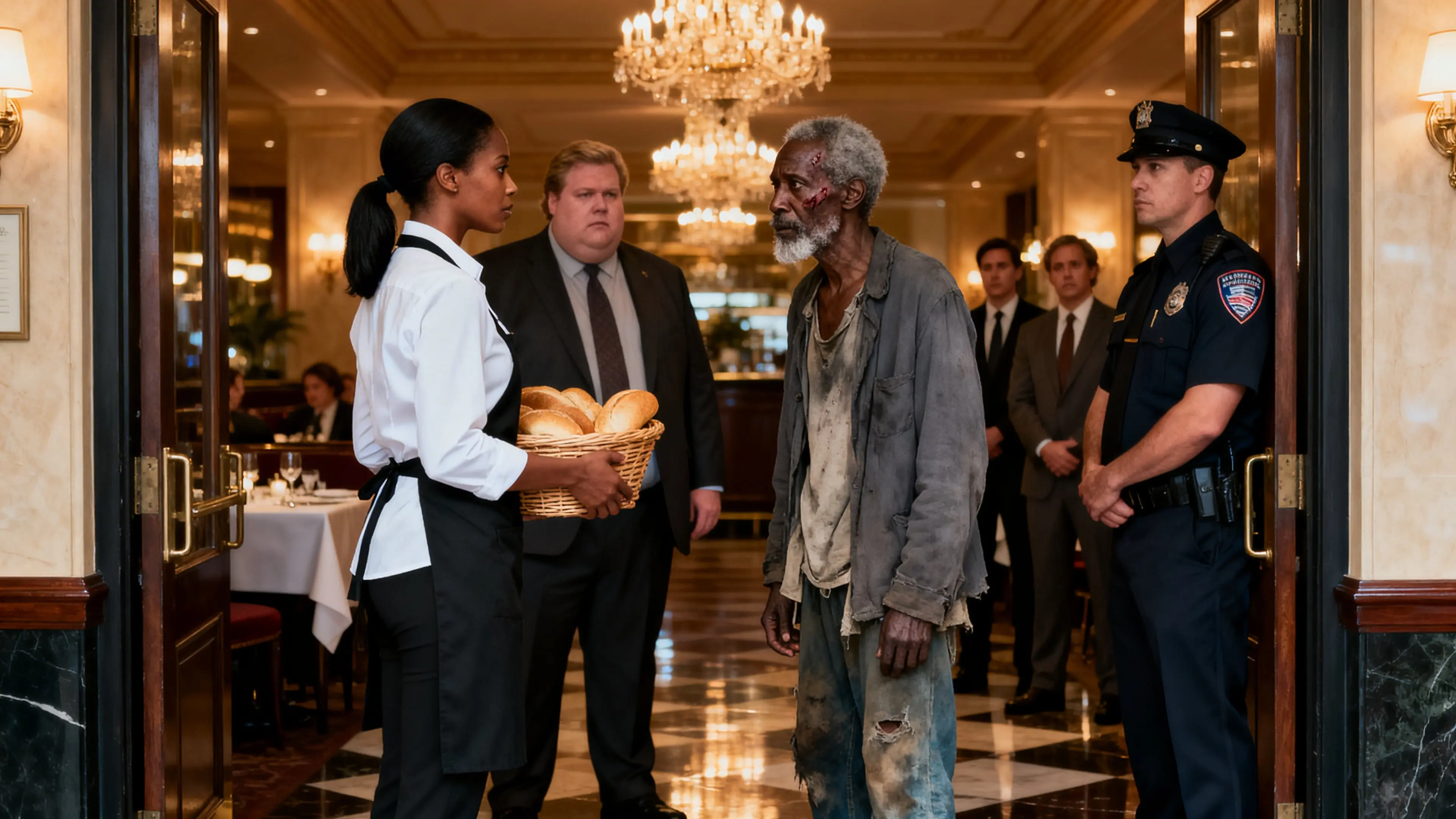
As security began moving toward him, someone else moved first.
Her name was Naomi Carter, a Black woman around thirty-five, her uniform simple but neat, her hair pulled back, her face marked not by hardship alone, but by resilience, the kind that forms when life strips things away one by one, when both parents are gone, when there is no one left to fall back on, when survival becomes something you carry alone every single day, and yet despite all of that, there was something in her that hadn’t hardened, something that still chose to see people, even when others refused.
She stepped forward quickly, holding a small basket of bread, her hands steady even though her heart was not.
“Sir,” she said softly, her voice cutting gently through the noise, “this is our house special. Warm rosemary bread with honey butter. It’s free today. Please don’t leave hungry.”
For a moment, everything paused.
Not because of what she said, but because of what she did.
The manager’s face turned red instantly, his anger sharp and immediate.
“Are you out of your mind, Naomi?” he snapped. “That’s premium bread. You give that to him again and you’re fired.”
The room fell silent again, but this time, it wasn’t curiosity.
It was tension.
Naomi froze for a brief second, the weight of his words pressing down on her, the reality of her situation flashing through her mind—rent, bills, being alone in a world that doesn’t pause for anyone—but even then, she didn’t take the bread back, she didn’t step away, she just stood there, holding her ground in the smallest way possible.
Mr. Collins looked at her, his expression softening just slightly, a faint smile forming as he accepted the gesture, even if he didn’t take the bread.
“You’re kind,” he said quietly.
“Thank you.”
Then, without another word, he turned and began walking toward the door, not rushed, not defeated, just steady, as if he had already accepted the outcome long before it happened, and as he passed Naomi, he slipped something into her hand, his movement so subtle that no one else noticed, and she felt it, her fingers closing instinctively around the folded piece of paper, her heart beating just a little faster, though she didn’t understand why.
The door closed behind him.
The room slowly returned to its rhythm, conversations picking back up, laughter fading into normalcy, the moment already becoming something people would forget, but Naomi stood there for a second longer, the paper still in her hand, the weight of it heavier than it should have been.
Later that night, when the shift ended and the restaurant emptied out, she finally opened it.
There was only one line.
“Tomorrow, 10:00 a.m., Sunrise Tower, 15th floor.”
She stared at it for a long time, confusion mixing with something else, something quieter, something that made her hesitate, not out of fear, but out of uncertainty about what it meant, about who he really was, about why he would leave something like this behind, and for a moment, she considered ignoring it, letting it go, moving on with her life the way she always had.
But something inside her didn’t let her.
The next morning, she stood outside Sunrise Tower, the building rising above her, nothing like the world she was used to, nothing like the restaurant, nothing like the life she had been living, and she took a breath before stepping inside, her movements slower now, more deliberate, as she made her way to the elevator, pressing the button for the fifteenth floor, her reflection staring back at her in the mirrored walls, reminding her of where she came from, of everything she carried.
The doors opened.
The floor was quiet, polished, empty except for a single reception desk and a large glass door beyond it, and standing there, waiting, was Mr. Collins, but something about him was different now, not in how he looked, but in how he stood, in the space around him, in the way the room seemed to belong to him rather than reject him.
“You came,” he said.
She nodded.
“I didn’t understand the note.”
“You don’t need to,” he replied gently.
He gestured toward the glass doors behind him.
“Just come see.”
They stepped inside together, and what she saw changed everything, offices, people moving with purpose, conversations that carried weight, a space that spoke of ownership, of control, of something far beyond what she had imagined, and she turned to him, her expression filled with realization.
“This is yours?”
He nodded once.
“I built it years ago,” he said.
She looked at him again, truly seeing him now, not as the man from the night before, not as someone the world dismissed, but as someone she had never taken the time to understand, just like everyone else.
“Why me?” she asked quietly.
He smiled faintly.
“Because you didn’t ask what I could afford,” he said.
“You didn’t measure me.”
He paused.
“You just chose to care.”
The words settled into her, simple but powerful, and he reached into his pocket, pulling out another folded paper, handing it to her carefully.
“This is for you.”
She opened it slowly, her hands steady, her eyes scanning the page, and her breath caught slightly as she realized what it was.
“A job?”
“If you want it,” he said.
“You can stay where you are, or you can work somewhere that values what you showed yesterday.”
She looked at him, then back at the paper, then at him again, her mind racing, her heart steadying, something inside her aligning in a way it hadn’t before.
“Why does this matter so much to you?”
He looked at her, his expression calm.
“Because I’ve been that man,” he said quietly.
“And I remember what it feels like when no one steps forward.”
There was a long silence.
Then she nodded.
“I’ll take it.”
And in that moment, something shifted, not loudly, not dramatically, but in a way that would last, because sometimes, the smallest act of kindness is not small at all, sometimes it is the moment that changes everything, and as Naomi stood there, in a place she never expected to be, she understood something she had always felt but never fully realized.
That even when life leaves you alone, kindness can still find its way back.