The wind came hard down Halsted Street that morning, pushing sheets of cold air between the buildings and rattling every loose sign it could find. Snow from the night before had turned into gray slush along the sidewalks, and people hurried past Redbird Diner with their collars raised and heads lowered, focused only on reaching warmth. Inside the diner, the windows were fogged from heat and steam. The scent of coffee, toasted bread, bacon, and cinnamon pie wrapped around every booth like a blanket. Plates clinked, forks scraped, stools turned, and the old radio behind the counter played a soft Motown song that no one consciously listened to but everyone somehow needed. Sloan Mercer was halfway through a double shift and running on discipline alone. At twenty-eight, she had mastered the art of looking more rested than she felt. Her blonde hair was tied back in a practical ponytail, though strands had escaped around her temples. Her navy diner uniform had faded from years of washing, and her white sneakers squeaked against the tile floor whenever she pivoted too sharply. Her feet hurt. Her shoulders ached. She had been awake since five-thirty. But none of that showed in the way she treated customers. She knew the businessman at Booth Three wanted efficiency, not conversation. She knew the retired couple near the jukebox liked extra butter without asking. She knew the young mother in the corner needed coffee before menus. She knew the truck driver by the window pretended to be gruff because loneliness embarrassed him. Sloan had learned that people were always saying more than their words. That was why she noticed the old man in Booth Seven. He sat near the front window, shoulders slightly curved inward, hands resting on the table as if uncertain they belonged anywhere else. His coat was old wool, once brown, now faded into a tired gray. It hung loose on his thin frame. His hair was white and uncombed at the edges. His face carried the marks of age, but not weakness. There was something sharp behind the tiredness. Something observant. He had no menu open. No cup. No food. He simply sat there, staring at the tabletop. Sloan approached with the coffee pot.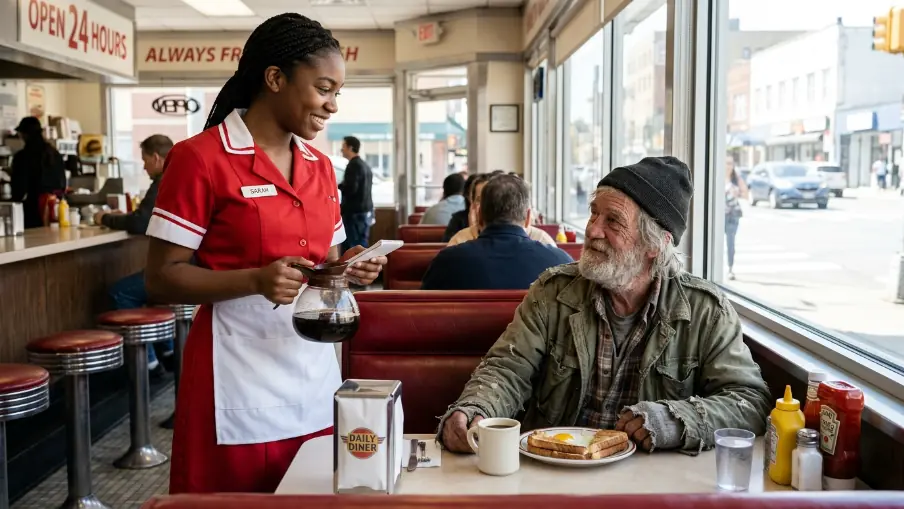
“You doing okay, sir?”
The man looked up as if returning from a long distance.
“I’m sorry,” he said quietly. “I left my wallet at home. I just... needed somewhere warm to sit for a minute.”
His eyes dropped immediately after saying it. Not manipulative. Not rehearsed. Ashamed. Sloan had seen lies before. This wasn’t one. She slid into the booth across from him.
“Hey,” she said softly. “It’s freezing outside.”
He gave a small nod.
“Let me get you some coffee.”
“I couldn’t.”
“You can.”
“I don’t take charity.”
“It isn’t charity.”
He looked at her then.
“It’s one human being being kind to another. That’s all.”
His chin trembled slightly. He swallowed and nodded.
“Thank you.”
Sloan stood, poured fresh coffee into a heavy ceramic mug, added cream packets, sugar, and then cut the warmest slice of apple pie in the display case. She placed both in front of him with no ceremony.
“There. Nothing dramatic.”
The man stared at the pie.
“I haven’t had homemade pie in years.”
“This one isn’t homemade,” Sloan said. “But our cook gets insulted if anyone says that out loud.”
The old man smiled faintly.
“What’s your name?” she asked.
“Declan.”
“Sloan.”
“Thank you, Sloan.”
What Sloan did not know was that Declan Shaw had not forgotten any wallet. He had intentionally left it at home. Three years earlier, Declan Shaw had been photographed shaking hands with presidents, ringing stock exchange bells, and standing on stages under lights bright enough to erase shadows. He had built Shaw Industries from a cramped garage office into one of the largest private technology firms in the country. He owned towers, patents, vacation homes, vineyards, aircraft, and enough assets that numbers had lost meaning. Magazines called him visionary. Television called him self-made. Investors called him genius. His wife Iris called him Declan. And she was gone. Thirty years of marriage ended one spring evening when she collapsed on the back patio while reading a gardening magazine. There had been no warning, no time for speeches, no final moment arranged like movies promised. One moment she was asking whether he wanted tea. The next, paramedics were speaking in tones he could not process. The funeral overflowed with flowers and powerful people. Then everyone went home. The house became unbearable. His children visited often, but mostly with proposals, ventures, debt restructures, requests for introductions, or subtle arguments about inheritance. Friends invited him to charity dinners where they praised Iris between discussions of markets. Advisors checked on him with concern polished by professionalism. No one asked how midnight felt. No one asked what silence sounded like in a forty-room house. No one sat with him long enough to hear grief breathe. After six months of this, Declan began to suspect a truth more painful than widowhood. He had built a life so large that no one could see him inside it. So he began an experiment. He found old coats from college. Cheap boots. Plain sweaters. He parked luxury cars blocks away. Left watches at home. Entered diners, clinics, parks, and grocery stores as an ordinary old man with nothing to offer. He was ignored. Talked over. Rushed. Treated as inconvenience. Pitied. Sometimes mocked. And then there was Redbird Diner. And Sloan Mercer. He ate the pie slowly, not because he needed food, but because he had forgotten what kindness tasted like when it came without agenda. When Sloan returned with the pot, she didn’t hover.
“Rough day?” she asked.
“Rough few years.”
She rested the pot lightly on the table.
“Want to talk about it?”
“My wife died.”
There was no performance in the sentence. Just weariness. Sloan’s face softened.
“My mom died two years ago.”
Declan looked up.
“She was my best friend.”
Sloan shrugged gently.
“Some mornings I still reach for my phone to call her before I remember.”
Declan stared.
“Yes,” he whispered. “Exactly that.”
They spoke for nearly twenty minutes in fragments between her tables. About grief. About numbness. About pretending to function. About how some days brushing teeth felt like achievement. When she had to return to work, she tapped the table.
“You come back tomorrow, I’ll save you a better booth.”
“This one seems fine.”
“Draft near the door.”
“I’ve survived worse.”
“I’m stubborn too,” she said, and walked off.
Declan returned the next day. Then the next. Then three days the following week. Always the old coat. Always coffee. Sometimes toast. Sometimes nothing. During slow moments, Sloan would slide into the booth for five minutes at a time. He learned she had delayed nursing school to care for her mother through chemo. He learned she worked doubles to pay tuition and rent. He learned she sent money to an aunt who had once helped them survive. He learned she volunteered Sundays at a food pantry even when exhausted.
“Why?” he asked one afternoon.
“Why what?”
“Why keep helping when life has taken so much?”
She thought a moment.
“Because if I let life take my softness too, then it wins.”
He wrote that sentence down later in the car. He told her about Iris. How she laughed with her whole body. How she rescued every injured bird she found. How she believed wealth was only useful when it moved.
“She wanted community clinics,” he said.
“So build them.”
“She wanted scholarships.”
“So fund them.”
“She wanted shelters.”
“So open them.”
He gave a sad smile.
“I spent thirty years expanding markets.”
Sloan reached across the table and squeezed his hand.
“Then spend what’s left expanding mercy.”
He went home and cried harder than he had at the funeral. Three months into their strange friendship, Sloan’s life collapsed. The building she rented was sold to developers. Renovation notices went up. Rent would nearly double. She recalculated her budget six times, hoping arithmetic would discover compassion. It did not. She would have to move two hours away to live with her aunt. Nursing school would pause. Probably end. She told Declan during her final scheduled week. He noticed her swollen eyes before she spoke.
“What happened?”
“Life happened.”
Then she told him.
“I’m sorry,” she said at the end. “I won’t be around much after this.”
He felt panic rise with embarrassing speed. He had already lost one person who made life warmer. He could not lose another when this time something could be done. But money given carelessly would insult everything real between them. He steadied himself.
“Sloan, there’s something I need to tell you.”
She looked suspicious.
“That sentence never leads anywhere good.”
“My full name is Declan Shaw.”
She blinked.
“You already told me your name.”
“No. The Declan Shaw.”
She laughed once.
“Okay.”
“I own Shaw Industries.”
The smile disappeared.
“No.”
“Yes.”
“You’re joking.”
“I wish I were.”
He pulled a business card from his pocket and slid it across the table. Heavy stock. Simple lettering. Founder and Chairman. Sloan stared at it, then at him.
“You lied to me.”
“I hid from the world.”
“That includes me.”
“Yes.”
Her jaw tightened.
“You tested me?”
“No. I tested humanity. You were simply the first person who was kind without knowing there was reward.”
She looked away.
“I don’t know whether to yell or leave.”
“Both are reasonable.”
“Why tell me now?”
“Because you’re leaving. And because I need your help.”
“With what?”
“With becoming the man my wife hoped I’d become.”
He explained everything. Iris’s dreams. His regret. The loneliness. The disguises. The months of searching for one genuine human connection. Then he slid a second folder toward her. Inside were plans for the Iris Shaw Community Center. Emergency meals. Tutoring. Mental health counseling. Job placement. Free clinic. Scholarships. Housing assistance. Sloan turned the pages slowly.
“I’m funding it,” he said. “But I need someone to build it honestly.”
“Hire executives.”
“I have executives. They understand metrics. I need someone who understands struggle.”
He leaned closer.
“I need you.”
She laughed in disbelief.
“I’m a waitress.”
“You’re a leader.”
“I have no executive experience.”
“You have judgment, stamina, compassion, and the ability to care when tired. That is rarer than experience.”
She shook her head.
“Why me?”
His voice cracked.
“Because you bought coffee for an old man who looked like he had nothing left.”
“You didn’t have nothing left.”
“I thought I did.”
Tears filled her eyes.
“You reminded me I was still human.”
She did not answer that day or the next. She spent two sleepless nights thinking about pride, betrayal, opportunity, and fear. Then she visited the warehouse space he had purchased on the South Side. Broken windows. Dust. Rust. Potential. She imagined warm meals. Students studying. Mothers breathing easier. Men finding jobs. Elders seeing doctors. Teenagers discovering futures. She called him that evening.
“If I do this, it cannot be about your image.”
“It won’t.”
“It has to serve people first.”
“Yes.”
“And if your ego returns, I’ll say it plainly.”
“I’m counting on that.”
“Then I’m in.”
The next eighteen months remade them both. Sloan attended nursing school by day and planning meetings by night. She learned budgets, grants, staffing, permits, fundraising, trauma care, mediation, and how often expensive consultants needed translation into common sense. Declan learned to listen. Really listen. He sat in community meetings where residents distrusted rich saviors. Instead of defending himself, he took notes. He changed plans repeatedly. He apologized often. He discovered humility was exhausting and liberating. The center rose brick by brick. On opening day, a line formed before sunrise. Parents with children. Veterans. Students. Widowers. Workers between jobs. Women fleeing violence. Teenagers pretending not to need help. Above the entrance were simple letters: Iris Shaw Community Center. No statue. No portrait. No gold plaque. Inside, Sloan greeted every guest personally. Three months later, she completed her nursing degree and divided time between the clinic wing and executive leadership. She still wore practical sneakers. She still refilled coffee before being asked. Declan visited weekly, no disguise now, but less attached to importance than ever before. One afternoon they stood in the courtyard watching children run between benches painted by volunteers.
“You know what I realized?” Sloan asked.
“What?”
“That day at the diner, you weren’t the only one being saved.”
He looked at her.
“I was drowning too. Double shifts, grief, debt, wondering if anything I did mattered. Then an old man needed coffee and accidentally handed me purpose.”
Declan laughed softly through tears.
“Iris used to say we’re all just walking each other home.”
“I think she was right.”
“She’d be proud of you.”
“She’d be proud of us,” Sloan corrected.
Years later, reporters would ask Declan the smartest investment of his career. He never mentioned software, mergers, or acquisitions. He always answered the same way.
“A slice of pie and a cup of coffee in Booth Seven.”
Every winter, on the coldest morning of the year, Sloan quietly paid for every coffee ordered at Redbird Diner until noon. When customers asked why, the cashier would smile and say:
“It’s just one human being being kind to another.”
And sometimes, that was everything.