The rain started just before sunset, first as a soft tapping against the front windows of Marlowe Grill, then as a steady curtain that blurred the traffic lights outside into red and gold smears. By six o’clock the restaurant was full. Couples leaned across candlelit tables. Office workers laughed over drinks near the bar. Servers moved quickly between booths carrying trays of steak, roasted salmon, steaming pasta, and baskets of warm bread. Glasses clinked. Music played low beneath the murmur of conversation. The air smelled of garlic butter, black pepper, grilled meat, and money.
Marlowe Grill was the kind of place where people came to feel successful.
At the back of the building, where the alley smelled of wet cardboard and fryer oil, success looked very different.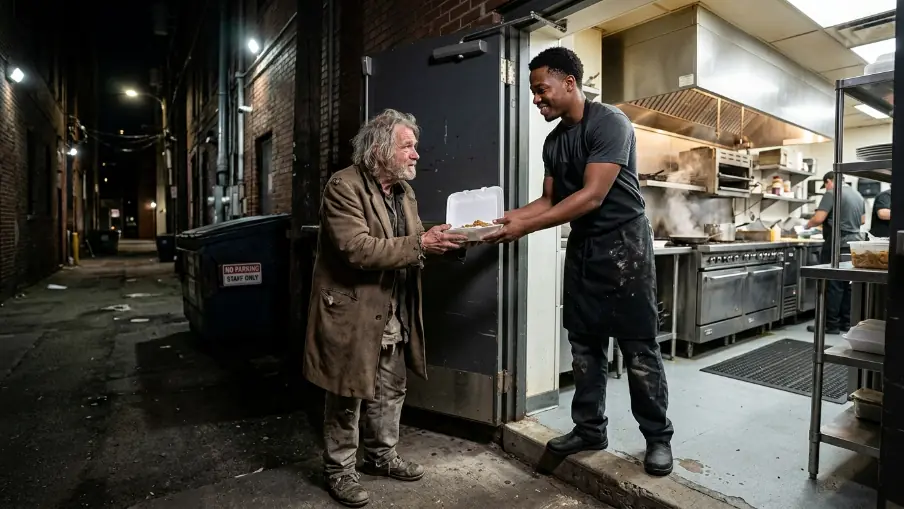
An old man stood near the kitchen door beneath the narrow overhang that barely shielded him from the rain. His coat was threadbare, the left sleeve torn at the cuff. His shoes were soaked through. Water dripped from his gray hair onto the pavement. His beard had grown uneven and wild. Yet beneath the dirt and exhaustion, there remained something dignified in the way he held himself, as if he had once been accustomed to standing tall.
He lifted one trembling hand and knocked gently.
No answer.
He knocked again.
The door flew open.
Victor Hale, general manager of Marlowe Grill, filled the doorway. At forty-six, Victor was sharply dressed even in the kitchen. Crisp shirt. Pressed slacks. Gold watch. Hair slicked back. Permanent irritation in his eyes. He had spent years climbing the ladder of hospitality management and had developed the smug certainty of a man who mistook authority for worth.
He looked the old man up and down.
“Hey, old man. Get out of here. This is a restaurant, not a charity.”
The old man swallowed.
“Sir, please. Just give me something to eat. Even leftovers. I haven’t eaten all day.”
Victor laughed once, cold and short.
“If you’re hungry, go dig through the trash. This place isn’t for people like you.”
He turned to walk away.
The old man steadied himself against the brick wall. His knees shook slightly. Rain blew across the alley and darkened his coat further.
Inside the kitchen, Jose Ramirez had seen everything.
Jose was twenty-nine, broad-shouldered, dark-haired, with tired eyes that rarely lost their softness. He had worked at Marlowe Grill for six years and knew every station better than the managers who supervised them. He could break down a chicken in under two minutes, grill ten steaks to ten different temperatures, and calm a kitchen meltdown with three sentences and a joke. He also knew hunger more intimately than anyone in the building.
His father had left when Jose was nine. His mother cleaned offices at night and motel rooms by day. Jose learned early how to make rice stretch, how to hide worry from younger siblings, how to say he wasn’t hungry when there wasn’t enough. There were winters when the church pantry mattered more than pride and summers when he took odd jobs instead of joining friends at the pool. Hunger had not destroyed him. It had educated him.
So when he saw the old man brace himself against the wall, Jose didn’t see a nuisance.
He saw a memory.
Victor disappeared down the hallway toward the dining room.
Jose moved quickly.
He grabbed a fresh takeout container, scooped hot chicken and rice from the staff pan, added sautéed vegetables, two dinner rolls, a banana from the prep shelf, and wrapped a fork in napkins. Then he opened the back door only a crack.
The old man looked up in surprise.
Jose pressed the box into his hands.
“Go sit by the back wall and eat. There are cameras here. Don’t let anyone see I gave this to you.”
The old man’s eyes filled immediately.
“Thank you, son.”
“Just eat while it’s hot.”
The man’s hands shook around the warm container.
“May God remember your kindness.”
Before Jose could answer, a voice exploded behind him.
“Jose!”
He turned.
Victor stood ten feet away, face red with rage.
“Who told you to give our food to someone like him?”
Jose straightened.
“Sir, he looked like he was going to faint.”
“Shut up.”
Victor strode closer.
“You think this is your kitchen? You think you can hand out inventory because you feel sorry for people?”
“It was one meal.”
“It was theft.”
Kitchen staff pretended not to listen while hearing everything.
Jose kept his voice level.
“I paid for meals here before when customers were short.”
“That was different.”
“How?”
Victor leaned close enough for Jose to smell cologne and coffee.
“Because paying customers matter.”
Jose said quietly, “Hungry people matter too.”
Victor pointed toward the time clock.
“As of now, you’re fired. Come back tomorrow for your final paycheck.”
Silence swallowed the room.
Jose removed his apron slowly, folded it, and set it on the prep counter.
“I was only trying to help.”
Victor smirked.
“And that’s why people like you stay stuck. You lead with feelings.”
Jose grabbed his jacket and walked out the back.
The old man was seated on an overturned milk crate beneath the overhang, eating carefully, savoring each bite.
When he saw Jose, he stood.
“I’m sorry.”
Jose shook his head.
“Don’t be. Finish your food.”
He walked home through rain with no umbrella, no job, and a strange sense that he still would not undo what he had done.
His apartment sat above a laundromat in a building that always smelled faintly of detergent and old pipes. Inside were two rooms, a narrow kitchen, and furniture collected over years from yard sales and curbside rescues. On the wall above the table hung a wooden crucifix his mother had given him when he moved out.
Jose sat by the window, listening to rain strike the glass.
Then he bowed his head.
“God, I just wanted to help someone starving. If I did wrong, show me. If I did right, help me trust that too.”
He slept badly.
The next morning dawned clear and cold. Jose shaved, dressed in his cleanest shirt, and walked back to Marlowe Grill to collect his final paycheck. Pride told him not to go. Rent told him otherwise.
As he approached the entrance, a black sedan rolled smoothly to the curb.
The rear door opened.
The old man from the alley stepped out.
But he looked transformed.
His beard was trimmed. His hair combed neatly back. He wore a tailored wool coat, polished shoes, and a crisp shirt. Age still bent him slightly, but dignity now stood where desperation had hidden.
Then another door opened.
A woman in an elegant navy suit stepped out after him. Early forties. Controlled posture. Sharp eyes softened by recent grief.
She looked directly at Jose.
“Was it you who gave my father food last night?”
Jose hesitated.
“I just saw he was hungry.”
Her jaw tightened as if holding back emotion.
“My name is Irene Mercer. He’s my father.”
Jose glanced at the old man.
Irene continued.
“After my brother died last year, my father’s mental health declined. He wanders sometimes. Last night he left home without anyone noticing.”
The old man muttered, “I noticed.”
She ignored that.
“We searched all night.”
She swallowed.
“If it wasn’t for you, he might have collapsed in that alley.”
The restaurant door opened.
Victor stepped outside holding a clipboard.
“Jose, payroll isn’t ready until—”
He froze.
His posture changed instantly.
“Ms. Mercer. What a surprise. If I had known—”
Irene’s voice cut through him.
“You know exactly why I’m here.”
Victor’s face paled.
“Ms. Mercer, I’m sure there’s been some misunderstanding.”
“My father stood at your back door hungry.”
Victor glanced at Arthur.
“I had no idea that was your father.”
“That is not the point.”
She stepped closer.
“What you gave him was humiliation.”
Victor swallowed hard.
“I run a business. We can’t encourage loitering.”
“A person who humiliates someone for being hungry has no right to run a restaurant.”
He opened his mouth.
“Enough,” she said.
Then she pointed toward the door.
“Effective immediately, you’re done here.”
“You can’t fire me.”
“Yes, I can.”
She held his stare.
“My family owns thirty percent of Marlowe Hospitality. I approved your promotion three years ago. Today I revoke it.”
Victor looked stunned.
“There has to be a process.”
“There is. It starts with you clearing your desk.”
He tried one final plea.
“One mistake shouldn’t cost a career.”
Irene answered without blinking.
“Cruelty is never one mistake. It is repetition revealed.”
Victor walked back inside in silence.
Then Irene turned to Jose.
“You probably don’t know this, but I’m opening a new location next month.”
Jose blinked.
“Okay.”
She placed a ring of keys into his palm.
“The manager position is yours.”
He stared at them.
“No. There are people more qualified.”
“Qualified on paper, yes.”
She smiled faintly.
“But I don’t need someone who only counts profit. I need someone who, when no one is watching, still helps.”
Jose’s eyes reddened.
“I’ve never managed a restaurant.”
Arthur Mercer stepped forward and took Jose’s hand.
“Son, what you gave me last night was more than a meal. It was mercy.”
Irene nodded.
“And mercy is leadership.”
Jose laughed once through tears.
“If I say yes, I’m going to need help.”
“You’ll have it,” Irene said.
“And if I fail?”
“Then fail honestly and learn quickly.”
He looked at the keys again.
“Yes.”
That afternoon, Jose entered through the front door as acting manager.
Some staff applauded softly. Others smiled in visible relief. The dishwasher hugged him hard enough to nearly knock him over.
What Jose inherited was a mess.
Schedules were chaotic. Vendor invoices overdue. Morale broken. A freezer had been failing for weeks. Two cooks were ready to quit. A server cried in the storage room because Victor had cut her hours after she missed one shift caring for a sick child.
Jose listened first.
Then he worked.
He posted schedules two weeks in advance so parents could arrange childcare. He fixed the leaking sink no one in management had cared about. He created family meals before each shift so no employee started work hungry. He met vendors personally and negotiated honest payment plans. He thanked dishwashers publicly and stopped managers from eating before the kitchen crew did.
Most importantly, he changed one rule.
Anyone hungry who came to the back door would be fed discreetly and respectfully.
No speeches.
No shame.
No cameras.
Word spread quietly.
Customers noticed changes before they understood them. Servers smiled more. Food arrived faster. Staff turnover dropped. Online reviews mentioned warmth as often as menu items. Revenue rose steadily.
The new location opened three months later in a busier district downtown.
Jose hired people others overlooked.
A single mother returning to work after five years.
A former inmate no one else would interview.
An older waitress labeled too slow elsewhere.
A culinary student with anxiety who shook during interviews.
They became his best team.
Meanwhile, Arthur Mercer began visiting weekly.
At first he came for coffee and silence. Then for lunch conversations. Then to help fold napkins because, as he said, “Rich men should remain useful.”
Jose learned Arthur’s story gradually.
Arthur and his late wife Eleanor had opened a tiny roadside diner forty years earlier with borrowed money and one used stove. They treated employees like family, fed hungry people quietly, and grew the business into a respected regional chain. Their son Daniel was meant to inherit operations. Their daughter Irene handled finance brilliantly. Then Daniel died in a car crash driving home from a charity event.
Arthur never recovered.
He withdrew. Wandered. Forgot appointments. Sometimes forgot to eat. Sometimes remembered only grief.
“I became angry at everyone still alive,” Arthur admitted one evening.
Jose nodded.
“Grief can make the world feel guilty.”
Arthur stared at him.
“You understand too much for your age.”
Jose smiled.
“I had practice.”
Irene watched her father improve month by month. He laughed again. He dressed himself carefully. He asked questions about inventory and guest experience. He even argued with Jose over soup seasoning.
One year later, Marlowe Hospitality hosted its annual leadership banquet.
Owners, executives, chefs, and managers filled a ballroom downtown. Jose hated tuxedos and wore one badly.
Irene took the stage.
She told the story of a rainy night, a hungry old man, a cruel manager, and a kitchen worker who chose compassion though it cost him everything.
Then she called Jose forward.
He walked reluctantly through applause.
She handed him a framed plaque.
“That’s not the real announcement,” she said.
Two attendants rolled out a large presentation board.
Architectural renderings covered it.
THE DANIEL MERCER COMMUNITY KITCHEN
A free daily meal center. Culinary job training. Emergency pantry. Counseling referrals. Transitional employment.
The room murmured.
Irene turned to Jose.
“My brother believed no one should be shamed for being hungry. This will honor him.”
Then she smiled.
“We want you to direct it.”
Jose nearly dropped the plaque.
“I already run two restaurants.”
“You also complain that you’re underchallenged.”
“I have never said that.”
“Your face has.”
Laughter filled the ballroom.
Arthur rose slowly from the front table.
“Take it, son.”
Jose looked at him.
“Why me again?”
Arthur’s eyes shone.
“Because some people feed stomachs. You feed futures.”
Construction began that summer in a renovated warehouse near the river. Jose spent mornings at restaurants, afternoons at the site, evenings in meetings. He designed the kitchen with dignity in mind: warm colors, real plates instead of disposable trays when possible, open seating rather than lines that felt punitive.
He insisted on one rule.
No one would be asked to prove hunger.
When the Daniel Mercer Community Kitchen opened, two hundred people came the first day.
Veterans.
Single parents.
Teenagers pretending they were only there to volunteer.
Workers between jobs.
Elderly couples counting coins.
Immigrants learning English.
People who had never asked for help before.
And people who needed help often.
They were all welcomed the same way.
With eye contact.
With respect.
With hot food.
Within a year the kitchen served over seventy thousand meals. It trained dozens of people for restaurant jobs. Several former guests became staff members. One young man who arrived hungry every Tuesday earned a culinary scholarship. A widow who first came for lunches became pantry coordinator and terrified lazy volunteers into punctuality.
Arthur worked the bread station every Wednesday.
He wore an apron proudly.
He called everyone friend.
One evening after closing, Jose stood alone in the silent kitchen. Pots dried on racks. Chairs were stacked. Tomorrow’s vegetables waited in crates.
He bowed his head like he had in the apartment window years before.
“God, thank you for not answering my prayer the way I expected.”
Arthur’s voice came from the doorway.
“Talking to upper management?”
Jose laughed.
“Something like that.”
Arthur walked in slowly and placed a hand on his shoulder.
“You know, son, what you gave me that night was mercy.”
Jose looked around the room.
“What you gave me was a chance to multiply it.”
Sometimes kindness looks small when it leaves your hand.
A boxed meal.
A door opened.
A stranger treated with dignity.
But once released, it moves farther than anyone can see. A firing became a calling. A hungry old man became family. One act of compassion became a place where thousands would eat.
And it all began because, when no one was watching, one man still chose to help.