They say money can buy power, silence, and safety, but it cannot buy loyalty. Amanda Sterling learned that lesson in one brutal day. At nine in the morning, she was untouchable, the CEO of a billion-dollar empire, standing above downtown Chicago from the forty-fifth floor of Sterling Tower. By five in the afternoon, she was a fugitive with no access to her money, no home she could enter, no friends brave enough to answer the door, and no one left to trust. She thought it was the end. She was wrong. It was only the beginning.
The view from the forty-fifth floor usually made Amanda feel like a god. From up there, cars looked like ants, and people were invisible. That was how she preferred it. At thirty-two, she was the youngest female billionaire in the tech sector, the ruthless mind behind Apex Systems, a company that controlled cybersecurity for half the Fortune 500. She stood by the window with a crystal tumbler in her hand, swirling amber scotch over ice, then turned toward the long mahogany conference table where Marcus Thorne waited with a stack of documents and a sleek black tablet.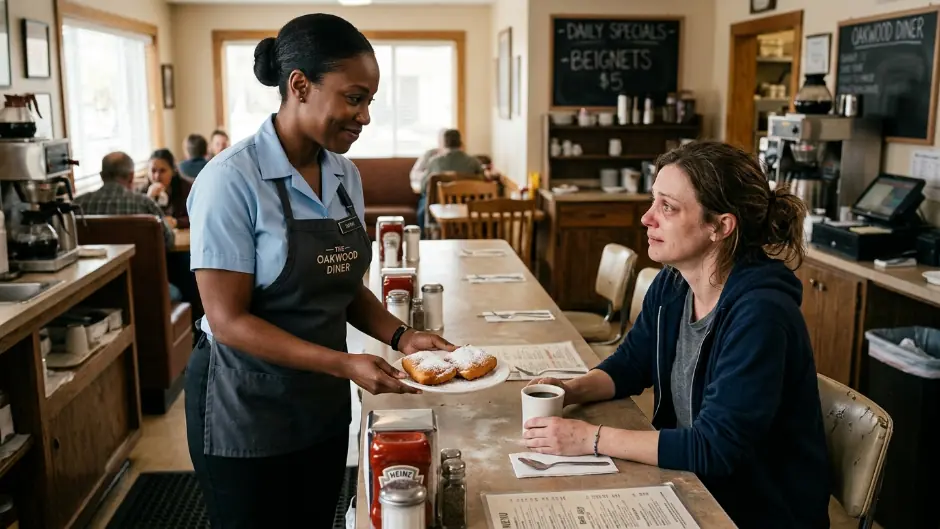
“The merger is set for noon, Amanda,” Marcus said, tapping his pen against the papers.
Marcus was her CFO, her right hand, and until recently, before things had gotten complicated, her fiancé. He was handsome in a predatory way, sharp cheekbones, expensive suit, and eyes that always seemed to calculate the cost of whatever they touched.
“Good,” Amanda said crisply. “Once we acquire Nebula, we own the market. No more competition.”
“There’s just one small formality,” Marcus said, smiling.
It was not his usual smile. It did not reach his eyes.
“The board requires your digital signature on the blind trust transfer, just to ensure no conflict of interest during the SEC review.”
Amanda sighed and walked to the table. She trusted Marcus. She had pulled him out of a mid-level accounting firm five years earlier and made him powerful.
“You handle the boring stuff, Marcus. I handle the vision.”
He slid the tablet toward her. Amanda pressed her thumb to the biometric pad.
Access granted.
“Done,” she said, checking her Rolex. “I have a dress fitting for the gala tonight. Don’t call me unless the building is on fire.”
Marcus looked down at the tablet, then back at her. His expression shifted. The warmth vanished, replaced by a cold, triumphant sneer.
“Actually, Amanda, the building isn’t on fire. But you are.”
“Excuse me?”
The heavy oak doors burst open. Amanda spun around as four men in dark windbreakers entered, followed by two uniformed officers. The lead agent flashed a badge.
“Amanda Sterling?”
“Yes. Who the hell are you?”
“Special Agent Miller, FBI. You’re under arrest for massive corporate embezzlement, securities fraud, and money laundering.”
Amanda laughed. It was sharp and incredulous.
“You’re joking. This is ridiculous. Marcus, call Legal.”
She looked at Marcus.
He did not move toward the phone.
He was leaning back in her chair, her chair, with his feet on the table.
“I’m afraid Legal can’t help you, Amanda,” Marcus said smoothly. “Not with the evidence we found. Transferring company funds into offshore accounts under your personal name. Sloppy. Very sloppy.”
Amanda felt the blood drain from her face.
“What are you talking about? I never moved any funds.”
“The digital logs say otherwise,” Agent Miller said, stepping forward with handcuffs. “We have your biometric authorization on the transfers, timestamped two minutes ago, and three months of backdated logs.”
Amanda’s eyes darted to the tablet she had just touched.
The blind trust.
It was not a trust. It was a full authorization transfer.
“Marcus,” she whispered, horror dawning. “You framed me.”
“I just did what was best for the company,” Marcus said, standing and buttoning his jacket. “The board voted this morning. Emergency session. You’re out, Amanda. All your assets have been frozen pending investigation. Your penthouse, your cars, your accounts, even the cards in your purse.”
“You snake.”
Amanda lunged at him, but Agent Miller grabbed her arm and twisted her around.
“Miss Sterling, do not make this worse,” Miller warned.
“I didn’t do it. He did it. Check his accounts,” she screamed as cold steel clicked around her wrists.
“We have,” Miller said. “Mr. Thorne is the whistleblower who alerted us.”
As they marched her out of her own office, past employees who watched with open shock, Amanda locked eyes with Marcus one last time.
He mouthed two words.
Checkmate.
The next six hours were a blur of processing, fingerprints, fluorescent lights, and humiliation. Amanda Sterling, the woman who usually did not open doors for herself, was stripped, searched, and placed in a holding cell. Her high-priced lawyer, Mr. Henderson, finally arrived at four in the afternoon, pale and sweating.
“Get me out of here, Henderson. Bail. Now.”
“I… I can’t, Amanda.”
“What do you mean you can’t? I pay you a retainer of half a million a year.”
“The retainer came from your personal accounts. They’re frozen. The firm dropped you an hour ago. I’m only here as a courtesy to tell you that you need a public defender.”
Amanda felt like the floor had opened under her.
“I have nothing.”
“Marcus… Mr. Thorne was thorough. They seized everything. However, there was a procedural error with the warrant timing. You’re being released on your own recognizance until arraignment Monday, but they took your passport.”
“I’m free to go?”
“Yes, but go where? Your penthouse is padlocked. Your credit cards are flagged.”
Amanda walked out of the precinct into heavy Chicago rain. She wore a designer silk blouse and tailored trousers, but no coat, because her coat had been taken as evidence. Her phone still existed, but the service had been cut. Her wallet was in her hand, but every card inside had become useless plastic. She stood on the sidewalk as rain plastered her hair to her face. Passersby hurried around her, ignoring the shivering woman who had been on the cover of Forbes last month.
So she walked.
She had nowhere else to go.
She walked until her heels blistered. Then she took them off and walked barefoot. She left the financial district behind, passed the upscale neighborhoods where her so-called friends lived, friends she knew would never open their doors to a woman accused of federal crimes, and moved into darker, grittier streets she had only seen from tinted car windows. Night fell. The temperature dropped. Amanda Sterling, who had been worth $4.2 billion at breakfast, was starving by nine.
By then, she barely looked like herself. Her makeup was smeared. Her expensive clothes were soaked and splashed with mud. She was shivering so violently her teeth chattered. The streetlights glowed yellow and dim. The air smelled of exhaust, wet trash, and old brick. Ahead, a neon sign buzzed above a small diner.
Rusty’s Diner.
The D flickered in and out.
Amanda stumbled toward the light. She only needed warmth. Just for a minute. She pushed open the door, and a bell jingled overhead. The diner was almost empty, except for an old man asleep in a booth and a truck driver eating pie at the counter. The air smelled of stale coffee and bacon grease, a smell Amanda would normally reject instantly, but right then it smelled like heaven. She slid into the booth farthest from the window, hiding her bare, dirty feet beneath the table.
“Be right with you, hun,” a voice called.
A waitress walked over. She looked tired. Her faded blue uniform had a ketchup stain near the pocket. Her name tag read Sarah. Dark circles sat beneath her eyes, and frizzy brown hair was tied back in a messy bun, but her smile was gentle.
“Rough night?” Sarah asked, pulling a notepad from her apron.
Amanda stiffened. Her instinct was to be defensive, to demand service, to remind people who she was.
“Coffee. Black.”
“Coming right up. Want a menu?”
“No. Just coffee.”
Amanda did not have a penny. She planned to drink the warmth, thaw her hands, and then she did not know what would happen when the bill came. Maybe she would run. Maybe she no longer had the strength.
Sarah returned with a steaming mug.
“It’s fresh. Just brewed it.”
Amanda wrapped her freezing hands around the ceramic. The heat seeped into her bones. She took a sip. It was bitter and cheap, but it was the best thing she had tasted all day. She drank too fast and burned her tongue.
“Whoa, slow down,” Sarah said softly.
Then she placed a small plate on the table.
“Two glazed donuts. On the house. They were going to get thrown out anyway.”
Amanda looked at the donuts. Her stomach roared. She grabbed one and ate it in three bites. Sugar rushed into her bloodstream.
“Thank you,” Amanda whispered.
It was the first time in years she had said those words and meant them.
“No problem,” Sarah said, leaning against the booth. “You look like you’ve been through the wringer. Boyfriend trouble?”
“Something like that,” Amanda lied. “He… he took everything.”
“Men,” Sarah sighed, shaking her head. “My ex left me with nothing but a pile of debt and a broken transmission. I get it.”
Suddenly, the kitchen door swung open. A large red-faced man in a grease-stained shirt stormed out. The owner, Rick, pointed a spatula at Amanda.
“Sarah, stop yapping and clean the grease trap. And who is this? We aren’t a shelter. If she ain’t ordering a meal, she’s got to go.”
“She’s drinking coffee, Rick,” Sarah said, her voice tightening.
“One cup. She’s been here twenty minutes. She looks like a vagrant. Look at those feet.” Rick sneered. “Hey, lady. You paying for that?”
Amanda froze. Her heart hammered.
“I… I left my wallet.”
Rick’s face turned purple.
“I knew it. Another freeloader. Get out before I call the cops.”
“Please,” Amanda begged, dignity shattering. “It’s raining. I just need ten more minutes.”
“Out.”
Rick slammed his hand on the table hard enough to make the mug jump.
“And you owe me two bucks for the coffee.”
Amanda stood, legs trembling. Tears rose, hot and humiliating. She was Amanda Sterling. She could buy this entire city block, and she was being kicked out for two dollars.
“Wait,” Sarah said firmly.
Sarah dug into her apron pocket and pulled out a crumpled pile of one-dollar bills and quarters, her tips for the night. She counted out three dollars and slapped them on the table.
“I’m paying for her, Rick. And she’s staying until she finishes her coffee.”
Rick stared at the money, then at Sarah.
“That’s coming out of your tips, Jenkins. And don’t expect sympathy when you’re short on rent again.”
He grunted and stormed back into the kitchen.
Amanda stared at the waitress. She knew what waitresses made. She knew that three dollars mattered to this woman.
“Why did you do that?” Amanda asked, voice trembling. “You don’t know me.”
Sarah shrugged with a sad, tired smile.
“I know what it looks like when someone is at the end of their rope. I’ve been there. Besides, my mom always said, ‘You never know when you’re entertaining an angel unaware.’ Though no offense, you look more like a fallen angel right now.”
Amanda looked at her closely then. Really looked. She saw the frayed collar, the cheap sneakers held together with duct tape, and the kindness in Sarah’s hazel eyes that asked for nothing in return.
“I’m not an angel,” Amanda said softly. “But I promise you, Sarah, you won’t regret this.”
“Don’t worry about it,” Sarah said. “Hey, my shift ends in ten minutes. If you have nowhere to go, I have a lumpy couch. It’s not the Ritz, and my apartment is tiny, but it’s dry.”
Amanda Sterling, who had slept on Egyptian cotton sheets most of her adult life, looked at this stranger offering her safety.
“I would like that very much,” she said.
As Sarah went to clock out, Amanda noticed a small, tattered notebook sticking out of Sarah’s back pocket. As she turned, the notebook shifted, revealing a logo stamped on the cover.
A blue falcon.
Amanda’s breath caught.
That was not just any logo. That was the logo for Thorn Industries, Marcus’s private shell company, the very company he had used to frame her. Why did a waitress in a rundown diner have a notebook from a top-secret shell corporation? The gears in Amanda’s mind, frozen by shock, began to turn again. The billionaire was down, but she was not out. Fate had just dealt her a card she never expected.
The apartment was a fourth-floor walk-up in a building that smelled of boiled cabbage and damp plaster. Sarah struggled with a sticky lock, pushed the door open, and ushered Amanda inside. It was a studio apartment no larger than Amanda’s walk-in closet at the penthouse. A mattress lay on the floor in one corner. A tiny kitchenette sat in another. But what caught Amanda’s eye was not poverty.
It was the wall above the desk.
It was covered in schematics, network topologies, lines of code scribbled on napkins, printed diagrams, and newspaper clippings. In the center, pinned with a red thumbtack, was a photo of Marcus Thorne.
Amanda froze in the doorway, rainwater dripping from her hair onto the linoleum.
“Make yourself at home,” Sarah said, tossing her keys into a bowl. “Bathroom’s through that door. I’ll find you some dry clothes. They might be a little big on you. You’re tiny.”
Amanda did not move. She pointed at the wall with a shaking hand.
“Why do you have a picture of my fiancé?”
Sarah stopped midstride. She turned slowly. The kindness from the diner evaporated, replaced by sharp suspicion.
“Your fiancé?”
Her voice dropped.
“You said you had boyfriend trouble. You didn’t say your boyfriend was Marcus Thorne.”
Amanda realized her mistake instantly. She was tired, emotional, and careless. Still, she straightened her spine and tried to summon the CEO persona that had protected her for years.
“I am Amanda Sterling, and Marcus Thorne framed me today for a federal crime I did not commit.”
Sarah stared at her. The silence stretched.
Then Sarah let out a short, harsh laugh.
“Amanda Sterling,” she said, shaking her head. “The ice queen of Chicago. I should have recognized you even without the Gucci armor. You look different when you’re drowning.”
“You know who I am?”
“Oh, I know you.”
Sarah walked to the desk, picked up the blue falcon notebook, and slammed it onto the table.
“I used to work for you. Technically, I worked for Nebula before your company started the hostile takeover process.”
Amanda stepped closer.
“Nebula? We haven’t even finished the acquisition yet.”
“No, but due diligence started six months ago. That’s when Marcus Thorne came in to audit assets.” Sarah’s hands clenched. “I was the lead developer on Project Chimera. Do you know what that is?”
“It’s the AI security protocol,” Amanda said automatically. “The crown jewel of the merger. It’s worth two billion dollars.”
“It’s my code,” Sarah spat. “I wrote Chimera. I spent three years bleeding into that keyboard. It was supposed to democratize data safety. But Marcus saw a weapon. He wanted to sell the backdoor access to foreign intelligence agencies.”
Amanda felt a chill.
“That’s treason. Marcus wouldn’t…”
“He would, and he did,” Sarah said. “When I found out, I tried to blow the whistle. I went to the board. The next day, my hard drives were wiped. I was fired for corporate espionage. Marcus blacklisted me. I lost my job, my reputation, my insurance. My little sister Lily has cystic fibrosis. Without that insurance…”
Her voice broke.
“We lost the house. We ended up here. Waiting tables to buy insulin and inhalers.”
Amanda sank onto the edge of the mattress. The pieces began falling into place. Marcus had not just framed her. He had built a criminal empire under her nose and destroyed this woman’s life to clear the merger path.
“He’s selling Chimera tomorrow,” Amanda whispered. “That’s why he needed me out today. As CEO, I would have had to sign off on the final code release. He knew I would eventually spot the back door.”
“Tomorrow?” Sarah whipped around. “No. The launch isn’t for two weeks.”
“He moved it up,” Amanda said. “He framed me to trigger an emergency vote. He’s in control now. If he sells that code tomorrow at noon, he disappears with billions, and global data security collapses.”
Sarah paced the small room, running her hands through her hair.
“I have the source code in my head. I know the flaw, but I can’t touch it. If I log into any server, his security bots flag me instantly. I’m locked out.”
Amanda looked at the schematics. She looked at the brilliant, broken woman standing before her.
“You’re locked out from the outside,” Amanda said slowly, a plan forming from the ashes of her life. “But not if you have the key master.”
Sarah looked at her.
“Who’s the key master?”
“Me.” Amanda stood. “I have biometric clearance levels that supersede Marcus. Even if he locked me out of bank accounts, he can’t scrub my biometrics from the core server without a physical reboot of the mainframe at Sterling Tower. He won’t do that until the weekend because it shuts down the grid.”
“You can’t walk into Sterling Tower,” Sarah said. “You’re a fugitive. Every guard has your face.”
“I don’t need to walk in. I need to get close enough to the internal network, and I need a computer that isn’t traceable.”
Sarah kicked a plastic bin under her desk. It rattled with electronic junk.
“I can build a rig. It won’t be pretty, but it’ll fly. We need a high-gain antenna to hit the tower’s signal from the street, and that costs money, which neither of us has.”
Amanda looked down at herself. The engagement ring was gone. The FBI had taken it. No necklace. No cash.
Then she remembered.
“Do you have pliers?”
“What? Why?”
“Just get them.”
Sarah rummaged through a drawer and handed her a rusty pair of pliers. Amanda kicked off her right shoe. It was a bespoke Italian leather heel ruined by mud. She flipped it over and used the pliers to rip the heel from the sole. It cracked open. Hidden inside the hollow heel was a small velvet pouch.
Sarah’s jaw dropped.
“You smuggled diamonds in your shoes.”
“Emergency fund,” Amanda said, dumping the contents into her palm.
It was not a diamond. It was a small micro-SD card and a gold coin.
“The coin is a Krugerrand worth about two grand. The SD card is my personal encryption key backup. I never trusted the cloud.”
Sarah stared at her with new respect.
“You’re paranoid.”
“I’m prepared. Will two grand get us the antenna?”
Sarah grinned, dangerous and sharp.
“For two grand, honey, I can get us into the Pentagon. But we have to move fast. The pawnshops open at eight. The merger is at noon.”
“Then we pull an all-nighter,” Amanda said. “Get your coffee, Sarah. We have a billionaire to take down.”
Sarah did not ask another question. Something had shifted between them in the cramped apartment. In the diner they had been a waitress and a ruined stranger. Now they were two women with different scars facing the same enemy. She tied her hair back tighter, cleared the desk in one sweep, and dragged three plastic storage bins into the center of the room. Out spilled circuit boards, cables, old laptops, stripped routers, antenna parts, soldering tools, and enough electronic debris to build either salvation or a small fire.“You really kept all this?” Amanda asked.
“I kept everything Marcus thought was worthless.”
Sarah snapped open an old ThinkPad missing half its casing.
“That man only understands visible value.”
Amanda sat beside her and, for the first time in years, followed someone else’s lead.
They worked until dawn. Sarah built a portable rig from discarded components and brute intelligence. Amanda mapped Sterling Tower’s internal architecture from memory on the back of grocery receipts. Elevators, maintenance shafts, blind corners, repeater nodes, rooftop relay patterns. Every system she had once considered abstract now mattered physically.
At six-thirty they sold the Krugerrand to a jeweler who asked no questions and paid too little.
At seven-fifteen they bought a directional antenna, prepaid hotspots, burner phones, and enough caffeine to induce religious experiences.
At eight-forty they stood in an alley three blocks from Sterling Tower, bundled in thrift-store coats, the city wind cutting between buildings like sharpened metal.
Amanda stared up at the tower carrying her name.
Marcus had already removed it from the website, she was sure.
“You ready?” Sarah asked.
“No,” Amanda said. “Perfect.”
They set up inside a parked delivery van rented in cash through a chain of favors Sarah somehow still possessed. The antenna pointed toward the forty-second floor service relay. Amanda’s biometric authority would not open doors physically, but digital credentials embedded deep in legacy systems could still handshake with internal nodes if reached through older maintenance channels.
“Try Node Delta-Seven,” Amanda said.
Sarah typed furiously.
“Dead.”
“Gamma-Two?”
“Redirected.”
“Sub-basement cooling grid?”
Sarah paused.
“Oh, you beautiful evil rich woman.”
A green line flashed.
Connection established.
Amanda felt adrenaline return like blood to a sleeping limb.
“Route through environmental controls. Then mirror into executive access.”
Sarah grinned.
“You really did build a kingdom on secret doors.”
“I built efficiency,” Amanda said. “Marcus weaponized it.”
Inside the van, screens bloomed with system maps. Camera feeds. Elevator diagnostics. Internal memos. Security rotations.
Then a file appeared automatically in queue.
BOARD EMERGENCY SESSION MINUTES.
Sarah opened it.
Marcus had secured unanimous temporary control by presenting forged evidence of Amanda’s fraud, then immediately approved transfer of Project Chimera licensing rights to Thorn Industries Global Holdings for one dollar pending external monetization.
“One dollar,” Sarah said flatly.
“He stole a two-billion-dollar asset with paperwork,” Amanda replied.
“Rich people crime is so boringly formatted.”
They needed proof stronger than outrage. Something public. Something undeniable before noon’s investor webcast.
Sarah dug deeper into Marcus’s directories while Amanda searched archived authorization logs.
Then they found both.
Marcus had backdated transfer records using Amanda’s credentials, but the timestamp server still carried hidden admin drift markers showing manual override. Worse, Thorn Industries had signed encrypted side letters with offshore buyers tied to hostile intelligence fronts.
Treasure.
Poisoned treasure, but treasure.
“We leak this to the FBI,” Sarah said.
“Too slow. He has friends.”
“We leak to press.”
“He’ll call it fabricated.”
Sarah stopped typing.
“What hurts him fastest?”
Amanda answered instantly.
“Shareholders.”
At 11:00 a.m., Apex Systems was scheduled to livestream the merger celebration and strategic future announcement. Thousands of investors, journalists, analysts, and regulators would be watching.
“If we hijack the stream,” Sarah said slowly.
“We don’t need long,” Amanda replied. “Ninety seconds.”
“Can you still override broadcast controls?”
Amanda looked at the tower again.
“If he hasn’t scrubbed founder privileges.”
They tried.
Access denied.
Tried again through an older media server.
Legacy Founder Credential Recognized.
Sarah slapped the dashboard.
“You dramatic corporate dinosaur.”
At 10:12, a new problem arrived.
Two black SUVs rolled into the alley mouth.
Security.
Amanda ducked instinctively.
“How?”
Sarah checked network traces.
“He’s sweeping unauthorized signal anomalies.”
Men in earpieces stepped out, scanning.
“Can they tie it to us?” Amanda whispered.
“In thirty seconds.”
Amanda looked around the van.
Crates. Uniforms. Delivery manifests.
Then she smiled for the first time since the arrest.
“Start the engine.”
“What?”
“Trust me.”
She swung open the rear doors, grabbed a dolly, stacked random cardboard boxes, and marched directly toward the nearest guard.
“Where do you want the catering displays?” she snapped.
The guard blinked.
“What?”
“For the investor event. Forty-fifth floor requested replacements because someone forgot branded pastry towers. If I’m late again, I’m billing your supervisor.”
Confidence is a skeleton key.
He stepped aside reflexively.
Another guard glanced at the logo on the borrowed van and waved irritably.
“Use service entrance.”
Amanda rolled straight past them into Sterling Tower.
Inside the freight elevator, Sarah stared.
“That was insane.”
“That was management tone,” Amanda said. “People obey it more than guns.”
They rode upward to the thirty-eighth floor logistics corridor, close enough for hardline proximity access. Amanda’s pulse hammered as familiar steel doors opened.
Her tower smelled the same: polished stone, filtered air, expensive control.
They moved through service hallways while Sarah plugged the rig into maintenance ports.
“Broadcast node in sixty feet,” Amanda whispered.
“How do you know all this?”
“I built it when I still liked people.”
Voices approached. They ducked into an AV closet packed with cables and spare monitors. Through the crack, two executives hurried by discussing Marcus’s keynote and stock surge projections.
Stock surge.
Perfect.
At 10:56 they reached the media control room. Empty except for one technician scrolling sports scores.
Amanda entered first.
“You’re in my chair,” she said.
The technician looked up, saw her face, and nearly fainted.
“You’re supposed to be—”
“Wrongly accused. Move.”
He froze.
Sarah held up a screwdriver like it was a weapon from pure determination.
He moved.
By 10:59 Marcus Thorne stood on stage upstairs before a giant LED wall reading APEX + NEBULA: SECURING TOMORROW.
Applause thundered through internal feeds.
Investors tuned in worldwide.
Marcus smiled into cameras with the confidence of a man who thought he had already survived.
“Ladies and gentlemen,” he began, “today marks a new era of trust, innovation, and ethical leadership.”
Sarah gagged theatrically.
“Ready?” she asked.
Amanda placed her thumb on the console scanner.
Founder override accepted.
“Now.”
The livestream flickered.
Marcus vanished mid-sentence.
Replaced by split-screen documents, transaction trails, offshore contracts, forged timestamps, and Marcus’s own emails discussing “pressure neutralization,” “using Amanda’s biometric vanity,” and “post-sale jurisdiction exits.”
Then Amanda stepped into frame from the control room camera.
“My name is Amanda Sterling. I was framed this morning by Marcus Thorne, who used falsified credentials to steal company assets, commit securities fraud, and attempt the sale of compromised national-security software to foreign actors. All evidence is now mirrored to federal regulators, major shareholders, and every journalist on this distribution list.”
Sarah hit send on three hundred encrypted packages.
Amanda continued.
“Marcus, checkmate requires honesty first.”
Feed ended.
Chaos began instantly.
Phones exploded across floors.
Security chatter screamed through radios.
Stock halted within minutes.
Emergency alerts hit financial terminals.
Upstairs, Marcus was reportedly shouting before microphones cut.
“Time to go,” Sarah said.
Too late.
The door burst open.
Marcus himself stood there with two security officers, face bloodless with rage.
“You,” he said.
Amanda stood slowly.
“Me.”
“You stupid sentimental fool. You could have disappeared quietly.”
“And miss your speech?”
He lunged toward the console, but Sarah yanked the power core cable. Sparks burst. Systems died.
Marcus turned on her.
“You gutter rat. I ended you once.”
Sarah stepped forward.
“No. You delayed me.”
One guard grabbed Amanda’s arm. She drove a knee into his thigh with years of pent-up fury and expensive Pilates discipline. He dropped cursing.
The second reached for Sarah just as federal agents flooded the corridor shouting commands.
Real agents this time.
Agent Miller entered first, weapon drawn.
“Nobody move!”
Marcus actually smiled.
“Perfect timing. Arrest them.”
Miller walked past Amanda.
Past Sarah.
Straight to Marcus.
“Marcus Thorne, you are under arrest for fraud, obstruction, conspiracy, and multiple federal offenses.”
Marcus’s smile broke like thin glass.
“You can’t—”
“We already did.”
Cuffs clicked.
Amanda exhaled a month in one breath.
Miller turned to her.
“You should have called counsel.”
“You didn’t seem very interested yesterday.”
He had the grace to look embarrassed.
“You were convincingly framed.”
Sarah snorted.
“Comforting standard.”
By evening, every network in America ran the story. Billionaire CEO betrayed by fiancé CFO. Whistleblower waitress hacker helps expose corporate conspiracy. Stockholders revolt. Board reverses suspension. Emergency vote reinstates Amanda pending formal review.
Journalists camped outside the tower.
Amanda ignored them all.
Instead, she went with Sarah to a children’s pulmonary clinic where Lily waited for subsidized treatment that never stretched far enough.
Lily was fourteen, thin, bright-eyed, oxygen tube looped beneath her nose.
“This is Amanda,” Sarah said carefully.
“The rich one from TV?” Lily asked.
“Temporarily,” Amanda replied.
Lily grinned.
“I thought richer people were meaner.”
“Commonly true.”
That night Amanda paid every outstanding bill anonymously, funded long-term treatment, and established a medical trust for Lily before Sarah could object.
“I’m not charity,” Sarah said later on the clinic steps.
“I know,” Amanda replied. “You’re equity.”
Weeks passed.
Charges against Amanda collapsed publicly. Marcus’s empire unraveled privately. Several board members resigned. Apex stock recovered after painful honesty and a new governance overhaul.
Amanda was offered full ceremonial restoration.
She accepted only part of it.
She returned as CEO for ninety days, sold divisions that thrived on surveillance abuse, open-sourced portions of Chimera under independent safeguards, and launched a foundation funding healthcare for children caught between illness and invoices.
Then she shocked markets again.
She appointed Sarah Jenkins Chief Technology Officer.
Reporters called it reckless.
Engineers called it brilliant.
Sarah called it “the weirdest revenge arc imaginable.”
As for Amanda, she sold the penthouse, kept one modest apartment, and never again measured worth by altitude.
Months later they ate breakfast at Rusty’s Diner after buying the place from Rick, who had happily sold once public outrage crushed business.
They kept the name.
They fired Rick.
Sarah ran operations badly for two weeks, then excellently.
Amanda poured coffee for truckers every Sunday morning just to remember temperature, eye contact, and scale.
One rainy dawn, standing by the same booth where everything changed, Sarah asked, “So what did losing four billion dollars teach you?”
Amanda topped off a mug and looked out at the wet street.
“That it wasn’t mine if it could vanish in a day.”
“And what did gaining it back teach you?”
She smiled.
“That some things are only yours after you lose them first.”
The bell above the diner door rang.
Customers entered.
Work waited.
For once, power looked like service.
Three months after Marcus Thorne was led out of Sterling Tower in handcuffs, the city had already turned the scandal into mythology. Chicago does that with public collapses. It sands off details and keeps only symbols. To some people, Amanda Sterling was the ruthless billionaire who survived betrayal and came back stronger. To others, she was proof that the wealthy always land on cushions no one else can see. Neither version interested her much. Mythology is just gossip wearing better clothes.The real aftermath was paperwork, insomnia, and rebuilding systems she once thought were strong.
Every week brought another hearing. Another regulator. Another board committee asking how so much fraud grew beneath the surface of one of America’s most trusted cybersecurity firms. The answer was never complicated enough for the room.
Neglect.
Vanity.
Speed worship.
Trust placed where admiration should have been questioned.
Marcus had not beaten the company with genius. He had used the blind spots Amanda herself created. She had prized results over friction, brilliance over character, loyalty over transparency. He merely moved through doors she left unlocked.
That truth stung more than his betrayal.
Sarah Jenkins, meanwhile, treated the title of Chief Technology Officer like a dare from the universe. She refused the executive floor office, converted an old training lab into an engineering war room, and filled it with whiteboards, thrift-store lamps, server racks, beanbags, and enough profanity to peel paint. Senior managers hated her instantly. Younger engineers adored her by lunch.
She wore hoodies to investor calls.
She corrected vice presidents mid-sentence.
She once asked a consultant charging twelve hundred dollars an hour whether his slide deck had ever touched a keyboard.
Amanda promoted her again the next week.
At first, the board tolerated Sarah because markets loved the redemption narrative. Then performance made tolerance unnecessary. Security incidents dropped. Product velocity rose. Employee attrition reversed. Engineers who had fled during Marcus’s reign began asking to return.
Competence has a way of ending debates.
Amanda kept her promise to remain CEO for ninety days only. On day ninety-one she resigned from operational leadership and moved to executive chair, handing day-to-day control to an interim president while the company searched formally. The board assumed she would eventually reclaim the seat.
Instead, she nominated Sarah.
The room reacted exactly as expected.
One director nearly choked on sparkling water.
Another asked whether Amanda understood fiduciary seriousness.
A third suggested Sarah lacked polish.
Amanda asked him to define polish.
He spoke for forty seconds without saying anything measurable.
Then Sarah entered wearing black jeans, boots, and a blazer she clearly resented. She gave a twenty-minute strategy presentation without slides, notes, or jargon. She outlined market threats, product flaws, cultural rot, three acquisition targets, two divestitures, and a hiring model that would cut cost while improving quality. She answered every question directly, including hostile ones.
When the vote came, it passed eight to three.
Later that night, over pancakes at Rusty’s Diner, Sarah stared at the appointment letter like it might self-destruct.
“You realize I used to cry in a bathroom here because tips were short,” she said.
Amanda poured syrup.
“Useful training.”
“For what?”
“For dealing with board members.”
They laughed harder than the joke deserved.
Rusty’s Diner had changed too. After public outrage, Rick’s reputation collapsed faster than his grill temperatures. He sold cheap. Amanda and Sarah bought the place through a trust, renovated the kitchen, raised wages, added health coverage, and kept prices reasonable enough that truckers still came at dawn.
They also installed one non-negotiable rule behind the register:
No customer may demean staff. Service may be refused without debate.
The framed sign became famous online.
People visited just to photograph it.
Most stayed for the pie.
Lily’s health improved steadily under proper treatment. Color returned to her face. She gained weight, sarcasm, and ambitions. At fifteen she announced plans to study biomedical engineering because “apparently adults can’t be trusted to build humane systems.”
Amanda funded the scholarship before Lily finished the sentence.
But recovery is not linear, and power does not retire quietly.
Six months after Marcus’s arrest, federal prosecutors approached Amanda with a private warning. Portions of Project Chimera had leaked before the takedown. Someone inside the old network copied fragments of the compromised code and sold them through darknet brokers. If reconstructed, it could expose hospitals, transit systems, utilities.
“Do you know who took it?” Amanda asked.
Agent Miller, now considerably more respectful, slid over a folder.
Three names.
Former Apex executives loyal to Marcus.
One current contractor.
And one surprise.
Board Director Harold Vane.
Harold had voted against Sarah.
Harold also chaired the ethics committee.
“Of course he did,” Sarah said when told.
The next weeks became another war, smaller in headlines but larger in consequence. This time Amanda did not lead from the top of a tower. She led from conference rooms, diner booths, and late-night calls with people who trusted her because she had once fallen publicly.
Sarah built countermeasures.
Lily tested user interfaces and mocked everyone equally.
Agent Miller handled warrants.
Amanda handled Harold.
He invited her to a private club, assuming old habits still applied. Leather chairs. Scotch walls. Men speaking in expensive murmurs.
“You’ve become emotional since the scandal,” Harold said, folding manicured hands. “This company needs steadier stewardship.”
“You sold weaponized code,” Amanda replied.
“Allegedly.”
“You mistake courtesy for uncertainty.”
He smiled thinly.
“And you mistake visibility for power. You lost that when you were arrested.”
Amanda leaned forward.
“No. I lost illusion.”
She slid a pen across the table.
“What’s this?”
“A resignation letter. Sign now and avoid tomorrow’s search warrant cameras.”
He laughed.
Then stopped when she placed photographs beside it. Cash pickups. Metadata logs. Messages to brokers.
He signed.
Some people collapse loudly.
Others fold with exquisite manners.
The remaining network was dismantled within a month. Chimera was rebuilt clean under independent oversight and released as secure open infrastructure for hospitals and municipal systems. It became more valuable by being less exploitable.
Another lesson.
The market rewarded trust faster than fear.
One year after the day Amanda lost everything, Chicago Magazine requested an exclusive interview titled THE FALL AND RETURN OF AMANDA STERLING.
She declined.
Instead, she invited the reporter to Rusty’s at 5:30 a.m.
The reporter arrived confused and underdressed for dawn.
Amanda handed him an apron.
“Coffee first,” she said.
“For me?”
“For table seven.”
He served badly. Spilled cream. Got corrected by a retired bus driver. Waited twenty minutes for a quote.
Finally, while wiping a counter, he asked, “Why here?”
Amanda looked around the diner. Nurses ending night shifts. Construction crews starting dawn. Sarah in the kitchen arguing joyfully with pancake batter ratios. Lily doing homework in a booth before school. Rain against the windows.
“Because this is where I learned value again.”
“From losing money?”
“From needing people.”
The article ran anyway, mostly about the diner.
Public fascination slowly cooled after that. It always does. New scandals bloom. Fresh heroes are manufactured. The city moved on.
Amanda preferred obscurity. She kept one modest apartment with functional furniture and a terrible view of an alley. She owned fewer things and used more of them. She answered some emails herself. She walked places. She learned names of doormen, cashiers, janitors, nurses, delivery riders. Invisible professions became visible once she stopped being carried past them.
Sometimes she still visited Sterling Tower, now run by Sarah with alarming effectiveness. The top floor no longer had a private bar or sculpture wall. It had a childcare center, employee clinic, and a cafeteria with real food.
“The shareholders complained,” Sarah said proudly.
“About cost?”
“About quinoa.”
One snowy evening, long after closing, Amanda sat alone in Rusty’s old corner booth. The same booth where she once hid bare feet under the table and prayed for ten more minutes of warmth.
Sarah slid in across from her.
“You’re doing the face again.”
“What face?”
“The one where you think too hard and look expensive.”
Amanda smiled.
“Do you ever miss before?”
“Before what?”
“Before all this. Before titles. Before arrests. Before responsibilities.”
Sarah considered.
“I miss ignorance sometimes. It was restful.”
Then she pointed around the diner.
“But not enough to trade.”
Amanda nodded.
Outside, snow softened the streetlights.
Inside, dishes clinked. Someone laughed near the grill. The bell over the door rang as late customers entered from the cold.
A year earlier, she had walked through that door stripped of certainty, wealth, and identity.
Now she understood something the forty-fifth floor never taught her.
Height is not the same as perspective.
Money can buy distance.
Power can command silence.
But only humility lets you hear what matters when life starts speaking softly.
Sarah stood to help at the register.
“You coming?”
“In a minute.”
Amanda wrapped her hands around a mug of cheap black coffee, still the best thing she had tasted on the worst day of her life.
Then she rose and went back to work.