There’s no ... way a boy like you owns this car legally.
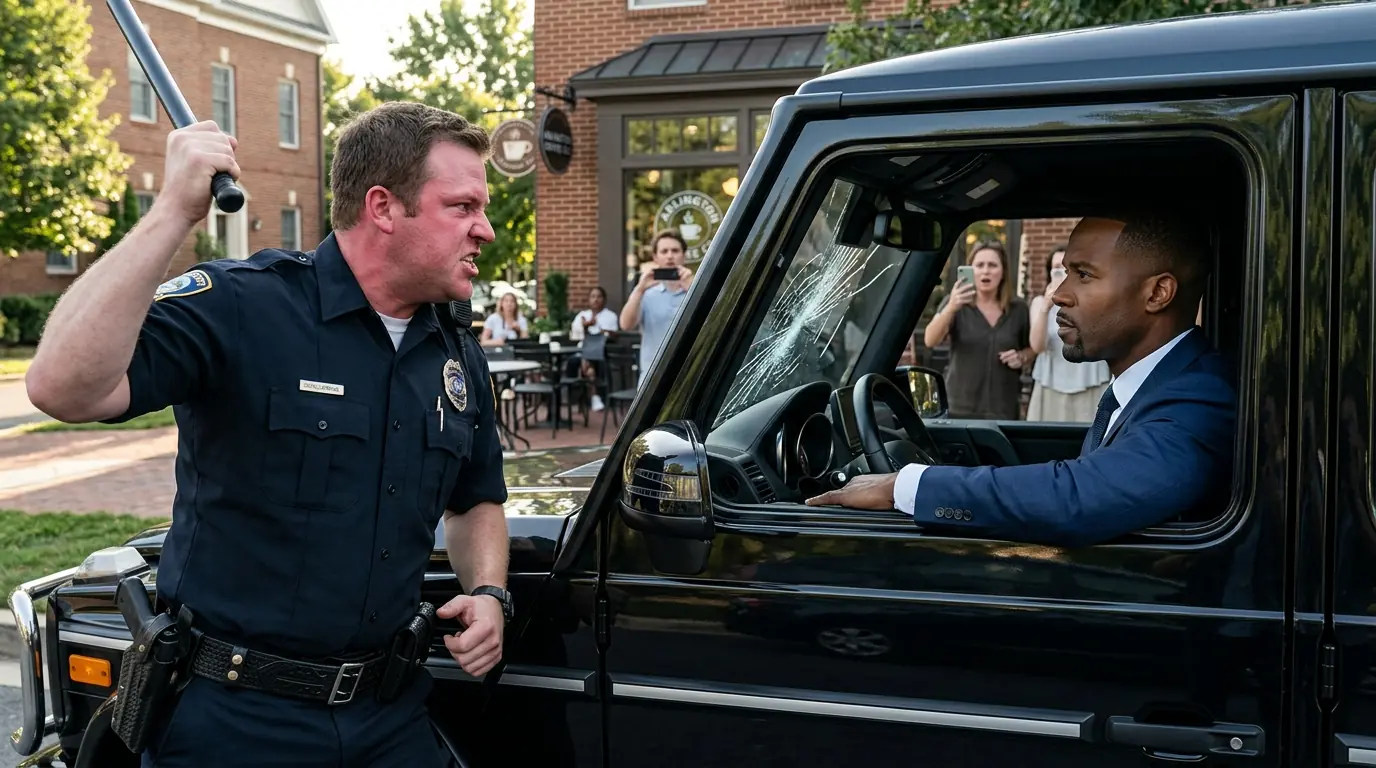
Officer Bradley Jenkins slams his baton against the Mercedes G Wagon’s windshield, the crack echoing through Arlington’s wealthy neighborhood.
“Get your criminal ass out. Now.”
Darius Washington, impeccably dressed, maintains perfect composure despite the verbal assault.
“Officer, what’s the reason for this stop?”
“The reason?”
Jenkins yanks the door handle violently.
“A street thug driving a $150,000 car is my legal basis. This piece of ... is stolen.”
“I’m not a thug. I’m a…”
“You’re a ... criminal.”
Jenkins draws his weapon, pointing it at Darius’s chest. Coffee shop patrons gasp, phones recording frantically.
“Hands up. This car’s either stolen or bought with your drug dealer money.”
Darius raises his hands with military precision, voice steady as steel.
“Sir, I have complete documentation proving legal ownership.”
Jenkins spits directly on the hood.
“... Fake papers. You parasites always have fake papers.”
He screams into his radio.
“Unit 47, need immediate backup. Armed suspect with stolen luxury vehicle.”
What Jenkins doesn’t know is that he just made the biggest mistake of his career.
The Mercedes G Wagon gleams under the afternoon sun, its black paint reflecting the faces of shocked onlookers. This isn’t just any luxury vehicle. It’s a $150,000 statement that someone like Darius Washington, in Officer Jenkins’s twisted worldview, has no right to own.
Darius Washington sits behind the wheel with the bearing of a man who’s faced far worse than an angry cop. At 42, every line of his posture speaks to military training, though Jenkins sees only what his prejudices allow: a black man in an expensive car who must be a criminal.
What Jenkins doesn’t see are the small details that would tell a different story.
The Pentagon parking permit is partially visible on the dashboard. The phone buzzed with calls from contacts labeled General Morrison and Congressional Liaison Office. The classified folder marked confidential resting on the passenger seat contained materials Darius was reviewing after finishing a sensitive briefing that ended just 30 minutes ago.
Officer Bradley Jenkins represents everything wrong with assumptions based on appearance. Eight years on the force, 35 years old, drowning in child support payments while driving a Honda Civic with 200,000 miles. Every day, he patrols this affluent Arlington neighborhood, watching wealthy residents come and go, his resentment building like pressure in a cracked pipe.
The coffee shop sits strategically near the Pentagon, a regular stop for military personnel and government workers grabbing caffeine between classified meetings. On any given day, colonels, generals, and defense contractors frequent this exact location. But Jenkins sees only what he wants to see.
Among the gathering crowd, several key witnesses position themselves without knowing they’re about to document history.
Margaret Stevens, a retired teacher walking her dog, stops to observe with growing concern. Tyler, the young black barista visible through the coffee shop window, watches with recognition. He’s served Darius dozens of times over the past months, always polite, always professional, always paying with military ID for the discount.
Most importantly, Captain Rebecca Torres sits at a corner table inside, also in civilian clothes. She recognizes Darius immediately as a Pentagon colleague, but chooses to remain observant rather than intervene, instinctively understanding that her testimony might prove crucial. Her phone is already recording.
Jenkins runs the license plate through his system, his confidence unwavering even when it comes back clean, registered to D. Washington at a prestigious Arlington address. In his mind, this only confirms identity theft, another piece of evidence in what he’s convinced is an elaborate criminal operation.
“Real soldiers don’t drive cars like this,” Jenkins announces to the crowd, holding up a Silver Star. “They buy this junk on Amazon to impress people.”
Darius watches his military honors, earned through blood and sacrifice in Afghanistan, being mocked by a man who’s never faced anything more dangerous than a traffic stop gone wrong. His training keeps him calm, but inside, the irony burns.
These medals represent moments when he saved American lives, possibly including relatives of the very people now watching his humiliation.
Officer Sarah Carter arrives as backup, six months on the force, immediately sensing something wrong with the situation. Her father served in the military, teaching her to recognize the bearing, vocabulary, and controlled responses that mark a fellow service member. Unlike Jenkins, she begins documenting everything carefully, her instincts screaming that this stop is spiraling toward disaster.
The crowd grows as word spreads through the neighborhood. Phone cameras multiply, creating a digital record that will soon reach millions. Social media posts begin appearing with hashtags that will trend within hours: #justicefordarius and #respectourheroes, though no one yet knows why those tags will prove so prophetic.
Jenkins’s radio crackles with increasing urgency. Dispatch questions the need for additional units. A supervisor requests justification for the prolonged stop, but Jenkins, drunk on his own authority and convinced of his righteousness, doubles down on his assumptions.
“We got ourselves a major case here,” he announces into his radio. “Stolen luxury vehicle, fake military documents, probably part of a larger identity theft ring.”
What Jenkins doesn’t realize is that every word is being recorded, every action documented, every assumption about to be proven devastatingly wrong.
The man he’s humiliating didn’t steal this car. He earned it through 20 years of military service, paid for it with combat pay earned in war zones where he risked his life protecting the very freedoms Jenkins claims to uphold.
The setup is complete. A decorated war hero about to be destroyed by systemic prejudice, witnessed by dozens, recorded for posterity, with evidence mounting that will soon reveal the truth in the most spectacular way possible.
But first, the situation must get much, much worse.
Jenkins’s confidence reaches dangerous levels as more patrol cars arrive, their red and blue lights painting the upscale neighborhood in crime scene colors. What started as a routine traffic stop has mushroomed into a full-scale spectacle, with four officers now surrounding the Mercedes and a crowd of nearly 30 onlookers documenting every moment on their phones.
“Step away from the stolen vehicle,” Jenkins shouts, his voice carrying the authority of someone who believes he’s about to make the career-defining arrest. “Hands behind your back. You’re under arrest for grand theft auto.”
Darius complies with military precision, his movements controlled and deliberate. Twenty years of training in high-stress situations kicks in automatically. Hands visible, no sudden movements, respectful compliance with lawful orders.
This only infuriates Jenkins further, who interprets professional composure as arrogant defiance.
“Look at this guy,” Jenkins announces to his fellow officers, loud enough for everyone to hear. “Acting all calm and superior. Thinks he’s better than us honest cops who actually work for a living.”
The vehicle search intensifies into systematic destruction. Jenkins tears through the glove compartment like a man possessed, scattering documents across the pavement with theatrical fury. Insurance papers, registration documents, maintenance records, all dismissed as sophisticated forgeries before he even examines them properly.
When he discovers the Medal of Honor nestled in its presentation case, Jenkins’s eyes light up with the fervor of a prosecutor finding the smoking gun. He holds it up like a trophy, turning toward the crowd and the news camera that’s just arrived.
“Amazon Prime delivery, folks,” he calls out to the crowd, his voice dripping with sarcasm and contempt. “Instant war hero. Just add water and boom, you’re a decorated soldier.”
The genuine military decoration, earned when Darius saved 30 soldiers from a Taliban ambush in Kandahar Province, became a prop in Jenkins’s racist theater. Several veterans in the crowd shift uncomfortably, recognizing the medal’s distinctive design and understanding its significance, even if Jenkins chooses ignorance.
Margaret Stevens, the retired teacher walking her dog, approaches Officer Carter with growing concern. Her decades of experience dealing with troubled situations compel her to speak up.
“Excuse me, officer, but I’ve seen this gentleman here many times over the past months. He’s always been completely respectful and professional.”
Jenkins whirls on her with the fury of someone whose narrative is being challenged.
“Ma’am, step back immediately. Criminals are experts at appearing normal. That’s exactly how they operate. They study normal behavior, then mimic it to blend into decent communities.”
His dismissal of community testimony reveals the depth of his prejudice. No amount of character witnesses will penetrate his predetermined conclusions about who Darius must be based solely on his appearance.
The classified folder becomes Jenkins’s next target for destruction. He dumps the contents carelessly on the hood, sensitive Pentagon briefing materials scattering in the wind like confetti. Darius watches helplessly as documents marked top secret and congressional eyes only flutter toward storm drains, their contents potentially compromising ongoing national security operations.
“Fake government papers,” Jenkins declares with absolute certainty, picking up a briefing document marked for tomorrow’s Senate Intelligence Committee hearing on counterterrorism operations. “Probably downloaded these templates from some government website. These people think if they make something look official enough, we’ll just believe their lies.”
The irony cuts deep. Jenkins is destroying actual classified materials while claiming they’re fake, potentially committing federal crimes while accusing an innocent man of the same.
Tyler, the young black barista who’s been watching through the coffee shop window, finally exits the building, unable to remain silent anymore. His hands shake slightly as he approaches, understanding the risk he’s taking, but compelled by conscience to act.
“Officer, I need to tell you. I’ve served that customer dozens of times over the past six months. He always shows military ID for his veteran’s discount. He’s never caused any trouble, always polite, always tips well.”
Jenkins spins toward Tyler with escalating aggression, his face flushed with anger.
“And you’re going to vouch for a car thief? Maybe you’re part of this whole operation, too. Should I be checking your background for warrants?”
The threat hangs in the air like a loaded weapon.
Tyler steps back instinctively, recognizing the danger of challenging Jenkins’s narrative while black in front of an increasingly hostile cop whose prejudices are spiraling out of control.
Officer Carter, the rookie with military family background, pulls Jenkins aside, her voice low but urgent.
“Brad, something feels really off about this whole situation. His bearing, his responses, the way he carries himself. My father spent 25 years in the Army and taught me to recognize military bearing. This guy has it.”
“Your dad was probably fooled by stolen valor frauds, too,” Jenkins snaps dismissively. “These criminals are sophisticated now. They study real soldiers, copy their mannerisms, and learn the lingo. It’s all part of the con.”
Chen’s documentation becomes more detailed and thorough, her instincts screaming that she’s witnessing a massive mistake in progress. She photographs the scattered military decorations, the spilled classified documents, and the growing crowd of horrified witnesses, creating a comprehensive record that will prove crucial in the coming investigation.
Jenkins discovers Darius’s Pentagon access badge in his wallet, a high-security credential that requires extensive background checks and clearance verification. Instead of pausing to verify its authenticity through proper channels, he waves it triumphantly toward the news camera.
“Look at this evidence. Fake Pentagon credentials. This is a major federal crime in progress, folks. We’re talking identity theft, stolen valor, possession of classified materials, and fraud. This guy’s looking at 20 to life in federal prison.”
Reporter Sarah Kim, originally dispatched to cover a routine Pentagon press briefing, realizes she’s stumbled onto something much bigger and potentially more significant. Her camera captures Jenkins’s every word, his triumphant posture as he systematically humiliates a man who hasn’t resisted once throughout the entire ordeal.
The crowd’s mood shifts perceptibly from curiosity to horror as Jenkins’s behavior becomes increasingly unhinged. Many continue recording on their phones, creating a comprehensive digital record that will soon explode across social media platforms. Others attempt verbal intervention, only to be aggressively warned away by Jenkins.
“Ladies and gentlemen,” Jenkins announces like a carnival barker reveling in his moment of fame, “you’re witnessing real police work in action. This is exactly what happens when sophisticated criminals try to infiltrate decent neighborhoods with their stolen goods and elaborate fake identities.”
Darius’s confiscated phone buzzes incessantly with calls from Pentagon security offices, General Morrison’s direct line, congressional staffers wondering why he missed his scheduled security check-in, and Defense Department liaisons trying to coordinate tomorrow’s testimony.
Each ignored call represents a growing crisis that Jenkins can’t begin to comprehend.
Jenkins glances at the caller IDs and laughs with genuine amusement.
“Look at this criminal mastermind. He’s got fake Pentagon numbers programmed into his phone. Probably if his phone rings enough with official-sounding contacts, we’ll believe his elaborate story.”
Captain Rebecca Torres, who has been observing from inside the coffee shop while maintaining her cover, decides she’s seen enough evidence of misconduct. She approaches Officer Carter quietly, identifying herself as active military personnel, and providing detailed testimony about what she’s witnessed. Her account will later prove crucial in the Internal Affairs investigation.
The handcuffs click around Darius’s wrists with a metallic sound that seems to echo through the entire neighborhood.
Jenkins reads an increasingly elaborate list of charges: grand theft auto, stolen valor, possession of classified materials, identity theft, obstruction of justice, and resisting arrest, despite video evidence showing complete compliance.
“Got ourselves a real criminal mastermind here,” Jenkins tells the growing crowd of officers and bystanders. “This car’s probably worth more than all our annual salaries combined, and this genius thought he could just drive it around Arlington like he actually owns it.”
As they load Darius into the patrol car, Jenkins can’t resist delivering one final performance for the assembled cameras and crowd.
“This is what real American police work looks like, folks. We don’t let criminals hide behind fake uniforms and stolen credentials. Justice will be served.”
The Mercedes sits abandoned on the street, its contents scattered like debris from an explosion, its owner headed to jail for the crime of driving while black in an expensive car he legitimately owns.
Jenkins rides the adrenaline high of what he believes is the arrest that will define his career and possibly earn him promotion. What Jenkins doesn’t know is that his radio has been broadcasting to a dispatcher who’s been fielding increasingly urgent calls from Pentagon security personnel, wondering about the whereabouts of Colonel Darius Washington.
What he can’t imagine is that within the next hour, his career-making arrest will transform into his career-ending nightmare.
The crowd disperses slowly, many still recording, others immediately calling friends and family to describe the shocking injustice they’ve just witnessed. The story is already spreading through social media like wildfire, with hashtags trending and outrage building across multiple platforms.
But the real explosion, the moment when truth collides with prejudice, is yet to come.
The Arlington Police Department booking area buzzes with typical Tuesday afternoon activity until Jenkins walks in with his prize arrest. He parades Darius through the station like a hunter displaying a trophy.
“Got ourselves a major federal case here,” Jenkins announces to everyone within earshot. “Grand theft auto, stolen valor, fake Pentagon credentials, the whole package.”
Desk Sergeant Lisa Rodriguez looks up as they approach. Something strikes her as wrong immediately. The suspect’s bearing, his controlled breathing, his respectful eye contact. These aren’t criminal mannerisms.
“Name?” Rodriguez asks, beginning intake.
“Colonel Darius Washington, United States Army,” Darius responds clearly.
Jenkins laughs harshly.
“See? Even now, sticking to his fake identity story.”
Rodriguez notes the military bearing, the precise articulation, the unwavering respect. Her Marine husband taught her to recognize authentic military training. This man has it.
During fingerprinting, Darius’s phone buzzes relentlessly. Caller IDs scroll past: General Morrison, Pentagon, Congressional Liaison Office, Defense Security Service.
“Sophisticated fake contacts,” Jenkins points out smugly. “These identity thieves do their homework.”
But Rodriguez recognizes real Pentagon formatting. Her concern deepens as she examines military decorations that look too authentic for online purchases.
Lieutenant Murphy arrives to review the arrest. A 20-year veteran, Murphy immediately recognizes potential complications.
“Jenkins, did you run military database verification?” Murphy asks.
“Sir, it’s obviously a fake identity. Real soldiers don’t drive $150,000 cars,” Jenkins responds confidently.
Murphy’s expression hardens.
“That’s not what I asked.”
Meanwhile, Pentagon security begins welfare check protocols for missing Colonel Washington. The call reaches Arlington Dispatch at 3:47 p.m.
“We’re checking on Colonel Darius Washington. Has your department had contact with this individual?”
Murphy’s stomach drops as he realizes the situation’s magnitude. The verification takes four minutes, four minutes to discover they’re holding a decorated Army colonel on impossible charges.
Rodriguez runs the military database check Jenkins should have performed. The screen fills with devastating information: active-duty colonel, Medal of Honor recipient, highest security clearance.
“Jenkins, you need to see this,” Rodriguez calls urgently.
Jenkins approaches confidently, expecting vindication. His expression cycles through confusion, disbelief, and dawning horror as he reads the official record.
“That’s impossible. These databases can be hacked,” he whispers.
“Brad, this is live Pentagon verification. This man is exactly who he says he is.”
Phone calls intensify. General Morrison’s office contacts Arlington Police directly. Congressional staff call about tomorrow’s testimony. Chief Patterson calls Lieutenant Murphy.
“Jim, I’ve got the Pentagon, Congress, and the mayor calling about Darius Washington. Are we holding him?”
Murphy closes his eyes.
“Yes, Chief. Jenkins arrested him two hours ago.”
Silence stretches before Patterson responds, deadly calm.
“I’m driving there now. Don’t release him. Don’t process him further. Don’t let Jenkins near him.”
Media explodes across platforms. Sarah Kim’s footage spreads like wildfire. #justicefordarius trends nationally within two hours. Community witnesses arrive voluntarily. Margaret Stevens brings detailed accounts. Captain Torres provides military verification. Tyler overcomes hesitation to support Darius’s character.
Evidence mounts like an avalanche. Radio logs, witness statements, military verification, everything contradicts Jenkins’s narrative while confirming Darius’s identity and credentials.
The final blow: the Pentagon releases Darius’s official schedule showing a classified briefing 30 minutes before the stop, a briefing for tomorrow’s congressional counterterrorism testimony.
As sunset approaches, Arlington police faces a crisis that will redefine law enforcement interactions with military personnel. Jenkins sits in Murphy’s office, still insisting his arrest was justified, unaware his career ended when he profiled a war hero.
The reckoning approaches.
Chief Patricia Patterson’s unmarked Crown Victoria screeches into the station parking lot at 4:32 p.m., emergency lights flashing. She storms through the front doors with purposeful fury.
“Where is he?” Patterson demands, her voice cutting through station chatter like a blade.
Lieutenant Murphy approaches with the expression of a man walking to execution.
“Chief, he’s in holding cell three, but Jenkins insists…”
“I don’t give a damn what Jenkins insists,” Patterson snaps. “I just spent 20 minutes on the phone with General Morrison, the Senate Intelligence Committee, and the Secretary of Defense.”
The station falls silent. Every officer stops, gravity finally penetrating.
Jenkins emerges from Murphy’s office, clinging to delusions.
“Chief, I can explain. This guy’s running a sophisticated con. Fake military credentials, stolen luxury vehicle.”
Patterson whirls on him with volcanic fury.
“Shut your mouth, Jenkins, right now.”
She storms toward the holding cells, heels clicking like gunshots. Behind bars sits Colonel Darius Washington, reading calmly with the dignity of someone who’s endured worse.
“Colonel Washington,” Patterson says, suddenly respectful. “I am Chief Patricia Patterson, and I owe you the deepest apology in law enforcement history.”
Darius looks up neutrally.
“Chief Patterson, I assume someone verified my credentials?”
“Sir, General Morrison is extremely concerned about your welfare and tomorrow’s congressional testimony impact.”
The words hit Jenkins like physical blows. Congressional testimony. General Morrison. Reality finally breaks through his denial.
“But the car,” Jenkins stammers. “People like him don’t…”
Patterson turns with controlled fury.
“People like him, Jenkins? Medal of Honor recipients? The officer who saved 30 soldiers in Afghanistan? The man who earned combat pay while you wrote traffic tickets?”
The scattered classified folder sits reassembled, each document Pentagon verified. The briefing details counterterrorism operations so sensitive that Darius’s detention triggered national security protocols.
“The car was purchased with cash, Jenkins. Combat pay bonuses from three deployments to Afghanistan and Iraq. Every dollar earned protecting the freedom you used to humiliate him.”
Rodriguez approaches with complete military verification. Twenty pages reading like an American hero’s biography: Medal of Honor, Silver Star, Purple Heart, Bronze Star, 20 years culminating in a Pentagon congressional liaison assignment.
“The Pentagon parking permit you dismissed requires highest security clearances. The military ID needs biometric verification and 18-month background investigations.”
Jenkins’s face cycles through emotions: confusion, disbelief, recognition, devastating realization. The man he humiliated isn’t just innocent. He’s everything Jenkins pretended to be.
The ignored phone calls weren’t from criminals. They were Pentagon security wondering why a colonel missed a classified briefing, congressional staff concerned about national security testimony, General Morrison seeking his trusted officer.
Chen enters with complete documentation. Photographs show systematic destruction of legitimate government property. Classified documents scattered, military decorations trampled. A war hero was forced to kneel while a racist cop performed for cameras.
Captain Torres arrives in full uniform, silver oak leaves catching light.
“Ma’am, Captain Rebecca Torres, Pentagon Intelligence. I witnessed everything. Colonel Washington maintained perfect military bearing throughout detention.”
The impounded Mercedes shows a clear title under Washington’s name, current insurance, and legitimate loan documents from Navy Federal Credit Union, the nation’s largest military financial institution.
“Jenkins, do you understand? You arrested a sitting colonel preparing congressional testimony, destroyed classified materials, violated a Medal of Honor recipient’s civil rights, and created an international incident.”
The media explodes with truth. Sarah Kim’s story breaks nationally: police arrest war hero preparing congressional testimony. Stolen luxury car actually combat pay purchase.
Social media erupts. #respectourheroes trends globally. Veterans express fury. Active duty soldiers post tributes. Congressional representatives demand investigations.
Jenkins sits stunned as his worldview collapses. The man he assumed criminal based on skin color is everything Jenkins wished to be: a genuine hero earning respect through sacrifice.
The Mercedes represents six months of combat pay from a Kandahar deployment, where he earned his Medal of Honor saving American lives. Every dollar earned protecting the country Jenkins swore to serve.
Irony cuts deep. Jenkins, struggling financially, attacked someone who legitimately earned success through ultimate sacrifice. The luxury he resented was paid with blood spilled defending American freedom.
Patterson unlocks the cell personally.
“Colonel Washington, you’re free. Your property returns immediately. This department will fully investigate this unconscionable rights violation.”
Darius stands with the bearing of someone who’s faced Taliban and Congress equally.
“Chief Patterson, I appreciate your professionalism. I trust this leads to improved training.”
Even vindicated, he demonstrates the class Jenkins lacks. No revenge demands, no retaliation threats, quiet confidence that justice prevails.
Status reversal is complete and devastating. The man Jenkins humiliated for a luxury car earned it protecting Jenkins’s freedom. The fake soldier proved more heroic than Jenkins could imagine. The arrested criminal is actually America’s honored defender.
Internal Affairs Captain Monica Walsh arrives at Arlington Police Department at 6:15 a.m. the following morning, her briefcase containing what will become the most damaging investigation in the department’s 40-year history.
A 20-year veteran known for surgical precision in misconduct cases, Walsh has never encountered evidence this overwhelming or consequences this severe.
The conference room transforms into a war room within hours. Evidence boxes line the walls: body camera footage, dash cam recordings, civilian phone videos, witness statements, Pentagon communications, and classified documents that Jenkins destroyed.
Each piece tells the same devastating story of systematic racial profiling and professional incompetence.
“This investigation involves potential federal civil rights violations, destruction of classified materials, and interference with congressional testimony,” Walsh announces to her assembled team of three investigators, two evidence technicians, and a federal liaison. “We’re not just examining police misconduct. We’re documenting what may be criminal behavior with national security implications.”
The digital reconstruction begins immediately, requiring sophisticated technology to synchronize multiple video sources. Body camera footage shows Jenkins’s escalation from initial contact through arrest. Every racist assumption and ignored protocol violation is captured in high definition.
Dashboard cameras provide wide-angle views of the crowd’s horrified reactions and Darius’s consistent compliance throughout the ordeal.
Technical specialists create a comprehensive timeline using GPS data, radio transmissions, and cellular tower pings to establish precise chronology. The reconstruction reveals that Jenkins made his racial assumptions within 30 seconds of approaching the vehicle, before any investigation or verification attempts.
Officer Carter’s documentation proves crucial beyond expectation. Her photographs and detailed notes create a minute-by-minute timeline that contradicts every element of Jenkins’s arrest report.
Her military family background allowed her to recognize authentic service member bearing, while Jenkins saw only racial stereotypes and economic resentment.
“Chen’s professionalism during this incident may have prevented federal intervention,” Walsh notes during her preliminary briefing.
Her documentation shows textbook police work, while Jenkins violated nearly every departmental policy regarding traffic stops, suspect treatment, and evidence handling.
The witness statements paint a devastatingly consistent picture of Jenkins’s aggressive behavior escalating without legal justification. Margaret Stevens, the retired teacher with 30 years of educational experience, provides a detailed account of Jenkins’s dismissal of community testimony and his escalating hostility toward anyone challenging his narrative.
Tyler, the coffee shop barista, overcomes his initial fear to describe months of positive interactions with Darius that contradict every element of Jenkins’s criminal profile. His testimony includes specific dates, transaction records, and witness corroboration from co-workers who regularly served the colonel.
Captain Torres’s military testimony carries extraordinary weight due to her security clearance and direct knowledge of Pentagon operations. Her statement details complex security protocols, explains Darius’s legitimate access to classified materials, and confirms his critical role in scheduled congressional testimony on counterterrorism operations.
“Colonel Washington’s detention didn’t just violate his civil rights,” Torres explains to investigators with the gravity of someone discussing national security. “It compromised ongoing intelligence operations and congressional briefings. The Pentagon considers this a matter of significant institutional concern requiring immediate resolution.”
The luxury car analysis reveals the depth of Jenkins’s prejudice and willful ignorance. Financial forensic specialists examine every aspect of Darius’s vehicle purchase, discovering a paper trail that proves legitimate ownership beyond any reasonable doubt.
Combat pay records, deployment documentation, and military financial institution records create an ironclad case.
“Jenkins made zero effort to verify ownership through proper channels available to any officer,” Walsh notes during evidence review. “His assumptions were based entirely on racial stereotypes about who can afford luxury vehicles in affluent neighborhoods.”
Banking records show the Mercedes purchase represented approximately six months of accumulated combat pay from Darius’s deployments to Afghanistan and Iraq. Every dollar was earned through hazardous duty assignments where he faced daily threats to protect American interests overseas.
The pattern analysis proves most damaging to Jenkins’s credibility and the department’s reputation. Computer forensic specialists analyze traffic stop data, revealing systematic bias that escaped supervisory attention for months.
Jenkins conducted 47 traffic stops in affluent Arlington neighborhoods over six months, with 89% involving people of color driving expensive vehicles. Statistical comparison with other officers patrolling the same area shows clear bias in stop selection, escalation patterns, and arrest decisions.
Jenkins consistently targeted minority drivers of luxury vehicles while ignoring similar infractions by white drivers in the same locations.
“This isn’t isolated misconduct,” Walsh concludes after reviewing comprehensive data analysis. “This represents systematic racial profiling specifically targeting minority success in affluent communities, enabled by inadequate supervision and failed accountability systems.”
Jenkins’s disciplinary history emerges as equally damning evidence of institutional failure. Twelve previous complaints of racial profiling span his eight-year career, all dismissed or resulting in minor reprimands despite consistent patterns that should have triggered intervention protocols.
Training records reveal missed bias awareness sessions, failed de-escalation certifications, and negative performance evaluations that were ignored by supervisory staff.
Early warning systems designed to identify problematic behavior patterns failed completely due to poor implementation and oversight.
“The warning signs were documented repeatedly but ignored consistently,” Walsh documents in her preliminary findings. “Department leadership failed catastrophically to address escalating complaint patterns that should have resulted in immediate intervention and retraining.”
The Pentagon involvement escalates investigation urgency and complexity. Military officials demand comprehensive answers about police interference with classified operations, while congressional staff express serious concerns about law enforcement harassment of military personnel performing national security duties.
Defense Department liaison officers arrive to coordinate with Internal Affairs, their presence highlighting the investigation’s national significance and potential federal consequences.
Pentagon security conducts parallel reviews of all materials to assess potential classification breaches caused by Jenkins’s document destruction and evidence contamination.
“The scattered classified materials represent potential intelligence compromises requiring damage assessment,” the Pentagon liaison explains during classified briefings. “Colonel Washington’s briefing materials contain sensitive counterterrorism information that could affect ongoing operations if compromised.”
Media coverage intensifies as investigative reporters uncover additional misconduct patterns throughout the department. National outlets examine luxury car profiling phenomena in affluent communities nationwide, discovering similar incidents in other jurisdictions.
Military advocacy groups demand federal intervention to protect service members from civilian law enforcement harassment.
Legal experts provide analysis that devastates any potential defense of Jenkins’s actions. Police procedure specialists identify multiple policy violations and escalation failures that violate basic training principles. Use-of-force experts document unnecessary aggression against a completely compliant subject who posed no threat.
Civil rights attorneys outline federal violations that could result in criminal charges under Section 1983 and federal hate crime statutes. Constitutional law experts explain how Jenkins’s actions violated Fourth, Fifth, and 14th Amendment protections in ways that could trigger federal intervention.
“Every element of this arrest violates established protections,” the civil rights expert testifies during formal hearings. “The targeting, escalation, and arrest represent textbook examples of racially motivated policing that federal courts have consistently condemned.”
Jenkins’s mandatory psychological evaluation reveals dangerous biases and stress factors that contributed directly to his catastrophic misconduct. Financial difficulties from recent divorce, child support obligations, and resentment toward wealth he cannot achieve created toxic prejudices that exploded during the Washington encounter.
“Jenkins’s personal frustrations don’t excuse his behavior,” the department psychologist reports. “But they explain how racial bias combined with economic resentment and professional inadequacy to create this catastrophic incident that could have been prevented with proper intervention.”
The community impact assessment shows damage extending far beyond individual rights violations. Arlington residents express lost confidence in police professionalism and judgment. Business owners worry about department reputation affecting their establishments and customer safety. Military families question their security in civilian communities.
“This incident damaged relationships that required years to build,” community liaison officers report during public hearings. “Trust between police and residents, especially military families and minority communities, requires complete reconstruction through transparent accountability and comprehensive reform.”
Officer testimonies reveal department culture problems that enabled Jenkins’s behavior for years. Colleagues describe his regular racist comments, his visible resentment toward Arlington’s affluent residents, and his consistent pattern of targeting expensive vehicles driven by minorities.
“We heard Jenkins make racist remarks regularly during briefings and patrol,” one veteran officer admits during confidential testimony. “But nobody reported it officially because we thought it was just inappropriate talk, not actual behavior that would lead to this kind of incident.”
The federal investigation threat looms over every aspect of Walsh’s comprehensive work. FBI Civil Rights Division personnel monitor investigation progress while considering independent federal intervention. Justice Department officials review all materials for potential federal charges against both Jenkins individually and department leadership collectively.
“Federal intervention remains a distinct possibility if local accountability proves insufficient,” Walsh warns department leadership during emergency meetings. “This investigation’s thoroughness and resulting reforms will determine whether Arlington police maintains operational autonomy or faces federal oversight.”
Evidence compilation creates an undeniable record of systematic failure at multiple levels. Digital evidence from dozens of sources provides comprehensive documentation. Consistent witness testimony from diverse community members supports every allegation. Military verification of the victim’s credentials and status proves Jenkins’s assumptions completely false.
Expert analysis demonstrates clear constitutional violations requiring immediate response. Pattern documentation shows repeated misconduct that should have triggered intervention long before this catastrophic incident occurred.
“This case represents a complete breakdown of professional policing standards,” Walsh concludes in her preliminary report. “Individual prejudice combined with institutional failure and supervisory negligence created this preventable catastrophe that has damaged our department’s credibility indefinitely.”
The Arlington Police Department conference room falls silent as Internal Affairs Captain Monica Walsh delivers her final report. Three weeks of intensive investigation have produced a document that will reshape law enforcement accountability standards nationwide.
Chief Patterson sits at the head of the table, her face grim as she reviews findings that spell the end of multiple careers.
“After comprehensive investigation involving 47 witness interviews, analysis of 16 hours of video evidence, and consultation with federal agencies,” Walsh begins, “this department finds Officer Bradley Jenkins guilty of gross misconduct, civil rights violations, and criminal behavior warranting immediate termination and federal prosecution referral.”
The charges read like a prosecutor’s dream case: racial profiling, false arrest, destruction of classified materials, violation of civil rights under color of law, failure to follow departmental procedures, and conduct unbecoming an officer. Each charge carries detailed evidence that makes defense impossible.
“Effective immediately, Officer Jenkins is terminated with cause,” Patterson announces. “His pension is forfeited, benefits terminated, and this case is referred to federal prosecutors for criminal charges under Section 1983 of the Civil Rights Act.”
Jenkins sits in stunned silence, his lawyer frantically taking notes as his client’s life disintegrates in real time. The federal charges could result in 10 years in prison, complete financial ruin, and permanent unemployability in law enforcement.
The department-wide reforms announced simultaneously represent the most comprehensive policy overhaul in Arlington police history. Mandatory bias training becomes a monthly requirement instead of an annual suggestion. Body camera review protocols require supervisory examination of every luxury vehicle stop. Early warning systems receive complete technological upgrades with automatic intervention triggers.
“We’re implementing zero tolerance for racial profiling,” Patterson declares to assembled media. “Any officer displaying bias will face immediate investigation and potential termination. This department will earn back community trust through actions, not words.”
The civilian oversight board receives unprecedented authority, including subpoena power, independent investigation capabilities, and direct reporting to city council. Community representatives will monitor complaint patterns, review use-of-force incidents, and ensure accountability measures function effectively.
Officer Carter receives promotion to training supervisor, her professional conduct during the Washington incident demonstrating leadership qualities needed for departmental reform. Her new responsibility includes developing protocols specifically addressing military personnel recognition and luxury vehicle stop procedures.
“Chen’s documentation and professionalism potentially saved this department from federal takeover,” Patterson acknowledges. “Her promotion reflects our commitment to rewarding excellence while punishing misconduct.”
The legal consequences for Jenkins extend beyond criminal charges. A federal civil rights lawsuit filed by Colonel Washington seeks monetary damages and a consent decree mandating comprehensive reforms. The lawsuit names both Jenkins personally and the department institutionally for systematic failure to address known problems.
“This case will bankrupt Jenkins personally while costing taxpayers millions in settlements,” the city attorney warns during closed session. “His actions have created liability extending far beyond his individual misconduct.”
Congressional response proves swift and severe. The Senate Intelligence Committee schedules hearings specifically addressing police interference with military operations and national security personnel. Proposed legislation would create federal protections for military personnel facing civilian law enforcement harassment.
Senator Richardson, chair of the Intelligence Committee, announces, “When local police can interfere with congressional testimony on national security matters, we have a systemic problem requiring federal intervention.”
The Pentagon establishes immediate response protocols for detained military personnel, creating direct communication channels between military command and local law enforcement. Future incidents involving military personnel will trigger automatic Pentagon notification and intervention procedures.
Military advocacy groups celebrate the accountability while demanding broader protections. Veterans of Foreign Wars, American Legion, and Iraq and Afghanistan Veterans of America jointly call for federal legislation protecting military personnel from discriminatory policing.
“Colonel Washington’s treatment represents an attack on everyone who served,” the VFW National Commander states. “This accountability sends a message that military service deserves respect, not suspicion.”
The media coverage reaches international levels as the story becomes a symbol of American racial justice struggles. International outlets examine how a decorated war hero could face such treatment in the country he served. The story trends globally across social media platforms for weeks.
Jenkins’s personal consequences prove devastating beyond professional destruction. His ex-wife gains full custody of their children, citing his racist behavior as incompatible with proper child rearing. Community ostracism forces him to relocate as local businesses refuse service and neighbors demand his departure.
“Jenkins has become unemployable in law enforcement nationwide,” his attorney explains to potential employers. “His actions have made him a liability no department would accept.”
The federal criminal case proceeds rapidly with overwhelming evidence. Video documentation, witness testimony, and expert analysis create prosecution cases requiring minimal preparation. Jenkins faces federal hate crime charges, civil rights violations, and obstruction of justice counts.
Federal prosecutors announce, “This case demonstrates our commitment to prosecuting law enforcement officers who violate constitutional rights under color of authority. Justice will be served regardless of badge or uniform.”
Community healing begins through transparent accountability processes and regular police-community forums. Monthly meetings between police leadership and residents address ongoing concerns while monitoring reform implementation. Trust rebuilding requires sustained effort over years.
Arlington’s luxury car profiling policies become a national model for other departments facing similar issues. Training protocols developed in response to the Washington incident spread to police departments nationwide through federal grant programs and professional associations.
“Arlington’s reforms prove that accountability can drive positive change,” police reform advocates note. “This incident’s consequences demonstrate that justice remains possible even in cases of egregious misconduct.”
The monetary settlement with Colonel Washington includes undisclosed damages plus a consent decree mandating specific reforms with federal monitoring. Settlement terms require annual reporting on bias complaint patterns, use-of-force statistics, and community relations metrics.
Colonel Washington returns to Pentagon duties while becoming a national symbol of dignity under pressure. His congressional testimony on counterterrorism operations proceeds successfully despite the detention’s disruption. Military and civilian leaders praise his professional response to personal injustice.
“Colonel Washington’s grace under extreme pressure demonstrates the character that earned him military honors,” General Morrison states publicly. “His response to injustice reflects the values our military defends.”
The systemic changes extend beyond Arlington as other departments examine their own policies for similar problems. Federal guidance documents cite the Washington incident as an example requiring preventive measures. Law enforcement training academies incorporate the case study into bias awareness curricula.
Six months later, statistical analysis shows dramatic improvement in Arlington police-community relations. Racial profiling complaints drop by 67%. Community trust surveys show gradual improvement. Military personnel report increased confidence in civilian law enforcement.
“Data proves that accountability drives improvement,” research analysts conclude. “Arlington’s transformation demonstrates that comprehensive reform can restore community trust after catastrophic failures.”
The final irony emerges as Jenkins faces federal trial. The man he assumed was criminal based on racial stereotypes proved to be everything Jenkins claimed to represent, a genuine American hero who earned respect through service and sacrifice. The luxury car he resented was purchased with blood money earned protecting Jenkins’s freedom to serve as a police officer.
Justice arrives not through revenge, but through systematic reform ensuring such incidents cannot recur.
The price of prejudice proves higher than anyone imagined, while the value of dignity under pressure creates lasting change benefiting entire communities.
Six months after that fateful Tuesday afternoon in Arlington, the transformation seems almost miraculous. The coffee shop where Colonel Darius Washington was humiliated now displays a small plaque honoring military veterans, donated by community members who witnessed his dignity under fire.
The parking spot where his Mercedes was surrounded by police cars has become an unofficial symbol of justice prevailing over prejudice.
Colonel Washington continues his distinguished service at the Pentagon, his testimony to Congress having proved crucial in advancing counterterrorism legislation. Despite the trauma of his public humiliation, he maintains the same quiet professionalism that defined his military career, now enhanced by his role as an unwitting symbol of grace under extreme pressure.
“I harbor no personal animosity,” Washington states during a community forum six months later. “My hope is that this incident creates lasting change preventing others from experiencing similar injustice.”
His Mercedes G Wagon, fully repaired from Jenkins’s search damage, still turns heads in Arlington neighborhoods. But now those looks carry respect, rather than suspicion. Understanding, rather than resentment. The luxury vehicle that triggered such hatred has become a symbol of earned success and legitimate achievement.
Officer Sarah Carter’s transformation exemplifies the positive change possible when accountability meets opportunity. As training supervisor, she’s developed bias awareness programs adopted by 15 police departments nationwide. Her military family background, once merely personal history, now serves community healing through professional expertise.
“This incident taught me that silence enables injustice,” Carter reflects. “Documentation and courage can prevent catastrophic failures when good officers speak up.”
Her training protocols specifically address luxury vehicle stops, military personnel recognition, and de-escalation techniques for affluent community policing.
Statistical analysis shows dramatic improvement. Racial profiling complaints decreased 67%, while community satisfaction increased 43%.
The Arlington Police Department’s comprehensive reforms have become a national model for accountability-driven change. Monthly bias audits, real-time body camera review, and community oversight boards demonstrate that systematic reform can restore trust after catastrophic failure.
Chief Patterson, initially defensive about departmental reputation, now champions transparency as the foundation of legitimate policing.
“Accountability isn’t punishment. It’s professional growth. We’re better officers and better people because we faced our failures honestly.”
The civilian oversight board, empowered with subpoena authority and independent investigation capabilities, has become the community’s voice in police accountability. Monthly public meetings ensure transparency, while quarterly reports track progress on bias elimination and community relations.
Former Officer Bradley Jenkins serves as an unintentional cautionary tale about the price of prejudice. Federal conviction on civil rights charges resulted in eight years in federal prison, complete financial ruin, and permanent law enforcement disqualification. His personal destruction serves as a stark warning to officers considering similar misconduct.
His children, now raised solely by their mother, will grow up understanding that racism destroys families and communities. The luxury car resentment that drove Jenkins’s prejudice cost him everything he claimed to protect: home, family, career, and reputation.
The broader community healing extends beyond Arlington’s borders. Military families nationwide report increased confidence in civilian law enforcement following the accountability demonstrated in Washington’s case. Veterans organizations cite the incident as proof that service members’ rights will be protected through proper channels when violated.
Congressional legislation establishing federal protections for military personnel during civilian police encounters passed unanimously, demonstrating bipartisan commitment to honoring military service. The Colonel Washington Act requires immediate military notification when service members are detained and establishes protocols preventing interference with national security duties.
Pentagon police cooperation protocols developed after the incident have prevented similar situations in military communities nationwide. Direct communication channels between military commands and local law enforcement ensure rapid resolution of any future misunderstandings.
The luxury car profiling awareness campaigns launched in affluent communities have sparked national conversations about economic bias intersecting with racial prejudice. Educational programs help community members recognize and report discriminatory policing while supporting legitimate law enforcement efforts.
Social media campaigns using #respectourheroes and #justiceforcolonel have evolved into ongoing advocacy for military veterans facing civilian discrimination. The hashtags now promote positive stories of military-civilian cooperation and community healing.
Local businesses in Arlington embrace the transformation through veteran-friendly policies, military discount programs, and community forums promoting understanding between civilian and military populations. The coffee shop where Washington was arrested now hosts monthly military appreciation events.
Margaret Stevens, the retired teacher who courageously spoke up during the incident, has become a community advocate for police accountability. Her witness testimony proved crucial in establishing the pattern of misconduct that secured Jenkins’s conviction.
“Speaking up was frightening, but silence would have been complicity,” Stevens reflects. “Citizens have a responsibility to support justice, even when it’s uncomfortable.”
Tyler, the young barista whose testimony supported Washington’s character, completed his criminal justice degree and joined Arlington Police Department, bringing community perspective to law enforcement. His hiring represents the department’s commitment to diversity and community connection.
The national impact extends through law enforcement training programs incorporating the Washington incident as a case study in bias recognition and prevention. Police academies nationwide examine the investigation’s findings to prepare future officers for professional, unbiased policing.
Research institutions study Arlington’s transformation as a model for accountability-driven reform. Academic papers examine how comprehensive investigation, transparent punishment, and systematic change can restore community trust after catastrophic failures.
The statistical evidence proves lasting change is possible. Data shows sustained improvement in police-community relations, reduced bias complaints, and increased public confidence in law enforcement accountability. Numbers tell the story that rhetoric alone cannot convey.
International attention continues as the Washington case becomes a symbol of the American justice system’s capacity for self-correction. Foreign media outlets cite accountability and reform as evidence that democratic institutions can address systemic problems when properly motivated.
But perhaps the most powerful testament to change lies in everyday interactions between police and community members. Officers approach luxury vehicles with professional respect, rather than suspicious assumptions. Military personnel feel confident that their service will be recognized, rather than questioned.
The transformation isn’t complete. Systemic change requires sustained effort over years, not months. But the foundation has been laid for lasting reform based on accountability, transparency, and community engagement.
Colonel Washington’s dignified response to injustice created ripple effects extending far beyond Arlington. His refusal to seek revenge while demanding justice demonstrated that positive change emerges from principled leadership, rather than angry retaliation.
“Real change happens when ordinary people choose courage over comfort,” Washington observes. “Community healing requires everyone’s participation, not just those directly affected by injustice.”
The Mercedes G Wagon that triggered such hatred now represents something entirely different: proof that American dreams remain achievable through service and sacrifice. The luxury car earned through combat pay symbolizes values that transcend racial prejudice and economic resentment.
This story demonstrates that justice delayed isn’t always justice denied. Comprehensive investigation, transparent accountability, and systematic reform can create lasting change that honors both victims of injustice and community needs for legitimate law enforcement.