The rain had been falling since before sunrise, thin and cold, turning the parking lot outside Maplewood Diner into a gray sheet of puddles and tire tracks. By noon, the windows were fogged from the heat inside, and the old neon sign above the entrance flickered against the dull sky. Customers came in shaking water from their coats, rubbing their hands together, and asking for coffee before they even sat down. The diner smelled of bacon, vegetable soup, fried onions, fresh bread, and the apple pie cooling behind the counter. It was the kind of place where people came because it was cheap, familiar, and forgiving. The booths were cracked. The menus had stains. The floor tiles were worn smooth in the path between the kitchen and the counter. But to Norah Whitfield, Maplewood Diner was more than a workplace. It was the place that had kept her family from sinking completely after her father died. At twenty-four, Norah had been waitressing there for six years. She had started right after high school, when her father’s sudden heart attack left her mother Geneva buried under medical bills, mortgage payments, and grief so heavy it seemed to change the air in their home. Norah had once dreamed of college, maybe nursing, maybe teaching, maybe anything that did not involve counting tips at midnight with swollen feet. But dreams became luxuries when the electric bill was overdue and her mother’s medication could not wait. So she worked doubles, smiled when customers were rude, carried plates until her wrists ached, and learned to stretch every dollar until it almost screamed. She knew what quiet desperation looked like because she saw it in the mirror every morning before tying her apron.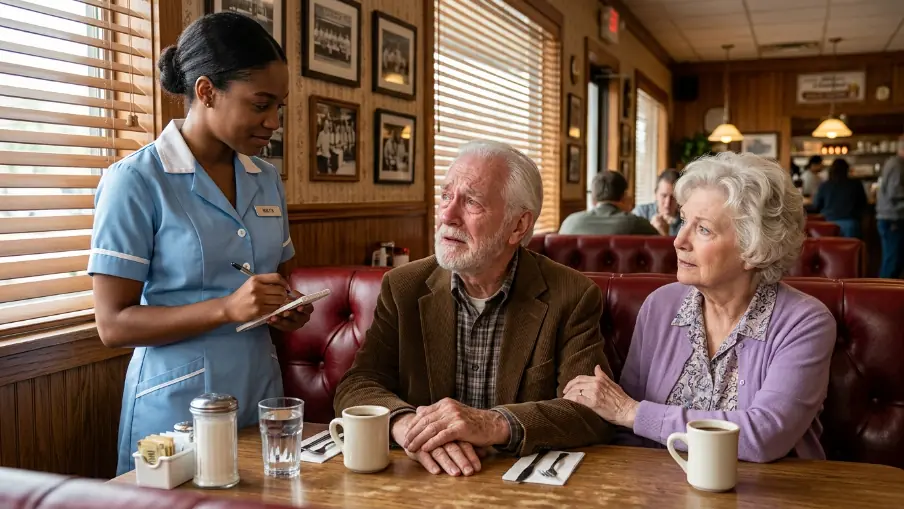
That afternoon, Norah was refilling coffee near the counter when she noticed the elderly couple in Booth Nine. They had come in quietly, almost apologetically, as if afraid to take up space. The man was tall but stooped with age, his weathered face lined deeply from years under sun and wind. His hands were large, rough, and slightly trembling. He wore a faded denim jacket, clean but frayed at the cuffs. The woman beside him was small, with silver hair pinned neatly under a soft knitted hat. Her cardigan was old, one pearl button missing near the collar, but everything about her was carefully kept. They sat close together, shoulders touching, hands occasionally finding each other across the table. Norah served them vegetable soup, half a turkey sandwich, and two coffees. It was the cheapest lunch special on the menu, but even then she noticed the woman’s careful movements. Constance took tiny spoonfuls, making every bite last. Harold cut his sandwich in half, then slid the larger half toward his wife when she looked away. It was such a small gesture that most people would have missed it. Norah did not. Hunger had a language, and she had learned it young. A few minutes later, as she passed their booth with the coffee pot, she heard Constance whisper.
“We don’t have enough, Harold. I’m so sorry.”
Harold reached across the table and covered her fingers, his own hand shaking as much as hers.
“It’s all right, Constance. We’ll figure something out. We always do.”
But there was defeat in his voice, the kind people tried to hide when they had already done every calculation and found no answer. Norah stopped walking. The coffee pot suddenly felt heavy in her hand. She looked at the faded coin purse Constance held open on the table. A few bills. Some coins. Not enough. Constance pushed her soup bowl away even though it was still half full, and Harold turned his untouched sandwich slightly as if preparing to pretend he had not wanted it anyway. Norah had seen customers lie for pride before. She had done it herself. She stepped closer and lowered her voice.
“Is everything okay?”
Harold looked up, embarrassment flooding his tired blue eyes.
“Miss, we thought we had more cash with us. We can leave our information and come back tomorrow with the rest.”
Constance quickly added.
“Or we could just have coffee. We’re not that hungry anyway.”
Norah looked at the soup, the sandwich, the way Constance’s fingers trembled around the coin purse. She pulled out her order pad and pretended to check the ticket.
“You know what? I made a mistake. This meal was supposed to be part of our senior lunch special today. Completely covered.”
Harold frowned gently.
“We didn’t see any special on the menu.”
“It’s new. Manager just mentioned it this morning.”
Constance stared at her, and tears rose so quickly in the older woman’s eyes that Norah knew she had been seen through.
“You’re lying, aren’t you? You sweet, foolish girl. You’re paying for this yourself.”
Norah’s throat tightened. She could have denied it, but the truth felt kinder.
“Maybe. But you remind me of my parents. My mom and dad used to come here every Sunday. Same booth you’re sitting in, actually. He always ordered pie before lunch because he said life was short, and my mom always pretended to scold him. After he passed, she still came sometimes and ordered his favorite pie just to feel close to him.”
She paused, surprised by her own honesty. She had not meant to say so much.
“Please let me do this. It matters to me.”
Harold’s weathered hand covered Constance’s and Norah’s together.
“What’s your name, young lady?”
“Norah. Norah Whitfield.”
Constance repeated it softly.
“Norah Whitfield. You have no idea what this means to us.”
But Norah did have some idea. She knew what it meant to sit across from someone you loved and feel ashamed because money had become the enemy. She knew what it meant to count coins while pretending not to be afraid. She knew what it meant when someone treated your hunger like dignity instead of failure. She took the ticket, went to the register, and paid the twelve-dollar bill from her own tips. That money had been meant for the electric company. She would figure it out later. She always did. Harold and Constance stayed for another hour, drinking their coffee slowly and speaking in low voices. Norah checked on them without hovering. When they finally rose to leave, Constance moved carefully with her cane, then turned and hugged Norah with surprising strength.
“You’re an angel. Don’t ever let the world convince you otherwise.”
Norah smiled, but tears burned behind her eyes.
“I’m just a waitress.”
Harold shook his head.
“No. You’re someone who remembered we were people.”
That evening, Norah came home exhausted, her shoes damp from the rain and her apron smelling faintly of coffee. The apartment she shared with Geneva was small, with secondhand furniture and a kitchen table that had become a battlefield of bills. Geneva sat there with her walker nearby, wearing the faded blue robe she used on bad pain days. She had once been lively, sharp, and full of laughter. After Norah’s father died, grief seemed to hollow her out. Chronic illness took what was left. Still, when Norah told her about Harold and Constance, Geneva smiled for the first time that day.
“You did a good thing, honey.”
Norah dropped into the chair across from her and rubbed her forehead.
“We can’t afford good things right now, Mom.”
Geneva glanced at the bills, then at her daughter.
“Kindness doesn’t ask if we can afford it. It only asks if we’re willing.”
Norah gave a tired laugh.
“That sounds like something Dad would say right before giving away money we needed.”
“And somehow, he always found a way to make us feel rich.”
Norah looked down. Her father, Daniel Whitfield, had been a mechanic with grease permanently under his nails and a habit of helping people who could not pay. He had fixed cars for single mothers, patched roofs for neighbors, carried groceries for widows, and once gave away his winter coat to a man outside a gas station. Geneva used to scold him, but Norah remembered the way her mother smiled when he was not looking. After he died, half the town came to the funeral. Some brought flowers. Others brought envelopes with small amounts of cash. One man cried and said Daniel had kept his truck running long enough for him to keep his job. That was when Norah first understood that poverty and generosity could live inside the same house.
Two days after the diner incident, Norah was home between shifts when someone knocked at the apartment door. She almost ignored it. Knocks rarely brought anything good. But it came again, firm and polite. She opened the door and found a man in a charcoal suit standing on the cracked porch, holding a leather briefcase. He looked so out of place in their struggling neighborhood that Norah instantly grew nervous.
“Miss Norah Whitfield?”
“Yes?”
“My name is Thomas Brennan. I’m the attorney for Harold and Constance Merritt. May I come in?”
Norah’s heart jumped.
“Are they okay? Did something happen?”
“They’re fine. Better than fine, actually. But I need to discuss something important with you.”
In the living room, Thomas sat carefully on the edge of the worn sofa while Geneva appeared from the hallway with her walker, confusion written across her face. Thomas opened his briefcase and removed a thick folder.
“Miss Whitfield, two days ago you paid for a meal for Mr. and Mrs. Merritt at Maplewood Diner. Is that correct?”
Norah shifted uncomfortably.
“Yes. But it was just twelve dollars.”
Thomas looked at her gently.
“It was not just twelve dollars. To them, it was everything.”
Norah sat down slowly.
“Harold and Constance have been married for sixty-two years. They owned a farm about forty miles from here. One hundred and seventy acres. It has been in Harold’s family for four generations. His great-grandfather cleared the first field by hand. His father built the east barn. Harold was born in the farmhouse bedroom overlooking the pond.”
Geneva lowered herself into a chair, listening closely.
“Six months ago, Harold suffered a stroke. He survived, but the medical bills, combined with equipment repairs, crop losses, and the cost of maintaining the property, drained nearly everything they had. They sold livestock, old tools, machinery, even Constance’s jewelry. They fought as long as they could.”
Norah’s eyes filled.
“The day they came into the diner, they had just met with me about foreclosure. They had received final notice from the bank. They spent their last cash on gas to get home. That meal you bought them was the first kindness they had experienced in months of losing pieces of their life.”
Norah whispered.
“I didn’t know.”
“No. That is exactly why it mattered.”
Thomas opened the folder and slid a document across the coffee table.
“They had an offer from a developer. The developer wanted to buy the land and turn it into a strip mall and storage units. The money would have covered their debts and allowed them to move comfortably into a senior living community. They were going to accept.”
Norah nodded weakly.
“That sounds reasonable. They deserve comfort.”
“They changed their minds after meeting you.”
She stared at him.
“What?”
“This is a deed transfer. Harold and Constance Merritt are giving the farm to you.”
Norah stood so quickly her chair scraped the floor.
“No. No, that’s not possible. They can’t do that. I bought them soup and a sandwich.”
Thomas remained calm.
“They are not giving it to you because of soup and a sandwich. They are giving it to you because you reminded them why the land mattered in the first place.”
“That doesn’t make sense.”
“It does to them.”
He explained that Constance had asked around town. She had learned about Norah’s father, her mother’s illness, the debt, the double shifts, the way Norah sometimes packed leftover food for neighbors, the way she gave even when she had little.
“They have no children,” Thomas said. “No close family who values the farm. They believe legacy should belong to someone who understands sacrifice.”
Geneva was crying now, one hand pressed to her mouth.
“There are conditions,” Thomas continued. “You must keep the farmhouse maintained. You must visit Harold and Constance monthly at Willowbrook Senior Living, where they are moving. And if the land is ever sold, it cannot go to developers. It must remain agricultural, become a park, or serve the community.”
“I don’t know how to run a farm,” Norah said, voice breaking.
“The fields are leased to a neighboring organic farmer. That lease provides steady income. There is also a tenant cottage on the property. The rent provides additional support. Combined, it is enough to cover taxes, basic repairs, your mother’s medications, and more.”
Norah looked at Geneva, who was openly sobbing.
Thomas pulled out a handwritten letter.
“They asked me to read this if you resisted.”
His voice softened as he read.
“Dear Norah. We are old. We have no children to leave our life’s work to, no family who understands what this land has meant. But we have you, a stranger who saw us in humiliation and answered with grace. That is rarer than anything we ever grew in those fields. Let this farm give you what you gave us: hope, security, and the chance to help others. Live there with your mother. Build a life. And when you sit on the porch at sunset, know that you earned this not with money, but with the kind of wealth that matters. With love, Harold and Constance.”
No one spoke for a long time.
A week later, Norah and Geneva visited Harold and Constance at Willowbrook Senior Living. The facility was modest but clean, with bright windows, potted plants, and residents playing cards near the lobby. Constance spotted Norah first and rose from her chair with her cane trembling in one hand.
“You came.”
Norah crossed the room and hugged her.
“I still don’t know how to accept this.”
Harold approached slowly from behind her.
“By understanding that it was never only a gift. It was trust.”
They sat in the courtyard for three hours. Harold told stories about the farm. He described waking before dawn as a boy, the smell of wet earth, the sound of his mother singing while making biscuits, the year a drought nearly broke them, the neighbors who arrived with wagons of hay when his father had no feed left. Constance showed photographs from an old album: the farmhouse covered in snow, the barn lit for a community dance, church families gathered under maple trees, rows of tomatoes, children fishing at the pond, Harold as a young man standing beside a tractor with dirt on his face and pride in his eyes.
“We never had children,” Constance said softly. “That was our sorrow. We poured that love into the land instead.”
Harold took Norah’s hand.
“And now we want that love to keep moving.”
Three months later, Norah and Geneva moved into the farmhouse. The first night, Norah stood on the porch and listened to crickets instead of sirens. The sky seemed impossibly wide. The house smelled of wood, dust, old memories, and lemon oil Constance had always used on the banister. Geneva cried when she saw the bedroom on the first floor because she would no longer have to climb stairs. Norah cried when she opened the kitchen cabinets and found Constance had left handwritten notes taped inside. Which shelf held the flour. Which window stuck in spring. Which neighbor to call for plumbing. Which rosebush had been planted the year Harold survived pneumonia.
At first, peace felt suspicious. Norah kept waiting for someone to knock and say there had been a mistake. But weeks passed. The lease payments arrived. The tenant cottage rent came on time. Geneva’s medication was paid in full. The electric bill was no longer a monster. Slowly, their shoulders lowered. Geneva began cooking again. She planted tomatoes near the porch and herbs by the kitchen window. Norah reduced her diner shifts and enrolled in community college classes. She studied business basics, land management, bookkeeping, and nonprofit planning, though she did not yet know why that last subject called to her.
Every Sunday, they visited Harold and Constance. Sometimes they brought soup. Sometimes Geneva baked bread. Sometimes they simply sat together and talked. The four of them became family without anyone officially naming it.
One year after the day in the diner, they gathered in the farmhouse kitchen. Rain tapped softly against the windows, just as it had that first day. Harold sat at the table shelling peas. Constance sorted recipe cards. Geneva kneaded dough. Norah stood by the window looking toward the old barn.
“I’ve been thinking about the barn.”
Harold smiled.
“That usually means someone is about to work.”
“It’s too big to sit empty.”
Constance looked up.
“What do you want to do with it?”
“A community kitchen. Once a week at first. A place where people can come for a hot meal with no questions, no shame, no forms. Just food.”
Geneva stopped kneading. Constance’s eyes filled. Harold looked toward the barn, then back at Norah.
“What would you call it?”
Norah swallowed.
“Harold and Constance’s Kitchen.”
Constance covered her mouth.
“Oh, sweetheart.”
“That twelve dollars gave my mother peace. It gave me a home. It gave me a future. I want the land to keep doing what you said land should do. Feed people.”
Harold stood slowly and walked to the window. His shoulders shook. When he turned back, tears traced the lines in his face.
“We chose right.”
Constance reached for Norah’s hand.
“We really did.”
The barn took six months to prepare. Volunteers came from Maplewood Diner, Geneva’s church, nearby farms, and families who had heard the story. The neighboring organic farmer donated vegetables. A retired carpenter repaired tables. A local electrician fixed the lights for half price. Harold supervised from a chair, offering advice no one dared ignore. Constance organized recipes, insisting that free food should still taste like someone cared. Geneva became the heart of the kitchen, stirring soup in enormous pots with the calm authority of a woman who had known hunger and refused to let it shame anyone else.
On opening night, fifty people came. Then eighty the next week. Then more than one hundred. Some were elderly. Some were families with children. Some were workers between paychecks. Some were people who had never asked for help before and stood awkwardly near the door until Norah greeted them by name if she knew it, and warmly if she did not.
Years later, people still talked about how it began. Not with wealth. Not with planning. Not with a grand announcement. It began with a tired waitress who had twelve dollars less than she needed and spent it anyway. It began with two old people who had almost lost hope and found it in a diner booth. It began with soup, a sandwich, and the decision to see strangers as family before the world gave a reason.
Norah often stood on the farmhouse porch at sunset, watching the fields shift in the evening light. Geneva would sit beside her with tea. Harold and Constance would visit when their health allowed, and every time they arrived, the house felt more complete. The farm had not erased pain. It had not brought back Daniel, restored Harold’s strength, or returned the years Constance wished she had spent raising children. But it had transformed loss into shelter. It had turned grief into a table where others could eat.
One evening, after the community kitchen served its thousandth meal, Norah found Constance sitting alone on the porch, looking out at the barn.
“Are you tired?”
Constance smiled.
“At my age, dear, tired is a permanent address.”
Norah sat beside her.
“Do you ever regret it? Giving us the farm?”
Constance took her hand.
“Never. The land was dying in our hands because we were afraid of losing it. With you, it became alive again.”
Norah looked toward the barn, where volunteers were stacking chairs.
“I still feel like I didn’t earn it.”
“You earned it before you knew there was anything to earn.”
Harold, listening from the doorway, added quietly.
“That is the only kind of goodness that can be trusted.”
Norah thought about the diner, the coin purse, the unpaid bill, the moment she decided to help even though she could not afford to. She had believed she was losing twelve dollars. Instead, she had planted a future. A twelve-dollar meal became one hundred and seventy acres. A moment of compassion became family. A farm nearly sold for concrete became a place where hungry people were fed. And Norah learned what her father had spent his life trying to teach her: kindness is never small when it costs something. It moves through people quietly, taking root where no one expects, growing long after the giver has forgotten the seed.